Table of Content


Quick Summary:
- A fintech app development service covers the app, ledger, KYC checks, payment rails, security testing, and audit trails.
- Enterprise buyers should evaluate providers on vendor risk evidence, core banking integration, and code-ownership terms.
- US fintech investment reached $80.8 billion across 933 deals in H1 2026, according to KPMG’s Pulse of Fintech.
- PCI DSS 4.x, NYDFS MFA rules and the GENIUS Act reshaped fintech build requirements in 2025 and 2026.
- At Code Brew Labs, a sandbox-ready fintech MVP costs $30K to $150K and takes 3 to 5 months.
- AI now powers fraud scoring, identity checks, AML alerts, and credit decisions in modern fintech software.
- Stablecoins, tokenized deposits, agentic payments, and passkeys will shape US fintech app development through 2027.
Top fintech app development service providers in the USA for 2026–27 build regulated financial products such as digital wallets, neobanks, lending platforms, and trading apps. Their strengths differ by product type, compliance depth, and engagement model.
Table of Content
Enterprise buyers judge them on harder terms than startups do. Banks and Fortune 500 firms must clear vendor risk reviews, connect to legacy cores, and produce audit evidence.
High-growth fintechs race a funding clock instead. Sponsor banks, PCI DSS assessors, and state regulators all review the product before the first customer signs up.
A provider that misses these checks costs more than its invoice. Choosing a fintech software development services partner is a regulatory decision as much as a technical one.
Shortlisting fintech app development service providers for a wallet, neobank, or lending platform your sponsor bank will approve?
Why Is 2026 the Right Time to Hire a Fintech App Development Service Provider in the US?
Five market shifts favor US fintech builds in 2026, and each one raises the bar for development partners.
1. Fintech Capital Has Returned
KPMG’s Pulse of Fintech puts US fintech investment at $80.8 billion across 933 deals in H1 2026. Diligence teams now ask funded startups for audit logs and a reconciled ledger.
2. Customers Bank Mobile First
In a November 2025 ABA survey, 54% of US bank customers named a mobile app their main channel. The Atlanta Fed found 77% of consumers used mobile banking in 2025.
3. Enterprises Want Embedded Finance and Modern Cores
Retailers and SaaS platforms now embed payments, cards, and lending inside their own apps. Banks wrap legacy cores with API layers through enterprise software development to support instant payments.
4. Instant Payments Are Mainstream
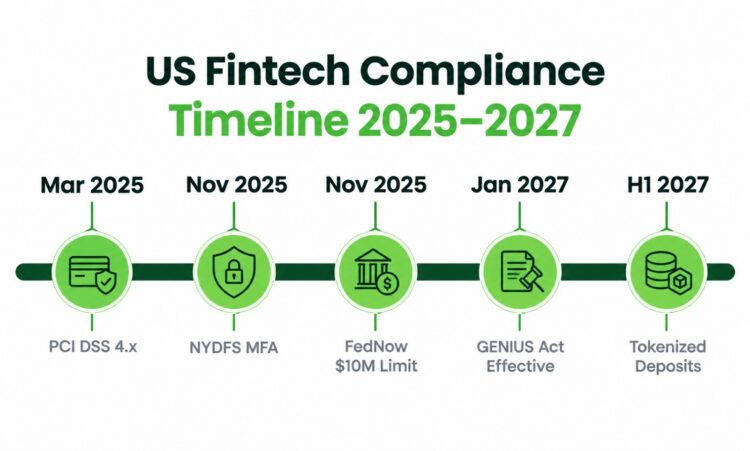
The Fed raised the FedNow limit to $10 million in November 2025. RTP cleared a record 2.27 million payments on May 1, 2026. Instant transfers are final, so our payment app development services run fraud checks before funds leave.
5. Compliance Rules Tightened
PCI DSS 4.x requirements became mandatory in March 2025, and NYDFS MFA rules followed in November 2025. The GENIUS Act takes effect by January 18, 2027, while the CFPB rewrites its open banking rule.
6. Fraud Losses Keep Climbing
Americans reported $15.9 billion in fraud losses to the FTC in 2025, up from about $12 billion. A breach in financial services now costs about $6.3 million on average, per IBM.
How Did We Choose These Fintech App Development Service Providers?
Each firm on this list cleared six checks. Position on the list does not signal rank, because fit depends on your product, budget, and engagement model.
- Fintech portfolio depth: We looked for published work in at least one regulated category. Payments, banking, lending, wealth, and insurance all qualified.
- Product breadth: Coverage of wallets, neobanks, lending, trading, and insurance apps lets you compare specialists with generalists.
- Security and compliance practice: Each firm shows public evidence of secure development and compliance-aware architecture for financial data.
- Delivery capacity for US clients: Teams had to overlap US working hours and support a product after launch.
- Engagement flexibility: MVP builds, dedicated teams, and modernization of existing platforms all had to be on offer.
- Client feedback: Recent reviews on independent platforms counted; read for project type as well as score.
Use these six checks as your own scorecard when you speak to each firm.
List of Top 10 Fintech App Development Service Providers in the USA for 2026–27
To save you time, we have narrowed down the list to 10 companies worth evaluating for fintech mobile app development.
The selection includes firms with financial technology experience, mobile development capabilities, enterprise engineering expertise, or relevant product development portfolios. The companies are not presented as a definitive ranking because the best fit depends on your requirements, budget, and preferred engagement model.
1. Code Brew Labs
Code Brew Labs is a top fintech app development service provider that builds applications and software platforms for businesses looking to launch or expand technology-driven services. Its fintech portfolio includes digital remittance, digital wallets, merchant payments, and consumer financial products.
The company can support businesses across the product development lifecycle, from understanding requirements and designing user journeys to engineering, integrations, testing, and deployment. This can be useful for startups building a new financial product as well as established businesses looking to improve an existing platform.
What You Can Build with Code Brew Labs as Your Fintech App Development Partner
- Digital wallets and e-money apps
- Cross-border remittance and money transfer apps
- Payment gateways and merchant payment solutions
- Neobank and mobile banking apps
- Lending, BNPL, and credit-scoring platforms
- Investment, trading, and wealth management apps
- Insurtech platforms
- Bill payment, recharge, and utility apps
- Expense management and business finance tools
- Embedded finance and white-label SDKs
Fintech Apps Developed by Code Brew Labs
1. Alfardan Exchange: Digital Remittance Platform
Code Brew Labs developed a digital remittance platform for Alfardan Exchange to simplify international money transfers. The solution integrates KYC and AML processes, supports compliance-focused transaction handling, and is designed to facilitate reliable cross-border payments.
The app has reported 10oK+ downloads and 99.5% platform availability, demonstrating its reach and focus on service reliability. The platform also supports international transfers completed in under three seconds.
2. duPay: Digital Wallet and Money Transfer App
Code Brew Labs developed duPay as a digital financial services platform that brings digital payments, local money transfers, international remittances, and bill payments into one convenient experience. The app incorporates authentication and compliance-related integrations to support secure everyday transactions.
The app has reported 1M+ downloads and a 4.8/5 Google Play rating from 27K+ reviews, reflecting its adoption and user feedback across its digital financial services offering.
2. Intellectsoft
Intellectsoft is a custom fintech app development company. Its services include custom mobile and web application development, payment processing integrations, blockchain-based solutions, backend engineering, cloud infrastructure, and quality assurance. These capabilities can support digital wallets, money transfer platforms, online lending applications, and other financial products, depending on project requirements.
Intellectsoft has also worked on a money transfer platform that incorporated blockchain and payment processing technology. The project involved developing a minimum viable product (MVP), with subsequent improvements and plans to introduce online lending functionality.
What You Can Build with Intellectsoft
- Money Transfer Platforms
- Digital Banking Solutions
- Payment Processing Integrations
- Blockchain-Based Financial Applications
- Custom Fintech Platforms
- Backend and Cloud Infrastructure
- Fintech MVP Development
3. 10Pearls
10Pearls is a digital development and consulting company that works across custom software, mobile applications, AI, cloud services, and digital transformation. Its relevant services include custom financial software, mobile app development, cloud engineering, API integrations, and AI-enabled solutions.
For fintech projects, businesses can evaluate the company for digital banking experiences, financial workflow automation, and platforms that need to connect with existing enterprise systems.
What You Can Build with 10Pearls
- Digital banking and neobank applications
- Digital wallets and peer-to-peer payment platforms
- Payment processing and gateway integrations
- Lending, loan origination, and BNPL solutions
- Investment and wealth management platforms
- Insurtech and insurance management applications
4. Itexus
Itexus specializes in custom software and financial technology development. Its published service areas include digital banking, payments, credit scoring, wealth management, insurance, digital lending, and stock trading.
Itexus offers capabilities across mobile and web applications, software architecture, integrations, quality assurance, DevOps, and cloud services. Depending on the project scope, these services can help businesses develop a financial product from initial architecture through deployment and ongoing support.
What You Can Build with Itexus
- Digital banking and online banking platforms
- Payment and money transfer applications
- Digital lending and loan management systems
- Credit-scoring and risk assessment tools
- Stock trading and investment applications
- Wealth management and portfolio tracking platforms
5. ScienceSoft
ScienceSoft is an established software development and IT consulting company with experience across complex business systems. Its broader engineering capabilities may suit financial organizations that need secure, maintainable applications and integrations with existing infrastructure.
For a fintech project, ScienceSoft may be worth considering when the requirements extend beyond a standalone mobile app to include backend systems, data management, reporting, or integration with existing business applications.
What You Can Build with ScienceSoft
- Mobile banking and customer-facing financial apps
- Payment processing and transaction management systems
- Digital lending and loan management platforms
- Financial data analytics and reporting tools
- Investment and portfolio management software
- Accounting and financial management applications
6. Cleveroad
Cleveroad is a renowned fintech app development service provider that builds web applications, mobile products, and data-driven solutions. Its services cover product development, UI/UX design, cloud architecture, AI engineering, and ongoing software improvement.
A startup can evaluate Cleveroad to turn an initial product concept into a working application, while a more established business may consider it to extend an existing platform. As with any provider, confirm that the proposed team understands your financial workflows, transaction handling, security needs, and third-party integration requirements before agreeing on a scope.
What You Can Build with Cleveroad
- Fintech MVPs and mobile applications
- Digital wallets and payment interfaces
- Personal finance and expense tracking apps
- Lending and loan management applications
- Investment and portfolio tracking tools
- Financial dashboards and analytics platforms
7. ArcTouch
ArcTouch is known for mobile app development, UX/UI design, web development, and connected digital experiences. It can be considered by financial businesses that place a strong emphasis on customer experience and mobile usability.
Its relevant capabilities include mobile product strategy, interface design, iOS and Android development, testing, and ongoing product improvement.
For a fintech application, these capabilities can help simplify onboarding, make payment flows easier to understand, and improve how users navigate account information or financial tools.
What You Can Build with ArcTouch
- Customer-facing mobile banking applications
- Digital payment and wallet interfaces
- Personal finance management apps
- Financial account management applications
- Investment and portfolio tracking interfaces
- Secure mobile onboarding experiences
8. Praxent
Praxent is a financial technology consulting and engineering firm that focuses on improving digital experiences for financial services businesses.
They may be worth considering if your project involves modernizing an existing financial product rather than launching a completely new standalone application. Its consulting-led approach can be relevant when businesses need to evaluate existing workflows, identify product gaps, and plan improvements before implementation.
What You Can Build with Praxent
- Digital banking experiences
- Financial services portals and customer platforms
- Lending and loan application workflows
- Payment-related digital experiences
- Financial account and data management tools
- Legacy financial application modernization
9. Topflight Apps
Topflight Apps is a fintech mobile application development company that works with businesses to design, build, and improve digital products. Its capabilities include mobile development, product strategy, UI/UX design, and custom software engineering.
For a fintech startup, the company can be evaluated for building an MVP, testing an initial product concept, and refining the user experience before a larger rollout.
What You Can Build with Topflight Apps
- Fintech MVPs for startups
- Personal finance and budgeting apps
- Digital wallet interfaces
- Investment and financial tracking applications
- Mobile banking user experiences
- Financial dashboards and reporting interfaces
10. ITechArt
ITechArt is a software development company that provides engineering teams and custom software services for technology businesses. Its broad development capabilities can be relevant to fintech companies that need to expand their engineering capacity or develop complex digital products.
Depending on the engagement, relevant services can include mobile and web application development, backend engineering, quality assurance, cloud solutions, and product maintenance.
What You Can Build with ITechArt
- Custom financial web and mobile applications
- Digital banking and account management platforms
- Payment-related applications and integrations
- Financial data and reporting systems
- Investment and wealth management software
- Financial workflow automation tools
What Mistakes Should You Avoid When Choosing a Fintech App Development Service Provider?
Avoid these seven mistakes when you compare fintech app development service providers.
1. Choosing on Price Alone
A cheap build that fails a bank audit costs more to fix than a sound build. Compare total cost, including audits, rework, and post-launch support.
2. Treating Compliance as a Post-Launch Task
Retrofitting audit logs, KYC flows, and card data controls after launch means rewriting core code. Ask how the team maps PCI DSS, GLBA, and state rules during discovery.
3. Skipping a Ledger and Reconciliation Review
The ledger decides whether every dollar can be traced. Reversals and chargebacks are where weak ledgers break. Ask to see the ledger model and how it reconciles with bank records each day.
4. Ignoring Sponsor Bank and Vendor Risk Requirements
Your bank partner will review your developer under federal third-party risk guidance. A vendor without a SOC 2 report, written incident terms, or a subcontractor list can stall approval.
5. Signing Vague IP and Exit Terms
Without clear IP assignment, you may not own the code your funding paid for. Get source code access, documentation, and a transition plan written into the contract.
6. Trusting a Generic App Portfolio
A polished food delivery app proves design skill. Fintech depth shows up in regulated references, live payment volumes, and audit history.
7. Overlooking Peak-Day Load Testing
Paydays, month-end, and tax season push transaction volumes far above average. Instant tax refund payments on RTP rose 78% in early 2026, per The Clearing House. Treat a vendor with no peak-volume test plan as a red flag.
How to Choose the Right Fintech App Development Service Provider
Not every mobile app development company has the experience needed to build financial products. Before selecting a partner, evaluate the following factors.
1. Domain Expertise in Financial Technology
Look for a company that understands financial workflows, transaction processing, user authentication, payment integrations, and data security.
Experience with banking, lending, remittances, digital wallets, or investment platforms can be particularly valuable because these products involve requirements that differ from those of ordinary consumer applications.
2. Previous Fintech Applications and Case Studies
A strong portfolio provides evidence of a company’s ability to deliver real products. Review its fintech case studies, published applications, and client references rather than relying only on general claims about technical expertise.
Where possible, examine measurable outcomes such as user adoption, transaction reliability, platform availability, or improvements in the customer experience.
3. Security and Compliance Capabilities
Financial applications handle sensitive personal and transaction data, making security a core product requirement.
Your development partner should understand secure authentication, encryption, access controls, audit logs, secure API integrations, and appropriate testing practices.
Depending on your product and operating markets, requirements may include PCI DSS for relevant card-data environments, applicable privacy laws, and financial regulations enforced by the appropriate authorities.
4. Flexible Engagement Models
Different businesses have different development needs. A startup validating an idea may need a small team to build a minimum viable product (MVP), while an established financial institution may require a dedicated engineering team for modernization and ongoing development.
Compare fixed-scope development, dedicated teams, time-and-materials arrangements, and long-term support options. The engagement model should match your budget, project uncertainty, internal capabilities, and expected development timeline.
5. Communication and Documentation
Financial applications often involve multiple stakeholders, including product managers, developers, compliance specialists, payment providers, and business teams. Your development partner should maintain clear documentation covering requirements, technical architecture, project milestones, integrations, testing, and deployment.
Regular progress updates and transparent discussions about risks can prevent misunderstandings and costly changes later in the project.
6. Client Reviews and Overall Ratings
Independent review platforms can help you understand a company’s communication, project management, delivery quality, and responsiveness.
However, ratings should be treated as one evaluation factor rather than proof of fintech expertise. A company with a high overall rating may have limited experience in your particular financial niche. Review the number of client reviews, their recency, the type of projects completed, and whether the feedback relates to work similar to yours.
How Much Does a Fintech App Development Service Cost in the USA?
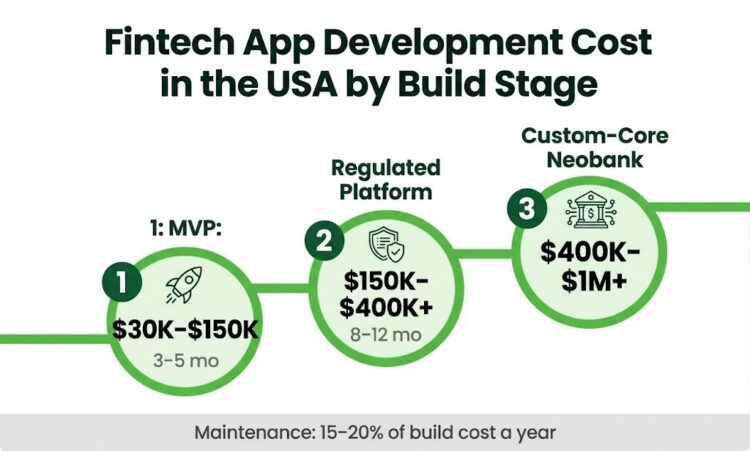
At Code Brew Labs, a sandbox-ready fintech MVP costs $30,000 to $150,000 and takes 3 to 5 months. A full regulated platform runs $150,000 to $400,000 or more, over 8 to 12 months.
Fintech App Development Cost by Product Type
Product costs vary more by compliance scope than by screen count. A wallet that holds customer funds costs more than a budgeting app that reads data.
| Fintech product | Typical scope | Code Brew estimate |
| Sandbox-ready fintech MVP | Core user flows, KYC, one payment rail, admin panel | $30K to $150K (3 to 5 months) |
| Custom crypto wallet MVP | Key management, multi-chain support, transaction history | $30K to $60K |
| Cash advance app | Bank linking, eligibility rules, repayments, notifications | $30K to $75K+ |
| Mobile banking app | Accounts, transfers, cards, alerts, support | $40K to $120K (MVP) up to $300K to $500K+ |
| Neobank on a BaaS partner | Sponsor bank APIs, card issuing, ledger, KYC | $80K to $150K (MVP) |
| Wealth management platform | Portfolios, advisory tools, reporting, custody links | $80K to $500K+ |
| Fully regulated platform | Multiple rails, complete compliance stack, scale testing | $150K to $400K+ (8 to 12 months) |
| Custom-core neobank | Own ledger and core banking, bank-grade controls | $400K to $1M+ |
Cost Drivers That Shape a Fintech Budget
- Ledger and core logic: A double-entry ledger with holds and reversals takes more effort than any screen. Shortcuts in the ledger are how fintechs lose track of customer money.
- Identity and compliance integrations: KYC, AML screening, sanctions checks, and transaction monitoring each need a vendor integration. Your compliance team also needs case management screens.
- Payment rails and partners: ACH, card issuing, RTP, and FedNow each bring their own formats and certification steps. A BaaS sponsor bank adds its own due diligence.
- Security and audits: Penetration tests, PCI DSS scoping, and SOC 2 readiness add cost before launch. Our mobile banking app development guide puts PCI DSS Level 1 work at $40K to $80K.
- Platforms and AI features: Native iOS and Android, a web portal, and an admin console multiply QA work. Fraud models and AI assistants add data pipelines and model monitoring, as our AI development cost breakdown explains.
In-House Team vs a Fintech App Development Company
The BLS puts the May 2025 median US software developer wage at $135,980, or $65.38 an hour. A five-person in-house team costs about $680,000 a year in base pay alone.
Benefits, recruiting, compliance hires, and tooling come on top. A fintech app development company spreads those fixed costs across many clients.
You pay for the build window, then scale the team down after launch. Our New York app development cost guide compares local and partner rates.
In-house teams still make sense for core systems you plan to own for a decade. Many US fintechs pair a small internal product team with an outside software development company in the USA.
Post-Launch Costs to Plan For
Budget 15% to 20% of the build cost each year for maintenance. Code Brew Labs quotes that range for its crypto wallet builds.
Vendor fees for KYC checks, card processing, and BaaS minimums grow with your user base. Annual penetration tests and SOC 2 renewals recur too.
Need a phased fintech app cost and timeline estimate your board and sponsor bank can both sign off on?
What AI Technologies Can a Fintech App Development Service Provider Add to Your Software?
A fintech app development service provider can add six AI capabilities to financial software. They cover fraud, identity, AML, credit, customer support, and payment automation.
Adoption is moving fast. In NVIDIA’s 2026 survey of financial firms, 65% were using AI, up from 45% a year earlier. Our AI-powered fintech solutions cover each capability that follows.
1. Machine Learning Fraud Detection
Models score each transaction in milliseconds using device data, payee history, amount patterns, and login behavior. The score decides whether a payment clears, waits for step-up authentication, or goes to review.
Results can be large. The US Treasury recovered $1 billion in check fraud in fiscal 2024 through machine learning detection. For instant payments, the model must decide before funds leave, because RTP and FedNow transfers are final.
2. AI-Driven KYC and Deepfake Defense
Document AI reads IDs, matches selfies, and runs liveness checks during onboarding. Newer models also flag injected video and synthetic identities built from real and fake data.
Fraudsters use the same tools. The FBI’s IC3 received 22,364 AI-related complaints in 2025, tied to $893 million in losses.
3. AML Transaction Monitoring
Rules-based monitoring floods compliance teams with false positives. Graph models link accounts, devices, and counterparties to surface mule networks that rules miss.
Generative AI can draft case summaries, while an analyst still makes the filing decision. The same intelligent process automation approach speeds up back-office reconciliation.
4. Explainable AI Credit Underwriting
Cash-flow underwriting uses bank transaction data to assess borrowers with thin credit files. It powers many lending and BNPL app development projects.
US lenders must still explain every denial. CFPB Circular 2022-03 says adverse action notices need specific reasons, even when a complex model decides.
In practice, that means reason codes per decision, model versioning, and fair lending tests before each release.
5. Generative AI Banking Assistants
LLM assistants answer balance questions, explain fees, and walk users through disputes. Strong builds ground every answer in account data and policy documents.
Those assistants also log conversations for complaint reviews and hand off to humans on regulated topics. Our generative AI development services follow that pattern.
6. Agentic AI for Payments
Agentic AI lets software agents pay on a user’s behalf within set limits. Visa Intelligent Commerce launched in April 2025 with tokenized agent credentials. Mastercard Agent Pay followed for US cardholders.
In NVIDIA’s survey, 42% of firms were using or assessing agentic AI. Fed Governor Christopher Waller warned in September 2026 that fraud systems built for humans may not fit agents.
Fintech apps will need agent-specific limits, consent logs, and anomaly rules. Our AI agent development company builds those controls into finance workflows.
What Is the Future of Fintech App Development Services in the USA?
The next 18 months will reward fintech products built for programmable money, machine customers, and stricter identity checks. Seven shifts matter for anyone planning a build.
1. Regulated Stablecoin Payments
Stablecoin supply reached about $317 billion in April 2026, per a Federal Reserve note. Visa began US settlement in USDC in December 2025. Its annualized run rate passed $7 billion by April 2026.
GENIUS Act rules from the OCC and Treasury are still at the proposal stage. Apps that hold or move stablecoins need reserve reporting, licensed issuer checks, and wallet screening. Our guide to stablecoin payment platform development covers the architecture.
2. Tokenized Bank Deposits
Tokenized deposits are bank deposits recorded on a blockchain ledger. In September 2026, The Clearing House picked Quant as technology partner for its On-Chain Money Initiative.
The network will settle tokenized deposits between banks and link to RTP and CHIPS. Launch is expected in the first half of 2027. Fintechs that plan for asset tokenization now will connect faster once banks go live.
3. A Rewritten Open Banking Rule
The CFPB is rewriting its Section 1033 rule after a court blocked the 2024 version. Data access fees remain an open question.
Put data connections behind an abstraction layer. You can then switch between aggregators and direct bank APIs as the rule settles.
4. Agentic Commerce
Agents that shop and pay need their own identity, spending limits, and dispute trail. Card networks will expect agent tokens, and issuers will ask for consent records. Fraud teams will retrain models on agent traffic. A bot paying 40 bills at midnight looks nothing like a human tapping a phone.
5. Passkeys Over One-Time Passwords
The FIDO Alliance’s 2026 Passkey Index found 36% of successful sign-ins now use passkeys. Passkey sign-ins succeed 93% of the time, against 78% for traditional MFA. For banking apps, that means fewer lockouts and less exposure to SMS-based account takeover.
6. Post-Quantum Cryptography
NIST published its first three post-quantum encryption standards in August 2024. A NIST draft transition plan proposes deprecating RSA and elliptic-curve algorithms after 2030 and disallowing them after 2035.
Attackers can harvest encrypted data today and decrypt it later. Fintech apps should adopt crypto-agile designs now, since financial records must stay confidential for years.
7. Bank Charters for Fintech and Crypto Firms
On December 12, 2025, the OCC gave conditional approval to five national trust bank charters. Ripple, BitGo, Fidelity Digital Assets, and Paxos were among them. A chartered fintech faces bank-grade exams from day one. Its app needs examiner-ready logs, access reviews, and change records before launch.
Why Choose Code Brew Labs as Your Fintech App Development Service Provider in the US?
Code Brew Labs has built fintech products for 13+ years. Remittance apps, wallets, trading platforms, and AI collection agents all sit in our portfolio. Our custom fintech app development covers payments, banking, lending, wealth, insurance, and digital assets.
-
Compliance first:
Our architecture maps to GLBA, CCPA, PCI DSS 4.0, and SOC 2 Type II controls. You reach bank-partner and audit reviews with evidence ready.
-
Vendor risk packs ready:
Security questionnaires, architecture documents, and incident procedures go to your risk team early. Your procurement team gets answers before it has to chase them.
-
60+ payment and banking integrations:
We have shipped ACH, RTP, card processor, core banking, and KYC connections. Your project inherits tested integration patterns.
-
Ledgers planned before screens:
Our architects map the ledger, reconciliation jobs, and audit trail before design starts. Finance and compliance teams can trace every transaction.
-
AI depth:
Our 350+ AI and software engineers build fraud models, KYC automation, and credit scoring. For First Financial Agency, a US collections firm, our AI agent for finance delivered 90% faster compliance checks. Compliance issues fell 32%.
-
Proven at fintech scale:
duPay, Alfardan Exchange and BharatPe run on apps we built. For a Riyadh brokerage, we cut order delay by 42% and duplicate orders by 96%.
-
US time-zone delivery:
A San Diego office handles our North American accounts. Our nearshore team in Guadalajara keeps US working hours for standups and releases.
-
Certified delivery processes:
CMMI Level 3 and ISO 9001:2015 practices govern how we plan, test, and release.
-
Engagement models for every stage:
Fixed-scope MVPs suit founders validating an idea. Dedicated teams and time-and-materials contracts suit banks modernizing legacy systems.
Clutch lists Code Brew Labs as a Global Leader and Champion. Our AI development company in the USA supports the AI side of every fintech build.
Ready to launch a compliant US fintech product with one partner for ledgers, payment rails, and AI?
Conclusion: Which Fintech App Development Service Provider Fits Your Business?
The right fintech app development service provider matches your product, risk profile, and growth stage. Every US fintech app must still pass the sponsor bank, the PCI assessor, and state regulators.
These ten companies bring different strengths. Some focus on financial software development and compliance-heavy builds. Others offer broad engineering, mobile product design, or dedicated teams.
Enterprise teams should weight vendor risk evidence, core integration depth, and exit terms. High-growth fintechs should weight launch speed, sponsor bank experience, and a phased roadmap.
Before you sign, compare relevant case studies and speak with past clients. Review the proposed ledger and architecture. Ask for a line-item breakdown of cost, deliverables, timeline, and code ownership.
Frequently Asked Questions
How long does it take to build a fintech app?
A sandbox-ready fintech MVP takes about 3 to 5 months. Full regulated platforms take 8 to 12 months or longer. Timelines depend on features, design depth, financial integrations, security testing, and regulatory approvals. Bank partner onboarding, licensing, and compliance reviews can add weeks. A phased plan lets you launch core flows first and add features after validation.
How much does it cost to build a fintech app?
At Code Brew Labs, a fintech MVP costs $30,000 to $150,000. A fully regulated platform starts around $150,000 and can go up to $400,000. Price depends on team rates, scope, third-party integrations, security controls, and support needs. Treat these as planning ranges and ask for a quote based on your own scope.
What should I consider before hiring a fintech app development company?
Check the company’s fintech experience, case studies, technical skills, security practices, communication process, engagement model, and client feedback. Settle IP ownership, source code access, documentation, testing duties, and post-launch support in the contract. Ask how the team handles payment failures, transaction reconciliation, data protection, and applicable compliance rules.
Can I develop a fintech app without technical knowledge?
Yes. Start with a business idea, a target audience, and a clear problem to solve. A development partner turns these into product requirements, user journeys, a technical plan, and an MVP. You still own business decisions such as demand validation, the revenue model, and legal advice. Good partners explain technical choices in plain terms and keep you in major decisions. Our guide to software development for startups walks founders through each stage.
What are the must-have features of a fintech app?
Core features include secure registration, identity checks, MFA, account management, and transaction history. Payments, notifications, fraud monitoring, and in-app support round out the base. The rest depends on the product. An investment app needs portfolio tracking and market data. A digital wallet centers on transfers and balances. See our list of must-have fintech app features for 2026.
How do you monetize a fintech app?
Revenue models depend on your product and regulatory permissions. Common options include transaction fees, subscriptions, premium features, merchant fees, interchange revenue where it applies, and B2B licensing. Lending and investment products add interest and advisory revenue, subject to disclosure laws. Show pricing up front, because surprise fees erode trust fast.
Which technologies are used for fintech mobile app development?
Native apps often use Swift for iOS and Kotlin for Android. Cross-platform builds use Flutter or React Native. Backends run on Java, .NET, Node.js, or Python, with relational databases for ledgers. Cloud hosting, monitoring, and API security controls complete the stack. Pick the stack that fits your product’s needs and your team’s skills.
Is it better to build a fintech app from scratch or use existing solutions?
Custom builds give full control over features, architecture, and user experience, but cost more and take longer. Licensed partners, BaaS platforms, APIs, and white-label products speed up launch. Many US fintechs combine both, with rented infrastructure for regulated rails and custom code for the customer experience. Your choice depends on your edge, compliance duties, budget, and roadmap.
How can I ensure my fintech app is secure?
Build security into every stage of development. That means secure authentication, encryption, access controls, protected APIs, audit logging, dependency management, vulnerability testing, and monitoring. Define incident response, data retention, backup and recovery plans before launch. Book independent security assessments and consult qualified security and regulatory advisers, since obligations vary by product and state.
Why should I hire a specialized fintech app development service provider?
A specialized fintech app development service brings experience with financial workflows, payment integrations, security rules, and money movement. That experience surfaces risks earlier and improves architecture decisions. Still, evaluate the actual team, relevant case studies, references, and the delivery plan before you sign.
Let's Convert Your Business Idea Into Success!
Free Consultation from Top Industry Experts
Let’s Build Your Dream App!
Share article on :



Ready To Fuel Your Vision With AI-Powered Innovation?


Level- 18, Dubai World Trade Centre Tower, Sheikh Rashid Tower, Sheikh Zayed Rd, Dubai, UAE
business@code-brew.com +971-55-645-7972
Plot no I - 36, Sector 83 Alpha, Mohali SAS Nagar 140308
business@code-brew.com +91-771-976-8427
Al Akaria 2, 6926 Olaya Street, RHOA2566, Riyadh, Saudi Arabia.
business@code-brew.com
Av. Miguel Hidalgo y Costilla 1995, Arcos Vallarta, 44600 Guadalajara, Mexico
business@code-brew.com +1(213)2614953
4231 Balboa Ave #512 San Diego, CA 92117 United States
business@code-brew.com +1(213)2614953
2nd floor, College House, 17 King Edwards Rd, London HA4 7AE, UK
business@code-brew.com +44 (20) 82644493
Partner With Experts Who Leverage AI & Tech To Transform Ideas Into Market-Leading Solutions.
Wait! Looking for Right Technology Partner For Your Business Growth?
It's Time To Convert Your Business Idea Into Success!
Get Free Consultation From Top Industry Experts:
I would like to keep it to myself