Table of Content

Quick Summary:
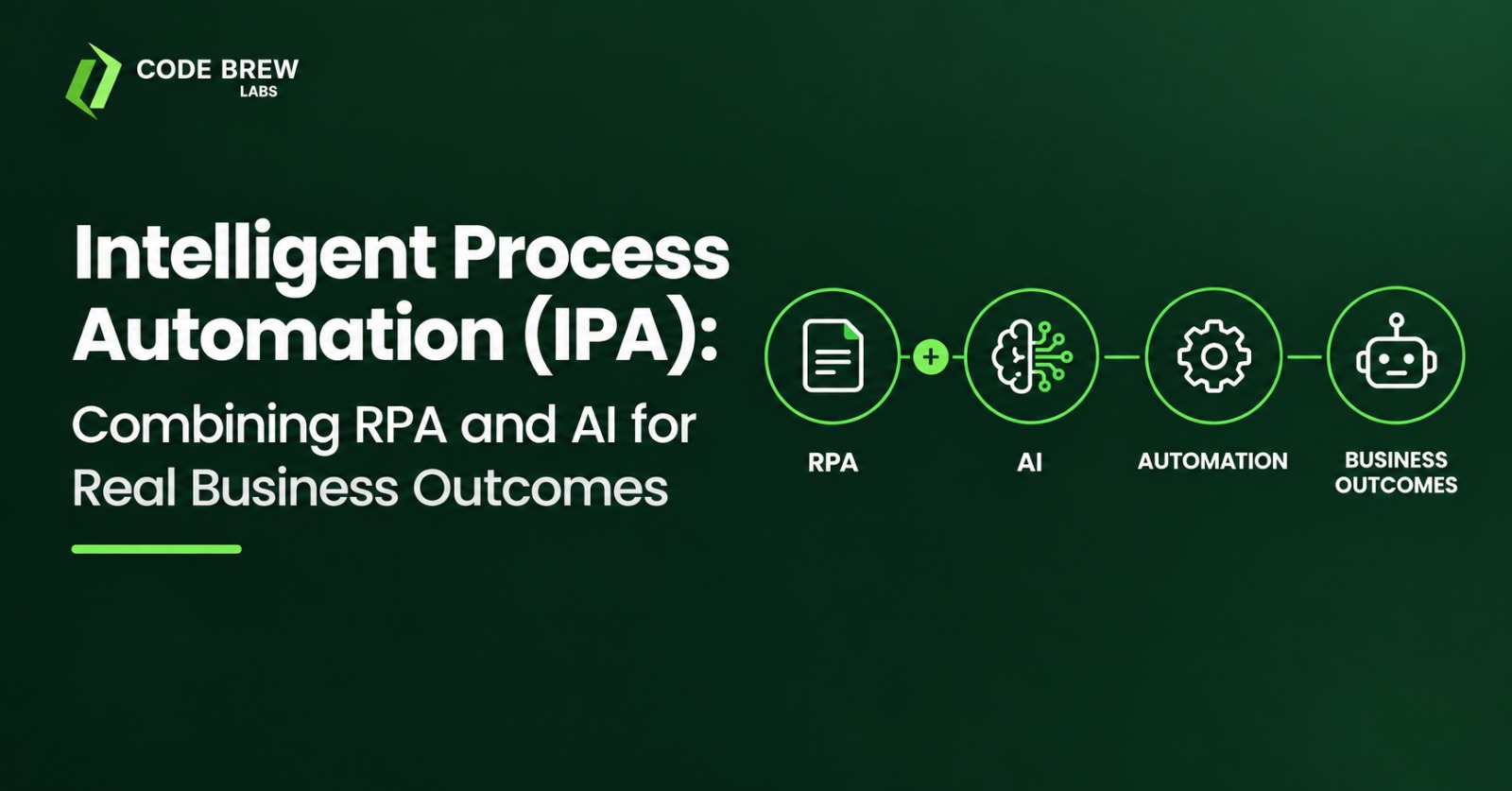
- Intelligent process automation combines RPA execution with AI cognition to automate complex, judgment-heavy processes end to end.
- RPA follows fixed rules, IPA reads unstructured data, and hyperautomation coordinates both across the whole enterprise.
- A working IPA stack blends OCR, NLP, machine learning, and RPA into one continuous pipeline.
- Banking, healthcare, and insurance see the fastest, highest-value gains from intelligent automation today.
- Process selection decides program success far more than the platform brand a company finally picks.
- Well-scoped pilots often recover their cost within roughly six months of go-live.
- Integration with legacy, ERP, and CRM systems is where most automation programs quietly stall.
- Agentic AI now sits above IPA and handles open-ended decisions once reserved for people.
Intelligent process automation exists because rule-based bots break the moment work stops looking tidy. A traditional RPA bot follows a script. Change the invoice layout, add an exception, or feed it a scanned PDF, and the script fails. Someone then steps in to fix the mess by hand.
Table of Content
Pure AI automation has the opposite gap. Models read documents and predict outcomes well, yet they rarely execute a full transaction across five enterprise systems without help. Reading is not the same as doing.
IPA closes both gaps. Think of RPA as the hands that click, type, and move data. AI, machine learning, natural language processing, and computer vision act as the brain that interprets, decides, and adapts. Together they automate processes that neither could finish alone.
The money follows the shift. Grand View Research values the global IPA market at $14.6 billion in 2024, rising to $44.74 billion by 2030 at a 22.6% CAGR, with North America holding the largest revenue share (Grand View Research). US enterprises are driving that curve.
This guide walks through the tech stack, architecture, industry use cases, ROI math, platform choices, and a step-by-step path to your first agent. Read it as a buyer, not a spectator.
Ready to move past brittle bots and automate the processes that actually decide your revenue?
What Is Intelligent Process Automation (IPA)?
Intelligent process automation is the practice of automating complex business processes by combining RPA with AI technologies such as machine learning, NLP, and computer vision. It handles work that involves reading, judgment, and variation, not only repetitive clicks.
The term grew out of a clear evolution. First came RPA, which automated structured, rule-based tasks like copying fields between systems. Useful, yet fragile. Vendors and enterprises then layered AI on top so bots could interpret unstructured inputs and make probabilistic decisions. That layered result is what most analysts now call IPA, and many use “intelligent automation” (IA) as a synonym.
The purpose of IPA
The point is outcome, not activity. A rule-based bot saves a few minutes per task. An intelligent workflow can own an entire process from intake to resolution, escalating only the genuine edge cases to a human reviewer.
What makes IPA different from plain automation
Three qualities separate IPA from classic RPA:
-
Unstructured data handling
Emails, contracts, claims, and scanned forms become machine-readable through OCR and NLP, so the process no longer needs perfectly formatted inputs.
-
Adaptive decisioning
Machine learning models classify, score, and route cases based on patterns, which lets the workflow respond to situations no analyst pre-scripted.
-
Continuous improvement
Feedback from human corrections retrains the models, so accuracy climbs over months rather than degrading as conditions change.
Put simply, IPA automates the parts of work that used to require a person to look, think, and choose.
RPA vs IPA vs Hyperautomation: What Actually Differs
Buyers confuse these three constantly, and vendors rarely help. Here is the honest separation.

RPA is task-level. It automates deterministic steps inside a single process using fixed rules. IPA is process-level. It wraps AI around RPA so a full workflow, including its exceptions and unstructured inputs, runs with minimal human touch. Hyperautomation is a strategy, coined by Gartner, that orchestrates many tools together at organizational scale, including IPA, process mining, low-code platforms, and AI agents.
A comparison makes the boundaries concrete.
| Dimension | RPA | IPA | Hyperautomation |
| Focus | Rule-based tasks | End-to-end processes with decisions | Enterprise-wide automation strategy |
| Data handling | Structured only | Structured plus unstructured | All data across all systems |
| Intelligence | Deterministic rules | AI, ML, and NLP for adaptation | Orchestration of many AI and automation tools |
| Exception handling | Manual or scripted | Confidence-based escalation and learning | Continuous optimization via process mining |
| Scope | Task | Process | Value stream and organization |
| Maintenance | High, brittle | Lower, self-improving | Ongoing governance and orchestration |
Is IPA the same as hyperautomation?
No. IPA is a capability, while hyperautomation is the wider program that may deploy IPA as one of several moving parts. A company can run IPA on ten processes without ever calling its work hyperautomation.
Intelligent automation vs RPA: when to use each
Choose plain RPA for high-volume, stable, structured tasks where inputs never vary. Reach for IPA when documents, language, or judgment enter the picture. Move toward a hyperautomation program once automation spreads across departments and needs shared governance.
The IPA Tech Stack: OCR, NLP, ML and RPA Working Together
An IPA solution is not one product. Several technologies operate as layers, each handling a distinct part of the work.

RPA: the execution layer
Software bots interact with user interfaces and APIs the way a person would. They log in, move data, trigger updates, and complete transactions across applications that were never designed to talk to each other.
OCR and intelligent document processing
Optical character recognition and IDP turn scanned invoices, forms, and images into structured data. Computer vision extends this to layout understanding, so a bot knows a total from a line item even when templates shift.
NLP and language understanding
Natural language processing reads emails, contracts, and support tickets, extracts meaning, and can draft responses. It converts free text into signals the workflow can act on.
Machine learning and predictive analytics
Models classify cases, spot anomalies, forecast demand, and improve as they see more examples. This is the judgment layer that decides whether a claim is routine or suspicious.
Supporting components
Process mining discovers where automation will pay off. Decision engines encode business rules. Generative AI and large language models add summarization and drafting. Orchestration engines sequence everything and hand off to people when confidence drops.
How the pieces cooperate is the real story. OCR extracts the data, NLP interprets the intent, ML scores the decision, RPA executes across systems, and every human correction feeds back to sharpen the models. That closed loop is what lets accuracy grow with time instead of eroding.
IPA Architecture: How Enterprise-Grade Systems Are Built
A production IPA system moves through defined stages. Each stage has an owner, a control point, and an audit trail.
Data enters and gets normalized first. Documents, emails, and API feeds land in one place and convert into a common format. Interpretation follows, where OCR, NLP, and ML read and enrich the data. Decisioning then applies rules and model outputs to choose a path. Execution comes next, with RPA bots and API calls completing the transaction. Monitoring and continuous learning run underneath all of it, capturing outcomes and retraining models. Human-in-the-loop escalation catches low-confidence cases before they cause harm.
API-first, with UI automation as backup
Wherever an API exists, use it. API integration is stable, fast, and less prone to breakage. UI automation stays as the fallback for legacy screens that expose no interface.
Governance built into the flow
Confidence scoring, immutable audit logs, role-based access, and encryption belong inside the architecture, not bolted on later. US regulators expect traceability for every automated decision, so design for it from day one.
Architecture is where most vendor demos stay vague. The programs that scale are the ones that treat data quality, error handling, and monitoring as first-class citizens rather than afterthoughts.
Real-World IPA Use Cases by Industry
This is where intelligent process automation stops being theory. Below are the US sectors seeing the deepest returns, with the specific processes changing and the numbers behind them.
Banking and finance automation
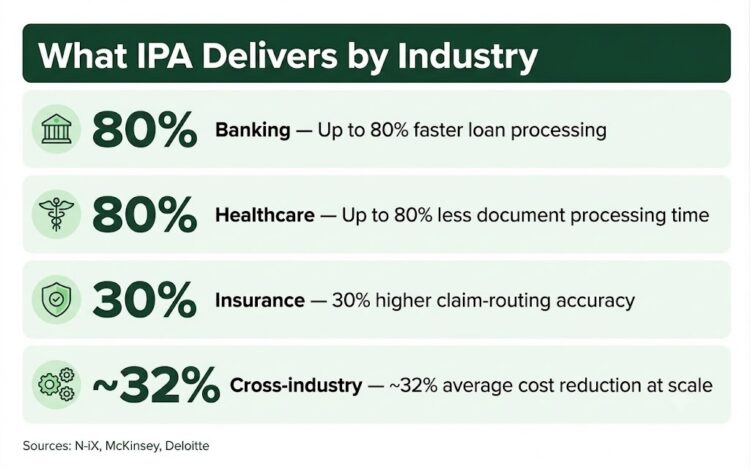
Money moves on paperwork, and paperwork is exactly what IPA eats. Loan origination once took days of manual review across credit files, income documents, and compliance checks. With IDP reading the documents and ML scoring the risk, banks compress that cycle sharply. McKinsey-referenced programs show loan processing times falling by up to 80%, and intelligent automation deployments reporting roughly 250% ROI within two years (N-iX).
- Beyond lending, the wins pile up across the back office.
- KYC and BSA/AML onboarding gets faster because bots gather documents while NLP flags mismatches.
- Accounts payable clears invoices without manual keying.
- Reconciliation runs overnight instead of over days.
- Fraud detection improves because anomaly models watch every transaction rather than a sample.
A large US commercial bank documented straight-through gains after automating account servicing, with wire processing dropping to seconds through bots paired with OCR. The pattern repeats: high volume, heavy documents, strict rules, and a clear cost per transaction.
The same physics drives the products Code Brew Labs has shipped, from high-scale AI-powered fintech solutions to mobile banking app development where onboarding, KYC, and transaction integrity sit at the core. Teams weighing banking automation software for US financial institutions start from those same document and compliance demands.
Healthcare automation
Healthcare drowns in documents, and the stakes are patient care plus tight regulation. Patient intake, insurance eligibility checks, prior authorization, claims, and revenue cycle work all run on forms that arrive in dozens of formats. IDP reads them, ML routes them, and RPA updates the EHR and billing systems.
The size of the prize is hard to ignore. McKinsey estimates that automation technologies could save the US healthcare industry between $350 billion and $410 billion each year (McKinsey). Document-heavy workflows alone see processing time drop by up to 80% once IDP replaces manual keying, with error rates falling in step.
HIPAA shapes every design choice, which is why AI healthcare software development in the US has to prove who accessed what and when. Live builds like Hakeem Care and the AI-driven Ingeni Health show how HIPAA-ready healthcare app development and telemedicine platforms return clinical hours to overworked staff. Freed from clerical load, clinicians spend more time on actual care.
Insurance automation
Insurance runs on claims, and claims are a perfect IPA target. A single motor claim touches intake, document review, liability assessment, fraud checks, and settlement. Each step involves reading, judgment, and system updates. Intelligent automation handles the routine 70% end to end and escalates the rest.
Real programs show the scale. One major insurer improved claim-routing accuracy by 30%, cut complex liability assessment time by more than three weeks, reduced customer complaints, and saved over $75 million on a single claims domain in one year. Underwriting, policy administration, and renewals follow the same automation logic. Carriers modernizing this flow lean on insurance claims automation that reads documents, scores risk, and escalates only the genuine exceptions.
Marketing and sales automation
Revenue teams gain speed once IPA takes over the repetitive middle. Lead routing, data enrichment, campaign setup, and reporting move from spreadsheets to workflows. Code Brew Labs built Marketing Pro, an AI marketing command center that runs campaigns 4X faster, and Kaizan AI, which cuts reporting time by 70%. Sales operations reclaim hours that used to vanish into copy-paste. Most teams reach these gains through an AI automation agency model that wires campaigns, enrichment, and reporting into one flow.
Cross-industry: supply chain and customer service
Logistics and support show broad value too. Order processing, shipment tracking, and exception handling automate well, as seen in freight platforms like Trukker that coordinate thousands of drivers. Customer service triage improves when NLP reads tickets and routes them before a human opens the queue. Freight and fulfillment operators see similar wins from AI logistics software development and delivery management software that coordinate drivers, routes, and exceptions in real time.
| Industry | Process automated | Reported outcome | Source |
| Banking | Loan origination | Up to 80% faster processing | N-iX |
| Healthcare | Document-heavy workflows | Up to 80% less processing time | McKinsey |
| Insurance | Motor claims domain | $75M+ saved in one year | Secondary (verify) |
| Marketing | Campaign execution | 4X faster (Marketing Pro) | Code Brew Labs |
Build vs Buy: An IPA Decision Framework
Every enterprise hits this fork. Buy a platform and move fast, or build custom and own the differentiation. The right answer depends on the process, not on ideology.
Buying wins on speed, proven reliability, and vendor support. Platforms come with pre-built connectors, IDP models, and governance features that would take quarters to replicate. Building wins on control, data ownership, and competitive edge, which matters when the process itself is your product.
Most enterprises land on a hybrid. Buy a core platform for standard workflows, then extend it with proprietary logic and models where the business truly differentiates. That approach captures speed without surrendering the parts that create advantage.
Weigh the decision against clear criteria rather than gut feel:
- Process volume and strategic value: High-volume commodity work suits a platform, while core differentiating processes justify custom investment.
- Data sensitivity and regulation: Strict HIPAA or financial controls may push toward tighter in-house control of data and models.
- In-house talent: A mature engineering and data team makes building realistic, whereas a lean team is better served by a platform.
- Time-to-value: When the business needs results this quarter, buying shortens the runway.
- Total cost of ownership: License price is one line among many, so compare full lifecycle cost, covered below.
The pragmatic move for most US enterprises is to start by buying for standard processes, prove value, then build selectively where the numbers and strategy support it. If your team lacks internal AI depth, a specialist partner offering enterprise AI automation for US companies can shorten the build path without locking you into a single vendor’s roadmap.
Integration With Existing Systems: Legacy, ERP and CRM
Integration decides whether IPA scales or stalls. A pilot that touches one clean system looks great in a demo. Reality involves decades-old ERPs, customized CRMs, and mainframes that predate the cloud.
Two integration styles cover most cases. API-first integration connects directly to system endpoints and stays stable through upgrades. UI automation drives the screen when no API exists, which fits legacy applications but needs more maintenance. A mature program uses both and knows when each applies.
Connecting to ERP and CRM
Most US enterprises run SAP, Oracle, or Microsoft Dynamics for ERP, and Salesforce or HubSpot for CRM. IPA reads and writes to these through connectors and APIs, so a single workflow can pull a customer record, check inventory, and update a case without human hops.
Handling legacy and mainframe systems
Rip-and-replace is rarely realistic. Bots interact with legacy green screens and older applications through UI automation, which lets an enterprise automate now and modernize on its own timeline.
Middleware and orchestration
An iPaaS or orchestration layer keeps the pieces coordinated. It manages queues, retries, and handoffs, so a failure in one system does not silently break the whole chain.
Deloitte’s research names integration difficulty as the single biggest barrier to scaling automation, cited by 62% of organizations (Deloitte). Treating integration as an afterthought is the most reliable way to stall a promising program. Enterprises that plan AI integration with legacy ERP and CRM early tend to avoid that trap.
Measuring the ROI of Intelligent Process Automation
ROI is where automation earns or loses its budget. The metrics that matter go beyond a vague “efficiency” claim.
Track cost savings in FTE-equivalent terms, cycle-time reduction, error-rate drop, throughput increase, compliance improvement, and satisfaction scores for both employees and customers. Each maps to a dollar figure a CFO recognizes.
Benchmarks give a realistic frame. Organizations running RPA at scale report an average 32% cost reduction in impacted areas, with payback landing around 9 to 12 months, and well-scoped pilots recovering cost inside 6 months (Deloitte).
Building a CFO-ready business case
Finance leaders respond to modeled numbers, not enthusiasm. A strong case shows net present value, internal rate of return, and payback across conservative, expected, and optimistic scenarios. Adding a contingency line for maintenance and model retraining signals rigor and earns trust.
Pitfalls that quietly destroy ROI
Three mistakes wreck returns more than any technical flaw:
- Poor process selection: Automating a low-volume or unstable process yields thin savings and constant rework.
- Ignoring exceptions and maintenance: Bots that break on edge cases create hidden labor that erases the headline gain.
- Weak governance: Without ownership and standards, automations sprawl, drift, and lose accountability.
Many programs pair the ROI model with reusable components from an RPA development services team, which lowers the cost of every process after the first.
Want to know which of your processes will pay back in under six months before you spend a dollar?
Total Cost of Ownership: A Calculator-Style Framework
License price is the tip of the iceberg. A credible TCO model counts every recurring and one-time cost across three years.
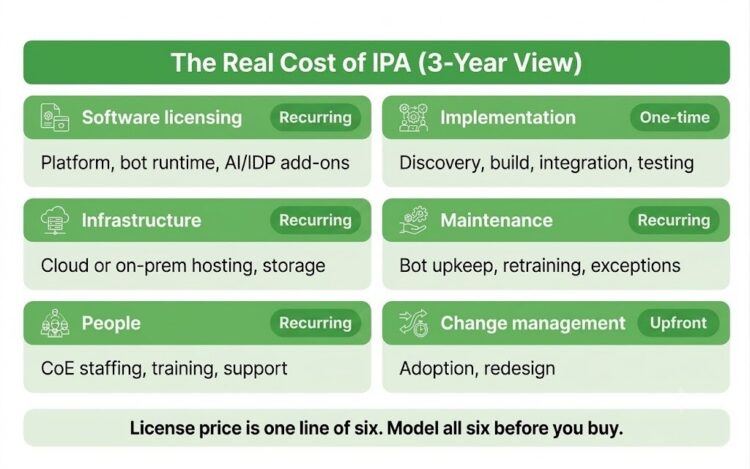
Six components make up the real number. Software licensing covers the platform, bot runtime, and AI or IDP add-ons, sometimes billed per page for OCR. Implementation includes discovery, development, integration, and testing. Infrastructure spans cloud or on-premises hosting and storage. Maintenance covers bot upkeep, model retraining, and exception handling. People costs fund the Center of Excellence and training. Change management pays for adoption and process redesign.
| TCO component | What to count | Typical timing |
| Software licensing | Platform, bot runtime, AI/IDP add-ons | Recurring |
| Implementation | Discovery, build, integration, testing | One-time |
| Infrastructure | Cloud or on-prem hosting, storage | Recurring |
| Maintenance | Bot upkeep, retraining, exception handling | Recurring |
| People | CoE staffing, training, support | Recurring |
| Change management | Adoption, communication, redesign | Mostly upfront |
Hidden costs that inflate TCO
Bot fragility drives surprise maintenance when brittle scripts break on small UI changes. Scope creep adds unplanned processes mid-project. Model drift forces retraining as data patterns shift. Naming these early keeps the three-year number honest and protects the business case you presented to finance.
IPA Implementation Roadmap: A Phased Approach
A successful rollout follows a sequence. Skipping a phase is the quickest route to a stalled program.
-
Strategy and alignment
Link automation to business goals, assess readiness, and stand up a cross-functional Center of Excellence with a clear owner.
-
Discovery and prioritization
Use process and task mining to find candidates with high volume, real pain, and manageable complexity.
-
Proof of concept
Pick one to three processes, capture a baseline, ship the automation, and measure against that baseline honestly.
-
Build and scale
Make architecture and platform choices, start with RPA, add AI where variation demands it, and design human review into the flow.
-
Govern and optimize
Set standards, monitor performance, and run improvement loops so accuracy climbs as the portfolio grows.
-
Change management and sustainability
Train affected teams, communicate the intent, and shift culture so people trust the automations they work alongside.
How long does IPA implementation take?
A first pilot commonly reaches production in 8 to 12 weeks. Enterprise-wide programs unfold over 12 to 24 months as new processes join the portfolio. Speed depends on data quality and integration complexity more than on the tool.
Best practices worth following
Begin small while planning big. Favor end-to-end processes over isolated tasks. Invest in data quality before models. Measure with discipline so every automation defends its place. Strong predictive results usually trace back to disciplined machine learning development rather than a fancier platform.
Process Selection Framework: Which Processes to Automate First
The wrong first process can sink a program before it proves value. A scoring model turns a subjective debate into a defensible ranking.
Score each candidate across weighted factors, then rank by total. Volume shows how much time you reclaim. Rule stability predicts how often the bot breaks. Exception rate reveals how much human handling remains. Data readiness flags whether inputs are clean enough. Strategic value ties the work to business priorities. Compliance risk warns where mistakes get expensive.
| Factor | Weight | What a high score means |
| Volume | 25% | Many repetitions per day or week |
| Rule stability | 20% | Steps rarely change |
| Data readiness | 15% | Clean, structured, or digitizable inputs |
| Exception rate | 15% | Few unpredictable edge cases |
| Strategic value | 15% | Tied to a core business outcome |
| Compliance risk | 10% | Manageable, well-understood controls |
The processes that top the ranking share a profile: high volume, stable rules, and a clear cost per transaction. Start there, bank the win, and use the credibility to fund the harder cases.
Human + Machine Collaboration and Change Management
Technology rarely kills an automation program. People do, when they resist a change they never understood. Deloitte found that difficulty changing ways of working blocks 52% of programs, and skills gaps block 55% (Deloitte).
Design for human-in-the-loop
Confidence-based escalation keeps people in control of the decisions that matter. When a model’s certainty drops below a threshold, the case routes to a reviewer whose correction then trains the system. Trust grows because staff see the safety net working.
Reskill rather than replace
Framing automation as headcount reduction guarantees resistance. Present it as freedom from drudgery, and adoption follows. Staff who once keyed invoices move to exception handling, analysis, and customer work that machines cannot do.
Stand up a Center of Excellence
A CoE sets standards, curates the pipeline, and shares reusable components. It prevents the sprawl of ungoverned bots and keeps quality consistent as the program scales.
Drive adoption across business and IT
Business teams know the processes; IT owns the systems. Pairing them from day one avoids the classic failure where automations get built without the people who run the work. Communication, training, and visible early wins carry the cultural shift, which is often the hardest part of any digital transformation effort.
Steps Involved in Building an AI Agent for Process Automation
Agentic automation is the frontier, and building an AI agent follows a clear sequence. An AI agent perceives its environment, reasons over goals, calls tools, and acts with limited supervision. Here is how teams build one for a real process.
-
Frame the goal and guardrails
Pin down the outcome the agent must deliver and the boundaries it must never cross, including compliance limits.
-
Map the environment and tools
Catalog the systems, APIs, and data the agent will touch, since an agent is only as capable as the tools you expose to it.
-
Choose the reasoning model
Select an LLM or decision model sized to the task, balancing accuracy against latency and cost.
-
Connect data and memory
Give the agent retrieval over your documents and a memory of past actions, so it stays grounded and consistent.
-
Build the tool-calling layer
Wire the agent to functions that read records, trigger RPA bots, and update systems through secure APIs.
-
Add human oversight
Route low-confidence or high-risk actions to a person, and log every step for audit.
-
Test against real cases
Run the agent on historical data and edge cases, then compare its actions to a known-good baseline.
-
Deploy, monitor, and refine
Ship to a narrow scope first, watch behavior in production, and expand once it proves safe and reliable.
Gartner expects 40% of enterprise applications to include task-specific AI agents in 2026, up from under 5% in 2025 (Gartner via BotCity). Building this capability now positions a business ahead of that curve. A partner skilled in AI agent development and generative AI solutions can compress the learning curve considerably.
Challenges, Risks and Best Practices
Every IPA program meets predictable obstacles. Knowing them in advance turns surprises into planned work.
Technical risks include poor data quality, model drift, and integration complexity across brittle systems. Organizational risks cover weak adoption, unclear governance, and shortages of RPA and AI skills. Ethical and compliance risks span model bias, thin auditability, and privacy exposure in regulated data.
The best practices that counter these are consistent across mature programs:
- Fix data quality first, because clean inputs decide model accuracy more than model choice.
- Design for exceptions, so edge cases escalate cleanly instead of breaking the workflow.
- Govern from the start with a CoE, standards, and ownership for every automation.
- Monitor and retrain on a schedule, since accuracy fades when models meet drifting data.
- Document decisions so auditors and regulators can trace any automated action.
Programs that treat these as core engineering work, rather than cleanup, are the ones that survive past the pilot.
Security, Compliance and Governance for US Regulated Industries
Regulated US industries carry the highest stakes and the highest reward. Governance has to be engineered into the automation, verifiable at any moment.
Core controls start with bot credential vaulting and least-privilege access, so a bot can reach only what its task requires. Immutable audit trails record every action for later review. Confidence thresholds decide when a human must approve. Model documentation explains how a decision was reached, which regulators increasingly ask to see.
Mapping to US frameworks keeps the program defensible:
| Domain | Key US frameworks | What it governs |
| Healthcare | HIPAA, HITECH | Protected health data, access, audit |
| Banking | SOX, GLBA, FFIEC, BSA/AML | Financial reporting, privacy, KYC |
| Insurance | NAIC, state regulations | Claims fairness, policyholder data |
| Privacy | CCPA/CPRA, state laws | Consumer data rights |
| AI risk | NIST AI RMF, SOC 2 | Model risk, security controls |
Enterprises building compliant automation should treat these controls as design inputs, never as late-stage audits. That discipline is what separates a proof of concept from a system a regulator will trust.
IPA Software, Solutions and Platforms From Code Brew Labs
Buying a shelf product rarely fits a process that makes your business different. Code Brew Labs builds intelligent process automation around the workflow you actually run, then ties it into the systems you already own.
The practice covers the full stack under one roof. Custom RPA development services handle the execution layer, while machine learning and NLP add the judgment that brittle bots lack. Document-heavy work runs through intelligent document processing, so scanned forms and PDFs become clean, structured data.
Where processes need reasoning, the team ships production-grade AI agent development and generative AI that acts with human oversight. Predictive models come from a dedicated machine learning development capability, tuned to your data rather than a generic template.
Integration is treated as core engineering, not glue. Bots and agents connect to ERP, CRM, and legacy systems through AI integration services built for messy enterprise environments. A managed AI automation agency model then runs discovery, build, and scale as one accountable engagement.
Everything ships with US compliance in mind, covering HIPAA, SOX, GLBA, and NIST-aligned controls. For enterprises that want a proven AI development company in the US, the value is one partner from first pilot to production, with the enterprise software development depth to keep it stable at scale.
| Capability | What it delivers |
| Custom RPA | Bots for execution across UIs and APIs |
| IDP and OCR | Structured data from documents and images |
| AI agents | Goal-driven automation with oversight |
| ML models | Classification, scoring, and forecasting |
| Integration | ERP, CRM, and legacy connectivity |
| Managed CoE | Standards, governance, and scale support |
How to Choose the Right IPA Platform
Platform selection rewards a structured evaluation over a flashy demo. Run every contender through the same checklist so the comparison stays fair.
- Native AI and IDP rather than a thin bolt-on, since integrated intelligence ages better.
- Integration depth across your ERP, CRM, legacy systems, and APIs.
- Scalability and orchestration to move from one process to hundreds.
- Governance and US compliance support, including audit trails and access control.
- Total cost of ownership, weighed across three years instead of by sticker price.
- Time-to-value and support, because a capable tool with weak support still fails.
- Deployment options across cloud, on-premises, and hybrid to match your data rules.
Score each option against these factors with weights that reflect your priorities. The winner is the one that fits your systems and constraints, which is rarely the one with the loudest brand.
The Future of IPA: Agentic Automation and Beyond
The next wave is already arriving. Agentic process automation puts AI agents above the IPA stack, so software can pursue goals and make open-ended decisions rather than follow fixed paths. Generative AI deepens this further, drafting, summarizing, and reasoning inside workflows.
Convergence is the broader theme. IPA, process intelligence, and hyperautomation are merging into unified platforms that discover, automate, and optimize in one loop. Gartner’s forecast of a $1.04 trillion hyperautomation-enabling software market signals how central this becomes (Gartner via BotCity).
For US enterprises, the takeaway is timing. Companies that master IPA now build the foundation that agentic automation will run on. Waiting means rebuilding later on someone else’s schedule.
Why Choose Code Brew Labs for AI Automation
Choosing an automation partner comes down to proof, range, and staying power. Code Brew Labs brings all three, with delivery experience across regulated and high-growth sectors.
End-to-end delivery under one team
Discovery, build, integration, and scale run through a single accountable team, which removes the handoff gaps that slow multi-vendor projects.
Full-stack automation expertise
RPA, AI, machine learning, and intelligent document processing sit inside one practice, so you get a complete solution instead of stitched-together point tools.
A track record in regulated, high-scale products
Live products span fintech, healthcare, and logistics, where compliance and reliability are non-negotiable. That experience shows up in how the systems are architected.
Proof in production
Numbers from shipped work tell the story better than promises:
| Product | Domain | Outcome |
| Kaizan AI | BI reporting | 70% faster report generation |
| Marketing Pro | Marketing ops | 4X faster campaign execution |
| Trukker | Logistics | 12,000+ drivers coordinated |
| Ingeni Health | Healthcare AI | AI-driven care monitoring |
Teams that want a proven partner gain one who has taken automation from concept to production, not just to a demo.
Ready to turn a stalled RPA pilot into an enterprise-wide intelligent automation program?
Conclusion
Intelligent process automation earns its place when it fixes the work that broke every rule-based bot before it. Combining RPA execution with AI judgment gives enterprises accuracy, resilience, and returns that neither delivers alone. The path is well marked: compare the models, score your processes, prove value in a scoped pilot, then scale under real governance. Start with one high-volume process where the cost per transaction is clear. Build the foundation now, because agentic automation will run on top of it sooner than most teams expect.
Frequently Asked Questions
What is the difference between RPA and IPA?
RPA automates structured, rule-based tasks using fixed scripts, so it handles repetitive work with no judgment. IPA adds AI, machine learning, and NLP on top, which lets it read unstructured data, make decisions, and manage exceptions. RPA is the hands, and IPA adds the brain that interprets and adapts.
Is IPA the same as hyperautomation?
No. IPA is a capability that combines RPA with AI to automate whole processes. Hyperautomation is a broader organizational strategy, defined by Gartner, that orchestrates many tools together, including IPA, process mining, low-code platforms, and AI agents. A company can run IPA without pursuing full hyperautomation.
How long does IPA implementation take?
A first pilot usually reaches production within 8 to 12 weeks. Enterprise-wide programs roll out over 12 to 24 months as more processes join the portfolio. The timeline depends heavily on data quality and integration complexity, so clean inputs and stable systems speed everything up.
What is the typical ROI of Intelligent Process Automation?
Organizations running RPA at scale report around 32% cost reduction in affected areas, per Deloitte. Payback commonly lands at 9 to 12 months, and well-scoped pilots often recover cost within 6 months. Finance-sector programs have reported roughly 250% ROI within two years.
Can small and mid-size businesses adopt IPA?
Yes. Cloud-based platforms lower the entry cost, so mid-size firms can start with one or two high-volume processes. Beginning with a focused pilot, proving ROI, then expanding keeps risk low. The build-vs-buy logic still applies, and buying usually fits smaller teams first.
What is IT Process Automation Software and where does it fit?
IT process automation software automates infrastructure and IT operations tasks, such as provisioning, monitoring, and incident response. It differs from IPA, which targets business processes like claims or onboarding. Many enterprises run both, keeping scopes separate so the tools complement rather than overlap.
Let's Convert Your Business Idea Into Success!
Free Consultation from Top Industry Experts
Let’s Build Your Dream App!
Share article on :


Ready To Fuel Your Vision With AI-Powered Innovation?


Level- 18, Dubai World Trade Centre Tower, Sheikh Rashid Tower, Sheikh Zayed Rd, Dubai, UAE
business@code-brew.com +971-55-645-7972
Plot no I - 36, Sector 83 Alpha, Mohali SAS Nagar 140308
business@code-brew.com +91-771-976-8427
Av. Miguel Hidalgo y Costilla 1995, Arcos Vallarta, 44600 Guadalajara, Mexico
business@code-brew.com +1(213)2614953
4231 Balboa Ave #512 San Diego, CA 92117 United States
business@code-brew.com +1(213)2614953
2nd floor, College House, 17 King Edwards Rd, London HA4 7AE, UK
business@code-brew.com +44 (20) 82644493
Partner With Experts Who Leverage AI & Tech To Transform Ideas Into Market-Leading Solutions.
Wait! Looking for Right Technology Partner For Your Business Growth?
It's Time To Convert Your Business Idea Into Success!
Get Free Consultation From Top Industry Experts:
I would like to keep it to myself