Table of Content

Quick Summary:
- Smart contracts manage the rules behind tokenized assets. They can control issuance, transfers, permissions, distributions, and redemption.
- Token minting is only the beginning. A production-ready RWA token may also need investor eligibility checks, transfer restrictions, corporate action handling, and payment records.
- Compliance requires both on-chain and off-chain controls. Smart contracts can enforce programmed restrictions, while legal reviews, identity verification, and other checks may depend on external systems.
- Upgradeability introduces administrative risk. The ability to change a contract can be useful, but privileged keys must be secured and governed carefully.
- Testing and independent security audits are essential. Automated tests and audits help identify vulnerabilities but cannot guarantee that a contract is completely secure.
- Development cost depends on complexity. A basic token contract and a regulated, multi-feature RWA platform require very different levels of engineering, testing, and security review.
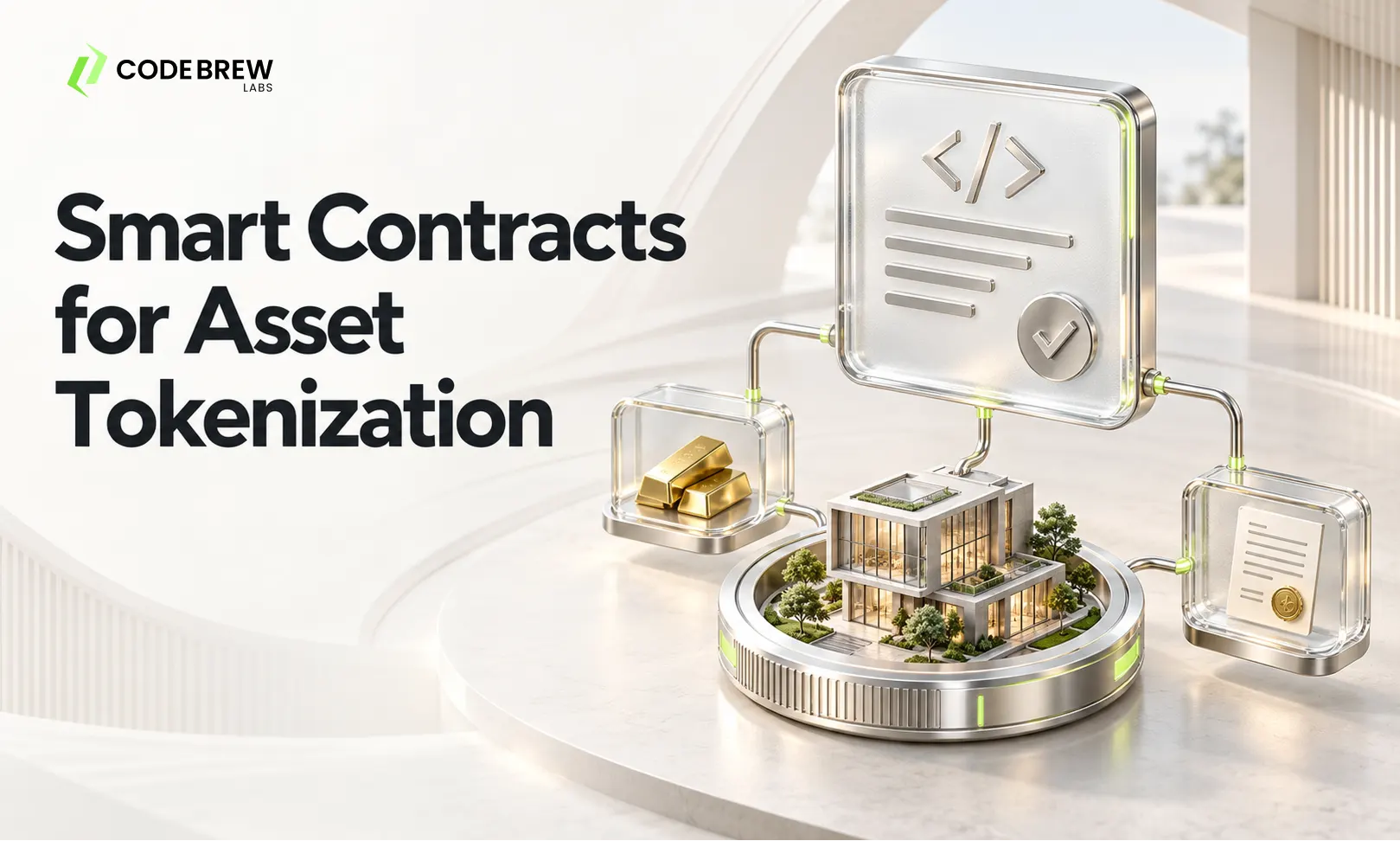
Think of taking a real building and breaking it into digital pieces. You can buy, sell, or trade those pieces online. That’s what asset tokenization is, turning real-world assets into digital tokens on a blockchain. But issuing a token is only one part of the process. A tokenized asset may also need ownership records, investor eligibility checks, transfer restrictions, income distributions, and a way to handle redemption.
Table of Content
This is where smart contracts for tokenization come in.
Smart contracts define the rules that govern how tokens are created, transferred, managed, and redeemed. They can automate specific tasks and help enforce predefined conditions, but they must work alongside legal agreements, compliance processes, and reliable asset records.
In this guide, we explain how tokenization smart contracts work, the six functions an RWA token typically needs, how on-chain and off-chain compliance fit together, and what businesses should consider before deploying these contracts.
What Are Smart Contracts for Tokenization?
Smart contracts for tokenization are blockchain programs that define and execute rules for creating, transferring, managing, and redeeming digital tokens representing assets or legally defined interests in assets. They can enforce permissions, restrict eligible transfers, record token ownership changes, and calculate distributions according to programmed conditions. Their effectiveness depends on correct code, reliable external data, and a legal structure that defines the rights represented by each token.
For example, a company tokenizing interests in a real estate investment vehicle may use smart contracts to issue tokens to eligible participants, restrict transfers to approved wallets, and distribute available income according to documented rules.
The smart contract handles the programmed operations. Legal agreements establish the rights behind the tokens, while external systems may handle identity verification, accounting, asset administration, and payment processing.
How the Tokenization Lifecycle Works
A tokenized asset moves through several stages after its initial issuance. Smart contracts can support each stage, provided the relevant rules and data have been defined.
Stage 1: Issuance and minting
The contract creates tokens according to the approved supply, allocation, and authorization rules. Depending on the model, issuance may require an administrator’s approval, an eligible investor, or confirmation that specified conditions have been met.
Stage 2: Ownership and transfers
When a holder transfers tokens, the contract checks whether the transaction meets the applicable rules. These may include wallet eligibility, holding limits, lock-up periods, or other transfer restrictions.
Stage 3: Corporate actions and updates
Depending on the asset and legal structure, the platform may need to support distributions, voting, asset substitutions, changes in terms, or other events affecting holders. Some actions require approvals and off-chain processing.
Stage 4: Distributions and payments
The platform calculates or coordinates payments according to the applicable rules. For example, an income-bearing token may entitle eligible holders to a share of a defined distribution, subject to the governing agreements.
Stage 5: Redemption and closure
Tokens may be burned or marked as redeemed when the holder exercises a valid redemption right or the asset reaches a defined end point. The contract should follow the documented redemption process rather than assume that every token can be redeemed on demand.
Not every tokenized asset needs all these features. A token representing a license may have different lifecycle requirements from a token representing a contractual interest in a real estate investment.
The token’s purpose, legal rights, and operating model should determine which functions are built.
6 Functions Every RWA Token May Need
The exact requirements vary by asset class and jurisdiction. However, most production-oriented RWA tokenization projects should assess the following six functions.
1. Controlled token issuance
The minting function creates tokens and assigns them to approved addresses.
A properly designed issuance process should define:
- Who can authorize new tokens.
- The maximum or approved token supply.
- How initial allocations are calculated.
- Whether additional issuance is permitted.
- What records must be retained for each issuance.
- How incorrect or unauthorized issuance is prevented.
For example, if a company issues tokens representing defined interests in an asset, the contract should prevent an unauthorized wallet from creating additional tokens.
Supply controls must reflect the legal and commercial arrangement. A maximum supply alone does not prove that the number of tokens accurately corresponds to the underlying asset or rights.
2. Transfer restrictions and eligibility checks
A standard cryptocurrency token may allow any compatible wallet to receive and transfer it. A regulated or permissioned asset token may need stricter controls.
Transfer rules can check whether:
- The sender is authorized to transfer.
- The recipient’s wallet is approved.
- Required holding periods have expired.
- The transfer complies with applicable limits.
- The transaction meets the conditions specified in the token’s governing rules.
For example, a token may be transferable only between wallets that have completed the required onboarding process.
The contract can enforce eligibility information supplied to it, but it cannot independently establish a person’s identity or determine every aspect of their legal status without reliable external processes.
3. Investor and wallet permission management
A tokenization platform may need to maintain an approved list of wallets or use another permission system to determine who can hold or transact with a token.
A permission-management design should specify:
- How wallets are approved and rejected.
- Who can grant or revoke permissions.
- How expired or changed eligibility is handled.
- How wallet changes are reviewed.
- How administrative actions are recorded.
These controls should be designed with the off-chain onboarding process. If a person’s eligibility changes, the platform needs a defined procedure for updating the relevant permissions.
4. Distribution calculations
Some tokenized assets generate income that must be allocated among holders. Depending on the arrangement, this may include rental income, interest, dividends, or royalty-related revenue.
A distribution function may need to:
- Receive an approved distribution amount.
- Determine which holders qualify for payment.
- Calculate each holder’s allocation.
- Account for documented deductions or fees.
- Record completed and failed payments.
- Support reconciliation with accounting records.
The calculation method must match the governing agreement. A simple balance-based allocation may be sufficient for one project, while another may require payment dates, holding-period rules, different share classes, or other conditions.
Smart contracts should not treat unverified revenue figures as automatically correct. External reporting and reconciliation remain important.
5. Corporate action handling
Corporate actions are events that can change the rights, economic interests, or status of token holders.
Depending on the asset and its legal structure, these may include:
- Voting on specified matters.
- Changes to payment terms.
- Asset or portfolio substitutions.
- Changes to an investment vehicle’s structure.
- Maturity events.
- Updates to contractual rights where legally permitted.
Not every corporate action should be executed automatically. Some require legal review, administrator approval, notices, or other off-chain steps before a smart contract is updated.
The contract should reflect the authorized outcome and preserve a suitable record of the action.
6. Redemption and token burning
Redemption is the process through which a holder exercises an applicable right to exchange or return tokens under the terms of the arrangement. Burning permanently reduces the recorded token supply by destroying tokens.
A redemption workflow should define:
- When redemption is allowed.
- Who can initiate or approve it.
- Whether a notice period applies.
- How the redemption value is calculated.
- How payment is completed.
- When the tokens are burned or marked as redeemed.
Redemption rules differ between assets. Some tokens may have a defined maturity date, while others may be transferable interests with no routine redemption right.
The smart contract must not promise liquidity or repayment that the underlying legal and commercial arrangement does not provide.
Compliance: What Belongs On-Chain vs. Off-Chain?
A common mistake in tokenization projects is assuming that putting compliance rules into a smart contract makes the entire platform compliant.
In practice, compliance usually requires a combination of blockchain controls and processes outside the blockchain.
| Compliance requirement | On-chain role | Off-chain role |
| Wallet eligibility | Enforce approved-wallet or permission rules | Verify identity and assess eligibility |
| Transfer restrictions | Reject transfers that violate programmed conditions | Determine the applicable restrictions and maintain supporting records |
| Issuance authorization | Restrict minting to authorized roles | Verify asset documentation and approve the issuance |
| Ownership records | Record token balances and transactions | Maintain legal records and reconcile them with the token structure |
| Transaction monitoring | Expose relevant events and apply supported rules | Monitor activity and investigate potential concerns |
| Distributions | Calculate allocations and record transaction outcomes | Verify revenue, manage banking or payment services, and reconcile accounts |
| Reporting | Provide transaction histories and contract events | Prepare required disclosures, reports, and regulatory filings |
| Redemptions | Enforce approved redemption conditions | Verify payment obligations and complete off-chain settlement where required |
1. On-chain compliance
On-chain compliance refers to rules implemented directly in the smart contracts. These may include approved-wallet checks, transfer restrictions, role-based permissions, issuance limits, and selected transaction controls.
The benefit is that the contract can apply the same programmed conditions whenever a relevant transaction occurs.
However, on-chain rules only enforce what has been implemented and supplied to the contract. Incorrect configuration or outdated eligibility information can still create problems.
2. Off-chain compliance
Off-chain compliance includes the processes required to establish and maintain the legal and operational basis for the token.
These may include:
- Know Your Customer (KYC) and Anti-Money Laundering (AML) checks where required.
- Legal reviews of the asset and offering.
- Verification of ownership and supporting documents.
- Investor classification and eligibility assessments.
- Sanctions screening and transaction monitoring where applicable.
- Accounting, tax, reporting, and payment operations.
A well-designed tokenization platform connects these processes to the smart contracts through controlled integrations.
The key principle: Smart contracts can help enforce compliance rules, but they do not replace the legal, operational, and regulatory processes needed to establish compliance.
Upgradeability and Admin-Key Risk
Smart contracts may be designed to remain unchanged after deployment or to support controlled upgrades. Neither approach is automatically right for every tokenization project.
1. Immutable contracts
An immutable contract cannot ordinarily have its deployed code changed through an administrative upgrade mechanism.
Potential benefits:
- The rules remain stable after deployment.
- Holders can inspect the deployed code.
- There is no upgrade administrator who can replace the implementation through a standard upgrade mechanism.
Potential limitations:
- A serious bug may be difficult or impossible to correct.
- New legal or business requirements may require a migration.
- Incorrect settings may create lasting problems.
An immutable contract can still have privileged functions or external dependencies if they were designed into it. Immutability alone does not guarantee security.
2. Upgradeable contracts
Upgradeable contracts allow an authorized party to change the implementation or configuration under defined conditions. This can be useful when a platform must support evolving business requirements or respond to vulnerabilities.
Potential benefits:
- Fixes can be deployed without requiring every user to migrate immediately.
- Approved changes can be introduced as requirements evolve.
- Certain administrative settings can be updated through controlled procedures.
Potential risks:
- A compromised administrator could make unauthorized changes.
- A malicious or poorly reviewed upgrade could alter token behavior.
- Poorly managed permissions can create a single point of failure.
- Changes can introduce new bugs or affect existing integrations.
How to reduce administrative risk?
For an RWA tokenization platform, consider:
- Multisignature authorization: Require approvals from multiple authorized signers for sensitive actions.
- Timelocks: Introduce a delay before significant upgrades take effect, where appropriate.
- Role separation: Keep minting, pausing, compliance administration, and upgrades under appropriately separated permissions.
- Event logging: Record administrative actions and contract changes for monitoring and review.
- Emergency procedures: Define when pausing transactions is allowed, who can initiate it, and how normal operations resume.
- Independent review: Test upgrade mechanisms and administrative controls as part of the security assessment.
A multisignature wallet or timelock is not a complete solution by itself. The design must also consider signer security, recovery procedures, governance, and the consequences of an emergency action.
Planning a tokenization project?
Explore asset tokenization platform development to understand how smart contracts fit into the wider platform architecture.
Smart Contract Testing and Security Audits
A smart contract can behave correctly in a simple demonstration and still fail under unusual conditions. Tokenization contracts may involve financial rights, restricted transfers, external integrations, and privileged operations, so testing must cover more than the successful transaction path.
What should be tested?
- Unit testing: Check individual functions such as minting, transfers, permission updates, distribution calculations, and redemption.
- Integration testing: Verify that contracts interact correctly with the registry, identity system, payment services, and other components.
- Negative testing: Confirm that unauthorized minting, restricted transfers, invalid approvals, and other prohibited actions fail as intended.
- Boundary testing: Test supply limits, zero balances, rounding, maximum values, expired permissions, and other edge conditions.
- Fuzz testing: Generate many varied inputs to identify unexpected behaviors and potential failures.
- Invariant testing: Verify properties that should always hold, such as supply constraints or allocation rules, under the intended operating conditions.
- Upgrade testing: Where upgradeability is supported, test storage compatibility, authorization, state preservation, and the behavior of the new implementation.
- Operational testing: Check deployment configuration, key management, monitoring, pause controls, and incident response procedures.
What does a smart contract audit involve?
A smart contract audit is an independent technical review intended to identify vulnerabilities, design flaws, and implementation errors. Depending on the engagement, it may include manual code review, automated analysis, fuzz testing, threat modeling, and a report of findings.
An audit is not a guarantee that the contract is free from vulnerabilities. Its value depends on the scope, methods, auditor expertise, quality of the code submitted, and whether identified issues are corrected and retested.
For an RWA token, the review should cover the business rules as well as standard security risks. For example, the auditor should understand how transfer restrictions, supply limits, distribution logic, and administrative roles are intended to work.
Before launch, teams should address material findings, document any accepted residual risks, and consider an additional review after significant changes.
Smart Contract Development Cost for Asset Tokenization
There is no single price for smart contracts for tokenization. The cost depends on whether the project needs a basic token contract or a complete system with permission controls, corporate actions, distributions, external integrations, and independent security reviews.
A low-cost token deployment should not be treated as equivalent to building and securing a production-ready RWA tokenization system.
Indicative cost ranges
The following are broad budgeting estimates in USD, not fixed market rates or a quote from Code Brew.
| Scope | Indicative budget | Typical inclusions |
| Basic token contract | $3,000–$8,000 | Standard token implementation, limited customization, basic tests |
| Custom tokenization contract set | $8,000–$25,000 | Custom issuance logic, roles, transfer restrictions, and expanded testing |
| RWA smart contract system | $20,000–$60,000+ | Multiple connected contracts, permissions, distribution or redemption workflows, and integration requirements |
| Complex or multi-chain system | $60,000–$150,000+ | More complex contract interactions, cross-chain components, advanced governance, or enterprise requirements |
These ranges describe potential development scope and should not be interpreted as a complete platform price. User interfaces, legal structuring, compliance services, external data integrations, deployment, maintenance, and independent audits may be priced separately.
Smart contract audit costs
Audit pricing is separate from development pricing in many engagements. Public 2026 pricing guides show that audits can range from several thousand dollars for simple token contracts to tens of thousands or more for complex financial systems. The exact fee depends on the codebase, complexity, auditor, review depth, and retesting requirements.
For planning purposes, a team might budget approximately $5,000–$20,000 for an independent review of a relatively simple token contract, while more complex multi-contract systems can require $25,000–$100,000 or substantially more. These are indicative ranges, not guaranteed quotes.
What drives the cost?
- Number of contracts and their interactions.
- Custom issuance, transfer, and redemption logic.
- Compliance and wallet permission requirements.
- Distribution calculations and external data integrations.
- Upgradeability and administrative governance.
- Blockchain network and any cross-chain functionality.
- Test coverage, formal verification, and independent audits.
- Deployment, monitoring, maintenance, and incident response.
For a reliable estimate, define the asset type, rights represented, target jurisdictions, expected transaction flows, and required security assurance before requesting a quote.
Common Use Cases for Tokenization Smart Contracts
Smart contracts support different workflows depending on the asset and commercial model.
Real estate tokenization
A real estate tokenization platform may use contracts to issue tokens representing defined interests, restrict transfers to eligible wallets, record ownership changes, and coordinate approved distributions. The legal structure determines what the tokens represent and how investors receive their rights.
IP tokenization
For intellectual property, smart contracts can manage defined license permissions, record relevant token balances, and allocate eligible royalty revenue. The platform also needs reliable royalty data and legal agreements that specify the rights and payment rules.
Explore our guide to IP tokenization to understand how tokenization models can apply to patents, music royalties, film rights, and brand licenses.
Invoice tokenization
Invoice tokenization may represent a defined contractual interest connected to an invoice or receivable. Smart contracts can support issuance records, eligibility controls, payment-status updates, and distribution workflows. The underlying receivable, assignment rights, debtor obligations, and applicable financing rules still need to be established and verified.
Asset-backed and financial products
For other tokenized assets, smart contracts can enforce issuance limits, holder eligibility, transfer rules, payment schedules, and redemption conditions. The functions required depend on the asset and the rights being represented.
To understand the broader platform components around these workflows, explore our asset tokenization platform development services.
How to Choose a Smart Contract Development Partner
A tokenization contract should be designed around the asset’s legal and operational requirements, not just a token standard.
When evaluating a development partner, ask:
- Can the team translate the asset model into clear contract requirements?
- Does it have experience with issuance, permissioned transfers, distributions, and redemption?
- How will external data and compliance systems connect to the contracts?
- What testing methods are used before deployment?
- Will independent security review be included or arranged separately?
- How are administrative keys, upgrades, and emergency actions governed?
- What documentation, monitoring, and post-launch support are provided?
A reliable development partner should explain both what the contract can automate and which responsibilities remain with legal advisers, administrators, data providers, and the asset owner.
Conclusion
Smart contracts provide the operating rules for tokenized assets. They can help manage issuance, transfer permissions, distributions, corporate actions, and redemption while creating a record of relevant blockchain activity.
But building a reliable RWA tokenization system requires more than writing and deploying contract code. The team must define the rights behind the token, connect the right compliance processes, manage external data, protect administrative access, and test the system thoroughly.
Start by identifying what the token represents and how it should behave throughout its lifecycle. Then design the smart contracts around those requirements, validate the legal and operational dependencies, and arrange appropriate security reviews before launch.
Frequently Asked Questions
1. What is a smart contract in asset tokenization?
A smart contract is a blockchain program that applies predefined rules to token-related actions. In asset tokenization, it may manage issuance, transfers, eligibility checks, distributions, corporate actions, and redemption. The contract operates within its programmed scope and depends on correct code, reliable external data, and a valid legal structure.
2. How are smart contracts used for tokenization?
Smart contracts are used to issue tokens, record transactions, enforce supported transfer restrictions, manage permissions, and automate defined financial or administrative workflows. Some functions, such as identity verification and asset ownership checks, require off-chain systems or authorized approvals.
3. What functions should an RWA smart contract include?
Depending on the asset, an RWA smart contract may need controlled minting, transfer restrictions, wallet permissions, distribution calculations, corporate action handling, and redemption. Not every project requires all six functions. The design should follow the legal rights, asset type, and intended user workflows.
4. Can a smart contract guarantee regulatory compliance?
No. A smart contract can enforce programmed restrictions, but regulatory compliance also depends on legal structuring, identity and eligibility checks, disclosures, monitoring, recordkeeping, and other obligations that may operate outside the blockchain.
5. What is the difference between an immutable and an upgradeable smart contract?
An immutable contract generally cannot have its deployed code replaced through a standard upgrade mechanism. An upgradeable contract supports controlled implementation changes. Immutability can limit the ability to fix bugs, while upgradeability introduces administrative risks that require strong authorization and governance controls.
6. How much does smart contract development for tokenization cost?
A basic token contract may cost several thousand dollars, while a customized tokenization contract set or an RWA smart contract system can cost tens of thousands of dollars or more. Independent security audits, integrations, and platform development may add to the budget. The final cost depends on the required functions, code complexity, security scope, and deployment environment.
7. Is a smart contract audit enough to secure an RWA token?
No. An audit can identify vulnerabilities in the reviewed scope, but it cannot guarantee complete security or validate every off-chain process. Security also depends on deployment configuration, administrative key management, external data, integrations, monitoring, and how the system is operated after launch.
8. Can smart contracts distribute income to token holders automatically?
They can calculate and coordinate distributions when the necessary conditions and data are available. If the revenue originates outside the blockchain, the platform needs a reliable process to verify the amount and submit it to the contract. Payment services and accounting systems may also be required.
9. Can tokenized assets be redeemed through smart contracts?
Yes, when the underlying arrangement provides a redemption mechanism and the required conditions are met. The contract can enforce eligibility, calculate or record the redemption amount, and burn tokens when appropriate. It cannot create a redemption right or guarantee that sufficient funds are available unless those rights and resources exist under the arrangement.
Let's Convert Your Business Idea Into Success!
Free Consultation from Top Industry Experts
Let’s Build Your Dream App!
Share article on :


Ready To Fuel Your Vision With AI-Powered Innovation?





Level- 18, Dubai World Trade Centre Tower, Sheikh Rashid Tower, Sheikh Zayed Rd, Dubai, UAE
business@code-brew.com +971-55-645-7972
Plot no I - 36, Sector 83 Alpha, Mohali SAS Nagar 140308
business@code-brew.com +91-771-976-8427
Al Akaria 2, 6926 Olaya Street, RHOA2566, Riyadh, Saudi Arabia.
business@code-brew.com
Av. Miguel Hidalgo y Costilla 1995, Arcos Vallarta, 44600 Guadalajara, Mexico
business@code-brew.com +1(213)2614953
4231 Balboa Ave #512 San Diego, CA 92117 United States
business@code-brew.com +1(213)2614953
2nd floor, College House, 17 King Edwards Rd, London HA4 7AE, UK
business@code-brew.com +44 (20) 82644493
Partner With Experts Who Leverage AI & Tech To Transform Ideas Into Market-Leading Solutions.
Wait! Looking for Right Technology Partner For Your Business Growth?
It's Time To Convert Your Business Idea Into Success!
Get Free Consultation From Top Industry Experts:
I would like to keep it to myself