People worldwide owned crypto in 2025, up from 659 million a year earlier.
Source: Crypto.com Market Sizing Report, 2026
Code Brew Labs designs, builds and launches custodial, non-custodial and MPC wallets for startups, exchanges and fintech brands. We take care of the product, the key management, the security testing and the app store release, so your team can stay focused on users and growth.
Crypto wallets delivered
Wallet and blockchain integrations
In-house experts
Years building crypto products
Trusted by 5,000+ businesses worldwide









Wallets explained
A crypto wallet is software that creates and protects the private keys that control a person's digital assets. The coins never sit inside the app. They live on the blockchain, and the wallet proves ownership by signing transactions with the key.
A seed phrase (BIP-39) or distributed key shares (MPC) are generated on the device or across secure servers.
The app queries nodes and indexers to show tokens, NFTs and history across every supported chain.
When the user sends or swaps, the transaction is signed on the device or by key shares. The full key is never exposed.
The signed transaction is broadcast, validated by the network and shown in the wallet within seconds or minutes.
Crypto wallet app development turns that into a product people trust with real money: the interface, the key management behind it, the connections to blockchains and partners, and the audits and store reviews before launch.
Most users never think about keys, nodes or gas. They judge a wallet by how quickly they can send, swap and recover access. If the wallet is one part of a bigger product, our blockchain app development company team can build the exchange, token or dApp around it.
Market snapshot
Adoption keeps growing, and so do the stakes.
People worldwide owned crypto in 2025, up from 659 million a year earlier.
Source: Crypto.com Market Sizing Report, 2026
Stolen from crypto services and users in 2025, with private key compromises behind the largest losses.
Source: Chainalysis, 2025
The MiCA transitional period ended. Crypto service providers in the EU now need full authorization.
Source: ESMA, 2026
Business model
Sending users to MetaMask or Trust Wallet hands someone else your customer relationship and your fee revenue. A branded wallet keeps both, and lets you decide how custody, compliance and recovery work.
A small fee on in-app token swaps is usually the biggest earner. MetaMask, for example, charges around 0.875% per swap.
Partners such as MoonPay and Transak share part of their fee when users buy crypto by card or bank transfer.
Take a percentage of the rewards users earn when they stake through your wallet.
A crypto debit card earns a share of every purchase your users make with it.
Paid tiers with lower fees, advanced analytics or priority support for heavy users.
Charge issuers to distribute tokenized assets, or license your wallet to other businesses.
Our services
From a first MVP to an institutional custody platform, our crypto wallet development services cover the whole build: product strategy, UX, key management, blockchain integration, security testing and launch. Pick one service or combine several.
A custom wallet development solution shaped around your users, your chains and your revenue model. We build native iOS and Android apps, web wallets and browser extensions from the ground up, with the custody model, features and admin tools your business needs. It is the right path when the wallet is the product rather than an add-on.
Start from our production-tested wallet core, then add your brand, pick your chains and switch on the features you want. White label crypto wallet development cuts launch time to weeks, and a source code option means you can keep extending the product later without being tied to a vendor.
Multi-party computation splits signing power into key shares held by the user's device, your server and a backup. No single party ever holds the full key. For mainstream users that removes the seed phrase problem, and for institutions it adds approval flows, spending policies and key rotation.
Smart accounts built on ERC-4337 and EIP-7702 let users pay gas in stablecoins, recover access through trusted contacts, batch several actions into one tap and set daily spending limits. We write the contracts, set up the bundler and paymaster, and design app flows that make all of it feel simple.
One wallet for Bitcoin, Ethereum, Solana, Layer 2 networks and more, with swaps, staking, liquidity positions and a dApp browser through WalletConnect. We handle the differences between chains behind the scenes, so users see one balance and one clean flow.
Galleries that render images, video and 3D assets, with collection data, floor prices, transfers and marketplace connections. A good fit for gaming studios, creator platforms and brands running digital collectibles or loyalty programs.
Wallets for tokenized real estate, funds, bonds and commodities, with investor onboarding, whitelisting, transfer restrictions and income distributions. Asset tokenization only works if compliance is checked at the wallet level, so we build those checks into every transfer.
Let customers pay in crypto and stablecoins, and let merchants settle in the currency they prefer. We connect wallets to invoicing, QR checkout and a crypto payment gateway, with instant conversion and clear settlement reports.
Put a wallet inside an app you already run, without asking users to download anything new. We build embedded wallets with email or social login, plus SDKs and APIs that let your partners create wallets for their own customers.
Already running a wallet? We review the code and key management, close security gaps, add chains and features, and move users to a new setup such as MPC without losing funds or transaction history.
Open our self-custody wallet demo, create a wallet, switch networks and try a swap. It takes about two minutes and shows what your users could have on day one.

Who we build for
Every industry brings its own mix of users, risks and rules. Here is the setup we usually recommend as a starting point for each one.
Launch quickly with a white label or MVP wallet, prove demand, then grow the feature set with real user data.
Give traders a wallet that moves funds to and from the exchange in one tap, with withdrawal controls that protect reserves.
Offer crypto next to fiat accounts without breaking the banking experience customers already know.
Hide the blockchain from players with embedded wallets, gasless actions and in-game asset galleries.
Accept, convert and settle crypto and stablecoin payments for merchants in many countries.
Control company funds with approval flows, role-based access and a full audit trail.
Hold and trade fractional property or fund tokens with investor checks built into every transfer.
Remittance, loyalty, charity or a DAO community? Tell us what you are working on and we will suggest the right setup.
Talk to an ExpertWallet types
Cryptocurrency wallets differ in three ways: who controls the keys, where the wallet runs and whether it stays online. Most products combine one option from each group.
Your platform holds the keys and manages recovery. Users get a familiar login and a password reset when they need it.
Users hold their own keys through a seed phrase or a key stored on their device. Nobody else can move their funds.
The key is split into shares across devices and servers. Shares sign together, and the full key never exists in one place.
Funds move only after several approvals, for example 2 of 3 signers, enforced by a smart contract or script.
Programmable accounts (ERC-4337 or EIP-7702) with gas sponsorship, spending rules and social recovery.
Native iOS and Android apps with biometrics, push alerts and keys protected by the phone's secure hardware.
Browser-based access with nothing to install, usually paired with MPC or passkeys for security.
Chrome, Brave, Edge and Firefox extensions that connect to dApps with one click.
Windows, macOS and Linux apps for power users, traders and larger balances.
Wallets that live inside Telegram, built on TON or other chains, so users never leave the chat.
Support for Ledger and Trezor devices so users can approve transactions with hardware they already trust.
Connected to the internet for fast, everyday use. Keep working balances here, not reserves.
Keys are generated and kept offline, and used only to move reserves or long-term holdings.
Hot wallets for daily flow, cold storage for reserves, with automatic sweeps and limits between them.
Side by side
Three decisions shape cost, compliance and user experience more than any single feature. These are the trade-offs we walk every client through before a line of code is written.
| What matters | Custodial walletYour platform holds the keys | Non-custodial walletThe user holds the keys |
|---|---|---|
| Who holds the keys | Your platform | The user |
| Account recovery | Email, ID check or support reset | Seed phrase, social recovery or MPC backup |
| Onboarding | Familiar sign-up with KYC | Wallet ready in seconds, KYC optional |
| Licensing load | High. Usually needs a license (CASP, MSB, VARA) | Lower. Often outside custody rules |
| Your liability | You are responsible for user funds | Users are responsible for their keys |
| Build cost | Higher: custody infrastructure and compliance | Lower to moderate |
| Best for | Exchanges, neobanks, regulated apps | DeFi, Web3 apps, self-custody brands |
| What matters | MPC walletKey shares sign together · Most flexible | Multisig walletSeveral keys approve on-chain | Smart accountProgrammable contract account |
|---|---|---|---|
| How it works | Key shares sign together off-chain | Several keys approve on-chain | Programmable contract account |
| Chain support | Almost any chain | Depends on the chain | Mainly EVM chains |
| On-chain footprint | Looks like a normal transaction | Visible approvals, higher fees | Contract calls through a bundler |
| Recovery | Reshare or rotate key shares | Replace a signer | Guardians and social recovery |
| Gas and fees | Standard network fees | Higher per transaction | Can be sponsored or paid in tokens |
| Best for | Mainstream apps, institutions | DAOs, treasuries | Consumer onboarding, games |
| What matters | Custom buildOwn the product end to end | White labelBranded wallet on a tested core · Fastest launch | Wallet-as-a-ServiceEmbed a provider's wallet via API |
|---|---|---|---|
| Time to launch | 2 to 12 months | 3 to 6 weeks | Days to weeks |
| Upfront cost | $30k to $400k+ | $15k to $40k | Low setup, then monthly fees |
| Code ownership | Full | Source code option | Provider keeps it |
| Flexibility | No limits | High, within the core | Limited to the API |
| Compliance effort | Designed for your markets | Pre-built flows you adapt | Partly handled by the provider |
| Best for | Wallet as the core product | Fast market entry | Adding a wallet to an existing app |
Features
Features decide whether people open your wallet once or every day. We group them into what every wallet needs, what sets yours apart and what your team needs to run it.
Coins, tokens and stablecoins across chains in one portfolio view.
Scan, paste or pick a contact, with address checks before anything is sent.
Best-price routing through DEX aggregators without leaving the wallet.
Cards, bank transfers and local methods through on-ramp and off-ramp partners.
Live prices, profit and loss tracking, and price alerts.
Searchable, filterable records with export for tax reporting.
Instant alerts for incoming funds, confirmations and security events.
Saved contacts and ENS or domain names, so nobody copies a long address by hand.
Stake supported assets and track rewards without leaving the app.
Sponsor gas or let users pay fees in USDC through a paymaster.
Restore access through trusted contacts or devices instead of a paper phrase.
Face ID or fingerprint sign-in backed by WebAuthn, with no password to leak.
Connect safely to thousands of Web3 apps from inside the wallet.
Spend balances anywhere cards are accepted through an issuing partner.
Flag risky addresses, unusual amounts and phishing contracts before the user signs.
Simulate each transaction and show exactly what leaves and enters the wallet.
Users, balances, transactions and system health in one place.
Review documents, screening results and flagged transfers.
Set swap fees, withdrawal fees and limits per asset or user tier.
Separate permissions for support, compliance, finance and engineering.
Retention, volume, conversion and revenue reports your team can act on.
Travel Rule data, suspicious activity reports and complete audit logs.
Ticketing, user lookups and safe account actions for your support team.
Referral bonuses, cashback and in-app announcements to grow active users.
Security and key management
Chainalysis found that private key compromises were behind the largest share of stolen crypto in 2025. So we start with how keys are created, stored and used, then work outward to the app and the servers. No honest team can promise a wallet that can never be attacked. We build one that makes attacks expensive, visible and contained.
Book a Security CallProblems solved
These are the problems that sink wallet projects most often. Each one has a known fix if you plan for it early.
Seed phrases get lost, photographed or phished. Support cannot help, and the user blames your brand.
MPC or social recovery, so a lost phone is an inconvenience rather than a disaster. Users who prefer seed phrases get backup checks and reminders.
Talk to an expertEvery extra check adds friction, and friction quietly kills conversion.
Risk-based security. Small everyday actions stay fast, while new devices, large amounts and unknown addresses trigger extra checks.
Talk to an expertAsking someone to buy ETH before they can move their USDC loses them on day one.
Paymasters and gas abstraction let users pay fees in the token they already hold, or let you sponsor fees during onboarding.
Talk to an expertBitcoin UTXOs, EVM accounts, Solana programs and TON messages each need their own logic, nodes and edge cases.
A chain adapter layer behind one internal API. Adding a network becomes a configuration job, not a rewrite.
Talk to an expertMiCA, Travel Rule updates and new stablecoin laws can change requirements halfway through a project.
Compliance runs as separate services, so KYC providers, screening rules and reports can change without touching the wallet core.
Talk to an expertApple and Google review crypto apps closely, and one rejection can cost weeks.
We design around store guidelines from the first sprint and prepare the licensing documents reviewers ask for, based on crypto and fintech apps we have already shipped.
Talk to an expertA few of the wallet and blockchain products our team has taken from idea to live users.
 Wallet for fintech
The client needed a wallet its users could trust from the first transaction. We built a multi-chain crypto wallet with institutional-grade security protocols and smart contract integration, ready to handle real payment volume from launch.
 Code Brew product
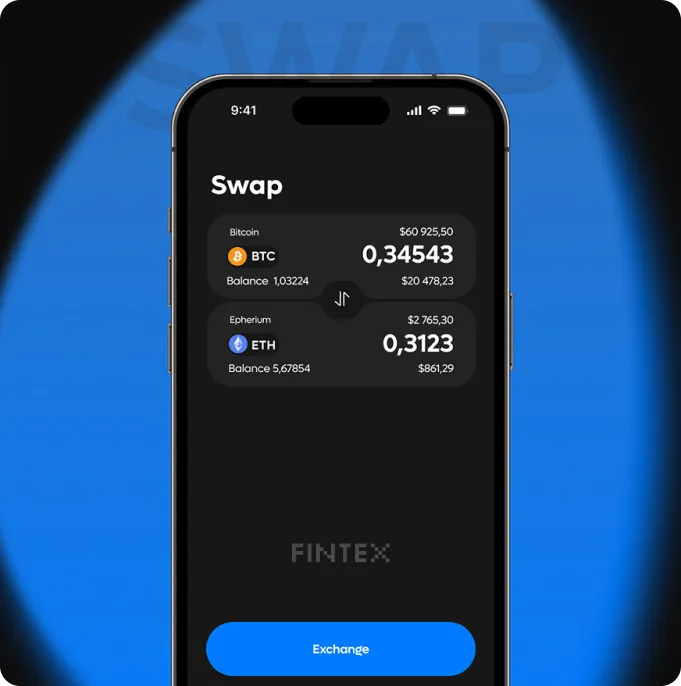
Our own self-custody wallet supports any coin or token on its integrated chains, with DeFi access, fiat-to-crypto purchases, cross-chain transactions and real-time portfolio tracking. Brands use it as the starting point for a white label launch.

 Blockchain for real estate, Dubai
We combined AR/VR with blockchain integration to create an immersive experience for Dubai's premier real estate market, laying the groundwork for tokenized property ownership and wallet-based transactions.

Compliance by region
The rules depend on where your users are and whether you hold their funds. We build the compliance features each market expects and work alongside your legal counsel on licensing.

MiCA is now fully in force. If you hold user funds or run exchange services, you need authorization from a national regulator, and Travel Rule data must travel with every transfer.
 ESMA / MiCA

The US has no single crypto license. Custody or exchange activity usually triggers FinCEN registration plus state licenses, while pure self-custody software often sits outside them.
 FinCEN

Dubai and Abu Dhabi run dedicated virtual asset regimes. The right license depends on which emirate you operate from and which services you offer.
 VARA
 ADGM
 CBUAE

Singapore licenses digital payment token services under the Payment Services Act and enforces strict AML and Travel Rule notices.
 MAS

UK crypto businesses register with the FCA under the Money Laundering Regulations, and every crypto promotion has to follow the financial promotion rules.
 FCA

Virtual digital asset service providers register with FIU-IND and follow PMLA reporting and record-keeping duties.
| Obligation | Custodial wallet | Non-custodial wallet |
|---|---|---|
| License or registration | Usually required | Often not required for pure self-custody software |
| KYC and AML | Required | Needed once you add on-ramps or custodial features |
| Travel Rule | Required on transfers you process | Not directly, unless you run custodial or exchange services |
| Sanctions screening | Required | Strongly recommended |
| Global standards | FATF R.16, SOC 2, ISO 27001, CCSS | OWASP MASVS, CCSS for key handling |
Pricing
Most projects fall between $15,000 and $400,000 or more. The custody model, number of chains, security audits and compliance scope drive most of the difference. Budget another 15 to 20% of the build cost each year for maintenance.
For teams that want to be live in weeks on a proven wallet core.
For funded startups whose wallet is the core of the product.
For products adding staking, dApps and cross-chain movement.
For exchanges, fintechs and institutions holding user funds.
10 to 12 weeks. iOS and Android apps, 3 chains of your choice, send, receive, swap and buy, fiat on-ramp, admin panel, security testing, store release and 30 days of post-launch support.
How we work
A clear process keeps budgets predictable and surprises small. Here is how a typical build runs, with the time each step usually takes.
Workshops on users, markets, custody model and revenue. We map the rules that apply and turn it all into a scoped backlog and estimate.
Wireframes, a clickable prototype and the technical plan: chains, nodes, services and integrations.
Seed, MPC or smart account, threat modeling, recovery flows and access policies.
Two-week sprints with a demo at the end of each. Mobile, web, backend and smart contracts are built in parallel.
Functional, device and load testing, plus penetration testing and smart contract review.
Production deployment, App Store and Play Store submission, monitoring and a staged rollout.
SLA-backed support, new chains, new features and security updates as the market moves.
Share your idea and get a feature-level estimate, a suggested architecture and a realistic timeline. It is free, and we sign an NDA first if you need one.
Engagement models
Pick the model that fits your scope and how involved you want to be. You can switch models as the project grows.
Scope, price and timeline are agreed up front. Changes go through a simple change request, so there are no surprises on the invoice.
Pay for the hours worked, with weekly reports and full control over what the team builds next.
Crypto wallet developers, QA engineers and a project manager working only on your product, managed by you or by us.
Start with a fixed-price first release, then move to a dedicated team for new features once you have users.
Technology and integrations
Blockchain wallet development touches a lot of moving parts. These are the networks, tools and partners we work with most, and we add others whenever a project calls for them.
Bitcoin, EVM chains, Solana and more behind one internal API, with new networks added as configuration.
 Bitcoin
 Ethereum
 Solana
 BNB Chain
 Polygon
 Tron
 TON
 Avalanche
 Arbitrum
 Optimism
 Base
 zkSync
 Starknet
 Cardano
 Polkadot
 XRP Ledger
 Stellar
 Hedera
 Aptos
 Sui
 NEAR
 Cosmos
 Lightning Network
Fungible, non-fungible and permissioned token formats across the chains we support.
ERC-20ERC-721ERC-1155ERC-3643ERC-4337EIP-7702BEP-20SPLTRC-20BRC-20TON JettonsLanguages, frameworks and client libraries used to write, test and connect wallet logic.
 Solidity
 Rust (Solana)
 Move (Aptos, Sui)
 Hardhat
 Foundry
 OpenZeppelin
 ethers.js
 viem
 web3.js
 bitcoinjs-libSolana web3.js
 WalletConnect
Native and cross-platform toolkits for iOS, Android, web wallets and browser extensions.
 Swift
 Kotlin
 Flutter
 React NativeReact
 Next.js
 TypeScript
Services, cloud and key infrastructure that sign, store and monitor safely.
 Node.js
 GoRust
 Python
 AWSKMS, CloudHSM
 Google Cloud
 Docker
 Kubernetes
 Terraform
 HashiCorp Vault
Let users buy and sell crypto with cards, bank transfers and local payment methods.
 MoonPay
 Transak
 Ramp Network
 Banxa
Identity checks, wallet screening and Travel Rule messaging for regulated wallets.
 Sumsub
 Onfido
 Jumio
 Chainalysis
 TRM Labs
 Elliptic
 Notabene
Best-price routing across DEXs and bridges, plus reliable price and market data.
 1inch
 0x
 Jupiter
 LI.FI
 Chainlink
 Pyth
 CoinGecko API
Node providers, institutional custody and wallet connection standards.
 Alchemy
 Infura
 QuickNode
 Fireblocks
 BitGoWalletConnect
Crypto cards with issuing partners, plus the local rails and wallets users already trust.
 Marqeta
 Baanx
 Rain
 Visa
 Mastercard
 SEPAEurope
 ACHUnited States
 Faster PaymentsUnited KingdomUPIIndia, via licensed partners
 PIXBrazil
 Apple Pay
 Google Pay
Why Code Brew Labs
You are trusting a partner with your users' money and your brand. Here is what you get when that partner is us: a team that has shipped over 100 wallets and stays with you after launch.
Talk to a Wallet ArchitectBlockchain engineers, designers and QA specialists on our own payroll. The people you meet on the first call build your product.
Threat modeling, secure key storage and testing are part of every sprint, not a checkbox at the end.
KYC, AML screening, Travel Rule and reporting modules are designed in from day one, ready for your licensing process.
We know what Apple and Google look for in crypto apps and prepare for review long before submission.
Full source code and IP transfer on custom projects, with an NDA signed before any detailed discussion.
SLA-backed maintenance, monitoring and upgrades as chains, operating systems and regulations change.
Founders stay with us for years. Here is how some of them describe working with our team.
 Video review
“I’ve been in business for 45 years and very seldom do I come across people like them who actually do what they say they’re going to do.”

 Video review
“I think Code Brew is passionate enough about what we’re doing and really wants to help grow and support that. I think that’s why our relationship has lasted as long as it has and continues to do so.”

 Video review
“We hired Code Brew about six years ago to help rebuild every aspect of an emergency app we created. The staff was friendly, courteous, and very professional. We continue to work together on several other projects.”

 Video review
“Codebrew Labs was an excellent partner to work with on the Safecity mobile app. The team was very attuned to our needs, worked in tandem with our team, was open to suggestions and did a quality job whilst adhering to timelines.”

 Video review
Recognition








Speak to a wallet architect. We will answer your questions about custody, licensing and budget on a free 30-minute call.
It designs, builds and launches the apps people use to store, send and manage digital assets.
That covers product strategy, UX design, key management, blockchain integration, security testing, compliance features and the app store release. A good partner also maintains the wallet after launch, adding chains and fixing security issues as the ecosystem changes.
Most projects fall between $15,000 and $400,000 or more.
White label wallets start around $15,000, custom MVPs cost $30,000 to $60,000, multi-chain DeFi wallets $60,000 to $150,000, and enterprise custodial or MPC platforms $150,000 and up. Budget another 15 to 20% of the build cost each year for maintenance.
A white label wallet can launch in 3 to 6 weeks.
A custom MVP takes 2 to 4 months, a multi-chain wallet 4 to 7 months, and an enterprise platform 6 to 12 months. Security testing and app store review add 2 to 4 weeks, and we plan for both from the start.
Choose white label if speed matters most and your needs match a standard wallet.
Choose custom if the wallet is your core product or needs features nobody else offers. Choose Wallet-as-a-Service if you only need to embed a wallet in an existing app and are comfortable with a provider's limits and monthly fees.
An MPC wallet splits the private key into shares that sign together without ever rebuilding the full key.
Multisig uses several separate keys that each approve on-chain. Both remove single points of failure. MPC works on almost any chain and looks like a normal transaction, while multisig is more transparent on-chain but costs more in fees and depends on chain support.
We support Bitcoin, Ethereum and Layer 2 networks such as Arbitrum, Optimism and Base, plus Solana, BNB Chain, Polygon, Tron, TON, Avalanche and more than 10 other networks.
Token support includes ERC-20, ERC-721, ERC-1155, BEP-20, SPL, TRC-20 and BRC-20. New chains can be added after launch.
We protect keys with secure device hardware, MPC or HD wallet standards and HSM-backed servers.
Transactions can be simulated before signing, risky addresses are flagged, and infrastructure is encrypted and monitored around the clock. Each release passes code review, automated scans and penetration testing before it reaches users.
It depends on custody.
If you hold user funds or run exchange services, you will usually need a license, such as MiCA CASP authorization in the EU, FinCEN MSB registration plus state licenses in the US, or a VARA license in Dubai. Pure non-custodial wallet software is often outside these rules. Always confirm with local counsel.
You do.
On custom projects we transfer full source code and intellectual property once the project is paid for, and we sign an NDA before any detailed discussion. White label projects come with a source code option, so you are not locked into us for future development.
Yes.
Our crypto wallet development services include SLA-backed support plans that cover monitoring, bug fixes, security patches, OS updates, new chains and new features. Many clients keep a small dedicated team with us after launch so they can keep shipping improvements.
Level- 18, Dubai World Trade Centre Tower, Sheikh Rashid Tower, Sheikh Zayed Rd, Dubai, UAE
Plot no I - 36, Sector 83 Alpha, Mohali SAS Nagar 140308
Av. Miguel Hidalgo y Costilla 1995, Arcos Vallarta, 44600 Guadalajara, Mexico
4231 Balboa Ave #512 San Diego, CA 92117 United States
2nd floor, College House, 17 King Edwards Rd, London HA4 7AE, UK
Partner With Experts Who Leverage AI & Tech To Transform Ideas Into Market-Leading Solutions.


