Table of Content

Key Takeaways:
Table of Content
- Software development for startups costs 40-60% less when outsourced as compared to building in-house
- Around 90% of start-ups fail, and poor software decisions are a major contributing factor
- MVPs typically take 8–16 weeks to build and cost between $20,000–$60,000 depending on complexity and region
- The #1 reason start-ups fail is building software nobody actually needs 42% of cases, per CB Insights
Every founder has a moment where they think: “If I could just get the software built, everything else would fall into place.”
It’s an understandable thought. But it’s also the thought that leads a lot of start-ups off a cliff.
The data is blunt. Roughly 90% of start-ups fail, with 70% shutting down before their fifth year. And when you look at why, nearly 42% collapse not because of poor execution, but because they built something the market never actually wanted.
That’s not a development problem. That’s a strategy problem disguised as one.
Software development for start-ups is different from building software at an established company. The budgets are smaller, the timelines are tighter, the stakes are higher, and every technical decision has compounding consequences.
The team structure that works beautifully for a 500-person company will bleed a bootstrapped founder dry.
This guide covers everything a first-time or repeat founder needs to know: when to build, how to build, what to build first, what it should cost, and how to avoid the technical mistakes that quietly kill otherwise great ideas.
It is also, frankly, the guide we wish more of our clients had read before they came to us.
Not Sure Where to Start With Your Startup’s Software?
What Makes Start-up Software Development Different
Start-ups and enterprises both write code. That’s where the similarity ends.
An enterprise runs on known variables. They have a customer base, predictable revenue, and time to plan carefully. They can afford to build exactly right. Start-ups, by contrast, operate almost entirely on uncertainty.
They are testing whether a problem is real, whether their solution fits that problem, and whether anyone is willing to pay for it — all at the same time.
This changes everything about how software should be built.
Speed matters more than perfection. Flexibility matters more than architecture purity. Validation matters more than features. Where an enterprise might spend six months defining requirements before writing a line of code, a start-up that does the same is probably already dead by the time they ship.
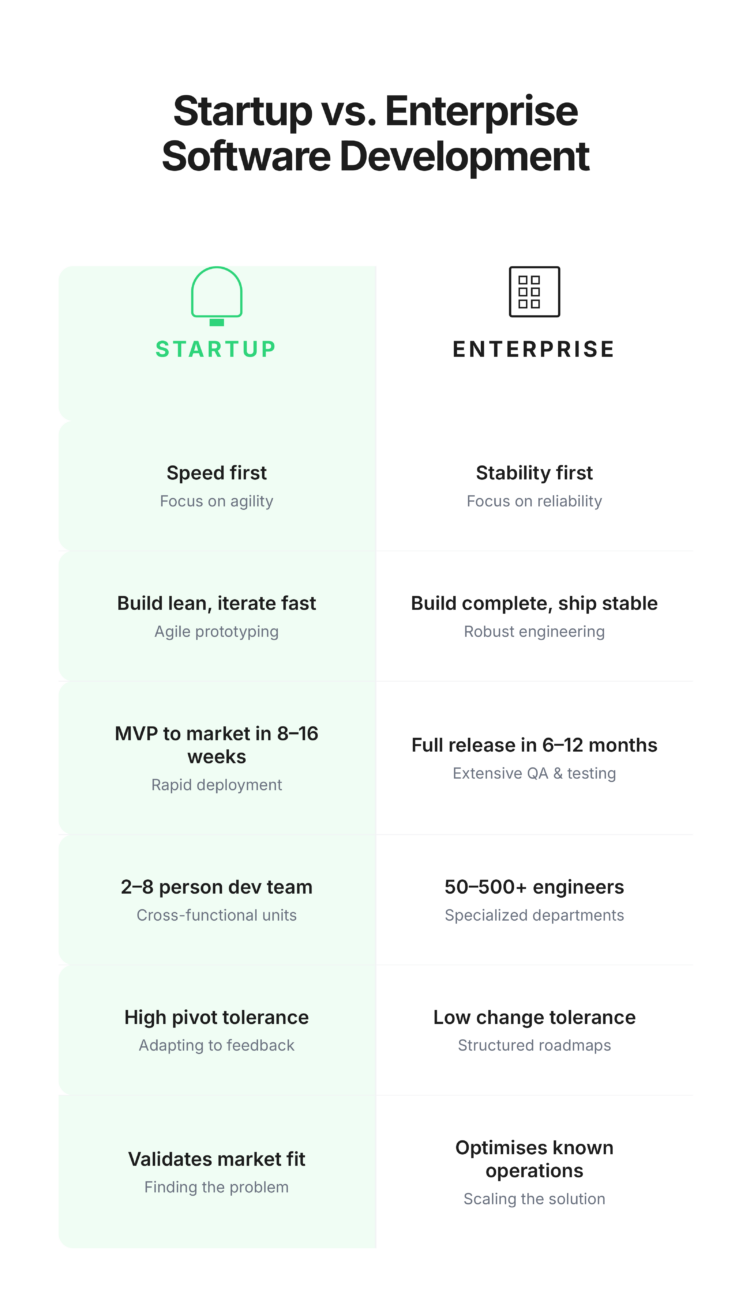
The table below captures the most important differences:
| Dimension | Start-up | Enterprise |
| Primary goal | Validate a hypothesis | Optimize a known operation |
| Risk tolerance | High pivots are expected | Low stability is required |
| Budget | Constrained, often burn-based | Allocated, often departmental |
| Timeline | Weeks to first version | Months to first release |
| Technical debt | Acceptable early; managed over time | Avoided from the start |
| Team size | 2–10 developers | 50–500+ |
| Decision speed | Fast, often founder-driven | Slow, committee-driven |
The moment founders understand this difference clearly, their software decisions get better. They stop trying to build the enterprise version of their product before they have a single paying customer.
The Funding Stage Framework: What to Build When
Most development companies tell you what software phases exist. They don’t tell you which phase you should be in based on where you are financially.
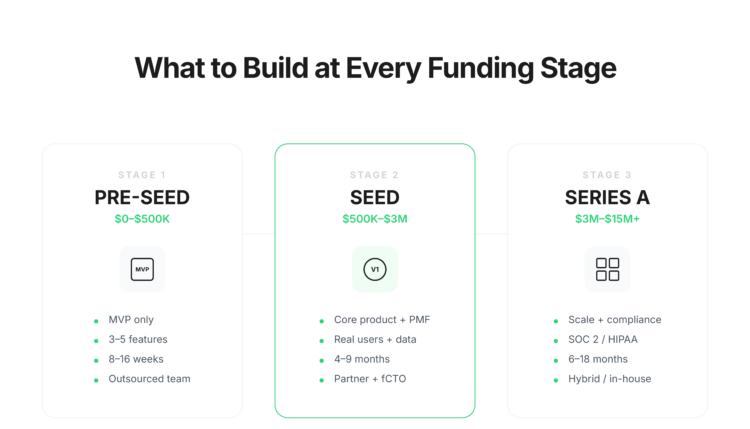
Pre-seed / Bootstrapped ($0–$500K):
Goal: Prove the idea. Nothing else.
What to build: MVP only. Three to five core features. No admin dashboard, complex integrations, and scalability architecture. You don’t need it yet, and building it will cost you weeks you don’t have.
What not to build: Anything you can’t validate with 50 users. If a feature can’t be tested in the first sprint review, it belongs on the backlog, not the roadmap.
Timeline: 4-6 weeks. If it’s taking longer, the scope has crept.
Right team model: Small outsourced team or a specialized startup development firm. A 3-month hiring process for a founding engineer is common. If you’re pre-seed, you likely don’t have that time or that runway.
Seed ($500K–$3M):
Goal: Validate product-market fit and start building the technical foundation.
What to build: Core product with real users, early data infrastructure, basic DevOps pipeline.
What not to build: Engineering team of 10. You don’t need it yet. Timeline: 4–9 months to a market-ready V1.
Right team model: Development partner plus fractional CTO, or a small in-house team of 2–3 engineers augmented by specialists.
Series A ($3M–$15M+):
Goal: Scale what’s working. Build the platform, not just the product.
What to build: Scalable architecture, proper CI/CD, security compliance (SOC 2, HIPAA as relevant), and documentation for technical due diligence.
Right team model: Mixed in-house and extended team. If outsourcing, you should have a structured handoff plan to in-house as you grow.
The methodology you use to build should also match this stage.
Before You Write a Single Line of Code
The most expensive mistake in start-up software development is building before validating. And it happens constantly.
Here is a useful way to think about it: software is the most expensive form of validation. A user interview costs nothing. A prototype built on Figma costs days, not months.
A landing page that pre-sells a product costs a few hundred dollars and a week of effort. If any of these simpler methods can tell you whether your idea has legs, use them first.
The validation stack, from cheapest to most expensive:
- Conversations — Talk to 20–30 potential users. Ask about their current problem, not about your solution. This is free and takes a week.
- Surveys and online listening — Mine Reddit, Quora, and LinkedIn groups. Find out what your target users complain about. Still free.
- Landing page test — Build a simple page that describes your product, put a “Join Waitlist” or “Buy Now” button on it, and drive targeted traffic to it. If nobody clicks, that’s a signal. If hundreds sign up, that’s also a signal. Cost: $300–$1,000.
- Wizard of Oz test — Simulate the experience manually before automating it. Dropbox famously validated demand with a demo video before building a single feature. Buffer validated pricing via a landing page before writing any code.
- No-code / low-code prototype — Tools like Bubble, Webflow, and Glide can get you to a functional demo without custom engineering. Useful for getting early customers and investor conversations. Cost: $500–$5,000.
- MVP — Only once the above have given you confidence should you invest in custom software development.
This approach doesn’t just save money. It produces better software, because by the time you’re writing real code, you know which features actually matter.
According to Startup Genome, 90% of start-ups run out of money or end up targeting the wrong market due to a lack of customer research.
Skipping validation doesn’t speed things up — it just moves the failure later and makes it more expensive.
The MVP: What It Is, What It Isn’t, and Why It Matters
The phrase “Minimum Viable Product” gets used so loosely in the start-up world that it has almost lost its meaning. Some founders treat it as an excuse to ship something broken. Others use it as permission to skip features users actually need. Neither is right.
A proper MVP is a version of a product with just enough features to be usable by early customers who can then provide feedback for future product development, as the concept was originally framed by Eric Ries.
The point isn’t to ship something fast. The point is to learn something specific with the least possible investment.
In practice, MVPs typically take between 8 and 16 weeks to build and cost anywhere from $20,000 to $60,000, depending on complexity, the region of development, and the technology stack involved.
A few things that make MVPs fail that most founders don’t expect:
- Overbuilding — Adding features “just in case” before anyone has asked for them
- Wrong success metric — Measuring downloads instead of retention, or sign-ups instead of actual usage
- Not talking to users after launch — Shipping and waiting, rather than shipping and engaging
- Treating MVP as the final product — Forgetting that the whole point is to iterate
Airbnb’s first version was a website with photos of an apartment. Dropbox’s MVP was a demo video. Zappos validated its idea by manually fulfilling orders before building any e-commerce infrastructure. These were not polished products — they were deliberate experiments.
Also watch Our Video:
MVP vs. Full Product: Which Does Your Startup Actually Need?
An MVP is not a bad version of your product. It is a deliberately scoped version built to answer one question: Does the market want this?
Startups defaulting to full-product builds before validating demand is one of the most common and expensive mistakes in software development. An MVP is not a rough draft.
It’s a precision instrument. Its job is to generate the fastest possible answer to your most important assumption with the least possible investment.
When an MVP is the right call:
- You’re pre-seed or early-seed with unvalidated demand
- You have less than 18 months of runway
- Your core assumption can be tested with 3–5 features
- You are willing to talk to users within the first two weeks of launch
When a full product makes more sense:
- You’re entering a regulated vertical (healthcare, fintech) where a bare MVP creates compliance exposure
- You already have validated demand, previous business, pilot customers, and LOIs on the table
- You’re competing directly against established players, where a thin product will be immediately dismissed
The single-question MVP test: Before building, write down the one question your MVP must answer. If your feature list doesn’t directly support answering that question, cut it.
But time savings mean nothing if the MVP doesn’t test the right assumption. Speed without clarity is just expensive noise.
MVP vs. Full Product Decision Matrix
| Situation | Build MVP | Build Full Product |
| Demand Unvalidated | ✅ | ❌ |
| Runway Under 18 Months | ✅ | ❌ |
| Regulated Vertical (HIPAA, PCI) | ❌ | ✅ |
| Pilot Customers/LOIs Signed | ❌ | ✅ |
| First-time founders/ Idea Stage | ✅ | ❌ |
What’s the Right Software Development Methodology for Startups?
The right methodology depends on what you’re building and how much you know about what users actually need.
Three approaches are worth understanding:
Agile/Scrum
Best for: Products where user feedback will change the spec, which describes most early-stage startups.
Trade-off: Requires active founder involvement in sprint reviews. If you can’t dedicate time to the process, Scrum breaks down fast.
Timeline impact: Ships in 2–4 week increments. Allows rapid course correction after each sprint. This is the structure that prevents six-month builds that miss the market.
Lean Development
Best for: Very early stage, where you are still defining the product, not building it.
Trade-off: Requires discipline to stay lean. “Just one more feature” is the enemy of lean methodology, and it creeps in constantly.
When to use it: When you have less than $150K and 90 days to validate.
Shape Up (Basecamp Methodology)
Best for: Seed-stage teams that have found initial traction and want to ship bigger features without endless sprint cycles.
Trade-off: Less flexible mid-cycle. Requires strong product thinking before development begins.
Practical recommendation: Start with Lean for idea validation, move to Agile once you’re building V1, and consider Shape Up post-product-market fit. Don’t get religious about it.
Methodology Decision Guide
| Stage | Recommended Methodology | Sprint Cycle | Best When |
| Pre-seed / idea validation | Lean Development | No fixed sprint | < $150K, < 90 days |
| MVP build | Agile / Scrum | 2-week sprints | Feedback will reshape spec |
| Post-PMF growth | Agile or Shape Up | 2–6 weeks | Known product, larger features |
| Series A scale | Agile + structured DevOps | 2-week sprints + CI/CD | Compliance, team growth |
Software Design Focus: UX Is Not Optional
One of the most consistent mistakes in start-up software is treating UX design as something you add after the product is built. The attitude is usually: “We’ll clean it up later.” Later usually never comes, or comes after you’ve already lost your first wave of users.
68% of start-ups that neglect mobile optimization fail, according to compiled industry research. That’s a staggering number for one variable. And mobile optimization is just one slice of the broader UX picture.
Good UX in a start-up context does not mean expensive UI design. It means three things:
Users can complete their core task without help. The primary user journey should require no instruction, no tutorial, and no manual. If people need help to use your product, your product has a problem.
The product loads fast and works on the device your users actually have. “Works on my laptop” is not a UX standard.
First-time users understand what the product does within 10 seconds. If a new user cannot answer “what does this do and why should I care” in under ten seconds on the home screen, something has gone wrong.
The best start-up software designers think like the user, not the engineer. They obsessively remove friction rather than adding features. Every additional step in a user flow is a place where someone can leave. The shorter the path to value, the better.
Startups are not the only businesses that benefit from thoughtful UX. Established companies also need digital products that are simple to use, fast to navigate, and built around customer needs. Whether you are launching a new platform or improving an existing one, investing in UX design for companies in Sharjah and beyond helps reduce user friction, improve customer satisfaction, and increase conversions.
The core principles remain the same regardless of business size. Understand user behavior, simplify every interaction, and validate design decisions through testing.
Companies that treat UX as an ongoing business strategy rather than a one-time design task are more likely to retain users and achieve long-term growth.
How to Choose Your Technology Stack in 2026
The technology stack question makes first-time founders disproportionately anxious. The reality is: the wrong technology stack rarely kills a start-up. The far more common killers: no market, no revenue, no team cohesion, kill start-ups long before the technology becomes a constraint.
With that said, good stack choices in the early stages make your life meaningfully easier. Here’s a practical framework:
Ask these questions before picking a stack:
- What does my team already know? The best technology is the one your developers are already proficient in. A team that knows Python well will build faster in Python/Django than in an unfamiliar framework, regardless of what the internet says is trendy.
- What’s the standard in my industry? Healthcare applications have different requirements from e-commerce platforms. Fintech has different compliance needs than social media. The industry shapes the appropriate tooling.
- What does “scalable” actually mean for me right now? Most early-stage start-ups don’t need to handle a million concurrent users. They need to handle twenty. Architecting for massive scale on day one is over-engineering — it adds complexity, slows development, and costs money you don’t have.
- Can I find and hire developers in this stack? React developers are easier to find than niche framework specialists. This matters as soon as you need to grow your team.
A practical starting point for most start-ups in 2026:
- Frontend: React or Vue.js — both are mature, well-supported, and widely available
- Backend: Node.js (JavaScript), Python (Django/FastAPI), or Ruby on Rails — all fast to develop in, all with strong ecosystems
- Mobile: React Native for cross-platform if budget is a constraint; Swift/Kotlin for native if performance is critical
- Database: PostgreSQL as the general default; MongoDB if data is highly unstructured
- Cloud infrastructure: AWS, Google Cloud, or Azure — all fine; pick the one where your team has experience or where your target market has data residency requirements
- AI/ML features: Python-based with cloud APIs (OpenAI, Anthropic, Google AI) for most use cases; purpose-built ML infrastructure only if that is literally what your product does
The one thing to avoid: choosing a stack because it’s what a large company uses. The stack that makes sense for Netflix or Meta was shaped by their specific problems at their specific scale. Your problems are different.
Tech Stack Recommendations by Startup Type
| Startup Type | Frontend | Backend | Database | Mobile |
| Web SaaS / B2B | React | Node.js or Python | PostgreSQL | React Native |
| Consumer mobile-first | React or Vue | Node.js | PostgreSQL | React Native / Flutter |
| Data / ML product | React | Python + FastAPI | PostgreSQL + Redis | N/A typically |
| Marketplace/transactions | React | Node.js | PostgreSQL + Redis | React Native |
| Healthtech / regulated | React | Python or Node.js | PostgreSQL | React Native |
Building Your Development Team: The Real Options
This is where start-up founders spend the most time debating, and often reach the wrong conclusion through the wrong reasoning.
There are three primary models:
In-house team:
You hire developers directly, they work exclusively on your product, and you manage them as employees. The advantages are control, deep context, and long-term alignment. The disadvantages are cost, time-to-hire, and the permanent overhead that comes with headcount.
Building in-house costs approximately 2.7x a developer’s base salary when all overhead — benefits, equipment, management time, office space — is included.
Outsourced/external development partner:
You work with an external agency or team, typically on a defined scope or ongoing engagement. Outsourcing can reduce software development costs by 40–60% compared to in-house teams</a>, with hourly rates varying considerably by region, from around $25–$50/hour in South and Southeast Asia to $75–$120/hour in Eastern Europe to $100–$200/hour in North America.
The tradeoff is less direct control and a communication overhead that requires active management.
Hybrid model:
Keep a small in-house team for strategy and product ownership, while outsourcing implementation and specialist work. This is increasingly common among start-ups that have found product-market fit and are in a scaling phase.
The decision framework is simpler than most founders make it:
- Pre-product-market fit (idea to first 50 customers): Outsource to a trusted partner, or work with a small in-house team if you have co-founders with technical expertise. Speed matters most at this stage. Permanent headcount is a drag on the runway.
- Post-product-market fit (scaling): Gradually shift toward in-house for core product decisions, while maintaining external partners for specialist capabilities (security audits, AI/ML work, platform-specific development).
The worst outcome is spending six months trying to hire a CTO before you have any product to show them. Hire to build, not to plan.
How to Choose a Software Development Company for Your Startup?
Checking portfolios and reading reviews are necessary but not sufficient. Here is the actual evaluation framework.
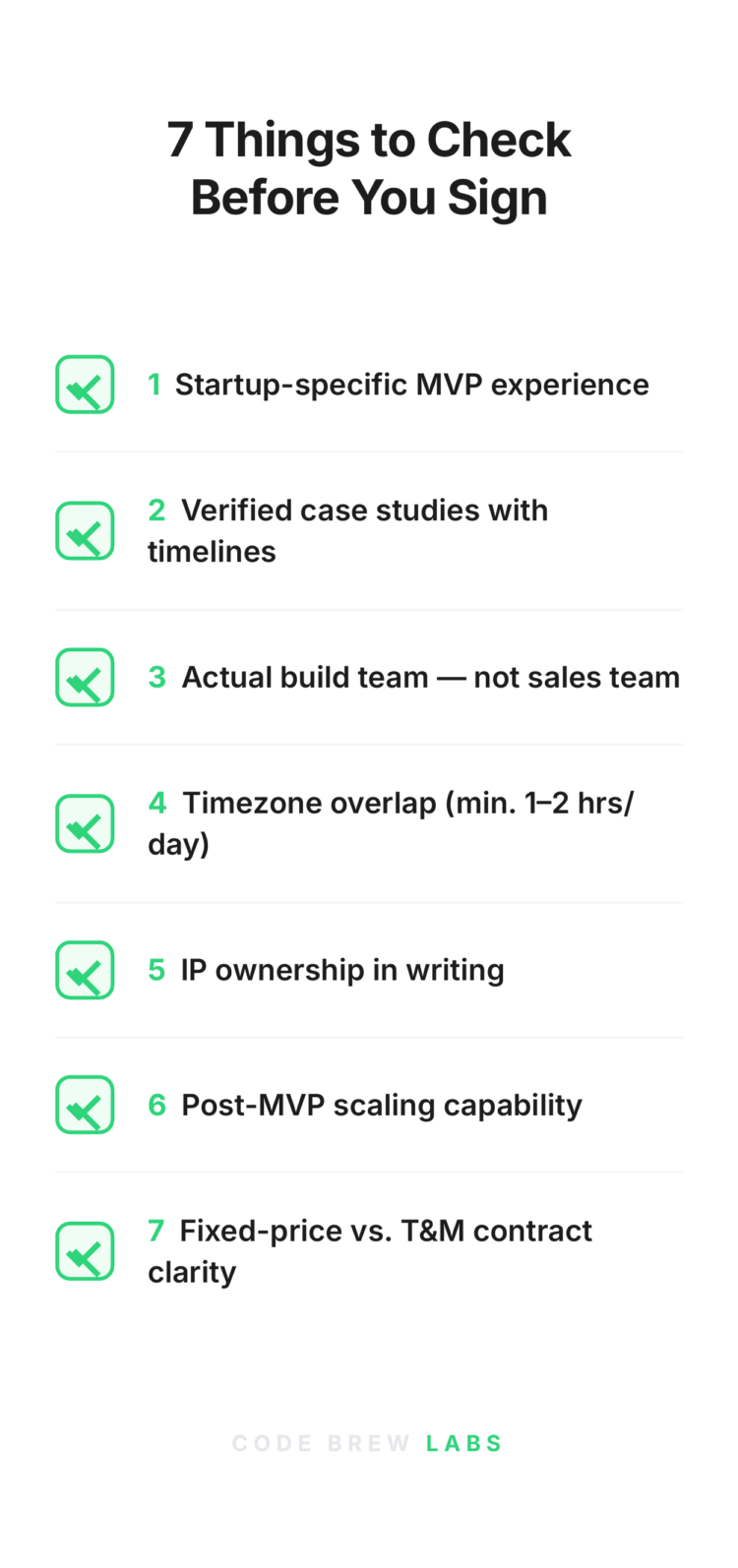
7-point vetting framework:
- Startup-specific experience, not just volume. A firm that has built enterprise ERP systems for Fortune 500 companies is not the same as one that understands runway constraints, investor timeline pressure, and MVP discipline. Ask specifically: “What’s the smallest product you’ve shipped from zero to live, and how long did it take?”
- MVP track record with verifiable timelines. Get specific case studies with timelines. “We build fast MVPs” is a marketing claim. “We shipped a functional MVP for [client] in 11 weeks” is verifiable. Ask for references you can call.
- Who actually builds your product. Senior engineers often pitch; junior engineers often build. Ask: “Who will be coding on my project?” Get the actual team in front of you before signing.
- Communication model and timezone overlap. Timezone overlap matters more than most founders realize. One to two hours of daily overlap with your development team is the minimum for an Agile process to function. Understand their sprint review cycle, how decisions get escalated, and how scope changes are handled.
- IP ownership clarity. This must be in writing before work starts. You want a full IP assigned to your company upon final payment. Any ambiguity here becomes a due diligence issue when you raise your next round.
- Post-MVP capability. Many firms are good at MVPs. Far fewer are equipped to scale with you. If you’re planning to raise and grow, understand what the firm can and cannot deliver at Series A scale before you’re mid-build and dependent on them.
- Cost structure transparency. Understand whether you’re on a fixed-price or time-and-material. Know what the change order process looks like. Scope creep is the most common source of budget overrun — and it almost always starts with ambiguous contract terms.
Software Development Costs for Start-ups: What to Actually Expect
Cost is the question every founder asks first, and most developers answer last. Let’s be direct.
MVP development: $20,000–$60,000 for a typical build. This range depends on complexity (a simple two-sided marketplace is more expensive than a single-function utility), team location, and whether design is included.
A basic utility app might come in under $20,000 with an experienced offshore team. A complex fintech MVP with compliance requirements might run closer to $80,000–$100,000.
Full product (post-MVP): $75,000–$300,000+, depending on the scale of features, integrations required, and the team model. Costs can run from $40,000 for simple projects to over $500,000 for complex applications; that range is accurate and not unusual.
Monthly ongoing development (post-launch): $8,000–$30,000/month, depending on team size and engagement model. A start-up maintaining and iterating its product will typically need 2–3 developers minimum.
Software Development Cost by Funding Stage
| Stage | Scope | Typical Cost Range | Timeline |
| Pre-seed MVP | Core features, 1 platform | $25,000–$75,000 | 8–16 weeks |
| Seed V1 | Full product, mobile + web | $75,000–$200,000 | 4–9 months |
| Series A build-out | Scalable platform + compliance | $200,000–$500,000+ | 6–18 months |
What drives cost up:
- Complex integrations with third-party systems (payment gateways, healthcare APIs, banking infrastructure)
- Regulatory compliance requirements (HIPAA, GDPR, PCI DSS)
- Multiple platforms at launch (iOS + Android + Web simultaneously)
- Real-time features (chat, live dashboards, video)
- AI/ML custom development
What keeps costs down:
- Starting with web-only (cross-platform later)
- Ruthless scope control on the MVP
- Well-defined requirements before development starts
- Choosing an outsourced partner over an in-house one at an early stage
- Avoiding premature optimization for scale
One number worth keeping front of mind:
Hidden costs can increase the total software development budget by 20–60% if projects and teams are managed poorly.
The companies that blow their development budget usually don’t do it by building the wrong features — they do it through scope creep, poor requirement definition, and changing direction mid-sprint without counting the cost of rework.
Not Sure Which Development Model Fits Your Funding Stage?
The Phases of Software Development for Start-ups
Regardless of methodology, every software product passes through recognizable phases. Understanding these phases helps founders know what to prioritize at each stage.
Phase 1: Discovery and Definition (2–4 weeks)
This is where the product is scoped. What problem are we solving? Who specifically is the user? What does the user need to be able to do on day one? What does success look like in six months?
A good discovery phase produces a product brief, user personas, a feature priority list, and an initial technical architecture.
This phase is often rushed or skipped entirely. It is the most valuable investment you can make, because decisions made here cost almost nothing to change. Decisions made in Phase 4 cost a fortune.
Phase 2: Design and Prototyping
UI/UX design converts the brief into actual screens. Wireframes first, then visual design, then a clickable prototype.
The prototype should be tested with real target users before any development begins.
Finding a major UX problem at the prototype stage costs a day of designer time. Finding the same problem after a developer has built it costs a week of an engineer’s time to undo.
Phase 3: MVP Development
The actual build. Ideally structured as two-week Agile sprints. At the end of each sprint, working features are demonstrated and reviewed.
This is not the time to add features — it’s the time to build exactly what was defined and test it ruthlessly.
Phase 4: QA and Testing
Quality assurance is not optional. It is also not just about finding bugs — it includes performance testing (does it work under load?), security testing (is user data protected?), and usability testing (do real users actually use it correctly?).
Skipping QA is the start-up equivalent of sending a first draft of an important contract without reading it.
Phase 5: Launch and Iteration (Ongoing)
Launch is not the end — it’s the beginning of the feedback loop. The first two weeks after launch are the most data-rich period in a product’s history.
Users who are struggling, features nobody is using, flows that are confusing — all of this surfaces immediately if you are watching.
The start-ups that do well after launch are the ones that treat those first two weeks as a research sprint, not a celebration.
What Does Investor-Ready Start-up Software Actually Look Like?
Raising a seed or Series A round means your technical architecture will face scrutiny — either from technical advisors on the investment team or in a formal technical due diligence process. Most founders don’t know what investors actually look at. Here it is.
What VCs and technical due diligence advisors evaluate:
Code ownership and IP assignment. Is all IP assigned to the company, not to individual contractors? This is the first thing an investor’s technical advisor checks.
Test coverage. No serious investor wants to fund a product with zero automated tests. Aim for 60%+ coverage on core functionality. Below that, expect questions.
Security fundamentals. Authentication, authorization, encrypted data at rest and in transit, no hardcoded credentials. These are table stakes, not differentiators.
Scalability architecture. Can this system handle 10x the current load without a rewrite? Cloud-native infrastructure matters here.
Documentation. Architecture decisions, API documentation, and onboarding docs. Absence of documentation signals technical risk — specifically, key-person dependency risk.
Technical debt honesty. Investors know early-stage products carry technical debt. What they’re looking for is whether the team knows where it is and has a plan for it.
Practical recommendation: Before your Series A due diligence process, commission a third-party technical audit. It costs $5,000–$15,000. It tells you what investors will find before they find it.
Addressing issues proactively is meaningfully better than discovering them in a data room.
Investor-Ready vs. Not-Ready Technical Checklist
| Criteria | Investor-Ready | Red Flag |
| IP assignment | Company owns all code | Contractor retains IP rights |
| Test coverage | 60%+ on core features | Zero automated tests |
| Security | Encrypted data, proper auth | Hardcoded credentials found |
| Scalability | Cloud-native, 10x headroom | No scaling plan or monolith |
| Documentation | Architecture + API docs present | Only in one engineer’s head |
| Technical debt | Known, mapped, planned | Unknown or denied |
AI-Integrated Development for Start-ups: What Actually Matters in 2026
AI has changed the software development landscape for start-ups in two distinct ways, and it’s worth being clear about both.
- AI as a development tool
AI-assisted coding tools (GitHub Copilot, Cursor, and similar) meaningfully accelerate certain types of development work — boilerplate code, test writing, documentation, repetitive refactoring.
They are not a replacement for engineering judgment, and they do not eliminate the need for experienced developers.
But they do mean that a competent team can ship more in less time, which matters enormously for start-ups.
- AI as a product feature
Many start-ups in 2026 are building AI into their products directly, chatbots, recommendation engines, document analysis, predictive features.
AI startups attracted nearly $210 billion in venture capital in 2025, representing almost 50% of all venture funding globally. That number represents real investor conviction that AI is infrastructure for the next decade of software.
For start-ups embedding AI features: The practical advice is to use API-based AI services (OpenAI, Anthropic, Gemini) rather than building custom models from scratch.
Custom model training requires data you probably don’t have yet, ML expertise that’s expensive to hire, and time you cannot spare.
Call the API, build the product, and validate the use case. Custom models come later, if and when the data and resources justify it.
Common Mistakes First-Time Software Entrepreneurs Make
Some of these are obvious in retrospect. None is obvious when you’re in the middle of them.
Building in stealth for too long. The longer you build without showing anyone, the more assumptions accumulate — and the harder it is to hear the bad feedback that would have saved you six months of work.
Founders who launch something broken and iterate on real feedback consistently outperform founders who polish something for a year before showing it.
Hiring too fast after raising. Getting funded feels like the starting gun. Many founders immediately hire five developers.
The more effective pattern is to hire one exceptional developer and a product designer, move quickly through the next phase of validation, and hire the rest of the team once you know what you’re building.
Treating the spec document as a contract. Software requirements change. What seemed like a clear specification in week one looks different in week six, after you’ve spoken to users, seen the prototype, and rethought the core flow.
Teams that cannot adapt to changed requirements without a contract dispute are not the right fit for start-ups.
Measuring the wrong things. Vanity metrics, including downloads, sign-ups, and page views, are easy to accumulate and nearly meaningless on their own.
The metrics that matter are retention (do people come back?), engagement (are they using the core feature?), and conversion (are they paying?).
Not investing in documentation. Documentation feels slow when you’re moving fast. The cost of no documentation compounds over time — new team members take longer to ramp, engineers make decisions without context, and the institutional knowledge lives only in one person’s head.
Even rough internal documentation pays for itself within three months.
How Code Brew Labs Builds Software for Start-ups
Start-up software development requires a partner who can think like a founder — not just a vendor who executes a spec.
At Code Brew Labs, we work with start-ups from pre-MVP validation through scale. Our process begins with a discovery engagement that defines not just what to build, but whether to build it, and in what order.
We are not interested in building large things quickly if there’s a faster path to proving the idea.
We use a build model that matches where the start-up is in its journey. At the idea stage: fast, lean, focused on validation. Post-PMF: structured, scalable, process-driven.
We have delivered products across fintech, healthtech, e-commerce, logistics, and EdTech — and the lessons from each sector inform how we work in adjacent ones.
What distinguishes our work on start-up projects specifically:
- We design for pivot readiness from the start, modular architectures that can adapt as the product direction shifts
- We build with investor due diligence in mind, not just user experience — clean code, documented architecture, security-first
- Our project teams include a dedicated product owner on our side, not just developers, someone who pushes back if the scope is growing without justification
- We offer fixed-scope engagements for MVPs where predictability matters, and time-and-materials for ongoing product development where requirements evolve
If you’re a founder trying to figure out whether to build, what to build, or how to get unstuck from a development process that isn’t working, that conversation is always free.
We’ve Shipped Products From $30K MVPs to Series A Platforms.
Frequently Asked Questions
What is software development for start-ups?
Software development for start-ups refers to the process of designing, building, and iterating on technology products within the constraints typical of early-stage companies, limited budgets, uncertain requirements, and the need for speed. It prioritizes validation and adaptability over completeness, and typically uses agile or lean methodologies to reduce risk.
How much does it cost to develop software for a start-up?
The cost varies widely. A basic MVP generally ranges from $20,000 to $60,000. A more complex product with multiple integrations, compliance requirements, or multi-platform support can run from $75,000 to $300,000 or more. The primary cost drivers are scope, team location, and the amount of custom engineering required.
What is the best software development methodology for start-ups?
Most start-ups benefit from an Agile approach, typically using two-week sprints to deliver working features incrementally. The Lean Start-up’s Build-Measure-Learn cycle is an effective complement, particularly in the pre-product-market-fit phase. Scrum works well for teams of five to nine; Kanban works better for smaller teams or teams managing ongoing product work.
Should a start-up build software in-house or outsource it?
In the pre-product-market-fit phase, outsourcing to an experienced development partner is usually faster and more cost-effective than building in-house. Outsourcing can reduce development costs by 40–60% compared to in-house teams.
What is an MVP and why does it matter for start-ups?
An MVP (Minimum Viable Product) is the smallest version of a product that can be used to test a core hypothesis with real users. It matters because it allows start-ups to validate ideas before committing the full investment required to build a complete product. MVPs typically take 8–16 weeks to build and cost $20,000–$60,000, depending on complexity and the development partner.
What technology stack should a start-up use?
There is no universal answer — the right stack depends on the product type, the team’s existing skills, and the industry. That said, common starting points for 2026 include React or Vue.js for frontend, Node.js or Python for backend, React Native for cross-platform mobile, PostgreSQL for relational data, and cloud infrastructure on AWS, GCP, or Azure.
What security practices should start-up software follow?
Start-ups handling user data should implement data encryption in transit and at rest, use established authentication libraries rather than building their own, enforce role-based access control, keep dependencies regularly updated, and consider a penetration test before launch. Regulatory compliance (GDPR, HIPAA, PCI DSS) is required regardless of company size if the product falls within those domains.
How long does it take to build start-up software?
An MVP typically takes 6-8 weeks from start to launch, assuming requirements are well-defined before development begins. Full product development post-MVP varies considerably; most start-ups should plan for a continuous development cycle rather than treating software as a project with a fixed end date.
What do investors look for in start-up technology?
Investors look for a technical architecture that is explainable, scalable beyond current usage, secure and compliant, not dependent on a single person to maintain, and carrying manageable levels of technical debt. In regulated industries, compliance is often a prerequisite for completing a funding round.
Let's Convert Your Business Idea Into Success!
Free Consultation from Top Industry Experts
Let’s Build Your Dream App!
Share article on :



Ready To Fuel Your Vision With AI-Powered Innovation?


Level- 18, Dubai World Trade Centre Tower, Sheikh Rashid Tower, Sheikh Zayed Rd, Dubai, UAE
business@code-brew.com +971-55-645-7972
Plot no I - 36, Sector 83 Alpha, Mohali SAS Nagar 140308
business@code-brew.com +91-771-976-8427
Av. Miguel Hidalgo y Costilla 1995, Arcos Vallarta, 44600 Guadalajara, Mexico
business@code-brew.com +1(213)2614953
4231 Balboa Ave #512 San Diego, CA 92117 United States
business@code-brew.com +1(213)2614953
2nd floor, College House, 17 King Edwards Rd, London HA4 7AE, UK
business@code-brew.com +44 (20) 82644493
Partner With Experts Who Leverage AI & Tech To Transform Ideas Into Market-Leading Solutions.
Wait! Looking for Right Technology Partner For Your Business Growth?
It's Time To Convert Your Business Idea Into Success!
Get Free Consultation From Top Industry Experts:
I would like to keep it to myself