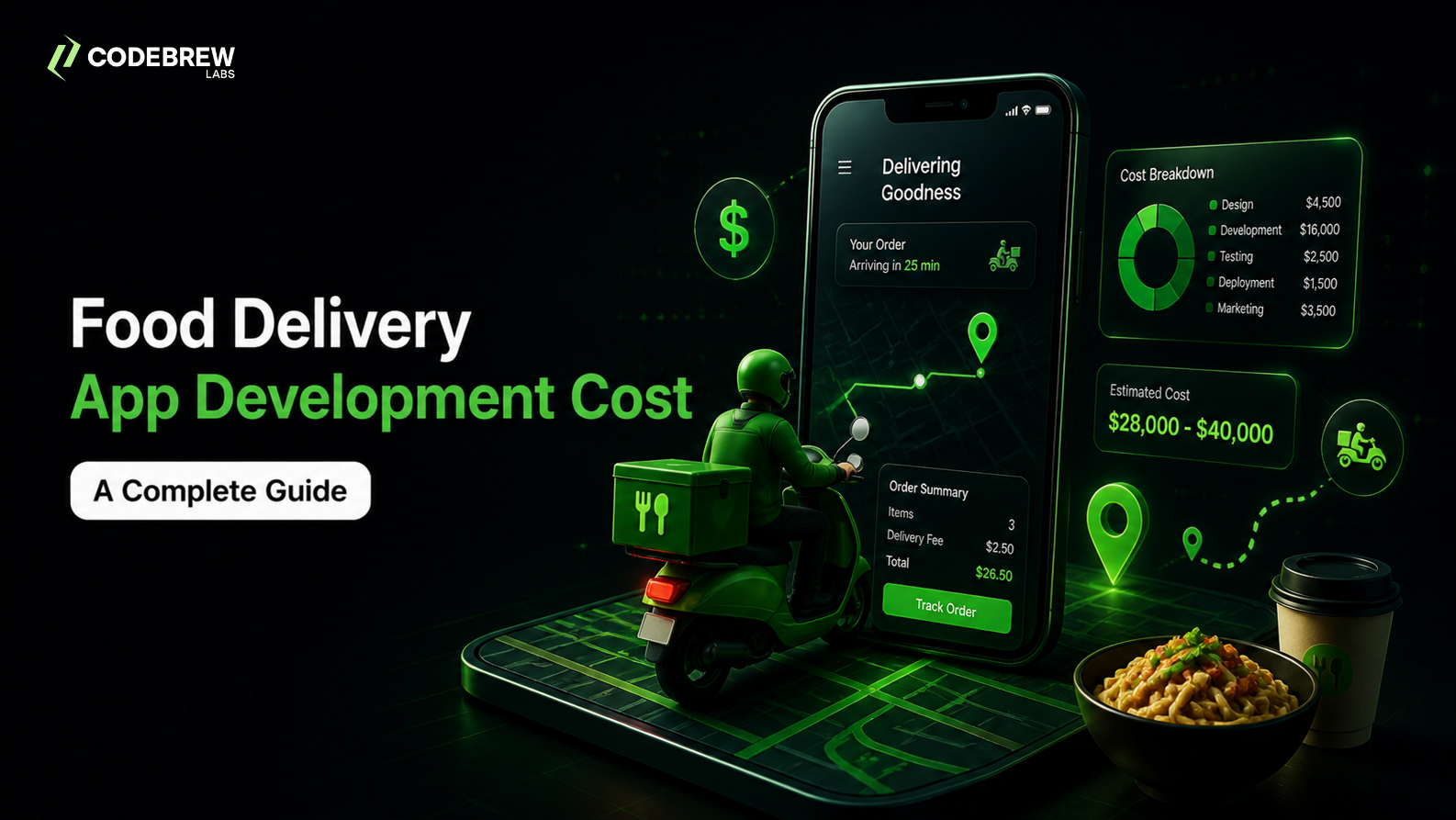
You decided to build a food delivery app. You ran the numbers, validated the market, and got your first round of early adopters excited.
Then you got your first development quote.
$80,000. Or $200,000. Or $450,000. And somehow, three different vendors gave you three entirely different figures for what sounded like the same product.
That confusion is not an accident. Food delivery app development is one of the most misquoted, misscoped, and misunderstood categories in the entire mobile product space.
This guide closes that gap. It is written for founders making their first platform decision and CTOs architecting their third.
You will find real cost breakdowns, system design principles that scale, honest unit economics, and the USA-specific dynamics that most generic guides completely ignore.
The US food delivery market is projected to generate $96.5 billion in revenue by 2027, with mobile orders representing over 60% of all transactions. Despite DoorDash, Uber Eats, and Grubhub holding market share, vertical and niche platforms are growing faster than the incumbents.
The global on-demand food delivery app development market will surpass $320 billion by 2030, according to Statista. But the more interesting story is happening at the edges.
National giants are losing ground in niche categories. Ghost kitchens, meal prep delivery, alcohol delivery, and hyperlocal cuisine apps are capturing both venture dollars and loyal user bases.
McKinsey research shows that consumers in the 25-44 age bracket now spend an average of $67 per month on food delivery, with mobile-first platforms commanding 73% of that spend. That number shifts dramatically by city density, and we will break that down in the USA-specific section.
Key 2026 market signals for founders:
This is the decision most guides skip. Before you write a single line of code or sign a development contract, you need to answer one question honestly:
Best for founders with a differentiated model, proprietary logistics, or vertical specialization. Custom restaurant delivery platform development gives you full control over data, dispatch logic, and monetization.
Cost range: $120,000 to $450,000. Timeline: 6 to 18 months. This is the path if your moat is operational, not cosmetic.
A white-label UberEats clone app or DoorDash-equivalent SaaS can reduce time-to-market from months to weeks. Platforms like Shipday, Ordering.co, or AppDupe offer pre-built infrastructure.
Cost range: $15,000 to $50,000 upfront plus recurring SaaS fees. The trade-off is limited customization and no data ownership. Acceptable for testing a market; dangerous for building one.
Start with a white-label MVP to validate the market, often built through on-demand delivery app development frameworks. Then migrate to a custom-built system once unit economics proves out. This is the path most successful niche delivery platforms took.
Cost range: $30,000 to $60,000 initial, then $150,000 to $300,000 for the full rebuild. It sounds like paying twice, but the data you collect during Phase 1 is worth more than the saved engineering hours.
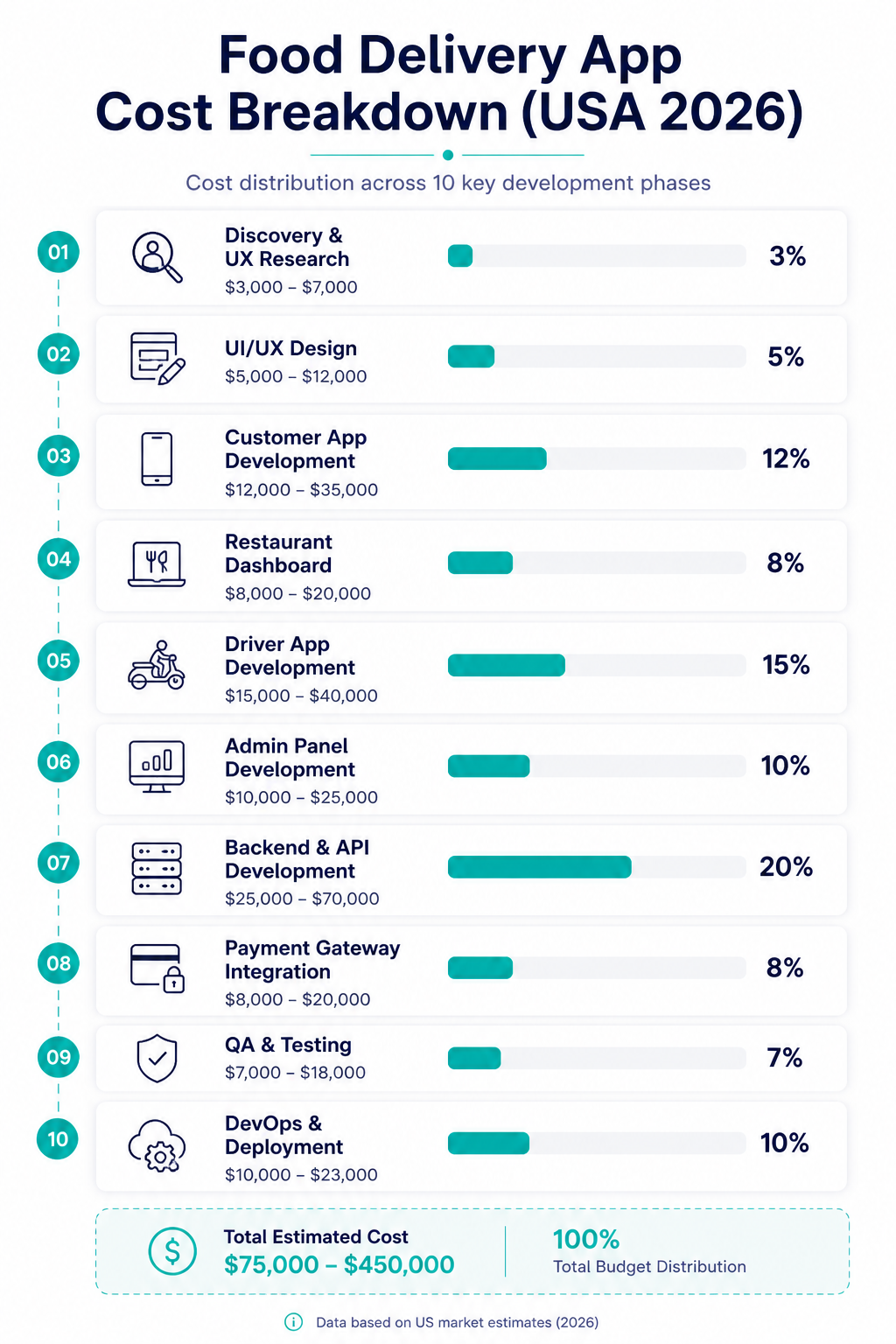
The cost of building a food delivery app is not a single figure—it’s spread across multiple layers of design, development, and infrastructure. Each component plays a critical role in how your platform performs and scales.
Here is what the actual cost distribution looks like across a standard full-featured build:
| Development Phase | Description | Cost Range (USD) | % of Total Budget |
|---|---|---|---|
| Discovery & UX Research | Requirements, competitive audit, user flows, wireframes | $8,000 – $18,000 | 5-8% |
| UI/UX Design | Customer, restaurant, driver, admin interfaces | $12,000 – $30,000 | 8-12% |
| Customer App (iOS + Android) | Ordering, tracking, reviews, loyalty | $25,000 – $75,000 | 18-25% |
| Restaurant Dashboard | Menu management, order acceptance, analytics | $15,000 – $35,000 | 10-14% |
| Driver App | Route optimization, real-time dispatch, earnings | $20,000 – $45,000 | 12-16% |
| Admin Panel | Platform ops, vendor management, reporting | $15,000 – $30,000 | 8-12% |
| Backend + API Architecture | Servers, real-time infra, database, integrations | $25,000 – $70,000 | 18-24% |
| Payment Integration | Stripe, Braintree, tips, split payments | $8,000 – $18,000 | 5-7% |
| QA + Security Testing | Load testing, pen testing, regression suites | $10,000 – $25,000 | 6-8% |
| Deployment + DevOps Setup | AWS/GCP config, CI/CD, monitoring | $8,000 – $20,000 | 4-6% |
| Post-Launch Support (Year 1) | Bug fixes, feature updates, server scaling | $15,000 – $40,000/yr | Ongoing |
Three factors push USA builds above global averages:
A production-grade food delivery app requires a microservices architecture with event-driven real-time layers. Monolithic builds fail at scale. The core infrastructure challenge is handling simultaneous state changes across three user types: customers, restaurants, and drivers.
Most failed delivery apps did not run out of customers. They ran out of architecture.
Before diving into the technical breakdown, let’s understand how a modern food delivery platform is structured across multiple layers.
Layer 1: Client Applications
Layer 2: API Gateway and Service Mesh
Layer 3: Core Microservices
Layer 4: Data and Infrastructure
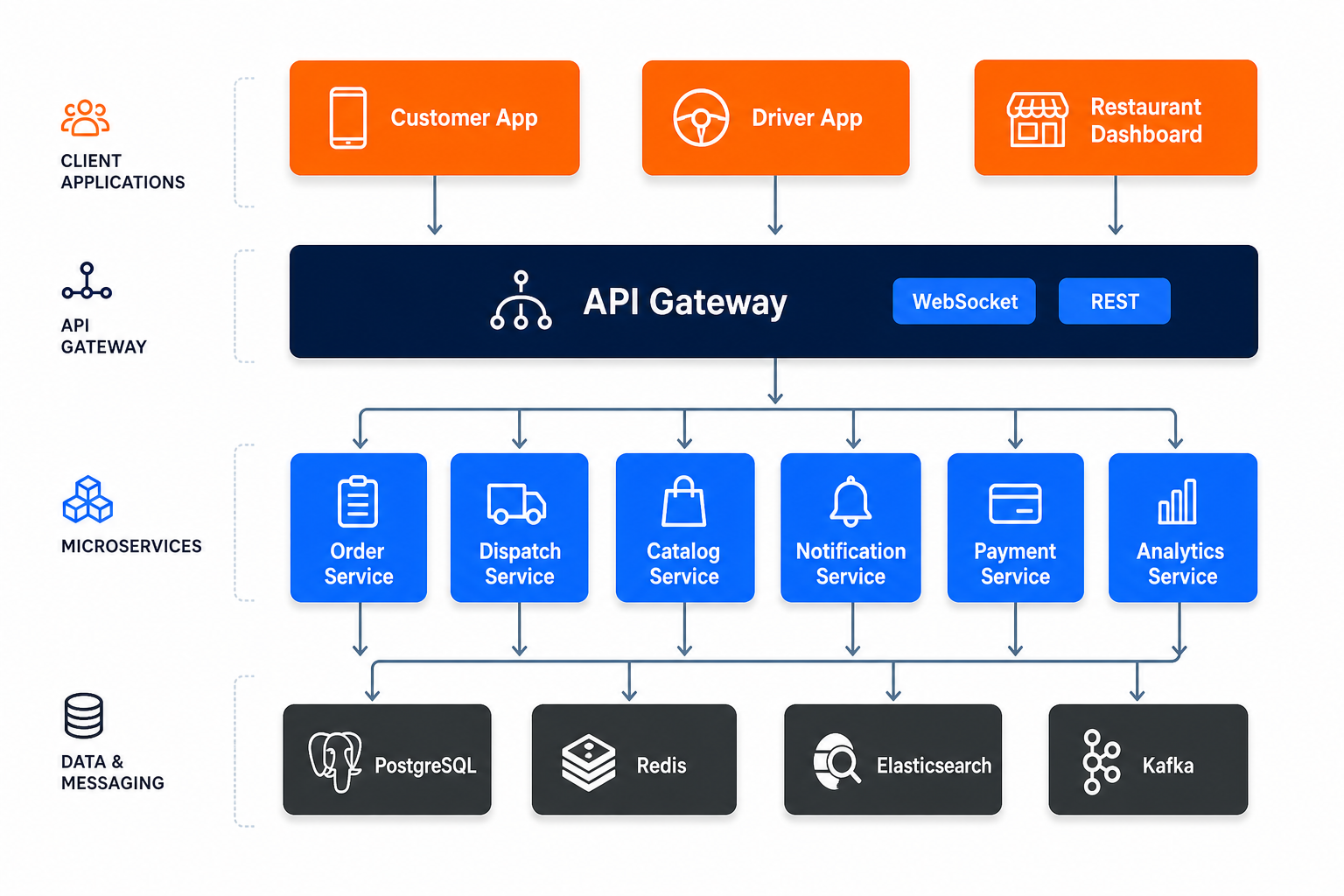
Every delivery platform is actually three products running simultaneously. Underbuilding any one panel kills the other two.
| Feature | MVP | Growth Stage | Enterprise |
|---|---|---|---|
| Geo-based restaurant discovery | Yes | Yes | Yes |
| Real-time order tracking (live map) | Yes | Yes | Yes |
| Push notifications + SMS updates | Yes | Yes | Yes |
| Rating and review system | Yes | Yes | Yes |
| Saved addresses and reorder | No | Yes | Yes |
| Loyalty points and rewards | No | Yes | Yes |
| AI-powered personalized feed | No | No | Yes |
| Subscription / meal plan model | No | Yes | Yes |
| Scheduled delivery slots | No | Yes | Yes |
| Multi-restaurant basket | No | No | Yes |
The most profitable food delivery platforms use stacked revenue models: commission from restaurants (15-30%), delivery fees from customers ($1.99-$6.99), surge pricing in peak hours, subscription tiers, and sponsored placement fees. No single revenue stream is sufficient at scale.
Here is the full monetization architecture used by top-performing platforms:
Charging restaurants 15% to 30% per order is the baseline. Most new platforms launch at 18% to 22% to stay competitive with DoorDash and Uber Eats rates. The risk: restaurants are increasingly resistant to high commission structures.
Standard range in US markets is $1.99 to $6.99 per delivery. Dynamic pricing based on demand, distance, and weather increases revenue per order by an average of 23% during peak windows.
DashPass generates an estimated $1.7 billion annually for DoorDash. A basic subscription tier ($9.99/month for free delivery) improves customer LTV by 2.3x and reduces churn by 40%.
Restaurants pay for premium placement in search results and category pages. At scale, this becomes a significant second revenue stream requiring its own auction or flat-fee bidding system.
License your platform infrastructure to restaurant chains, grocery operators, or retail brands who want their own branded delivery experience. This is the most scalable revenue model and requires minimal incremental engineering.
A healthy food delivery app in the USA targets a Contribution Margin of 12-18% per order after accounting for delivery costs, payment fees, and support overhead. Most platforms do not achieve profitability until 250+ daily orders in a single market.
Unit economics are where most food delivery apps die quietly. Founders focus on GMV. Investors eventually focus on contribution margin.
| Metric | Early Stage | Growth Stage | Scaled Platform |
|---|---|---|---|
| Average Order Value (AOV) | $28 – $34 | $32 – $40 | $35 – $45 |
| Customer Acquisition Cost (CAC) | $18 – $35 | $12 – $22 | $8 – $15 |
| Customer Lifetime Value (LTV) | $60 – $120 | $150 – $280 | $320 – $500 |
| LTV:CAC Ratio | 2:1 – 3:1 | 4:1 – 8:1 | 8:1 – 20:1 |
| Average Delivery Cost (driver payout) | $6.50 – $9.00 | $5.50 – $7.50 | $4.50 – $6.00 |
| Payment Processing Fee | 2.9% + $0.30 | 2.5% + $0.25 | Negotiated rates |
| Contribution Margin per Order | -$1 to +$3 | $2 to $5 | $4 to $8 |
| Monthly Orders to Break Even | N/A | 250 – 500/day | Already profitable |
| Monthly Burn Rate | $25K – $80K | $50K – $150K | Cash flow positive |
Three levers that improve unit economics faster than any other intervention:
AI in food delivery operates across four core functions: demand forecasting, intelligent dispatch, personalized discovery, and dynamic pricing. In 2026, platforms without ML-driven dispatch are operationally at a disadvantage against incumbents who have 5+ years of training data.
Artificial intelligence is not a feature you add to a food delivery app. It is an infrastructure layer that determines operational efficiency from day one, especially when building with AI in food delivery app development.
Machine learning models trained on historical order data, weather, local events, and day-of-week patterns can predict demand spikes with 85%+ accuracy. This directly reduces food waste for restaurant partners and improves driver pre-positioning.
AI-based dispatch systems reduce average delivery time by 12 to 18 minutes compared to static routing. Reinforcement learning models that optimize for multi-order batching are now accessible via APIs like Google OR-Tools and custom-trained PyTorch models.
Collaborative filtering and content-based recommendation systems increase reorder rate by 28% on average. The customer feed is no longer a static restaurant list. It is a ranked, personalized surface that improves with every order.
AI-driven surge pricing balances supply and demand in real time. When driver availability drops below a threshold relative to active orders, pricing adjusts automatically. Transparency in this system is critical for customer trust, especially in US urban markets.
ML-based anomaly detection identifies fraudulent orders, fake reviews, and payment fraud with significantly fewer false positives than rule-based systems. For US platforms processing thousands of daily transactions, this is a non-negotiable operational requirement.
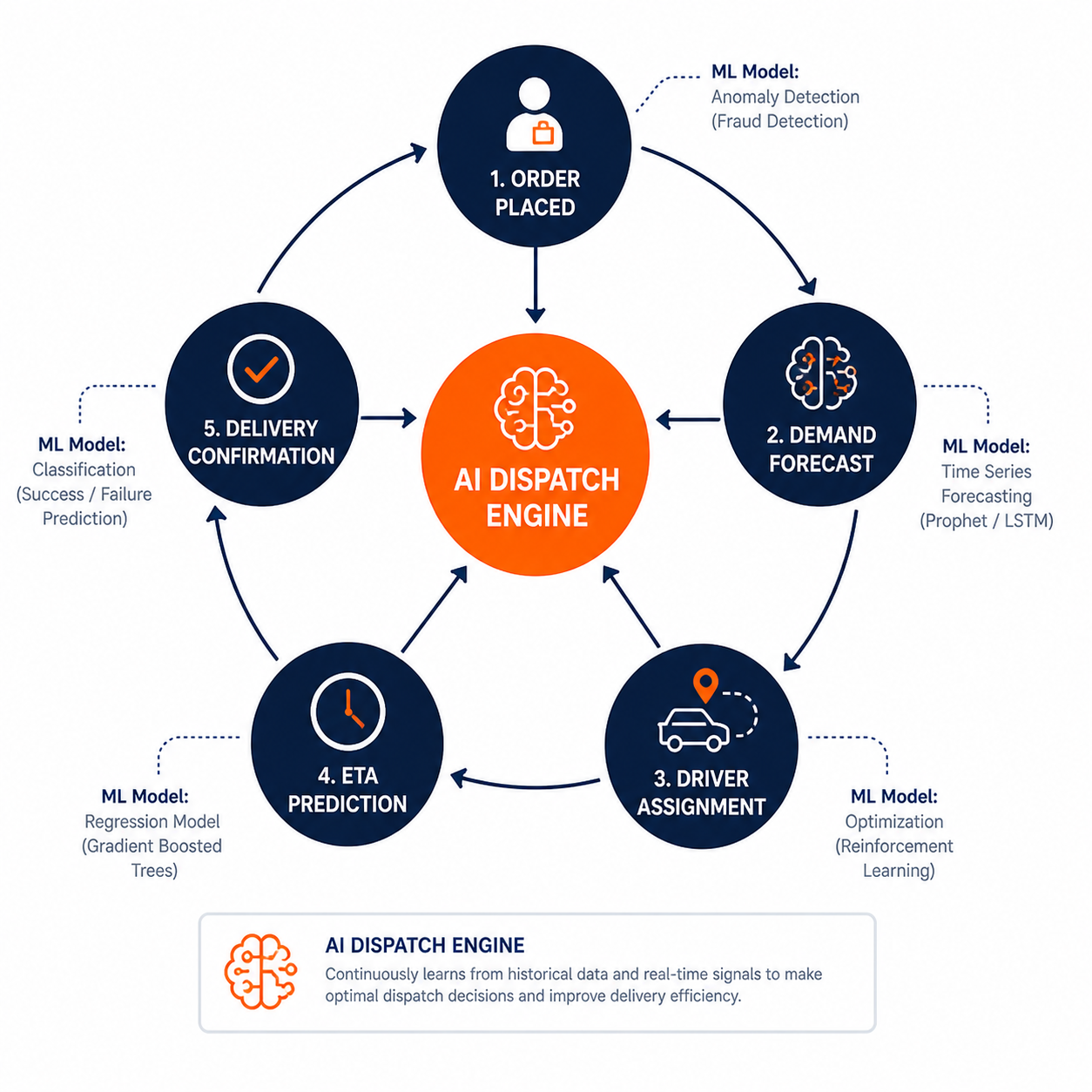
Launch is not the finish line. It is the starting gun for a different set of problems.
Most food delivery apps are built with a single PostgreSQL instance. At 500 concurrent orders, that instance becomes the platform’s single point of failure. The solution is read replicas, connection pooling (PgBouncer), and query optimization before you hit scale, not after.
Streaming GPS data for 200 simultaneous drivers requires a purpose-built geospatial data pipeline. Redis GEO or a dedicated PostGIS cluster handles this at scale. WebSocket connections need horizontal scaling through a pub/sub layer such as AWS SNS or Redis Pub/Sub.
The hardest operational scaling problem is not technical. It is maintaining a driver-to-order ratio above 1.3 during demand spikes. Algorithmic surge pricing helps, but only if driver onboarding and payment systems are frictionless enough to keep your supply pool active.
At 100 restaurant partners, operations are manageable manually. At 1,000, they are not. Automated onboarding flows, self-serve menu tools, and real-time performance dashboards are not nice-to-haves at this stage.
Over 70% of food delivery startups fail within 18 months of launch. The causes are predictable and preventable.
The US food delivery market is not uniform. Urban, suburban, and rural delivery economics differ dramatically. Tipping culture, payment expectations, labor law compliance, and city-specific density all affect product decisions that matter.
| Factor | Urban (NYC, LA, Chicago) | Suburban (Metro Edges) | Small City / Rural |
|---|---|---|---|
| Avg delivery radius | 1 – 3 miles | 3 – 8 miles | 5 – 15 miles |
| Driver availability | High density, fast supply | Moderate, car-dependent | Low supply, higher CAC |
| Average delivery time | 22 – 35 min | 30 – 50 min | 45 – 75 min |
| Average order value | $32 – $40 | $28 – $35 | $24 – $30 |
| Competitive pressure | Extreme | Moderate | Low – first-mover advantage |
| Infrastructure cost | Higher (ops, support) | Moderate | Lower tech overhead |
Tipping is culturally embedded in US food delivery. The average tip across national platforms is $3.50 to $5.00 per order. Your tipping UI directly affects driver satisfaction and retention.
Best practice: default tip percentage set at 18%, with easy toggle options at 15%, 20%, 25%, and custom. Platforms with post-delivery tipping prompts see 12% higher tip rates than pre-delivery only.
Following the California AB5 debate and evolving federal gig worker classification standards, US platforms must architect their driver model with compliance flexibility. The distinction between independent contractor and employee status has cost platforms hundreds of millions in reclassification settlements.
Design your driver onboarding, scheduling, and compensation systems to be classification-agnostic from day one.
US delivery platforms must handle: Stripe or Braintree payment processing, 1099-K issuance for drivers earning over $600/year, state-by-state sales tax on prepared food, and split payment logic for multi-restaurant orders.
The technology roadmap for delivery platforms over the next four years is defined by three macro shifts:
Sidewalk robots (Starship, Serve Robotics) are operational in 20+ US cities as of 2025. By 2028, expect hybrid dispatch systems that route short-distance orders to autonomous units and longer routes to human drivers. Your dispatch architecture needs to be modality-agnostic, especially when building scalable food delivery app development solutions.
Integration with Alexa, Google Assistant, and Apple Siri for reorder flows is already live among top platforms. In 2026, LLM-powered in-app chat agents will handle order customization, dietary preference matching, and customer support without human escalation.
US consumers are increasingly resistant to single-purpose apps. The strategic play for delivery platforms is to add adjacent services: grocery, pharmacy, alcohol, and pet supplies on a shared infrastructure. This increases session frequency, which is the single biggest lever on LTV.
As third-party cookie deprecation reshapes digital advertising, delivery platforms sit on extraordinarily valuable first-party data: what people eat, when they eat, how much they spend, and how often they reorder. Platforms that monetize this data responsibly will have structural advantages in customer acquisition.
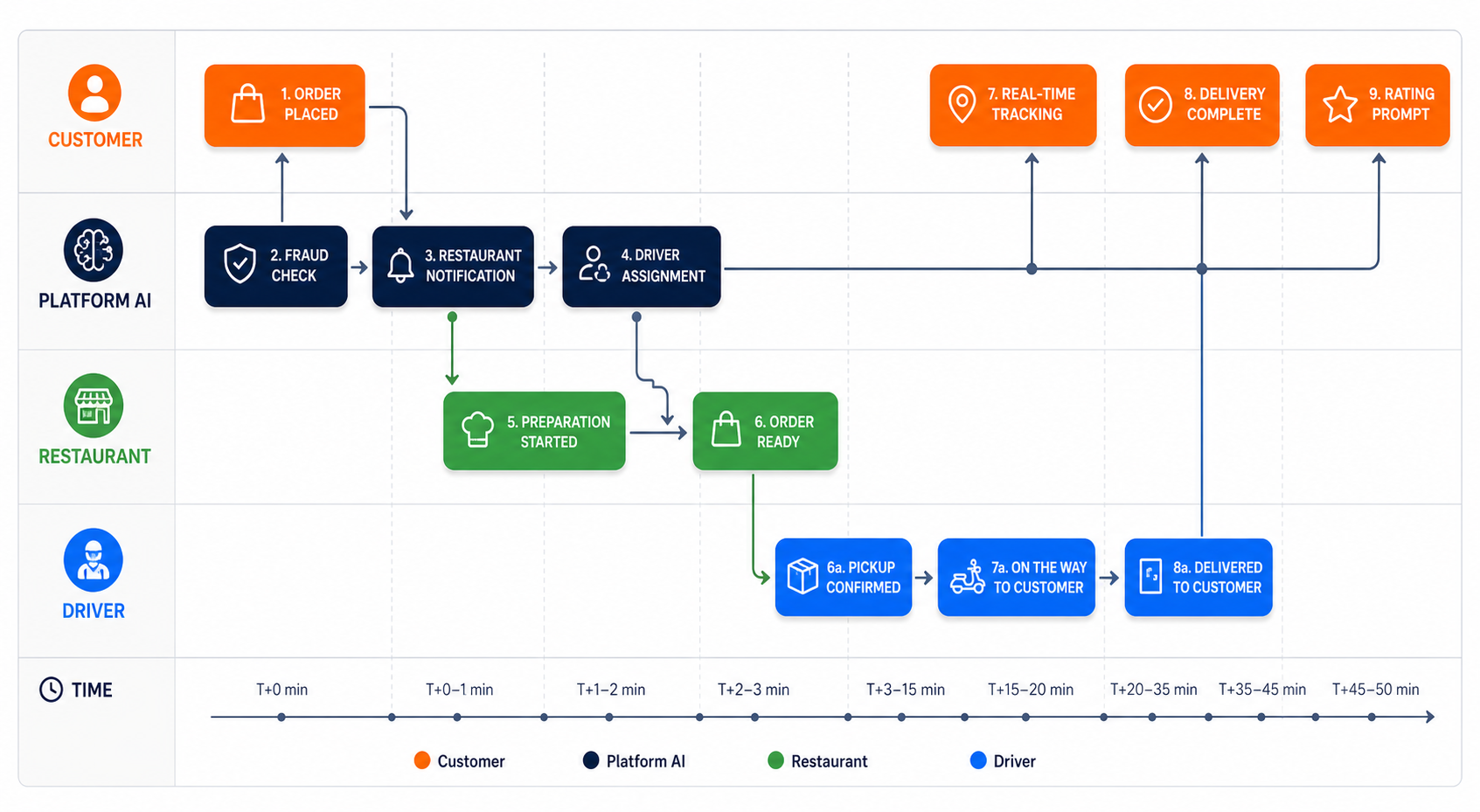
Code Brew Labs developed Yumm App, a full-scale food delivery platform designed to handle real-time ordering, driver management, and seamless user experience across customers, restaurants, and delivery partners.
The platform delivered strong business results, including:
This case highlights how combining scalable architecture, real-time tracking, and efficient dispatch systems can significantly improve both operational efficiency and user engagement.
Read full case study: https://www.code-brew.com/pdf/Yumm-App-Case-study.pdf
Building a food delivery app in the USA in 2026 costs between $75,000 and $450,000 depending on complexity, team location, and feature scope. A lean MVP covering customer ordering, driver tracking, and restaurant management typically costs $75,000 to $130,000. A full-featured platform with AI dispatch, subscription tiers, and multi-market support ranges from $200,000 to $450,000.
A basic food delivery MVP takes 4 to 6 months to build with a dedicated team. A full-platform launch including all three panels (customer app, restaurant dashboard, driver app) and admin infrastructure takes 8 to 14 months. AI-driven features, complex integrations, and multi-region deployment extend timelines further.
Most modern food delivery apps use React Native or Flutter for mobile front-ends, Node.js or Go for backend microservices, PostgreSQL for relational data, Redis for caching and real-time pub/sub, Elasticsearch for restaurant search, and AWS or GCP for cloud infrastructure. Real-time tracking uses WebSocket connections and Google Maps Platform or HERE API.
Food delivery apps generate revenue through multiple stacked models: restaurant commissions (15-30% per order), delivery fees charged to customers ($1.99-$6.99), subscription programs (like DashPass), sponsored restaurant placements, surge pricing during peak demand, and B2B white-label licensing. Relying on a single revenue stream is a structural risk.
A white-label UberEats clone is a pre-built platform customized with your branding, costing $15,000 to $50,000 with faster time-to-market but limited customization and no data ownership. Custom food delivery app development builds your platform from scratch, costing $120,000 to $450,000, with full control over architecture, data, and monetization. Most growth-stage companies start white-label and migrate to custom once product-market fit is proven.
The five most common failure causes: (1) underpriced delivery economics with no path to margin, (2) over-engineering the MVP before validating a single market, (3) neglecting driver experience and retention, (4) single-stream monetization relying only on restaurant commission, and (5) delaying compliance investment in PCI DSS, ADA accessibility, and gig worker classification requirements.
AI is not optional for competitive food delivery apps in 2026. Intelligent dispatch reduces delivery times by 12-18 minutes on average. Personalized recommendation engines increase reorder rates by 28%. Demand forecasting reduces operational waste. Basic AI capabilities are now accessible via APIs and do not require a dedicated ML team to implement at the MVP stage.
Food delivery app development is not a commoditized category. The platforms that win in 2026 are not the ones with the most features or the biggest launch budget.
They are the ones that built the right architecture for scale, understood unit economics before spending on growth, chose monetization models based on data, and treated driver experience as a core product layer.
The market is large enough to support new entrants. Demand is growing. What remains scarce is disciplined execution.
The best platforms are not built by teams that only understand development. They are built by teams that understand how architecture, economics, and operations work together from day one.
At Code Brew Labs, this is exactly how we approach food delivery platforms — combining technical depth with real-world product thinking to help founders build systems that scale, not just launch.
If you are evaluating architecture or planning your first development sprint, the decisions you make in the next 30 days will define your platform’s performance for the next three years.


 Contact Us
Team Up With Us Today For An Unforgettable Service Experience












 Book Free Consultation