Table of Content

Key Takeaways
- The market for building an online streaming platform like 0Gomovies is backed by a global OTT industry growing at a 14.3% CAGR and is projected to reach $1.6 trillion by 2030, making streaming one of the fastest-expanding sectors in tech.
- Piracy sites collectively receive 215 billion visits per year, not because users prefer piracy, but because legal platforms have failed to serve regional-language and diaspora audiences at an accessible price point.
- Building a full-featured legal online streaming platform costs between $67,000 and $169,000, with the primary cost drivers being DRM implementation, multi-CDN architecture, and AI-powered recommendation systems.
- AVOD is growing faster than SVOD in emerging markets, and platforms that enter with a free, ad-supported tier before introducing a subscription layer consistently outperform those that lead with a paywall.
- The single strongest predictor of streaming platform failure is not budget or content library size. It is building without a defined niche, a licensed content strategy, and load-tested infrastructure before launch day.
Table of Content
The global OTT market is projected to reach $1.6 trillion by 2030, according to Grand View Research. Video streaming app development is one of the fastest-growing investment opportunities in technology right now.
Yet despite that scale, piracy platforms still pull hundreds of millions of monthly visitors.
That is not a contradiction. It’s a signal.
Online streaming platforms like 0gomovies exist because legal streaming hasn’t caught up with what viewers in South Asia, MENA, and the global diaspora actually want: affordable, accessible, regional-language content with zero friction.
This guide covers everything needed to plan an OTT platform development project in 2026: how 0Gomovies works, why audiences use it instead of legal options, and how to build a streaming platform that captures that demand profitably.
You will find a full streaming platform cost breakdown ($67,000 to $169,000), a step-by-step build guide, core OTT app features, and a direct comparison of AVOD vs SVOD monetization models for different markets.
If you want to build something legal, scalable, and built for the audience 0Gomovies is currently serving, this is your starting point.
Getting a ballpark cost for your streaming platform takes 30 minutes
Building a Streaming Platform Like 0Gomovies: At a Glance
| Decision Point | Answer |
|---|---|
| Full-platform development cost | $67,000 to $169,000 |
| MVP launch cost | $50,000 to $90,000 |
| Development timeline | 6 to 10 months |
| Best entry model for emerging markets | AVOD |
| Best model for exclusive or original content | SVOD |
| Recommended tech stack | React Native, Node.js, HLS, Cloudflare CDN, Widevine DRM |
| Primary cost drivers | DRM, multi-CDN architecture, AI recommendations |
What Is 0Gomovies?
0gomovies is a free, unofficial streaming site that hosts regional and Hollywood films alongside other regional language content. It operates without licensing agreements and does not compensate studios or distributors for the content it carries.
The site attracts users with same-day access to new theatrical releases, a large back-catalogue, and no subscription requirement.
Its content library spans multiple genres: action, drama, romance, and thriller.
Users browse by language, genre, or release date without creating an account. Video quality ranges from 480p to 1080p. It works across both desktop and mobile devices.
No payment. No account. One click to play.
That zero-friction access is what separates it from legitimate platforms and drives its massive user base.
The platform is most popular among viewers in the Gulf, Southeast Asia, and North America.
Also, watch our video:
How 0Gomovies Works: The Technical Model
0Gomovies does not hold licensing rights to the content it streams. It sources or links to pirated copies, then delivers them through its interface. The platform uses adaptive bitrate streaming technology. This is the similar technology Netflix and Disney+ use. It auto-adjusts video quality based on your connection speed.
Content is organized by language, genre, and release year. New titles often appear on the same day as their theatrical release. There is no registration wall or credit card prompt. Content loads within seconds.
The user experience is built around one goal: remove every possible barrier between the viewer and the content. Legitimate video streaming app development solves the same delivery challenge through licensed infrastructure, CDN-backed content delivery, and proper rights management.
The piracy infrastructure, simplified:
- Content is ripped from theatrical prints, OTT platforms, or physical media
- Files are uploaded to anonymous hosting servers or streaming nodes
- The site embeds these streams using iFrame players from external sources
- Domains rotate frequently to evade copyright enforcement actions
Legitimate platforms solve the same streaming challenge through different means. They use CDN providers like Akamai or Cloudflare to deliver video. They use HLS (HTTP Live Streaming) or DASH protocols for adaptive bitrate playback that adjusts to connection speed.
According to Sandvine’s Internet Phenomena Report, video streaming now accounts for over 65% of all downstream internet traffic globally. The infrastructure challenge at scale is identical for piracy and legal platforms alike.
The difference is not the technology. It’s the content rights, the revenue model, and the compliance architecture sitting underneath it.
Why Millions of People Use 0Gomovies
Most users don’t choose 0Gomovies because they want to break the law. The data tells a different story.
MUSO’s 2024 Piracy Trends and Insights Report tracked 216.3 billion visits to piracy sites globally. Their conclusion: “Piracy persists not because consumers reject legitimacy, but because legitimate options still fail to meet expectations in price, access, or timing.”
Three factors drive the majority of piracy use.
Price and subscription fatigue
Deloitte’s Digital Media Trends study found 47% of consumers would cancel a streaming subscription if prices increase. Paying for four or five platforms adds up fast.
Content fragmentation
A Tamil film is on Zee5. The Malayalam hit is on SonyLiv. The Hollywood catalogue is on Amazon Prime. Sports are on Hotstar. Piracy consolidates everything in one place at no cost.
Regional content gaps
Major platforms carry limited regional language content. When users can’t find what they want legally, they find it elsewhere.
Zero friction
No signup, payment flow, and buffering tutorial. That user experience is harder to beat than most founders realize.
Understanding this demand is not a defense of piracy. It is a clear map of what a better platform needs to offer.
Content Library of 0gomovies and What It Covers
0gomovies built its audience on one specific gap most legal platforms left open: regional-language depth.
What’s in the library:
- Theatrical releases and classics, from mainstream hits to independent releases
- Franchise blockbusters alongside award-winning independent cinema
- Mainstream Bollywood and art-house productions.
The FICCI-EY Media and Entertainment Report 2024 found that regional content now drives over 60% of streaming hours in Tier 2 and Tier 3 Indian markets. That share is growing year on year.
This finding matters for platform builders. The content gap isn’t in Bollywood. Netflix and Amazon Prime have Bollywood covered. The real gap is in regional content for diaspora viewers who can’t access the platforms that carry it.
Multiple resolution tiers (480p, 720p, 1080p) let users adapt to their connection speed. The platform runs across devices without requiring a dedicated app download.
What this tells you: viewers in underserved language markets will accept piracy over a legal option if the legal option doesn’t carry what they want to watch.

What are the Features and User Experience of 0gomovies
0gomovies doesn’t succeed because of sophisticated technology. It succeeds because the experience has almost no friction at any point.
Zero-friction access: No account. No payment. No geo-block. Users arrive, search, and stream in under a minute.
Adaptive bitrate streaming: The video player adjusts quality in real time based on connection speed. Buffering is reduced even on slower connections.
Search and discovery: Content is searchable by title, actor, director, language, and genre. Discovery is fast.
Content freshness: New releases appear within days of theatrical or OTT release elsewhere. Sometimes the same day.
Multi-language interface: The platform is accessible to users across different linguistic backgrounds without requiring a language switch.
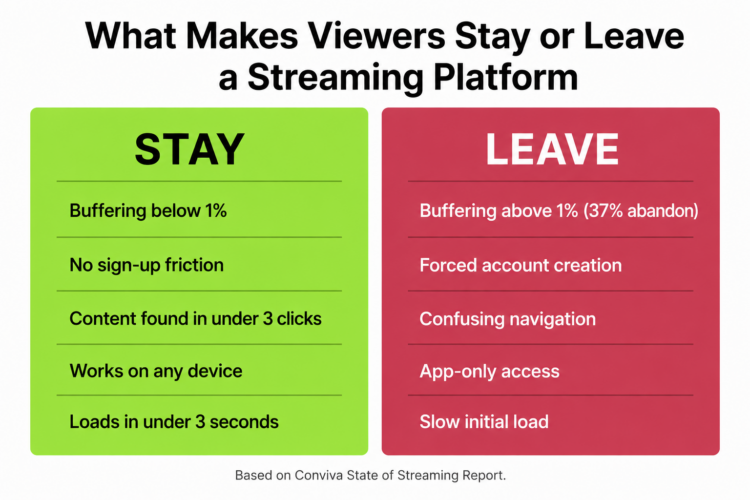
Conviva’s State of Streaming Report found that a rebuffering rate above 1% causes 37% of viewers to abandon a stream entirely. 0gomovies limits this by keeping the video player lean and lightweight.
The Legal and Ethical Reality of Using 0Gomovies
Understanding the demand doesn’t make using 0gomovies a sound decision. The risks are concrete, well-documented, and frequently underestimated. These are not vague warnings.
Enforcement against end users is inconsistent, but it is not absent. ISPs in several countries have been authorized to block piracy domains at the network level, and rights holders periodically pursue civil actions.
Legal exposure
Unauthorized streaming may violate copyright law in your country. In the US, the Digital Millennium Copyright Act applies. In India, the IT Act creates clear liability. The EU Copyright Directive enforces strong protections for rights holders.
Malware and security risk
A Digital Citizens Alliance study found piracy sites are 28 times more likely to serve malware than legitimate streaming platforms. Common threats include ad injectors, cryptominers, and credential stealers that run silently in the background.
Industry losses
The MPA estimates the global film and TV industry loses $29.2 billion annually to piracy. India’s film industry alone loses approximately 18,000 crore rupees per year, according to FICCI data.
Free streaming is not actually free. It carries a cost in device performance, data exposure, and, in some cases, direct financial risk.
Legal Alternatives Worth Knowing
Legal platforms have closed the regional content gap significantly in the last three years. Several now offer free, ad-supported tiers that make the cost argument against piracy harder to sustain.
Legal Alternatives
| Platform | Model | Free Tier |
| Netflix | SVOD | No |
| Amazon Prime | SVOD | No |
| Disney + Hotstar | SVOD + AVOD | Yes (ad-supported) |
| Zee5 | SVOD + AVOD | Yes (ad-supported) |
| SonyLiv | SVOD + AVOD | Yes (ad-supported) |
| MXPlayer | AVOD | Yes (fully free) |
According to Ormax Media’s OTT Audience Report, Hotstar and Zee5 together account for over 60% of the Indian OTT market share, and both built that position primarily on regional content.
For anyone building a platform: this table shows where the white space actually is. Affordable, globally accessible, regional-first streaming with a diaspora focus is still a relatively open field.
Thinking about entering the online streaming market?
The OTT Market Opportunity That 0Gomovies Reveals
0Gomovies exists because demand outran supply. Viewers wanted regional content, mobile-first access, and zero-friction streaming. Legal platforms didn’t deliver it fast enough or affordably enough.
That gap is still open.
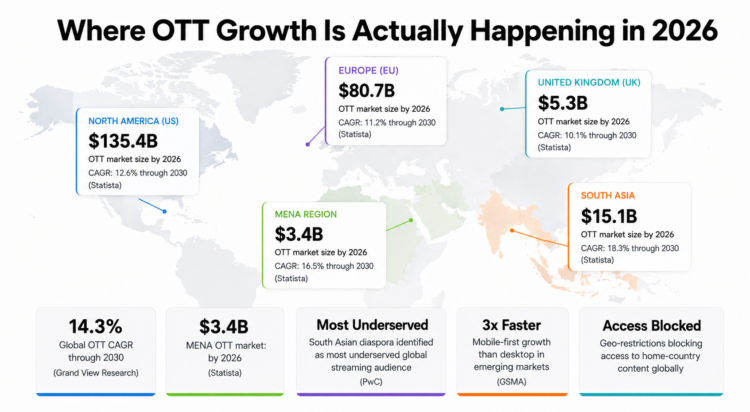
Grand View Research projects the global OTT market will grow at a 14.3% CAGR through 2030. The MENA region alone is projected to reach $3.4 billion in OTT revenue by 2026, yet remains dominated by just a handful of players. PwC’s Global Entertainment and Media Outlook identifies South Asian diaspora streaming as one of the most underserved segments in the world.
The GSMA Mobile Economy Report shows mobile-first internet users in emerging markets are growing three times faster than desktop users. For these audiences, a smartphone is the primary screen, not a fallback.
Billions of viewers. Fragmented content libraries. No single platform owns regional language streaming globally.
That is not a niche. That is a market.
The founders pursuing OTT platform development in these segments are not competing with Netflix. That race ended years ago. They are building for audiences that Netflix has not prioritized.
The actual opportunities are more specific:
- A regional-language-first platform for a specific diaspora community
- An AVOD platform built around a single content category: devotional content, independent cinema, and regional sports
- A white-label OTT product for broadcasters and independent studios wanting to go direct-to-consumer
None of these requires a nine-figure content budget. They require the right product architecture, a focused content licensing strategy, and a development partner with real OTT infrastructure experience.
Online Streaming Platform Segments You Can Build in 2026
The OTT market is not one market. It is a collection of underserved segments, each with its own audience, content need, and monetization logic.
Choosing the right segment before you build is more valuable than choosing the right tech stack.
Regional and Language-Specific Streaming
This is the segment 0Gomovies exposed most clearly.
Regional languages have massive, loyal audiences. Most major platforms serve them inconsistently. A focused regional platform with the right content library can own a language vertical that Netflix treats as secondary.
The FICCI-EY Media and Entertainment Report found that regional content now drives over 60% of total streaming hours in India’s Tier 2 and Tier 3 markets alone.
Best model: AVOD to acquire, SVOD to retain.
Sports Streaming
Live sports are one of the highest-retention content categories in OTT.
Fans return on a fixed schedule. They don’t cancel between seasons. They share access within households and communities.
The opportunity lies in local and niche sports. Cricket in South Asia, kabaddi, regional football leagues, combat sports, and motorsport all have dedicated audiences that major platforms underserve.
Best model: SVOD with TVOD for individual premium events.
Kids and Family Content
Parents are highly loyal subscribers when the content is trusted and safe.
A well-curated kids’ platform with strong parental controls and age-appropriate content earns long subscription lifecycles. Families don’t cancel lightly when their children are attached to a platform.
Regional language kids’ content is especially underbuilt globally. Most major platforms prioritize English-language children’s programming.
Best model: SVOD, often bundled with family plan pricing.
Education and E-Learning
EdTech and OTT have largely stayed separate. That gap is an opportunity.
A streaming platform built for structured learning, with progress tracking, quizzes, certificates, and instructor-led video, serves a different user need than YouTube.
Corporate training, professional development, language learning, and K-12 supplemental education each represent distinct and growing demand pools.
Best model: SVOD or institutional licensing for corporate and school markets.
Faith-Based and Religious Content
Faith-based streaming is one of the most consistently underestimated segments in OTT.
Platforms serving Christian, Islamic, Hindu, and other religious content communities have demonstrated strong subscriber loyalty and low churn rates. Audience members return weekly by habit, not by algorithm.
The content supply is large, production costs are often manageable, and major platforms give this category minimal shelf space.
Best model: SVOD or donation-supported hybrid.
Fitness and Wellness
At-home fitness content saw explosive demand after 2020. That demand has not disappeared; it has normalized.
A focused fitness streaming platform can serve yoga, strength training, meditation, rehabilitation, or sport-specific conditioning. Niche depth beats broad fitness libraries in retention.
Galaxy Weblinks research notes that niche OTT platforms in fitness consistently show stronger subscriber lifetime value than broad entertainment services.
Best model: SVOD, with premium live class tiers.
Music, Concerts, and Live Performances
Streaming live music concerts, artist documentaries, and backstage content is a growing and underdeveloped segment.
The appeal is direct: fans want access to performances they can’t attend in person. Regional music scenes, classical performances, and independent artists all have audiences that existing platforms don’t actively serve.
Best model: TVOD for live events, SVOD for archive content libraries.
News and Journalism
Independent news organizations and investigative journalism outlets increasingly need direct-to-audience distribution.
A streaming platform built for long-form news, documentary journalism, and live coverage removes dependence on social media algorithms and advertising intermediaries.
Reader-supported models in journalism have proven durable. A video-first version of that model is largely unbuilt.
Best model: SVOD or membership-based hybrid.
Gaming and Esports
Esports viewership now rivals traditional sports in key demographics. Tournament streams, player content, and gaming commentary all have deeply engaged audiences.
A dedicated esports platform can serve tournament coverage, coaching content, and community-driven gaming content in ways that Twitch and YouTube do not optimize for.
Best model: AVOD with premium SVOD tier for exclusive tournament coverage.
FAST Channels (Free Ad-Supported Streaming TV)
FAST is the fastest-growing segment in the entire OTT market.
It replicates the channel-surfing experience of traditional TV, but delivered over the internet with no subscription. Advertisers fund the model. Viewers get free, always-on content.
Pluto TV is the most recognized example. But regional and niche FAST channel operators are capturing significant ad revenue in markets where subscription fatigue is high.
Best model: Entirely AVOD. Revenue scales with viewership volume.
Quick Reference: Segment Selection Guide
| Segment | Audience Loyalty | Content Cost | Best Entry Model | Market Gap Size |
| Regional Language | Very high | Medium | AVOD to SVOD | Very large |
| Sports | Very high | High | SVOD + TVOD | Large |
| Kids and Family | Very high | Medium | SVOD | Large |
| Education | High | Medium | SVOD | Large |
| Faith-Based | Very high | Low | SVOD | Underestimated |
| Fitness and Wellness | High | Low | SVOD | Medium |
| Music and Live | Medium | Varies | TVOD + SVOD | Medium |
| News and Journalism | Medium | Medium | SVOD | Growing |
| Gaming and Esports | High | Low | AVOD + SVOD | Large |
| FAST Channels | Medium | Low | AVOD | Very large |
How to Build an OTT Streaming Platform: Step by Step
Building a streaming platform is a process, not a single sprint. Here’s what it actually involves, from the first decision to launch day.
Step 1: Define your niche and content strategy
Before any technical work starts, answer three questions clearly:
- Who is your target viewer, and what content do they currently pirate?
- Will you license content, create original content, or run a hybrid model?
- What’s your revenue model: AVOD, SVOD, TVOD, or a combination?
These answers dictate every architectural decision that follows. Without them, you’re building infrastructure with no clear product.
Step 2: Map the competitive landscape
Search for what your target viewer currently watches and where the gaps are. What content is unavailable on legal platforms in their region? Where do geo-restrictions create forced piracy? Where does pricing friction push viewers away?
This research becomes the product roadmap. It is not optional.
Step 3: Define your core feature set in two tiers
Must-have at launch: User authentication, video player, content management system, search, payment gateway (for SVOD/TVOD), and basic recommendation logic.
Phase 2: AI-driven recommendations, live streaming, multi-profile support, offline downloads, advanced analytics dashboard.
Building Phase 2 at launch add cost, extends timelines, and delays revenue. Prove the core product first.
Step 4: Choose your tech stack deliberately
Commonly used choices for production-grade streaming platforms:
- Frontend: React Native or Flutter for mobile; React.js for web
- Backend: Node.js or Django for API logic and data management
- Video delivery: HLS or DASH protocol; Cloudflare or Akamai as CDN
- DRM: Widevine for Android and Chrome; FairPlay for iOS and Safari
- Database: PostgreSQL for structured data; Redis for session caching
Step 5: Design for the first 30 seconds
The first experience on your platform determines whether a user stays.
Netflix’s product team has long operated around a principle: users should find something worth watching within three interactions.
Your onboarding flow, content discovery page, and autoplay logic need the same design rigour as your video infrastructure.
Nielsen research on recommendation engines found that platforms with personalised content discovery see longer average session duration compared to non-personalised counterparts.
Step 6: Handle content licensing and compliance
This step is consistently underestimated by first-time platform builders.
You need distribution licenses for each piece of content in each territory you serve. DRM protects content from being extracted and redistributed.
Geo-restriction logic enforces licensing boundaries. Age-gating satisfies platform policy requirements in regulated markets.
GDPR compliance applies if you serve European users. India’s Digital Personal Data Protection Act is in implementation and requires active monitoring.
Step 7: Build your monetization architecture before launch
AVOD requires ad network integration and an ad server. SVOD requires a subscription billing engine with trial logic and cancellation flows.
TVOD requires per-title payment handling and temporary access token management.
A McKinsey analysis on media technology infrastructure found that platforms built with modular, API-driven architecture recover their development cost significantly faster than those built on monolithic systems, primarily because they can update individual components without rebuilding the whole platform.
Step 8: Load test before you launch
Streaming platforms fail under traffic spikes. A major release day, a viral social moment, or a sporting event can send concurrent users to levels your infrastructure wasn’t tested for.
Load testing is not a QA task. It is a launch requirement.
Must-Have Features for an Online Streaming Platform in 2026
Every competitive streaming app needs a second tier of features beyond basic video playback. These have moved from differentiators to baseline expectations.
AI-powered content recommendations
Gartner research found that platforms with active personalized recommendation engines see 30 to 40% higher engagement than non-personalised counterparts. Amazon Prime Video attributes 35% of total viewing to its recommendation system.
Without AI recommendations, users land on your homepage and face a choice they weren’t ready to make. That’s where churn starts.
Multi-CDN failover
Single CDN dependency is a liability. If your CDN provider has an outage during a major release, your platform goes down with it. Multi-CDN architecture routes traffic to the next-fastest available provider automatically.
Offline downloads with DRM encryption
Encrypted offline downloads are a meaningful retention driver in markets with inconsistent connectivity. The encryption ensures content can’t be extracted and redistributed outside the platform.
Live streaming plus VOD hybrid architecture
A platform that handles both live events (sports, news, premieres) and on-demand content has a significantly wider content monetization surface than VOD-only.
Subtitle and dubbing pipeline
For any platform targeting diaspora audiences, subtitle support across multiple languages is a product requirement, not an add-on. A Tamil viewer in the UK watching Malayalam content needs subtitle access.
Analytics dashboard
Content performance data tells you what to license next, where users drop off during playback, and which genres drive the most session time. Without it, licensing decisions are guesswork.
Anti-piracy watermarking
Forensic watermarking embeds an invisible identifier into each stream tied to the user session. If that content appears on a piracy site, the leak source can be traced and actioned.
Adaptive bitrate streaming
This adjusts video quality automatically based on connection speed. Conviva’s State of Streaming Report found that rebuffering above 1% causes 37% of viewers to abandon a session immediately.
Multi-profile support with parental controls
Separate profiles increase household retention. Parental controls are a baseline expectation for any family-oriented platform.

Development Cost Breakdown of an Online Streaming Platform
Building a full-featured online streaming platform costs between $67,000 and $169,000 in 2026. A production-ready MVP with core video streaming, user authentication, and payment integration launches for $50,000 to $90,000.
The primary cost drivers are DRM implementation, multi-CDN architecture, and AI-powered content recommendations. Development takes 6 to 10 months from discovery to launch.
Cost Breakdown
| Phase | Deliverables | Estimated Cost (USD) | Timeline |
| Discovery and Planning | Requirements, architecture blueprint, competitor audit | $5,000 to $12,000 | 2 to 3 weeks |
| UI/UX Design | Wireframes, prototypes, full design system | $8,000 to $20,000 | 3 to 5 weeks |
| Core Development | Frontend, backend, streaming integration, and auth | $30,000 to $80,000 | 10 to 16 weeks |
| Advanced Features | AI recommendations, DRM, multi-CDN, analytics | $15,000 to $35,000 | 6 to 10 weeks |
| QA and Testing | Load testing, security audit, cross-device testing | $5,000 to $12,000 | 3 to 4 weeks |
| Launch and Scaling | Cloud setup, app store submission, and monitoring setup | $4,000 to $10,000 | 1 to 2 weeks |
| Total | Full-featured streaming platform | $67,000 to $169,000 | 6 to 10 months |
What pushes cost up: Original content ingestion pipelines, multi-region CDN configuration, and AI recommendation systems add significant scope.
What can be deferred safely: Live streaming capability, advanced analytics, and multi-language dubbing tools. These are Phase 2 investments that make more sense after the core product is validated.
Clutch.co’s benchmark data for media app development in 2024 puts mid-complexity streaming platforms in the $60,000 to $150,000 range, consistent with the figures above.
A phased build reduces upfront financial risk. Code Brew Labs structures projects this way as a default: validate the core product before committing to advanced feature development.
Monetization Models: Which One Fits Your Online Streaming Platform?
There is no universal right answer. The right monetization model depends on your market, your content library, and how much your target audience is willing to pay before they’ve experienced the product.
AVOD (Advertising Video on Demand)
Free to users, funded entirely by advertising revenue. MX Player built a 280 million user base in India on this model.
AVOD works best in price-sensitive markets where subscription friction is high. It requires meaningful traffic volume to generate sustainable revenue, which means it’s a long-term play, not an immediate monetization strategy.
SVOD (Subscription Video on Demand)
Monthly or annual fee. Predictable, recurring revenue. Netflix is the benchmark.
SVOD requires a content library strong enough that a user will commit to a subscription before watching. It works best when you have genuine depth or exclusivity in a content category.
TVOD (Transactional Video on Demand)
Pay-per-title access. No subscription commitment. Apple TV uses this model for premium theatrical releases and live events.
TVOD works well for live sports, major film releases, and events where viewers will pay once for a specific piece of content. Revenue is less predictable than SVOD.
Hybrid model
Most competitive platforms now combine AVOD and SVOD: a free ad-supported tier to build an audience, and a paid tier for an ad-free experience with premium content access. Hotstar built its dominant market position on exactly this structure.
Digital TV Research data shows AVOD growing faster than SVOD in emerging markets. If your target audience is price-sensitive, starting with AVOD and introducing a paid tier once you have traffic and validated content demand is the lower-risk commercial path.
Code Brew Labs for an Online Streaming Platform Development
The demand that built 0Gomovies is real and documented. Hundreds of millions of viewers want regional content, mobile-first access, and streaming that doesn’t demand three subscription accounts.
Legal platforms have captured parts of this market. Large, profitable parts. But meaningful gaps remain, particularly in regional language content and mobile-first emerging markets.
The question for anyone reading this is simple: Is that your opportunity?
Building a legal streaming platform means serving that demand without the legal exposure, the malware risks, or the platform instability that define unauthorized sites.
Code Brew Labs has built streaming platforms across entertainment, sports, and regional content verticals. We work in phases, not one-shot contracts. We handle DRM, multi-CDN architecture, compliance, and AI recommendation integration.
Ready to build?
Frequently Asked Questions
What is 0Gomovies?
0Gomovies is a free, unauthorized online streaming platform that offers movies and web series in Malayalam, Tamil, Hindi, and Hollywood content. It operates without licensing rights, making it illegal in most jurisdictions globally.
Is 0Gomovies legal to use?
No. 0Gomovies streams content without proper content licensing. Accessing it may violate copyright law depending on your country. In the US, India, and across the EU, legal consequences for end users are possible under existing copyright frameworks.
Why do so many people use 0Gomovies?
Users choose 0Gomovies primarily for three reasons: it is free, it requires no sign-up, and it covers regional language content that major legal platforms often delay or omit entirely. MUSO’s research confirms that piracy is driven by unmet demand, not deliberate lawbreaking.
How much does it cost to develop an OTT app in 2026?
A full-featured streaming platform costs between $67,000 and $169,000 to build in 2026. A solid MVP can launch for $50,000 to $90,000. Timeline ranges from 6 to 10 months, depending on feature scope and team structure.
What is the difference between AVOD, SVOD, and TVOD?
AVOD means free streaming supported by advertising, like MX Player. SVOD means subscription-based streaming, like Netflix. TVOD means pay-per-title access, like Apple TV rentals. Most competitive platforms today use a hybrid of all three to reach different audience segments.
How long does it take to develop an OTT streaming platform?
A basic MVP typically takes 3 to 4 months. A mid-scale platform with DRM, AI recommendations, and multi-device support takes 6 to 10 months. A full-scale platform with live streaming and advanced AI features can take 10 to 18 months from start to launch.
Can I build an OTT platform without a large content library?
Yes. Niche platforms with focused content libraries consistently outperform broad catalogs on user retention and subscriber lifetime value. Starting narrow and going deep is a smarter strategy than trying to compete with Netflix on day one.
What is the best tech stack for an OTT app development?
For most streaming startups, the right foundation is React Native or Flutter for cross-platform apps, Node.js for the backend, HLS for streaming protocol, AWS CloudFront for content delivery, and Widevine or FairPlay for digital rights management. This combination balances cost, scalability, and long-term flexibility.
Let's Convert Your Business Idea Into Success!
Free Consultation from Top Industry Experts
Let’s Build Your Dream App!
Share article on :


Ready To Fuel Your Vision With AI-Powered Innovation?


Level- 18, Dubai World Trade Centre Tower, Sheikh Rashid Tower, Sheikh Zayed Rd, Dubai, UAE
business@code-brew.com +971-55-645-7972
Plot no I - 36, Sector 83 Alpha, Mohali SAS Nagar 140308
business@code-brew.com +91-771-976-8427
Av. Miguel Hidalgo y Costilla 1995, Arcos Vallarta, 44600 Guadalajara, Mexico
business@code-brew.com +1(213)2614953
4231 Balboa Ave #512 San Diego, CA 92117 United States
business@code-brew.com +1(213)2614953
2nd floor, College House, 17 King Edwards Rd, London HA4 7AE, UK
business@code-brew.com +44 (20) 82644493
Partner With Experts Who Leverage AI & Tech To Transform Ideas Into Market-Leading Solutions.
Wait! Looking for Right Technology Partner For Your Business Growth?
It's Time To Convert Your Business Idea Into Success!
Get Free Consultation From Top Industry Experts:
I would like to keep it to myself