Table of Content

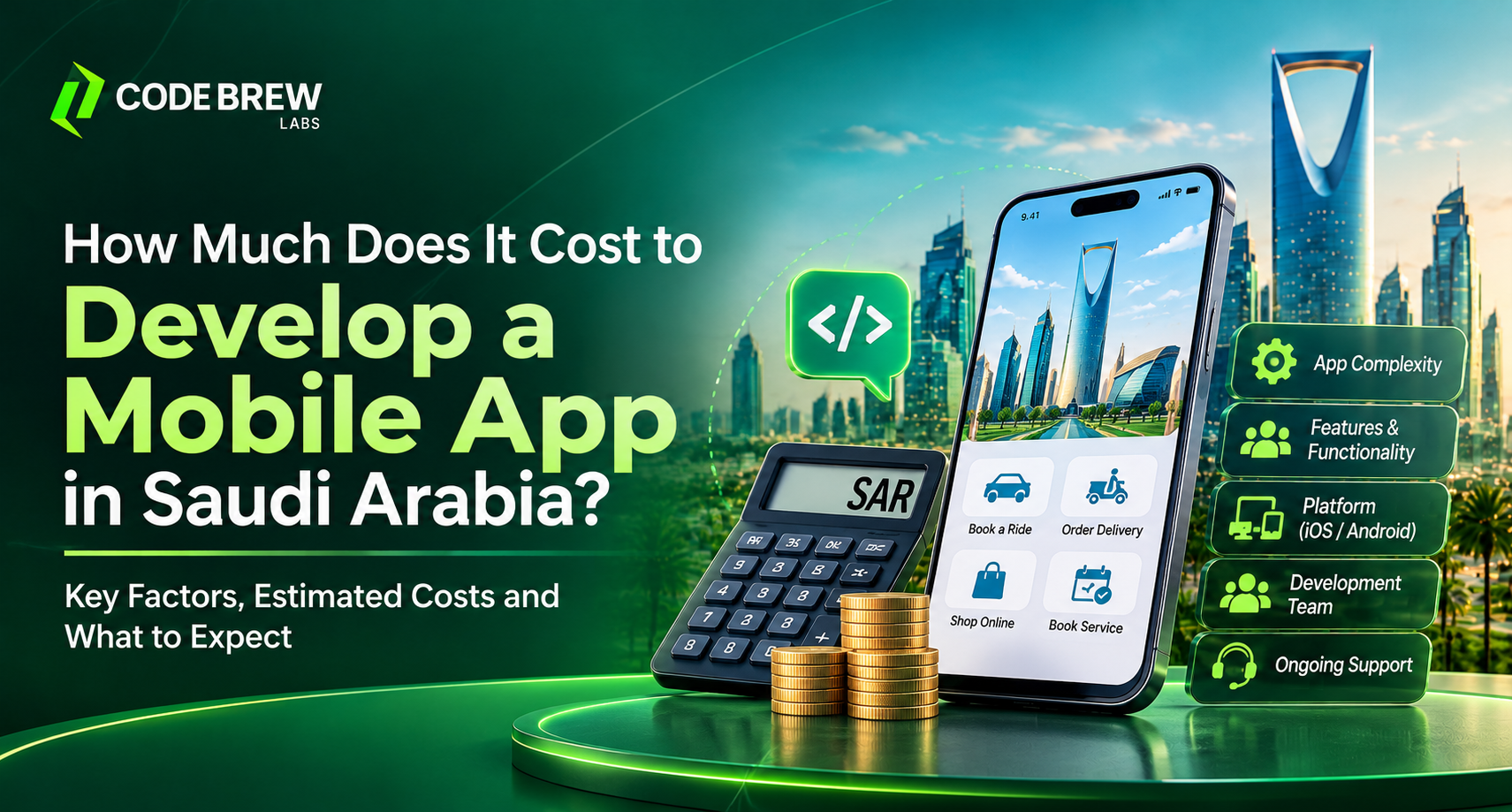
Quick Summary:
- Mobile app development costs in Saudi Arabia range from SAR 25,000 to SAR 250,000+, depending on app complexity and technical requirements.
- Basic apps cost SAR 25,000–60,000, mid-level apps cost SAR 60,000–120,000 and advanced applications cost SAR 120,000–250,000+.
- Development timelines range from 2 to 12+ months, depending on the features and integrations required.
- Saudi-specific requirements such as Arabic RTL support, Mada payments, Nafath authentication and PDPL compliance can add development work where applicable.
- Annual maintenance can be budgeted at 10–15% of initial development costs as an illustrative planning allowance rather than a fixed industry rate.
You have an app idea and a budget in mind. But how do you know whether SAR 50,000 will be enough or if the project will end up costing twice that amount? This is a common concern for Saudi businesses planning their first application.
Table of Content
The mobile app development cost in Saudi Arabia ranges from SAR 25,000 to SAR 250,000+ based on the features and development work involved.
The market is already heavily digital. According to the General Authority for Statistics’ 2026 ICT survey, 99.6% of individuals aged 15–74 in Saudi Arabia use mobile phones to access the internet.
Yet two apps serving the same industry can have very different budgets. A restaurant ordering app with very basic payment features will cost a lot less than one that also handles delivery drivers and live tracking of orders.
This guide explains what goes into the cost to develop an app in Saudi Arabia and how to work out a realistic budget before development begins.
Why Saudi Arabia Is a Promising Market for Mobile App Development in 2026
Is Saudi Arabia a good place to invest in for a new mobile app? The numbers give businesses an actual and concrete reason to consider it. Online purchases are common and now digital payments have overtaken cash and mobile internet speeds have improved. There is also a growing interest in technology in the Kingdom.
Saudi Consumers Are Spending More Time Shopping Online
People in Saudi Arabia are already used to ordering products and paying online. The Saudi Internet Report 2025 states that 76.9% of internet users shop online.
There is already an audience for digital commerce. The difficult part for a new app is getting customers to use it regularly when they have other options.
Digital Payments Have Replaced Cash in Many Transactions
The Saudi Central Bank reported that 85% of retail payments were electronic in 2025. The figure stood at 79% in 2024.
Saudi customers are familiar with paying digitally. Businesses can offer supported local payment options within their apps without having to introduce customers to an entirely new way of paying.
Saudi Arabia Has Fast Mobile Internet
According to the Saudi Internet Report 2025, the median speed of the mobile broadband internet connection in the Kingdom was 216 Mbps.
It is important for mobile applications that use real time data. While the speed of the Internet connection is a factor, the app’s performance is also dependent on the development process and the infrastructure of the app itself.
Government Spending Continues to Support Digital Growth
The Communications, Space and Technology Commission estimated the contribution of the digital economy to Saudi GDP at SAR 459 billion in 2024.
Digital transformation has also been prioritised as a national agenda in the government’s Vision 2030 programme. Industries that have traditionally been using manual methods are now focusing on technology.
AI Is Gaining Attention Among Internet Users
The Saudi Internet Report 2025 revealed that 45.2% of all internet users had used an AI tool.
The awareness of AI-based services is growing. The inclusion of AI in a mobile application, however, comes with extra development efforts and costs. For businesses, they should ask if the costs are warranted by the functionality they want to incorporate.
Mobile App Development Cost in Saudi Arabia: Pricing by Complexity
A SAR 30,000 app and a SAR 150,000 app can appear as though they are identical on a cell phone display. It’s typically what’s happening behind those screens that sets the difference. Payment Processing and automated workflows take time.
The mobile app development cost in Saudi Arabia starts at SAR 25,000 and can exceed SAR 250,000. Here’s how the budget changes with the app’s requirements.
Basic Mobile App Development Cost: SAR 25,000–60,000
Estimated timeline: 2–4 months
Not all businesses require an app with a lot of features. Sometimes, users only need a way to book a service or submit a request without calling the business.
Suppose a salon in Riyadh wants customers to book appointments without making a phone call. The app needs a service list and booking confirmations. A budget of around SAR 40,000 could cover this scope.
At this price, businesses can generally include:
- Customer login and registration
- Basic service or product listings
- Booking and inquiry forms
- Push notifications
- A simple admin panel
There is a limit to what SAR 60,000 can cover. Adding payment processing or connecting the app to existing business software may require a larger budget.
Mid-Level Mobile App Development Cost: SAR 60,000–120,000
Estimated timeline: 4–7 months
An app becomes more expensive when customers need to complete a lot of activities within the same platform.
A clothing store in Jeddah wants to sell through its own mobile app. Customers should be able to browse products and pay using Mada. Store employees also require a dashboard to handle orders.
An app with these requirements could cost around SAR 100,000.
The budget may cover:
- Custom user interfaces
- Product search and filters
- Payment gateway integration
- Customer accounts and order history
- Admin dashboards
- API integrations and database management
Now suppose the retailer wants stock quantities to update automatically across its app and physical stores. That adds integration work and testing hours, increasing the total cost.
Advanced Mobile App Development Cost: SAR 120,000–250,000+
Estimated timeline: 7–12+ months
A logistics business operating 100 delivery vehicles needs more than an app that shows driver locations.
Its dispatch team wants to assign orders automatically. Drivers need route updates, and customers expect live delivery tracking. Managers also want reports showing delays and vehicle performance.
Building such a system could require SAR 200,000 or more.
The development scope may include:
- Real-time GPS tracking
- Automated dispatch and route optimization
- Separate driver and management dashboards
- AI-based forecasting or automation
- ERP and third-party API integrations
- Data encryption and access controls
- Backend systems designed for higher traffic
The main expense here isn’t the number of screens. It’s the work required to keep diverse systems exchanging accurate information.
Mobile App Development Cost Comparison
| App Complexity | Estimated Cost | Development Timeline | Features | Suitable For |
| Basic App | SAR 25,000–60,000 | 2–4 months | Login, booking, notifications, basic dashboard | Startups and small businesses |
| Mid-Level App | SAR 60,000–120,000 | 4–7 months | Payments, custom UI, APIs, admin dashboard | SMEs and growing businesses |
| Advanced App | SAR 120,000–250,000+ | 7–12+ months | AI, real-time tracking, enterprise integrations | Enterprises and complex platforms |
Businesses can also discuss their requirements with a mobile app development company in Saudi Arabia to get a project-specific estimate.
Know the Cost Before App Development Starts
Tell us what your app needs to do. We’ll help you estimate the development work and budget required.
Mobile App Development Cost in Saudi Arabia by App Type
When it comes to cost, there are different aspects to consider, for instance, two apps that may have the same number of screens but be vastly different. Any shopping app needs to deal with products and accept payments. Patient records can be kept with a healthcare app, behind heavy security measures. Technical load differs from industry to industry. That manifests in Saudi Arabia as shown below:
eCommerce App Development Cost
SAR 40,000 to 120,000
An eCommerce app costs between SAR 40,000 and SAR 120,000. Product count and order handling decide where a project falls in that range. Local demand is strong. SAMA data reported by Arab News shows mada e-commerce spending up 72% year on year to SAR 25.97 billion in June 2025. Shoppers already pay by card online and expect checkout to work first time.
For a small retailer, it might be necessary only to have a catalog and checkout. A bigger store tends to include stock sync between its online presence and its stores.
Cost drivers include:
- Product catalog with search filters
- Mada and Apple Pay integration
- Cart and checkout
- Order history and tracking
- Inventory dashboard
A clothing company located in Jeddah is looking for an app that will have 500 products and online payments. If there is no warehouse integration, a simple shopping flow can be accomplished at a cost of SAR 70,000. Determine if ZATCA e-invoicing is applicable to the business using the app.
Food Delivery App Development Cost
SAR 60,000 to 180,000
Food delivery app development costs rise once the platform has to coordinate restaurants and drivers as well as customers. A single restaurant ordering app is far simpler than a marketplace serving 50 restaurants in Riyadh.
The main expense items:
- Separate customer and restaurant interfaces
- Driver app with GPS tracking
- Order assignment and delivery status
- Payment processing
- Restaurant commission management
- Admin dashboard
A chain of restaurants may be able to go for a new ordering app for SAR 80,000. If it’s a multi-restaurant site with automated dispatch, it may require an investment of SAR 150,000 or more.
Licensing deserves an early check. The Transport General Authority suspended four food delivery apps and two ride-hailing apps in March 2024 after rule violations.
Healthcare App Development Cost
SAR 35,000 to 300,000+
Patient data is very sensitive, so healthcare app development in Saudi Arabia needs very precise planning. A basic appointment app sits near the low end of the range. Medical records or hospital system links push the effort up.
Typical work items:
- Patient and doctor registration
- Appointment scheduling
- Electronic health record integration
- Video consultations
- Role-based access and encryption
- Audit logs and security testing
Two important Saudi regulatory requirements should be considered. Personal health information is protected under the PDPL. The SFDA regulates software used for a medical purpose and guidance for AI and machine learning medical devices deals with software that is used for the diagnosis or prediction of a disease based on medical information. Based on the functionality of the app, NPHIES integration can be utilized as well.
A clinic appointment app could cost SAR 90,000. A full patient management system may pass SAR 200,000.
Fintech App Development Cost
SAR 100,000 to 250,000+
Counting features will not price a fintech app. Moving money adds security demands and integration work. A finance tracker with manual expense entry is far simpler than an app that transfers funds between accounts.
Users already expect digital payments to work. SAMA reports that electronic payments made up 85% of retail transactions in 2025 against 79% in 2024. That sets a high bar on speed and trust.
Typical scope:
- KYC verification
- Multi-factor authentication
- Payment gateway or banking APIs
- Transaction monitoring
- Fraud detection
- Account dashboards
A start-up intending to create a digital wallet that verifies identities and records transactions may allocate SAR 180,000 to its initial rollout of a digital wallet. The final number is dependent upon integration approvals and the services provided. Check out the Saudi Central Bank requirements prior to locking the scope.
Taxi Booking App Development Cost
SAR 70,000 to 200,000
Live coordination between passengers and drivers sets taxi apps apart from ordinary booking apps. The system finds available drivers, estimates fares and updates trip status as the journey runs.
The market is large. The TGA’s annual report counts 80.5 million ride-hailing trips in 2024 and 45 licensed platforms.
Core requirements:
- Passenger and driver apps
- GPS tracking
- Booking and fare estimates
- Driver availability management
- Payment integration
- Trip history and ratings
A company in Riyadh that decides to develop an app for its fleet of taxi cars may begin by implementing a simple booking system. That is just the beginning of what is needed for a citywide marketplace. Transport licensing is not included in the technical budget and should be discussed separately.
Real Estate App Development Cost
SAR 40,000 to 130,000
A property app does not always require a very heavy backend. The cost to develop a real estate app is based on who can upload listings and how property details are verified. Within SAR 40,000 to 130,000, a business can build anything from a simple catalog to a platform with several agent accounts.
Scope items:
- Listings with images
- Location-based search
- Price and property filters
- Agent profiles
- Viewing requests
- Listing dashboard
A Jeddah agency wishes to display 300 properties and accept viewings. Certain agencies will accept a SAR 60,000 fee if they handle all the listings. Moderation and account management are added by allowing independent agents to open the platform.
Regulation matters here. REGA runs the FAL system and has licensed electronic real estate platforms. If outside agents will post listings, plan a license check into the app.
Logistics App Development Cost
SAR 30,000 to 400,000+
Most of a logistics build sits behind the screens. Take a fleet of 80 delivery vehicles. Drivers need assigned jobs. Dispatchers need live locations. Managers want delivery reports. All three depend on the right data reaching the right system at the right time.
Logistics app development usually covers:
- Fleet and driver management
- Live shipment tracking
- Dispatch and route planning
- Delivery confirmation
- Warehouse or ERP integration
- Operational reporting
The basic tracking option of a delivery management app will cost approximately SAR 100,000. It could reach SAR 200,000 with automated route optimization and enterprise integrations. It is also important for parcel apps to verify existing TGA regulations such as National Address requirements.
AI-Powered Mobile App Development Cost
SAR 90,000 to 250,000+
Adding an AI chatbot to an existing app is a different job from building around a custom model. That gap explains the wide range.
Common requirements:
- AI API integration
- Data processing and storage
- Recommendation systems
- Natural language processing
- Model evaluation and testing
- Usage monitoring
An Arabic customer support app built on an existing AI API needs less upfront than an app trained on specialized business data.
Development is only part of the spend. API usage and cloud processing create recurring charges that grow with the user base.
Car Rental App Development Cost
SAR 60,000 to 200,000+
A booking cannot be confirmed if the car is already out or in the workshop. That availability logic is why a rental app costs more than a simple booking app. A basic version may cost around SAR 60,000. More complex platforms pass SAR 200,000.
Features that move the budget:
- Vehicle listings and availability calendars
- Customer registration and verification
- Booking and payments
- Digital rental agreements
- Fleet management dashboard
- Pickup and return scheduling
A Riyadh company with 40 vehicles can develop direct reservations for only SAR 85,000. The more you add in branches and/or the more you launch in a peer-to-peer marketplace, the more functionality and cost you introduce.
On-Demand Service App Development Cost
SAR 50,000 to 160,000
On-demand apps match customers with available service providers. The work varies with the presence of business staff and/or the use of outsiders (freelance, outsourcing).
The basic price of a home cleaning booking app is approximately SAR 60,000. If there are multiple service categories in a marketplace, there will need to be a higher budget. It’s raised by automated provider assignment and live provider location tracking.
Typical features:
- Service selection and booking
- Customer and provider profiles
- Availability management
- Online payments
- Booking notifications
- Ratings and reviews
Estimated Mobile App Development Costs by Industry
| Mobile App Type | Estimated Cost (SAR) | Development Timeline | Key Features |
| eCommerce App Cost | 40,000–120,000 | 3–7 months | Catalog, payments, order management |
| Food Delivery App Cost | 60,000–180,000 | 4–9 months | Ordering, tracking, driver dashboard |
| Healthcare App Cost | 35,000–300,000+ | 5–12+ months | Appointments, patient records, APIs |
| Fintech App Cost | 100,000–250,000+ | 6–12+ months | KYC, payments, fraud monitoring |
| Taxi Booking App Cost | 70,000–200,000 | 4–9 months | GPS, booking, payments |
| Real Estate App Cost | 40,000–130,000 | 3–7 months | Listings, maps, inquiries |
| Logistics App Cost | 30,000–400,000+ | 5–12+ months | Fleet tracking, dispatch, analytics |
| AI-Powered App Cost | 90,000–250,000+ | 5–12+ months | AI APIs, recommendations, automation |
| Car Rental App Cost | 60,000–200,000+ | 4–10 months | Booking, fleet management, payments |
| On-Demand Service App Cost | 50,000–160,000 | 3–8 months | Scheduling, payments, notifications |
What Factors Affect Mobile App Development Costs in Saudi Arabia?
A quote is the sum of many decisions. Some are technical, like platform choice and backend design. Others are business decisions such as launch date and team model. Two vendors can price the same idea differently because they assume different answers. The factors below show where those answers move the number.
App Complexity and Feature Requirements
Features set the largest share of the budget. Count workflows, not screens. A login screen is one item. A booking flow with availability checks, payments and cancellations is many.
Four pointers help you size complexity:
- User roles
Customers and admin each need their own screens and permissions.
- Business rules
Pricing logic and cancellation policies all need development and testing.
- Real-time behavior
Live tracking and instant updates need more backend work than static content.
- Admin control
A dashboard that allows staff to manage operations and review reports requires additional development work.
UI/UX Design and Arabic RTL Support
Support for Arabic is not limited to translation. Arabic RTL support requires adjustments to navigation, text alignment, and interface elements. It should be considered from the first wireframe by designers and developers. Adding Arabic RTL support after development usually costs more than including it during the initial design phase.
| Design Area | What Changes in RTL | Effort Impact |
| Layout | Navigation, icons and progress indicators mirror | Medium |
| Typography | Arabic fonts need tested sizes and line spacing | Low to Medium |
| Mixed content | Numbers and English brand names sit inside Arabic text | Medium |
| Content | Every screen and error message exists in two languages | Low to Medium |
| Testing | Both directions need review on every screen | Medium |
iOS, Android and Cross-Platform Development
Native iOS and native Android both imply their own codebase. Flutter and React Native allow developers to share most of the code across iOS and Android. Sharing is not all about eliminating duplicate work, but it does eliminate some of it. There are still platform-specific tasks that require specific effort, like setting up the Apple Pay system and giving permissions for Android. Later in this guide, the platforms are discussed in detail.
| Development Option | What You’re Paying For | Cost Consideration |
| Native iOS | An app built specifically for iPhones | One platform to develop and maintain |
| Native Android | An app built specifically for Android devices | One platform to develop and maintain |
| Separate Native Apps | Two platform-specific applications | More duplicated development work |
| Cross-Platform | Shared code for iOS and Android | Can reduce duplicated work |
Backend Architecture and Database Development
The backend manages application data, business logic, and communication between connected systems. Our illustrative budget split later in this guide puts it near a quarter of total effort.
Four pointers shape backend cost:
- Data volume
The database design must match the number of users you expect in year one and year two.
- Hosting location
Some sectors may need data to stay inside the Kingdom and that changes the infrastructure plan.
- API count
The customer app and any partner system each consume APIs.
- Peak load
Campaign spikes such as Ramadan offers need a backend that scales without slowing down.
Third-Party API and Payment Gateway Integrations
Every outside service the app touches adds setup and testing. Many also add a monthly or per-transaction fee that sits outside the development quote.
| Integration Type | Common Examples | Why It Adds Cost |
| Payment gateways | Mada and Apple Pay and card processors | Testing of failed and refunded payments |
| Buy now pay later | Tabby and Tamara | Separate API and refund logic per provider |
| Identity | Nafath | Eligibility and approval steps before launch |
| Messaging and maps | SMS OTP and Google Maps | Usage fees and fallback handling |
| Business systems | ERP and CRM | Data mapping and sync logic |
Plan integrations early. A late addition forces rework in both the backend and the interface.
AI and Machine Learning Features
AI adds two cost lines. Building the feature is one. Running it is the other.
- API or custom model
A hosted API connects quickly. A custom model needs data collection, training and monitoring.
- Arabic quality
Test outputs with real Saudi dialect samples and not only formal Arabic.
- Data handling
User data sent to an outside provider falls under PDPL rules.
- Usage fees
Charges grow as the user base grows.
Security and Data Protection Requirements
The Personal Data Protection Law (PDPL) entered into force on 14 September 2023 and became fully enforceable after the compliance grace period ended on 14 September 2024. Under Article 36, certain violations can result in fines of up to SAR 5 million. Penalties depend on the type of violation and may increase for repeat offenses.
| Requirement | What the Build Includes | Cost Effect |
| Consent and privacy | Consent screens and privacy notice and data request handling | Variable |
| Encryption | Protected data in storage and in transit | Medium |
| Authentication | Multi-factor sign-in and biometric options | Medium |
| Access control | Role-based permissions and audit logs | Medium |
| Security testing | Independent penetration test before launch | Medium to High |
Regulated sectors add their own rules, such as SAMA requirements in finance and SFDA rules on medical software.
Development Team Size and Expertise
Who builds the mobile app shapes both price and speed. A quote that lists no roles hides how the effort is split.
| Role | What It Covers | Why It Matters |
| Project manager | Scope and timeline and client communication | Keeps change requests under control |
| UI/UX designer | User flows and RTL layouts | Prevents costly redesign later |
| Mobile developers | iOS and Android or cross-platform code | Carries the main build effort |
| Backend developer | APIs and databases and business logic | Supports every feature in the app |
| QA engineer | Test plans and device testing | Finds defects before users do |
| DevOps engineer | Hosting, releases, and monitoring | Keeps launches and updates stable |
Ask which roles the quote includes and how much time each one spends on your project.
Testing and App Deployment
Testing is where a rushed budget shows. Five pointers keep it honest:
- Device coverage: Android devices vary widely, so wider coverage takes more testing time.
- Both languages: Test every Arabic and English path and not only the main one.
- Store review: Apple and Google review each release and a rejection delays launch.
- Performance: Test under slow networks and heavy load.
- Acceptance criteria: Agree what counts as done before testing starts.
Factors Influencing Cost to Build a Mobile App in Saudi
| Cost Factor | Impact on Budget | Explanation |
| App Complexity | High | More workflows and user roles require more development |
| UI/UX Design | Medium | Custom interfaces and Arabic RTL increase design effort |
| Platform Selection | High | Each added platform widens the development scope |
| Backend Development | High | Complex databases and APIs require more work |
| Third-Party APIs | Medium to High | Integrations require development and testing and carry provider fees |
| AI Features | High | Advanced models and processing raise build and running costs |
| Security | Medium to High | Security controls and testing add effort |
| Team and Expertise | Medium | Role mix and seniority change price and speed |
| Quality Assurance | Medium | Testing scope varies with functionality and device coverage |
iOS vs. Android vs. Cross-Platform App Development Cost in Saudi Arabia
Platform choice decides how many builds you fund. Three terms help here. A native app is written separately in each platform’s own tools. A cross-platform app shares most of its code across iOS and Android. A codebase is the set of source files behind one build.
StatCounter’s web traffic data put Android at about 69% and iOS at about 31% of Saudi mobile use in June 2026. Both audiences are large. Check where your own customers sit before you choose.
iOS App Development Cost in Saudi Arabia
A native iOS app uses Apple’s tools and follows Apple’s design and review rules. Budget time for App Store review and for testing across iPhone models and iOS versions. Apple’s developer documentation sets the technical baseline.
Example: A Riyadh concierge service has clients who mostly use iPhones. It launches on iOS alone. That removes the Android build from the first quote and lets the team add Android after the idea proves itself.
Explore our iOS App Development services.
Android App Development Cost in Saudi Arabia
Device variety drives Android app development cost. Many brands and screen sizes and OS versions mean more testing. Google’s Android developer documentation covers the platform rules.
- Device range: Test across screen sizes and manufacturers.
- OS versions: Older versions stay in use so support them where your users are.
- Store rules: Google Play expects apps to target a recent Android version.
A fleet app used on company-issued phones can cut testing effort because the business controls which devices run it.
Explore our Android App Development services.
Flutter App Development Cost
Flutter is Google’s open-source toolkit that builds iOS and Android apps from one codebase. It suits apps with custom screens that should look the same on both platforms. A booking app with branded screens and standard payment steps fits well. Costs rise when the app needs deep device features such as special hardware or certain payment SDKs. Those parts need platform-specific code. See the Flutter documentation for supported features.
React Native Development Cost
React Native is Meta’s framework. Developers write in JavaScript and the app renders native interface components. It works well when a business already runs a React web store because developers can reuse skills and some logic. The React Native site lists what the framework supports. Native modules may still be needed where it lacks support and that adds effort.
Native vs. Cross-Platform Development Cost Comparison
Two native apps mean two build streams. A cross-platform app means one shared build plus platform-specific work. Shared code removes duplicate effort on shared screens and logic. It does not remove all effort. Demanding animations or heavy hardware use can justify native.
Pointer: Ask vendors to quote both options on the same scope. Compare line items and not totals. A low total can hide a thin test plan.
Mobile App Development Cost by Platform
| Platform | Estimated Development Cost (SAR) | Development Cost Considerations | Timeline | Suitable For |
| Native iOS | 25,000–120,000+ | Separate iOS development and testing | 2–7+ months | Apple-focused businesses |
| Native Android | 25,000–120,000+ | Android development and device compatibility testing | 2–7+ months | Android-focused businesses |
| Flutter | 30,000–150,000+ | Shared codebase reduces duplicate development work | 2–8+ months | Startups and SMEs |
| React Native | 30,000–150,000+ | Shared development with native integrations | 2–8+ months | Business applications |
| Native iOS + Android | 60,000–250,000+ | Two separate codebases increase development effort | 4–12+ months | Complex applications |
Mobile App Development Cost Breakdown by Development Stage
Budgets rarely vanish in one place. They are spread over 6 stages, and every stage comes with its own output. The split below is indicative and not a market split. Apps that are backend-heavy, like logistics, place more weight on the backend. Consumer apps, driven by design, move it in the UI/UX direction.
Discovery and Requirement Analysis
Discovery is the first phase in mobile app development in Saudi Arabia that turns an idea into a written scope. The team identifies the user roles and features, integrations and system architecture. It concludes with a requirements document and a prioritized list of features. Missing requirements often lead to change requests during development. These changes can increase project costs.
UI/UX Design and Prototyping
A wireframe is a basic layout sketch. A prototype is a model that can be clicked; a representation of the flow of screens. Designers make both and test them with real users without any code. At this stage, both Arabic and English versions of every screen need to be reviewed in a bilingual app.
Frontend Mobile App Development
Next is the frontend of the custom mobile app, which is exactly what users see and touch on their phones. Developers create screens and animations, add input fields, and link them to the backend. Custom interactions lead to higher cost, as does screen count.
Backend Development and API Integration
An API is a specific method of data transfer between two systems. The backends include the database, the business rules and the APIs. All payments, notifications, and maps are incorporated in this stage of app development. This stage is advanced by complex logic and many integrations.
Quality Assurance and Security Testing
Quality assurance (QA) testing of the app to ensure it performs according to its specifications. Typical checks include:
- Functional testing of every user flow
- Device and OS testing
- Performance testing under load
- Security testing before release
App Deployment and Launch
The deployment includes store listing and screenshots, and build submission and release configuration. Apple and Google will go through every submission, so give a few days for resubmission. Store account fees are not included in fees and are listed in the hidden costs section.
After-Launch Maintenance & Support
This is a continuous phase, where the app gets updated from time to time. In this phase, the app is constantly monitored for any bugs or issues to be checked and resolved. Maintenance requires a continuous yearly cost, which can be 10-15% of the total cost.
Estimated App Development Budget Distribution Based on Stages
| Development Stage | Illustrative Budget Allocation | Deliverables |
| Discovery and Planning | 10% | Scope, requirements and architecture |
| UI/UX Design | 15% | Wireframes and prototypes |
| Frontend Development | 25% | App screens and interactions |
| Backend Development | 25% | APIs, databases and business logic |
| Testing and QA | 15% | Functional and performance testing |
| Deployment | 10% | Release preparation |
| Total | 100% | Completed development scope |
Note: Maintenance costs are continuous based on a yearly basis, which can be 10-15% of the total app project cost.
Example: a SAR 100,000 mid-level eCommerce app
| Stage | Budget (SAR) | What It Covers in This Example |
| Discovery and Planning | 10,000 | Feature list, payment rules, architecture |
| UI/UX Design | 15,000 | Arabic and English wireframes and prototype |
| Frontend Development | 25,000 | Catalog, cart, checkout, order tracking screens |
| Backend Development | 25,000 | Product and order database, admin dashboard and gateway APIs |
| Testing and QA | 15,000 | Device tests, payment flow tests, security checks |
| Deployment | 10,000 | Store listings and release and launch support |
| Total | 100,000 |
How Much Does It Cost to Hire Mobile App Developers in Saudi Arabia? | كم تكلفة توظيف مطوري تطبيقات الجوال في السعودية؟
Hiring cost depends on who you hire and how you pay them. A freelancer bills by the hour. An agency bills by project. An in-house team costs salaries plus statutory on-costs every month. Let’s discuss cost to hire app developers based on different aspects:
Freelance Mobile App Developer Rates
Freelancers carry the lowest sticker price and the widest variance. Here is a general estimate:
| Level | USD per Hour | Approx. SAR per Hour |
| Junior | 25 to 45 | 94 to 169 |
| Mid-level | 45 to 65 | 169 to 244 |
| Senior | 65 to 85 | 244 to 319 |
The SAR 150 hourly rate used in the cost calculator later in this guide sits inside the junior to mid-level band. These numbers come from a vendor guide and not an audited survey.
Businesses hiring freelancers may need to manage project coordination and testing themselves. They have to also take into account that the developer may not be available. Freelance mobile app developers might offer lower rates than app development agencies, as they may not be able to provide project management and focus QA support. But businesses need to take into consideration extra coordination and testing expenses prior to comparing the total investment. Ask for samples of work for milestones and live store links.
Mobile App Development Agency Pricing
Mobile app development companies in Saudi Arabia charge by project or by hour and combine design, management and testing into a single team. The project bands in this guide (SAR 25,000 to 250,000) are agency band project estimates.
Before you sign, confirm three things:
- Roles included
The project manager, designer and QA should appear in the quote.
- Source code ownership
The handover terms should be written down.
- Post-launch support
The quote should state its length and its price.
In-House App Development Team Costs
Published salary data disagrees. Naukrigulf reports an average of SAR 7,734 per month for mobile app developers with a reported range of SAR 2,500 to 14,500.
Pay is not the only expense. Saudi Arabia does not have a personal income tax on employment income, but employers have other obligations. Under the current system, the employer contribution will be 11.75% for Saudi nationals and between 12.25% and 12.75% for newer registrants, as per reports. The 2% employer rate is applied to expatriates. End-of-service, medical insurance, recruitment, and equipment are additional.
Scenario: If a team of 4 members (mobile developer, backend developer and designer, and QA engineer) earns an average of SAR 10,000 per month, the total monthly cost of such a team is SAR 40,000. The cost of 6 months is SAR 240,000 without on-costs. That equals the top of the advanced project band.
Offshore vs. Local Development Costs
Offshore rates are lower at the bottom but the ranges overlap. Second Talent lists mid-level freelance rates in India at USD 25 to 65 per hour (SAR 94 to 244). The Middle East mid-level band above runs SAR 169 to 244. The saving is real at the low end and narrower than the headline suggests.
Local teams bring Saudi context. They know Arabic RTL layouts and mada and Nafath integration and PDPL practice. Offshore teams need extra care in three areas:
- Communication
Time zones and review cycles affect speed.
- Localization testing
Arabic quality needs native review.
- Data access
Personal data viewed outside the Kingdom may count as a cross-border transfer under PDPL. Confirm the rules with legal counsel.
Dedicated Mobile App Development Team Pricing
A dedicated team is a group you rent monthly and direct yourself. Outsourcing puts dedicated developers at USD 3,000 to 12,000 or more per month, depending on region. That is about SAR 11,250 to 45,000 per developer. The model suits long roadmaps with changing priorities. Ask about minimum commitment and replacement terms before you start.
Hiring Model Comparison
| Hiring Model | Pricing Structure | Advantages | Considerations |
| Freelancer | Hourly or fixed | Flexible hiring | Individual capacity |
| Local Agency | Project-based | Saudi market familiarity | Agency pricing |
| Offshore Agency | Hourly or project-based | Wider hiring options | Communication and localization |
| In-House Team | Monthly salaries | Direct oversight | Recruitment and employment costs |
| Dedicated Team | Monthly allocation | Long-term collaboration | Ongoing team commitment |
SAR 50K or SAR 250K? Find Out What Your App Needs
Not sure how much to invest? Share your requirements and get a project-specific quotation.
Hidden Costs of Mobile App Development in Saudi Arabia
A development quote covers the build. Running the app adds more lines. Ask your vendor which of the costs below the quote includes. Also confirm whether quoted prices include Saudi VAT at 15%.
Apple App Store and Google Play Fees
Apple’s Developer Program costs USD 99 per year, which is about SAR 371. Apple shows the fee in local currency at enrolment and adds tax where applicable. Google’s Play Console registration costs USD 25 once, which is about SAR 94. Both stores in year one cost USD 124 or about SAR 465. Later years cost USD 99 because only Apple’s fee recurs.
Both stores also charge a service fee on in-app sales of digital goods and subscriptions. The rate is 15% or 30% depending on the program and revenue. Physical goods and services such as food orders and rides sit outside that fee.
Cloud Hosting and Server Expenses
Hosting is a monthly bill that grows with usage. Four items drive it:
- Compute: servers that run your backend
- Storage: user files and databases and backups
- Bandwidth: data sent to users
- Monitoring: logs and alerts and uptime tools
In Saudi Arabia, it is important where one is. Google Cloud has been running a Dammam region since the end of November 2023, and Oracle has a Saudi region. Microsoft announced its Saudi Arabia East for Q4 2026. Verify AWS availability directly, as there are conflicting reports on when it will happen.
The data residency requirements in Saudi Arabia vary based on the industry and relevant laws. Certain data may be subject to further restrictions on storage or processing for financial institutions or healthcare providers. It’s important that businesses check the regulatory demands and data classification before choosing a cloud hosting provider. Take a look at the pricing for Google Cloud and AWS.
Payment Gateway Transaction Charges
Gateways will charge on a transaction basis. Mada is included in the list of third-party guides, with rates around 1%, and international cards range from 2.2% to 2.9% plus a fixed SAR charge. A few providers, such as HyperPay, Moyasar and Tap, price by quote. So, check these before app development.
SMS and OTP Verification Costs
One-time password messages can be charged on a per-message basis, and pricing differs based on provider and destination. This line can rise as long as the app grows faster and more users log in and out of it. Inquire about a per-message fee and if there is a minimum monthly charge. Provide an in-app or authenticator option if possible and if there is a risk for such an option.
Third-Party API Subscription Fees
Typically, maps, analytics and AI services are paid on a usage basis or subscription model. Google Maps Platform, for instance, is one, and it charges based on request volume. Don’t let a viral week catch you off-guard by setting usage limits.
Security Audits and Testing Expenses
A penetration test checks the app for weaknesses before launch. Make it a practice to repeat it after releases and whenever payments or sensitive data are added. There may be more than is enough for regulated sectors. Testing scope, user roles and integrations will determine the price.
Arabic Localization and Translation Costs
Translation fees increase as the number of screens and the amount of content increase. Include native review and RTL testing for all releases. There are also ongoing content costs, including notifications, store listings, support articles, etc that require translations into Arabic and English as well.
App Marketing and User Acquisition Costs
Launching an app does not guarantee users. Businesses also need a marketing budget to attract customers. Marketing is used as a campaign and is not part of the development quote. Make a launch and monthly acquisition budget. Determine the cost of the campaign if it is to be considered profitable.
Additional Mobile App Development Expenses
| Expense | Cost Type | Indicative Amount | Pricing Considerations |
| Apple Developer Account | Annual | USD 99 (about SAR 371) | Developer membership |
| Google Play Account | One-time | USD 25 (about SAR 94) | Registration fee |
| Cloud Hosting | Monthly | Usage-based | Server usage and storage |
| Payment Gateway | Transaction-based | Quote-based | Provider charges and VAT |
| SMS and OTP | Usage-based | Provider-based | Message volume |
| Third-Party APIs | Subscription or usage-based | Provider-based | Provider pricing |
| Security Audits | Periodic | Quote-based | Testing scope |
| Marketing | Campaign-based | Budget-based | Advertising channels |
Mobile App Maintenance Cost in Saudi Arabia
The first cost of launching your mobile app is only the beginning. When users begin to use the application, there may also be changes that you’ll need to make to the app if new versions of iOS and Android are released. Just because they might be relatively small, they can quickly become an unexpected expense without a maintenance budget.
Annual Mobile App Maintenance Cost
A useful starting point is to reserve 10–15% of the original app development budget each year for maintenance.
This is a planning assumption; it is not the fixed rate of the industry. A smaller app with restricted features and less users may require less. A platform that processes thousands of transactions every day might spend a lot more.
Example:
Suppose a Riyadh company invests SAR 100,000 in creating a mobile application.
- Initial development cost: SAR 100,000
- Maintenance budget at 10%: SAR 10,000 per year
- Maintenance budget at 15%: SAR 15,000 per year
- Equivalent monthly allowance: SAR 833–1,250
The business could therefore set aside SAR 10,000–15,000 for its first year after launch.
Bug Fixes and Performance Optimization
Some bugs only become visible when real customers start using the app.
The checkout may not be successful on a specific phone. An order might take an extended period to load during peak hours. Issues such as this require investigation so they can be assessed by the developers as to the cost of repair.
Optimization of performance is slightly different. The app may work correctly but still feel slow.
Maintenance work can involve:
- Fixing crashes and failed transactions
- Reducing slow screen-loading times
- Checking database performance
- Investigating errors reported by users
Inquire if your app development contract offers a defect warranty. It must be apparent which repairs are included and which changes will be charged for.
iOS and Android Compatibility Updates
An application that is functional today could require changes once a large operating system upgrade occurs.
Apple and Google regularly introduce changes to their platforms. Application developers may have to update software libraries or change the functionality of an application to ensure that it operates correctly.
When new devices begin to be used by customers, compatibility testing is also important.
Cloud Infrastructure and Security Monitoring
Hosting fees are not one-off.
Your application could require servers and databases to save customer data or to run requests. Part of the monthly bill is subject to usage.
A booking app may serve only a few users each day. A delivery platform may need to process thousands of daily orders.
Security work is also ongoing. App developers may have to complete some upgrades of dependencies and update any newly discovered vulnerabilities.
Ask if your maintenance quote includes the following:
- Cloud hosting and database charges
- Backups and recovery arrangements
- Security updates
- Server monitoring
Hosting fees are sometimes paid directly to the cloud provider rather than the development company. Confirm this before signing a support agreement.
Feature Upgrades and Technical Support
Maintenance and new development aren’t always the same expense.
Fixing a broken booking button is maintenance. Adding an entirely new loyalty programme is a feature upgrade.
If you plan to introduce new functionality every few months, ask for a separate development allowance. Otherwise, those upgrades could use up the money reserved for routine support.
Technical support agreements should also state how quickly the team will respond to different problems. A payment failure affecting every customer needs more urgent attention than a minor display issue.
Mobile App Maintenance Cost Breakdown
| Maintenance Component | Frequency | Cost Considerations |
| Bug Fixes | As needed | Support hours and defect complexity |
| OS Updates | Periodic | Compatibility testing and code changes |
| Security Updates | Ongoing | Monitoring and vulnerability remediation |
| Cloud Hosting | Monthly | Server, database and storage usage |
| Feature Upgrades | Project-based | New design and development work |
| Technical Support | Monthly or annual | Support hours and response commitments |
How Saudi Arabia’s Local Requirements Affect App Development Costs
An app that works in London or Mumbai won’t automatically work in Riyadh. Language is the obvious gap. Payments and identity checks and data rules are the ones that surprise founders when the quote lands. Each requirement adds cost.
Arabic and English App Development
Say you built an English app and a Saudi partner now wants Arabic at launch. The request sounds small. It isn’t. Arabic runs right to left, so back buttons and progress bars and menus all flip. Labels grow and shrink and break layouts. Dates and numbers misbehave inside mixed text. Forms and push notifications need translating. Someone must test every screen twice.
Plan both languages from the first wireframe and the cost stays in the low to medium range. Bolt Arabic onto a finished English build and designers reopen screens that were already signed off. That’s where budgets slip.
mada, Apple Pay and STC Pay Integrations
Which payment methods does your app need? Ask your customers before you ask your developer.
mada is the national debit network, and it runs under SAMA oversight according to a 2026 review of Saudi payment gateways. Apple Pay and STC Pay come next for many shoppers. Developers connect the app to a payment gateway and then handle confirmations, declined cards, and refunds. The gateway you pick decides which methods you can offer, so the quote should name it.
Gateway fees sit outside the build price in most agreements. The Saudi Central Bank explains how the payment system is regulated. Expect a medium cost impact.
Nafath Authentication Integration
Nafath is the national sign-in system. A user types an ID or Iqama number and approves the request inside the Nafath app. Didit’s integration guide cites Saudi Press Agency figures of 23.5 million users and more than 530 connected platforms as of November 2024. The same guide notes that SDAIA’s user guide covers public and private platforms but that integration costs aren’t published.
So no developer can promise a price or a go-live date before approval arrives. Start with a plainer question. Does the app need national ID checks at all? A food ordering app doesn’t. A lending app or a contract signing app probably does. If yes, then budget for coordination and testing once access is granted. The Digital Government Authority publishes information on national digital identity. Cost impact runs medium to high.
Saudi Personal Data Protection Law (PDPL)
The PDPL came into force on 14 September 2023 and has applied in full since September 2024. Fines can reach SAR 5 million. If your app collects names or phone numbers or locations, it falls under the law.
The work shows up in the build. Developers set who can see which records. They add retention rules and a way for users to delete their data. They add consent screens and a privacy notice and encrypted storage. A privacy policy page alone proves nothing. SDAIA is the official source of the PDPL. The cost varies with how much personal data the app handles.
Saudi Cloud Hosting and Data Residency
Where will your data live? Settle that before you pick a cloud provider.
Rules differ by sector. A SAMA-supervised fintech faces stricter in-Kingdom expectations than a retail loyalty app. Health data follows its own frameworks. Hosting abroad isn’t banned across the board, but moving personal data over the border needs safeguards. Google Cloud and Oracle already run Saudi regions and Microsoft has confirmed one for Q4 2026, as covered in the hidden costs section.
Three questions go to your vendor. Where do the primary and backup copies sit? Does personal data cross the border? Who holds the encryption keys? The National Cybersecurity Authority publishes security controls for organizations within its scope. The cost is variable.
ZATCA E-Invoicing Integration
Taking payments doesn’t automatically mean a ZATCA connection. The test is whether the business behind the app must issue e-invoices.
Phase 1 covers generating invoices. Phase 2 requires connecting to the Fatoora platform and ZATCA rolls it out in waves. On 24 July 2026, it announced the 25th wave. According to KPMG, it covers taxpayers with VAT-taxable revenue above SAR 187,500 and sets an integration deadline of 1 February 2027. The previous wave used SAR 375,000. Small shops now fall inside.
Check your client’s status first. If they’re in scope, the app may pass invoice data to accounting software or call Fatoora directly. Formatting and testing all add hours. See ZATCA’s own e-invoicing pages for the current rules. Cost impact runs medium to high.
Saudi-Specific Development Requirements
| Requirement | Development Considerations | Cost Impact |
| Arabic RTL | Interface localization and bilingual testing | Low to Medium |
| Local Payments | Payment gateway integration and transaction testing | Medium |
| Nafath | Identity authentication and eligibility requirements | Medium to High |
| PDPL | Privacy controls and documentation | Variable |
| Saudi Hosting | Infrastructure selection and data residency requirements | Variable |
| ZATCA | E-invoicing integration where applicable | Medium to High |
Cost to Add AI Features to a Custom Mobile App in Saudi Arabia | تكلفة إضافة ميزات الذكاء الاصطناعي إلى تطبيق جوال مخصص في السعودية
The cost of adding AI features to a custom mobile app in Saudi Arabia varies depending on the specific types of AI functionalities required.
AI Chatbot Integration Cost
Imagine a retail app that needs a bot to reply to order queries. No one has developed a language model for that. The developers integrate an LLM into an existing model via an API and dedicate their time to other tasks. They structure the dialogue, map out the bot to your order information and determine the next steps when the bot doesn’t know the answer.
Arabic adds testing time. Saudi users write in Modern Standard Arabic, in dialect and sometimes in English as well. Test using a real customer’s message. There are three expense categories: integration work costs, conversation testing and usage charges (which increase with traffic).
AI Recommendation Engine Cost
It’s simple to show the top five most popular products. It’s another method altogether to be able to show every customer what they will want next. It must have a history of browsing and previous orders and a pipeline to transform them into suggestions.
Two factors affect the cost: the amount of customer data available and how frequently the recommendations need to be updated.
AI Image Recognition Development Cost
Imagine an insurance application that reads a photo of a car registration card. Or a grocery app that can detect products on a shelf. An existing computer vision API can be used by developers. If a part has only one type of defect that needs to be identified, a custom-trained model might be required.
Test time is determined by accuracy targets. AI models may perform well during demonstrations but struggle with blurry or low-light images uploaded by real users. Processing large volumes of images can also increase cloud expenses.
AI Voice Assistant Integration Cost
An AI voice assistant combines speech recognition, intent processing, and voice response generation. The app converts voice data to text and interprets the intent and responds. A voice response is placed on top of that. Every piece comes with an API of its own, along with a fee.
Arabic needs the most care. Test in various regions of Saudi Arabia and in noisy areas, like on the road. A formal Arabic-tuned system will not work well with a speaker of Hijazi or Najdi Arabic. Pay for that testing as well as incremental charges for every voice request.
AI-Powered Analytics and Automation Cost
Predicting demand or detecting suspicious activity requires reliable data. Preparing that data often takes more time than building the AI model itself. Weak predictions result from gaps, duplicates, and inconsistent records. A lot of time is spent cleaning history, rather than developing the feature.
Prior to the implementation of an automated decision, test predictions against past outcomes. A reporting dashboard is much less expensive than a forecast that is constructed from multiple data sets.
Custom AI Model vs. AI API Integration Cost
Start with an API when an existing AI model can do the task. It starts up quicker and is less expensive. A custom AI model includes additional data preparation and evaluation. It also requires post-launch monitoring as accuracy changes over time due to real-world changes.
A pilot on an API shows whether users want the feature before you pay for training.
Watch data handling too. User data sent to an AI provider falls under the PDPL and sending it outside the Kingdom may count as a cross-border transfer. SDAIA is the official source on the rules. Confirm your setup with legal counsel before launch.
AI Feature Cost Considerations
| AI Feature | Estimated Development Cost (SAR) | Technical Requirements | Ongoing Expenses |
| AI Chatbot | 10,000–35,000 | LLM API and backend integration | API usage and conversation processing |
| Recommendation Engine | 20,000–60,000 | Data processing and recommendation algorithms | Hosting and data processing |
| Image Recognition | 25,000–75,000 | Computer vision API or custom model integration | Image processing and cloud storage |
| Voice Assistant | 20,000–65,000 | Speech recognition and voice response APIs | API usage and voice processing |
| Predictive Analytics | 30,000–90,000 | Data pipelines and predictive models | Infrastructure and model monitoring |
| Custom AI Model | 60,000–150,000+ | Data preparation and model training and deployment | Computing and ongoing model maintenance |
How to Reduce Mobile App Development Costs in Saudi Arabia
Cutting quality is not the usual way to save money. Cutting scope is. Most overspending traces back to two habits: building everything at once and changing your mind halfway through. Eight decisions made before anyone writes code do most of the saving.
Start With an MVP
A startup with SAR 150,000 set aside doesn’t have to spend all of it on version one. Build an MVP with the core flow and put it in front of real customers. Then decide what to add. If nobody uses it, you’ve lost a fraction of the money and you know why.
Prioritize Essential App Features
Take a food ordering app. Customers must browse a menu and place an order. A loyalty program and personalized recommendations can wait. Recommendations need user history to learn from and a new app has none.
Run one test on every feature. If it’s missing on launch day, what breaks? If the answer is nothing, it goes on the later list.
Consider Cross-Platform Development
Two native apps mean two builds. Flutter and React Native let developers share most of the code across iOS and Android and that cuts duplicate work. The savings shrink when the app leans on device-specific features. Ask your vendor to quote both routes on the same scope and compare the line items.
Use Existing APIs Where Appropriate
Nobody should build a payment processor from scratch when gateways already exist. The same goes for maps and push notifications. The catch is recurring cost. Fees and usage caps vary and many Saudi gateways price by quote. One 2026 review of the market advises readers to treat published percentages as estimates until they appear in a written quote. Lower initial development costs may not result in long-term savings if API usage fees are high.
Finalize Requirements Before Development
Picture a retailer who approves a basic checkout. In month three, the owner asks for delivery slots and a second warehouse. Developers must reopen screens that were already finished. You pay for that work twice.
A written requirements document prevents most of it. List the features and the screens and the exclusions. Then get everyone to sign it.
Plan Third-Party Integrations Early
Some integrations look simple until the approvals appear. Didit’s Nafath guide notes that Nafath access runs through approval and that integration costs aren’t published. Payment gateways have their own onboarding timeline too. Raise these in week one and not month four. A late surprise can push a launch back by weeks.
Build Features in Development Phases
A logistics company might launch with job assignment and shipment tracking. Route optimization and advanced reports can follow in a second phase. That spreads the spend and lets real usage decide what comes next.
Sketch the roadmap up front so phase one doesn’t need rebuilding in phase two. Reusable parts such as login and notifications and payment screens carry across phases and cut repeat work. The trade-off is less room for custom tweaks.
Select a Suitable Development Pricing Model
A fixed price suits a scope that is clear and stable. Time and materials suit a project that will keep changing. The cheapest-looking quote isn’t always the cheapest project. Read how the contract treats revisions and extra hours. A low fixed price with expensive change requests can end up costing more than a fair hourly deal.
Mobile App Cost Optimization Strategies
| Strategy | Potential Benefit | Consideration |
| MVP Development | Reduces initial scope | Feature prioritization |
| Cross-Platform Development | Shared development effort | Native feature requirements |
| Third-Party APIs | Reduces custom development | Recurring provider charges |
| Phased Development | Distributes investment | Roadmap planning |
| Clear Requirements | Reduces rework | Discovery effort |
| Reusable Components | Reduces repetitive development | Customization limitations |
Mobile App Development Cost in Riyadh, Jeddah and Dammam
Does an app cost more to build in Riyadh than in Jeddah? Not really. The features you want change the price far more than the city does. A salon booking app costs about the same in Riyadh or Dammam.
Mobile App Development Cost in Riyadh
Riyadh has the most users. In the last three months of 2025, the Riyadh region made up 44.45% of all delivery orders in Saudi Arabia. That was out of more than 124 million orders. Many Riyadh projects are big business tools and health apps.
Take a finance app that checks IDs and handles secure payments. It costs SAR 120,000 to 250,000 or more. The reason is the extra work on security and links to other systems. The city is not the reason. A mid-level app in Riyadh costs SAR 60,000 to 120,000.
Mobile App Development Cost in Jeddah
Jeddah is in the Makkah region. That region made up 22.17% of delivery orders in the same report. Tourism and delivery firms often ask for apps here. App development in Jeddah costs SAR 65,000 to 120,000.
Mobile App Development Cost in Dammam
Dammam is in the Eastern Province. That region made up 15.90% of delivery orders. Many local projects are for factories and service firms. Most of the work in these apps sits behind the screen.
Picture a service company that wants its field workers linked to its repair software. Developers must first learn how the old system works. A basic service app costs SAR 25,000 to 60,000. A full industrial app costs SAR 120,000 to 250,000 or more.
Does Developer Location Change the Price?
A little. Pay rates and office costs differ from team to team. No good public data shows that one Saudi city is always cheaper. A team in another city may quote a different price from a local one. Look at what each quote includes. Check the team roles and the support and the Arabic testing. Then send every company the same brief.
Mobile App Development Cost Across Saudi Cities
| City | Common App Types | What Drives the Cost | Cost Range |
| Riyadh | Finance, business, health | Links to other systems and complex features | SAR 60,000 to 250,000+ |
| Jeddah | Online shops, tourism, delivery | User steps and payment setup | SAR 65,000 to 120,000 |
| Dammam | Construction, delivery, service apps | Backend work and automatic tasks | SAR 25,000 to 250,000+ |
Why Businesses Choose Code Brew Labs for App Development in Saudi Arabia | لماذا تختار الشركات Code Brew Labs لتطوير تطبيقات الجوال في السعودية؟
Built Around Saudi Requirements
A Saudi app needs more than a translation. It needs Arabic layouts that read right to left. It needs local payment methods such as Mada. It needs care with personal data under the PDPL. Health apps need extra care because patient records are sensitive. Our app development company in Saudi Arabia builds solutions based on specific needs.
Experienced Development Team
Your app is built by people who have shipped apps before. Our team includes developers, designers and testers. We have built apps for 13+ years in different industries.
- Project manager: keeps scope and timeline on track
- UI/UX designer: plans the screens in Arabic and English
- Mobile developers: build the iOS and Android app
- Backend developer: builds the database and connections
- QA engineer: tests every flow before launch
Saudi Projects We Have Delivered
Our mobile app development company in Saudi Arabia has worked on various projects which include:
- ACWA Power: We supported ACWA Power’s digital transformation for energy and water operations serving 16 million households.
- DLVRD: We built the DLVRD food ordering app in Arabic and English with Tawseel reporting. It sped up order fulfillment by 65%.
- Hakeem Care: We developed a teleconsultation app for Hakeem Care that reached 50K+ downloads in Saudi Arabia.
Engagement Models
You choose how we work together. Each model suits a different project.
- Fixed price: You pay a set amount for a clear scope. It works best when the features are settled.
- Time and material: You pay for the hours used. It works best when the app will change as you learn.
- Dedicated team: A team works only on your product each month. It works best on long roadmaps.
From Small Bookings to Large Platforms
The projects above sit at very different sizes. A padel app with two user groups is not the same job as a system serving 16 million households. A teleconsultation app adds video calls and private health data. Size and links to other systems set the budget. That is why one price never fits every app.
Final Thoughts
Mobile app development costs in Saudi Arabia generally fall within three indicative ranges. Basic apps cost SAR 25,000–60,000, while mid-level applications range from SAR 60,000–120,000. Advanced apps with complex functionality may require SAR 120,000–250,000+.
These estimates are useful for initial planning, but the final price depends on your app’s features and technical requirements. Third-party integrations can also increase development expenses.
Remember to budget for maintenance and hosting after launch. These costs continue even when no new features are being developed.
A detailed quotation will give you a clearer understanding of the investment before you commit to app development in Saudi Arabia.
Have an App Idea? Find Out What It Will Cost to Build
Get a tailored mobile app development estimate from Code Brew Labs based on your project requirements and budget.
FAQs
1. How much does it cost to develop a mobile app in Saudi Arabia in 2026?
Mobile app development costs in Saudi Arabia typically fall within these indicative ranges:
- Basic app: SAR 25,000–60,000
- Mid-level app: SAR 60,000–120,000
- Advanced app: SAR 120,000–250,000+
The final cost depends on the application’s features and development requirements.
2. How long does it take to develop a mobile app in Saudi Arabia?
The app development timeline depends on the amount of work involved.
- Basic apps: 2–4 months
- Mid-level apps: 4–7 months
- Advanced apps: 7–12+ months
Projects requiring complex integrations or extensive testing may take longer.
3. Can I develop a mobile app in Saudi Arabia for SAR 50,000?
Yes. A budget of SAR 50,000 may be enough for a basic mobile app with limited functionality. An appointment booking app with customer registration and notifications is one possible example. The final scope depends on platform selection and technical requirements.
4. What factors increase mobile app development costs?
Several technical decisions can increase the cost to create an app budget:
- Complex features and user workflows
- Separate iOS and Android development
- Custom UI/UX design
- Third-party API integrations
- AI-powered functionality
- Advanced backend infrastructure
- Security and regulatory requirements
5. Is iOS app development more expensive than Android development in Saudi Arabia?
Neither platform is automatically more expensive. Development costs depend on the application’s functionality and technical requirements. Device compatibility and platform-specific integrations can affect the work involved. Businesses targeting both platforms should also compare native development with cross-platform frameworks.
6. How much does it cost to maintain a mobile app annually?
Annual maintenance allowance is 10–15% of the initial development cost.
For an app developed for SAR 100,000, this means:
- 10% maintenance allowance: SAR 10,000 annually
- 15% maintenance allowance: SAR 15,000 annually
- Monthly equivalent: Approximately SAR 833–1,250
This is a budgeting assumption rather than a universal industry rate. Hosting and major feature upgrades may require additional funding.
7. How much does it cost to develop an eCommerce app in Saudi Arabia?
An eCommerce mobile app may cost approximately SAR 40,000–120,000, depending on its functionality. A simple shopping application with a product catalog and checkout will generally require less development work than a platform with multiple sellers and advanced inventory integrations.
8. What is the cheapest way to develop a mobile app in Saudi Arabia?
Businesses can reduce initial development expenses by making practical choices:
- Launch an MVP with essential features.
- Consider Flutter or React Native for cross-platform development.
- Use existing APIs instead of building every component.
- Keep the initial design and functionality focused.
- Add advanced features in later development phases.
Cost savings should not come at the expense of essential security or testing.
9. How much does it cost to integrate AI into a mobile app?
AI integration costs range from SAR 10,000 to SAR 150,000+. It depends on the feature and the technology used. Connecting an existing AI chatbot API may require less development work than creating a custom recommendation model. Businesses should also account for ongoing API charges and cloud processing expenses.
10. Does mobile app development in Saudi Arabia require additional regulatory expenses?
Some applications need additional development work to address local requirements.
- Arabic RTL: Bilingual interface development and testing
- Payment integrations: Mada and supported digital wallets
- Nafath: Identity authentication where applicable
- PDPL: Personal data protection measures
- ZATCA: E-invoicing integration for applicable businesses
- Data residency: Hosting arrangements based on applicable requirements
The exact obligations depend on the business sector and app functionality.
11. Should I hire a local or offshore mobile app development company?
Both options can work. A local company may offer easier coordination for Saudi-specific requirements. An offshore team may provide different staffing costs and technical capabilities. Compare relevant experience and communication arrangements before making a decision. The cheapest hourly rate does not always produce the lowest total project cost.
12. How can I get an accurate mobile app development cost estimate in Saudi Arabia?
Prepare a short project brief before requesting a quotation.
Include:
- Your app’s main purpose and target users
- Essential features for the first release
- Preferred platform: iOS, Android or both
- Payment and third-party integration requirements
- Expected launch timeline
- Available development budget
Let's Convert Your Business Idea Into Success!
Free Consultation from Top Industry Experts
Let’s Build Your Dream App!
Share article on :



Ready To Fuel Your Vision With AI-Powered Innovation?


Level- 18, Dubai World Trade Centre Tower, Sheikh Rashid Tower, Sheikh Zayed Rd, Dubai, UAE
business@code-brew.com +971-55-645-7972
Plot no I - 36, Sector 83 Alpha, Mohali SAS Nagar 140308
business@code-brew.com +91-771-976-8427
Al Akaria 2, 6926 Olaya Street, RHOA2566, Riyadh, Saudi Arabia.
business@code-brew.com
Av. Miguel Hidalgo y Costilla 1995, Arcos Vallarta, 44600 Guadalajara, Mexico
business@code-brew.com +1(213)2614953
4231 Balboa Ave #512 San Diego, CA 92117 United States
business@code-brew.com +1(213)2614953
2nd floor, College House, 17 King Edwards Rd, London HA4 7AE, UK
business@code-brew.com +44 (20) 82644493
Partner With Experts Who Leverage AI & Tech To Transform Ideas Into Market-Leading Solutions.
Wait! Looking for Right Technology Partner For Your Business Growth?
It's Time To Convert Your Business Idea Into Success!
Get Free Consultation From Top Industry Experts:
I would like to keep it to myself