Table of Content

Quick Summary:
- Strategic Niche Selection: Broad swipe apps cannot outcompete Match Group. Target a specific demographic to capture market share.
- Early Algorithm Deployment: Integrate the matching engine into your MVP. AI requires behavioral swipe data from day one to optimize.
- Baseline AI Integration: Implement GPT-4o for conversation generation and AWS Rekognition for identity verification to drive engagement.
- High-Concurrency Architecture: Use Redis for atomic match detection and PostGIS for geolocation to avoid race conditions during high traffic.
- Localized Market Testing: Launch in a single geographic region first. A thin national launch creates empty swipe decks and damages retention.
- Development Cost Projections: Functional MVPs range from $30k–$70k. Advanced platforms with custom AI and video features exceed $350k.
First introduced in 2012, Tinder changed the dating industry forever with the swipe. But today’s users want more than just a game of chance. To understand how to build a dating app like Tinder for today’s audience, businesses must look at the what, why, and how of the swipe model.
Table of Content
Here is a professional guide on how to build a dating app like Tinder for the next generation, focusing on genuine compatibility, smart AI features, and user-first design.
Watch How to Develop a Dating App Like Tinder
For a walkthrough of how to create a dating app, this video from Code Brew Labs covers the process of Tinder-styled dating app development:
The Online Dating App Market Overview
Online dating moved from a niche behavior to the default way single adults meet. Match Group alone owns Tinder, Hinge, OkCupid, and several online dating apps. Entrepreneurs still ask how to build a dating app like Tinder because the mechanics are well understood, the monetization paths are proven, and AI has opened new doors.

The global online dating app market size was valued at $10 billion in 2025 and is projected to hit $17.9 billion by 2033. Three major shifts matter for anyone building a dating app in 2027:
- Consolidation at the top: The largest apps hold the broad audience, which pushes new entrants toward a defined niche rather than a general swipe deck.
- Monetization has matured: Subscriptions, consumable boosts, and algorithm-driven visibility (pay to be seen first) are now standard, not experimental.
- AI changed the game: A small team can now ship compatibility scoring and conversation assistance that used to require a dedicated data science group.
Have a dating app concept?
Get a technical roadmap, feature list, and accurate cost estimates from our mobile engineering team.
How Do Dating Apps Work? Key Features
Under the swipe cards and chat windows, every mainstream virtual dating app runs the same loop: swipe left, swipe right, match, chat. Before writing a single line of code, you need to understand the primary functions that dominate the dating app development market:
- Identity and profile setup: Phone or social sign-in, photo upload, bio, preferences, and a verification step such as a selfie liveness check.
- Discovery: A recommendation engine pulls a stack of candidate profiles based on location radius, stated preferences, and a scoring model.
- Matching: A match forms only after mutual interest, through a swipe, a like, or a prompt response, which unlocks messaging.
- Conversation: In-app chat, often with media sharing, GIFs, and voice or video calling for later-stage conversations.
- Monetization: Paywalled actions to unlock unlimited swipes, seeing who liked you, boosting visibility, or advanced filters.
- Safety layer: Reporting, blocking, photo moderation, and background-check integrations run alongside every step above.
Building an online dating app is mostly about tuning these functions for a specific audience: a stricter verification step for a safety-first niche, a slower reveal for a relationship-first app like Hinge, or a louder discovery feed for a high-volume app like Tinder.
Tinder vs. Hinge vs. Bumble: A Quick Comparison
To successfully build a virtual dating app, you must understand how the top players differ in their core mechanics and monetization.
| Feature | Tinder | Hinge | Bumble |
| Core Mechanic | High-volume swiping (Left/Right) | Prompt-based likes and comments | Women message first; 24-hour limit |
| Target Audience | Casual dating, broad demographic | Serious relationships, millennials | Safety-focused, professional |
| Matching Algorithm | Dynamic ranking based on swipe desirability | Gale-Shapley algorithm (Stable matching) | Swipe-based with time constraints |
| Primary Revenue | Freemium (Boosts, Super Likes, Tinder Gold) | Subscription-heavy (Hinge+) | Subscription + consumable boosts |
Why Develop a Dating App Like Tinder in 2027?
Mobile devices dominate the market due to real-time accessibility and location-based services. The 18-25 age group represents the largest user base, accustomed to mobile-first experiences. The traditional subscription model shows cracks.
Thus, platforms are shifting toward AI-powered premium matches, charging users for a curated “daily drop” of highly compatible profiles rather than an endless stream of low-quality swipes.
Building a dating app is one of the best mobile app ideas for three practical reasons:
- Low cognitive load: Swipe left or right asks nothing of a first-time user. Conversion from download to first action stays high compared to apps that open with a long questionnaire.
- Recurring, stackable revenue: A freemium core with paid boosts, super likes, and tiered subscriptions gives founders several price points instead of one. Match Group’s own apps run on exactly this structure.
- A proven data loop: Every swipe is a labeled data point. That feeds the matching algorithm from day one, which matters once AI-driven compatibility scoring becomes a selling point, not a nice-to-have.
Types of Dating Apps to Develop in 2027
Most founders land on swipe-based or niche community models for a first release, then add a video or AI-companion layer once the core user base is active. Picking a model early shapes the entire build, from the data schema to the AI features that matter. So, here are the types of dating apps to build in 2027:
| Type | Core mechanic | Typical monetization | Example | Build complexity |
| Swipe-based | Card stack, mutual like to match | Freemium + subscription + boosts | Tinder | Medium |
| Curated/relationship-first | Prompts, fewer daily profiles, slower reveal | Subscription-heavy | Hinge | Medium-High |
| Niche/community | Shared trait or interest as the filter | Subscription + listings | FarmersOnly, Christian Mingle | Low-Medium |
| Women-first | Women message first, time-limited matches | Subscription + boosts | Bumble | Medium |
| Video or live-first | Short video intros, live rooms | Subscription + virtual gifts | Snack | High |
| AI companion/girlfriend app | Persistent AI persona, chat and voice | Subscription + in-app purchases | Replika-style apps | High |
How to Build a Profitable Dating App in 2027?
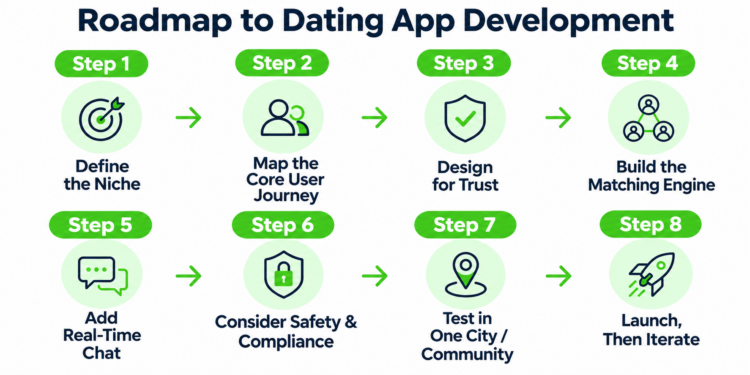
Building a dating app is a sequence of deliberate business and technical decisions. Rushing to the code before defining the business logic leads to expensive rewrites. Here is the exact process to follow:
Step 1: Define the Niche and Revenue Model First
Decide who the app is for and how it makes money before any design work starts. A general swipe app and a faith-based niche app require entirely different onboarding flows, moderation rules, and pricing structures.
For example, a luxury dating app like Raya relies on a highly vetted application process and a flat membership fee, whereas a faith-based app like Upward uses a freemium model. Remember, your niche dictates your monetization path.
Step 2: Map the Core User Journey
The user flow must follow a strict order: Sign-up, profile build, discovery, match, and chat. Every screen must earn its place. If a step delays the user from seeing their first swipe deck, cut it. In short, frictionless onboarding is mandatory for retention.
For example, look at Tinder’s onboarding. It requires an email or phone number, a few photos, and basic demographic data. It takes less than two minutes to reach the first swipe. If you force users through a 50-question personality survey before showing them a single profile, they will abandon the app.
Step 3: Design for Trust from Screen One
Trust is your strongest retention tool. Photo verification, clear reporting controls, and visible safety messaging reduce churn from users who leave after one bad interaction. So, build these elements into the UI from the start, so users feel secure before they ever send a message.
For example, Bumble introduced AI-driven photo verification, requiring users to submit a selfie that matches their profile photos to earn a blue checkmark. Hinge places the “Report” and “Block” buttons prominently on the chat screen, ensuring users do not have to hunt for safety tools when they feel uncomfortable.
Step 4: Build the Matching Engine Early, Not Last
Do not treat the matching algorithm as an afterthought. Even a simple rules-based scorer (filtering by location, age range, and shared interests) needs real usage data to improve. Thus, ship this logic with your MVP so it starts learning from user behavior immediately.
For example, Hinge uses the Gale-Shapley algorithm (originally designed for stable marriages) to power its “Most Compatible” feature. Even if your MVP just uses a basic weighted score (e.g., Location 40%, Shared Interests 60%), it needs to be live from day one to track which matches result in conversations.
Step 5: Add Real-Time Chat and Notifications
Instant messaging and push notifications drive the daily-return habit that makes a dating app profitable. Notifications for new matches and unread messages pull users back into the app. Thus, the chat infrastructure must handle high concurrency without latency.
For example, Bumble’s core mechanic is the 24-hour chat window. If a male-female match occurs, the female must message within 24 hours, or the match expires. This mechanic, powered by real-time push notifications, creates urgency and a daily habit loop.
Step 6: Put Safety and Compliance in the Build
Age verification, content moderation, and data privacy controls (GDPR, CCPA, and region-specific rules) are far cheaper to build initially than to retrofit. So, if you are handling sensitive user data and photos, security architecture must be part of the initial database design.
For example, instead of building a manual moderation team, integrate AI tools like AWS Rekognition or Google Cloud Vision to automatically flag explicit content upon image upload. For age verification, integrate APIs like Stripe Identity or Yoti.
Step 7: Test With a Closed Beta in One City or Community
Dating apps need density. A thin national launch produces empty swipe decks and kills retention before the product has a fair shot. Therefore, launch in a single city or a specific community to ensure users actually see active profiles and get matches.
For example, Facebook launched exclusively at Harvard University before expanding to other colleges. Tinder threw launch parties at fraternities and sororities at USC to ensure the app had critical mass in one specific area. So, if you launch globally with only 1,000 users, those users will be spread across 500 cities, resulting in zero matches and immediate uninstalls.
Step 8: Launch, Then Iterate on the Data
Once your online dating mobile app is live, make sure you rely on metrics over guesswork. Match rate, message response rate, and Day-7 retention will tell you exactly what works, what doesn’t work, and what to fix.
For example, if your data shows a high match rate but a low message response rate, your users are experiencing “match fatigue,” or your icebreakers are weak. If Day-7 retention is low, look at your notification strategy. You may need to introduce a “Daily Drop” feature or AI-generated conversation starters to give users a reason to return after the initial dopamine hit wears off.
AI Features for Dating App Development
AI dating apps are shifting the game from simple matching engines to proactive assistants. Hinge is testing an AI “photo finder” to identify the best profile pictures, while Tinder is piloting AI matchmaking features that analyze user behavior to suggest compatible partners.
Here are some trending AI features and the specific tech behind them:
| AI feature | How it works (The Tech) | Business impact |
| Compatibility scoring | Uses PyTorch/TensorFlow to rank profiles based on behavior, stated preferences, and past outcomes. | Higher match rate, longer session time |
| AI-generated icebreakers | Integrates OpenAI GPT-4o or Anthropic Claude 3.5 via API to suggest opening messages based on shared profile details. | Fewer unanswered first messages |
| Photo and identity verification | Uses AWS Rekognition or Azure AI Vision for liveness checks and face matching against uploaded photos. | Fewer catfish reports, higher trust |
| Chat moderation | NLP flags harassment, scams, and explicit content in real-time before a human moderator intervenes. | Lower moderation headcount, faster response |
| Fake profile detection | Behavioral signal analysis (swipe speed, message patterns, device fingerprinting) catches automated bot accounts. | Cleaner user base, better advertiser trust |
| AI companion persona | A persistent LLM-driven character with memory (using RAG architecture), used in standalone AI girlfriend or AI companion apps. | New subscription category, distinct from matchmaking |
How Much Does It Cost to Develop a Dating App Like Tinder?
If you are wondering how much it costs to build a dating app like Bumble or Tinder, here is how the budget breaks down based on individual features:
- UI/UX Design & Swipe Mechanics: $5,000 – $10,000
- Real-Time Chat & Push Notifications: $8,000 – $15,000
- Geolocation & Matching Engine (PostGIS): $10,000 – $20,000
- AI Verification & Moderation (AWS Rekognition): $5,000 – $12,000
- Admin Dashboard & Analytics: $7,000 – $15,000
- Payment Gateway Integration (Stripe/IAP): $3,000 – $5,000
A few line items push the number up regardless of stage. For instance, identity verification vendors, content moderation tooling, and compliance work for regions with strict data laws each add $5,000-$20,000. Ongoing costs after launch typically run 15-25% of the build cost per year, in line with standard AI app economics.
Here are the total build stage estimates:
| Build stage | What’s included | Timeline | Approximate cost (USD) |
| MVP | Swipe UI, profiles, basic rules-based matching, chat, one platform or cross-platform | 2-4 months | $30,000 – $70,000 |
| Mid-level app | AI compatibility scoring, photo verification, admin panel, payments, iOS and Android | 4-7 months | $70,000 – $150,000 |
| Advanced AI-native platform | Custom ML matching, video/voice calling, fraud detection, AI companion features, multi-region compliance | 7-12+ months | $150,000 – $350,000+ |
Tech Stack Used for Building a Dating App in 2027

Building a dating app requires high-throughput infrastructure. The tech stack must handle real-time messaging, image processing, and complex spatial queries. Here’s the tech stack for dating application development:
- Frontend: Swift and SwiftUI for iOS, Kotlin and Jetpack Compose for Android, or Flutter / React Native for cross-platform.
- Backend: Node.js, Python, or Go, with GraphQL or REST APIs serving the mobile clients.
- Real-time chat: Socket.io, Firebase, or a dedicated service such as Stream or Sendbird for message delivery and typing indicators.
- Video and voice calling: WebRTC-based SDKs such as Agora or Twilio for in-app calls.
- Geolocation: Google Maps Platform or Mapbox for distance-based discovery.
- AI and LLM layer: OpenAI GPT, Anthropic Claude, or Google Gemini for icebreakers and companion personas; TensorFlow or PyTorch for custom compatibility-scoring models.
- Moderation and verification: AWS Rekognition, Hive, or Microsoft Azure Content Moderator for photo and chat screening; dedicated liveness-check vendors for identity verification.
- Databases: PostgreSQL or MongoDB for profile and match data, Redis for session and real-time state.
- Payments: Stripe, Apple In-App Purchase, and Google Play Billing for subscriptions and consumables.
- Cloud and infrastructure: AWS, Google Cloud, or Azure, with Kubernetes and Docker for scaling the matching service independently from chat.
Why Choose Code Brew Labs for Dating App Development?

Building a dating app requires more than just coding a clone. It requires a dating app development partner who understands the delicate balance of database architecture, AI integration, and user privacy.
Code Brew Labs brings 13+ years of engineering experience. Our mobile app development team holds a portfolio of over 5,000 apps delivered globally, including complex, regulated platforms across fintech, healthcare, and on-demand services.
Furthermore, we hold Clutch Top App Development Company and Top AI Company recognitions.
Here is how our specific capabilities align with your next dating app development project:
-
AI Features Tied to Real Workflows
We do not bolt AI onto an app as an afterthought. Our teams build predictive matchmaking models, conversational AI agents, and computer vision systems for photo verification that directly integrate into your core user journey. For dating apps, this means smarter recommendations, better profile quality, and reduced catfishing.
-
Native and Cross-Platform Delivery
We build native iOS and Android apps when performance and security hardening matter most, and we use Flutter or React Native when you need a single codebase for faster releases. For a dating app handling real-time messaging and high-concurrency swipes, we choose the stack that fits your scale and budget.
-
Secure, High-Concurrency Architecture
Dating apps are I/O-heavy. Our engineering teams build backends on Node.js and Python with Redis for atomic match detection and PostgreSQL with PostGIS for geolocation queries. We design for race conditions so that when two users swipe right on each other simultaneously, the system registers exactly one match, reliably.
-
Compliance and Data Privacy
Because we build for healthcare and fintech, we apply strict standards to dating apps. We implement OWASP Mobile Top 10 guidelines to prevent vulnerabilities, use AES-256 encryption for user data at rest, and integrate APIs like Stripe Identity for smooth age verification and KYC compliance.
-
Proven Track Record
Our portfolio includes AI-powered platforms for Google, Walmart, Nielsen, and Dubai’s leading health insurance provider. We also hold Clutch Top App Development Company and Top AI Company recognitions for the UAE.
Want to see how we approach app development? Watch the video below:
Conclusion
Building a dating app like Tinder is a known problem with a known shape: profiles, discovery, matching, chat, and a monetization loop layered on top. What separates a product that survives its first year from one that doesn’t is the niche it picks, how early safety and moderation get built in, and how much of the matching work AI actually does. The build steps, costs, and tech choices above give a realistic starting point.
Ready to disrupt the online dating market?
Let us handle the high-concurrency architecture, AI integration, and compliance so you can focus on user acquisition.
Frequently Asked Questions
How to build a dating app?
Start by defining the niche and monetization model, then build the core loop: profile setup, discovery, matching, and chat, with safety and verification included from the MVP rather than added later.
How much does it cost to build a dating app?
An MVP typically runs $30,000-$70,000. A mid-level app with AI matching and verification runs $70,000-$150,000. An advanced AI-native platform with custom ML, video, and companion features can reach $150,000-$350,000 or more.
How long does it take to build a dating app?
An MVP takes 2-4 months. A mid-level app takes 4-7 months. An advanced AI-native platform takes 7-12 months or longer, depending on compliance and custom model work.
How to build an AI girlfriend app?
To build an AI girlfriend app, treat it as a conversational AI product: an LLM-driven persona with persistent memory, voice synthesis, strict content and age-verification guardrails, and a subscription model tied to depth of interaction rather than matches.
How to build an AI dating app?
Add a compatibility-scoring model, AI-generated icebreakers, and fraud or fake-profile detection on top of the standard dating app loop. Most teams start with a hosted LLM API for conversational features and move to custom models once usage justifies the cost.
How to develop a dating app like Tinder specifically?
To build a Tinder clone, replicate the core loop (swipe, match, chat) and the freemium-plus-boosts monetization model, then differentiate through a defined niche, stricter safety features, or AI-driven matching that a general-purpose app doesn’t offer.
Is building a dating app profitable?
It can be, with the right audience density and monetization mix. Subscriptions, consumable boosts, and visibility features give founders several revenue streams rather than one, but profitability depends heavily on user acquisition cost staying below lifetime value.
Do I need AI to compete in 2027?
Not for every feature, but compatibility scoring, verification, and moderation are now closer to baseline expectations than differentiators, especially against apps already running them. Reach out to us for more info.
Let's Convert Your Business Idea Into Success!
Free Consultation from Top Industry Experts
Let’s Build Your Dream App!
Share article on :


Ready To Fuel Your Vision With AI-Powered Innovation?





Level- 18, Dubai World Trade Centre Tower, Sheikh Rashid Tower, Sheikh Zayed Rd, Dubai, UAE
business@code-brew.com +971-55-645-7972
Plot no I - 36, Sector 83 Alpha, Mohali SAS Nagar 140308
business@code-brew.com +91-771-976-8427
Al Akaria 2, 6926 Olaya Street, RHOA2566, Riyadh, Saudi Arabia.
business@code-brew.com
Av. Miguel Hidalgo y Costilla 1995, Arcos Vallarta, 44600 Guadalajara, Mexico
business@code-brew.com +1(213)2614953
4231 Balboa Ave #512 San Diego, CA 92117 United States
business@code-brew.com +1(213)2614953
2nd floor, College House, 17 King Edwards Rd, London HA4 7AE, UK
business@code-brew.com +44 (20) 82644493
Partner With Experts Who Leverage AI & Tech To Transform Ideas Into Market-Leading Solutions.
Wait! Looking for Right Technology Partner For Your Business Growth?
It's Time To Convert Your Business Idea Into Success!
Get Free Consultation From Top Industry Experts:
I would like to keep it to myself