Table of Content


Quick Summary:
- $800 Billion Market by 2027: Global app revenue keeps climbing while installs stay flat. Retention, not downloads, drives growth.
- 20 App Ideas With Real Revenue Models: From AI assistants and finance trackers to telemedicine, pet care, and small landlord tools.
- Build Complexity Ranges Widely: Small landlord apps and sustainability trackers ship in 2–3 months. Super apps take 9–12+ months.
- Subscription Apps Earn Steadiest Revenue: AI, health, finance, and education lead. Marketplaces earn more overall but cost more upfront.
- Cross-Platform Cuts Build Time by a Third: Flutter and React Native let one team ship iOS and Android from a single codebase.
- AI In-App Purchase Revenue Hit $4 Billion: H1 2026 revenue rose 36% from the previous half, led by AI-powered apps.
- Validate Before You Build: Talk to 20–30 real users. A focused MVP takes 3–4 months and costs $25,000–$80,000.
Planning to build a mobile app in 2027? The most important question is not which category is hot. It is which problems people will pay to solve on their phones, and how quickly you can reach them. This guide covers twenty mobile app ideas with clear revenue paths, the technologies behind them, and what successful apps did right.
Table of Content
The Mobile App Market Overview
Mobile app revenue is exploding. Global app revenue will hit $800 billion by 2027, showing an annual growth rate (CAGR 2026-31) of 8.17%. Meanwhile, installs grew just 0.8% last year. What did grow? Time spent. Users now spend 5.3 trillion hours in apps, about 3.6 hours per person per day.
Why businesses keep investing in mobile app development:
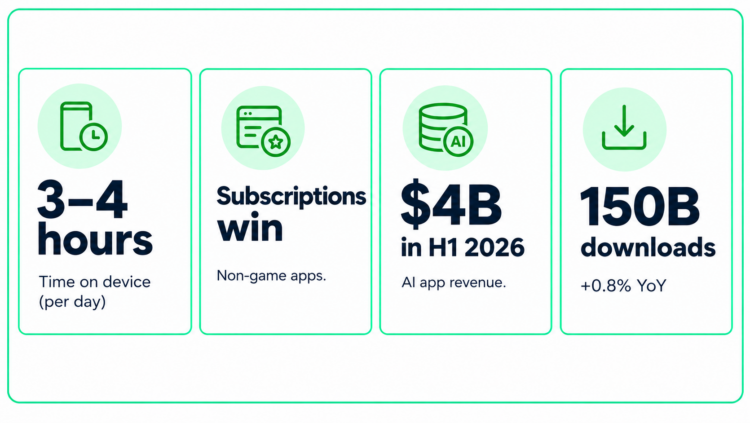
- Time on device: People spend 3-4 hours a day on mobile apps.
- Subscriptions win: Non-game app revenue now comes mostly from subscriptions, led by streaming, dating, productivity, and AI apps.
- AI is a new revenue line: Global in-app purchase revenue from AI apps hit $4 billion in H1 2026, a 36% rise from the second half of 2025.
- Downloads are flat; spending is up: Global downloads have edged up 0.8% YoY to around 150 billion.
That last point shapes every idea below. Winning in 2027 means building something people return to weekly. After all, the money is no longer in getting downloads. It is in getting people to stay, pay, and come back.
Top 20 Mobile App Development Ideas to Make Money in 2027
Which ideas for mobile app development will make money in 2027? Below are the twenty app ideas that make money, backed by real revenue signals. Some are consumer plays. Others are B2B tools quietly clearing seven figures. Each one fills a gap that larger apps and AI assistants have not addressed.
1. AI Personal Assistant for a Single Profession
General chatbots are crowded. A focused assistant for real estate agents, nurses, or truck dispatchers is not. It drafts messages, summarizes calls, and tracks tasks using that job’s vocabulary.
Revenue model: Monthly subscription, often $15-$50 per user, with team plans.
Ideal for: Solo professionals and small teams in service industries who spend hours on repetitive admin work.
2. Personal Finance and Budgeting App
Apps like YNAB and Monarch Money proved that users will pay to understand their spending. Bank-data APIs such as Plaid make account syncing standard. The open space now is in regional markets and specific groups, like freelancers who need tax set-asides.
Revenue model: Subscription, plus referral fees from financial products.
Ideal for: Freelancers, gig workers, and households in underserved regional markets.
3. Buy Now, Pay Later and Micro-Lending Apps
Klarna and Afterpay built the consumer side. Small retailers in emerging markets still lack simple credit tools. A merchant-facing app that offers short-term inventory loans fills that gap.
Revenue model: Merchant fees and interest. Needs lending licenses in most regions.
Ideal for: Small merchants and store owners in markets where traditional credit is slow or unavailable.
4. Telemedicine and Virtual Care
Teladoc and Practo showed that video consultations work at scale. Growth in 2027 sits in specialty care: dermatology, mental health, women’s health, and chronic disease follow-ups.
Revenue model: Per-consultation fees, subscriptions, or B2B contracts with employers and insurers.
Ideal for: Specialty clinics, independent practitioners, and employers offering virtual care benefits.
5. Mental Health and Sleep App
Calm and Headspace each built businesses worth over a billion dollars on guided audio. Newer mental health apps add mood tracking, therapist chat, and wearable sleep data.
Revenue model: Annual subscriptions, which reduce churn, plus corporate wellness plans.
Ideal for: Individuals managing anxiety, insomnia, or burnout — and HR teams building wellness programs.
6. AI Fitness and Nutrition Coach
These types of mobile apps read data from an Apple Watch or Fitbit and adjust workouts and meals each week. Users get coaching that once required a personal trainer.
Revenue model: Freemium with a paid tier at $10-$30 a month.
Ideal for: Fitness enthusiasts who want personalized coaching without the cost of a trainer.
7. Care and Remote Monitoring
Populations in Japan, Europe, and North America are aging fast. Families want fall alerts, medication reminders, and caregiver scheduling in one app.
Revenue model: Family subscriptions and partnerships with home-care agencies.
Ideal for: Adult children caring for aging parents and home-care agencies managing remote patients.
8. Quick Commerce and Hyperlocal Grocery Delivery
India’s Blinkit and Zepto turned 10-minute grocery delivery into a mainstream habit, using small “dark stores” close to customers. Smaller cities and specialty goods, such as pharmacy, pet supplies, and organic food, are still underserved.
Revenue model: Delivery fees, product margins, and in-app advertising from brands.
Ideal for: Entrepreneurs in tier-2 and tier-3 cities and niche grocery categories with loyal demand.
9. Multi-Service Super App
Gojek in Indonesia and Careem in the Middle East combine rides, food, payments, and parcels in one app. Therefore, regional players can follow the same model city by city.
Revenue model: Commission on each service, plus wallet and payment fees.
Ideal for: Regional operators with existing user bases in one vertical looking to expand into others.
10. Social Commerce and Live Shopping
TikTok Shop showed that people will buy straight from creator videos. A live-shopping app for one niche, like fashion resale, beauty, or home decor, can win where general platforms feel crowded.
Revenue model: Sales commission, seller subscriptions, and promoted listings.
Ideal for: Niche sellers and creators with engaged audiences who want to sell live.
11. Recommerce and Resale Marketplace
Vinted and ThredUp grew on secondhand fashion. Electronics, furniture, and children’s gear follow the same pattern, especially as buyers watch costs and waste.
Revenue model: Buyer protection fees, seller commissions, and shipping margins.
Ideal for: Buyers and sellers in categories where resale value stays high — fashion, electronics, baby gear.
12. EV Charging and Route Planner
Electric vehicle drivers still deal with broken chargers and unclear pricing. An app that shows live charger status, books slots, and plans trips around range solves a daily frustration.
Revenue model: Booking fees, charging-network partnerships, and premium route features.
Ideal for: EV owners in regions where charging infrastructure is uneven or unreliable.
13. AI Tutoring and Exam Prep
Duolingo, Byju’s rise and fall, and Khan Academy’s Khanmigo show both the size and the risks of this category. Apps focused on one exam, with adaptive practice, keep costs and churn low.
Revenue model: Subscriptions, one-time course purchases, and school licenses.
Ideal for: Students preparing for a specific certification, entrance exam, or professional credential.
14. Corporate Upskilling and Microlearning
Companies need to retrain staff on AI tools, compliance, and soft skills. Five-minute lessons on a phone fit around shift work better than desktop courses.
Revenue model: B2B licenses priced per seat.
Ideal for: HR and L&D teams in companies with deskless or shift-based workforces.
15. On-Demand Home Services
Urban Company in India and Angi in the US connect households with vetted cleaners, plumbers and electricians. Verified reviews and fixed upfront pricing are what will be keeping customers loyal.
Revenue model: Commission per booking, usually 15-25%, plus subscriptions for service providers.
Ideal for: Homeowners in urban areas who want reliable, vetted service providers on demand.
16. Pet Care Platform
Pet owners spend heavily on vets, food, grooming, and sitting. Rover built a large business on sitters alone. An app that adds vet chat, food reorders, and health records can earn from several angles.
Revenue model: Booking commissions, product sales, and care subscriptions.
Ideal for: Pet owners who want one app for vet access, grooming, food, and sitters.
17. Property Management for Small Landlords
Landlords with two to twenty units often still collect rent by bank transfer and track repairs in spreadsheets. A mobile app for rent collection, tenant chat, and maintenance requests saves them hours each month.
Revenue model: Monthly fee per unit, plus payment processing fees.
Ideal for: Independent landlords managing 2-20 units without property management software.
18. Creator Monetization Tools
Patreon and Substack showed that fans pay creators directly. Mobile-first tools for paid communities, tips, and digital downloads serve creators who want to earn outside ad revenue sharing.
Revenue model: Percentage of creator earnings, often 5-12%.
Ideal for: Independent creators building paid communities outside YouTube and Instagram.
19. Travel Planning With AI Itineraries
Travelers jump between booking sites, maps, and notes apps. One app that builds an itinerary, tracks bookings, and adjusts plans when a flight is delayed solves real friction.
Revenue model: Affiliate commissions from hotels, flights, and tours, plus a premium tier.
Ideal for: Frequent leisure travelers who plan multi-city trips and want one place to manage everything.
20. Sustainability and Carbon Tracking
To Good To Go, which sells surplus restaurant food at a discount, reported over 100 million registered users. Apps that make greener choices cheaper, from food waste to energy use, attract both users and corporate sponsors.
Revenue model: Transaction fees, brand partnerships, and B2B reporting tools.
Ideal for: Eco-conscious consumers and brands looking to reach them through sustainability programs.
Have an idea from this list, or your own?
Our team has built apps across every category on this page — from on-demand delivery to telemedicine to AI assistants.
Quick Comparison of All 20 Mobile App Ideas
Here is a side-by-side view of every mobile app development idea in this list, so you can quickly compare revenue models, build complexity, and time to MVP before deciding what fits your budget and team.
| App Idea | Revenue Model | Complexity | Time to MVP | Ideal For |
| AI Personal Assistant | Subscription | Medium | 3–4 months | Solo professionals and small teams in service industries |
| Finance, Budgeting App | Subscription, referrals | Medium | 3–4 months | Freelancers, gig workers, and households |
| Buy Now, Pay Later App | Fees, interest | High | 6–9 months | Small merchants and store owners |
| Telemedicine, Virtual Care | Consult fees, B2B | High | 6–9 months | Specialty clinics, practitioners, and employers |
| Mental Health App | Annual subscription | Medium | 3–4 months | Individuals managing anxiety, insomnia, or burnout |
| AI Fitness, Nutrition Coach | Freemium | Medium | 3–4 months | Fitness enthusiasts wanting personalized coaching |
| Aged People Care, Remote Monitoring | Family subscription | Medium | 3–5 months | Adult children and home-care agencies |
| Quick Commerce, Hyperlocal Grocery | Delivery fees, margins | High | 6–10 months | Tier-2/3 city founders and niche grocery categories |
| Multi-Service Super App | Commissions, payments | Very High | 9–12+ months | Regional operators expanding across verticals |
| Social Commerce, Live Shopping | Commission, ads | High | 6–10 months | Niche sellers and creators with engaged audiences |
| Recommerce, Resale Marketplace | Commission, fees | Medium | 4–5 months | Buyers and sellers in fashion, electronics, baby gear |
| EV Charging, Route Planner | Booking fees | Medium | 4–5 months | EV owners in regions with uneven charging |
| AI Tutoring, Exam Prep | Subscription | Medium | 4–5 months | Students preparing for certifications or exams |
| Corporate Upskilling, Microlearning | Per-seat licenses | Medium | 4–5 months | HR and L&D teams with shift-based workforces |
| On-Demand Home Services | Commission | Medium | 4–5 months | Urban homeowners wanting vetted providers |
| Pet Care Platform | Commission, products | Medium | 4–5 months | Pet owners wanting one app for all pet needs |
| Property Management | Per-unit fee | Low to Medium | 2–3 months | Independent landlords with 2–20 units |
| Creator Monetization | Revenue share | Medium | 4–6 months | Independent creators building paid communities |
| Travel Planning With AI | Affiliate, premium | Medium | 4–6 months | Frequent leisure travelers planning multi-city trips |
| Sustainability, Carbon Tracking | Fees, partnerships | Low to Medium | 2–3 months | Eco-conscious consumers and partnering brands |
Technologies Shaping App Development in 2027
The mobile app development ideas above depend on a short list of technologies. You do not need all of them. You need the ones that make your core feature faster, cheaper, or more accurate.
-
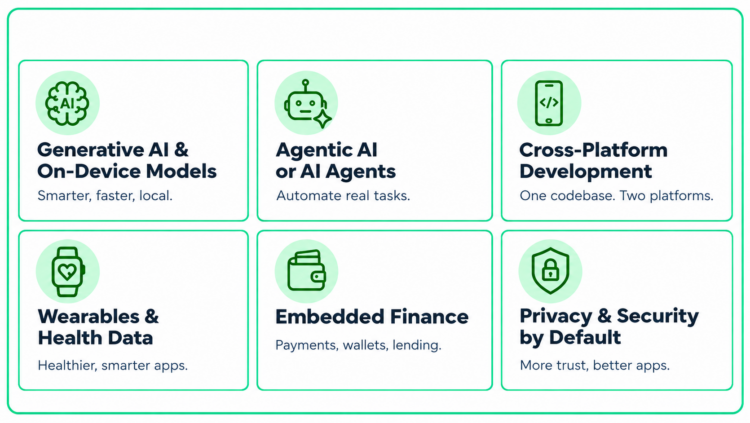
Generative AI and On-Device Models
Large language models from OpenAI, Anthropic, and Google now power chat, search, and content features inside apps. Apple Intelligence and Google’s Gemini Nano also run smaller models directly on the phone, which cuts server costs and keeps personal data local.
-
Agentic AI or AI Agents
AI agents go a step beyond chat. They can book an appointment, fill out a form, and reorder groceries on the user’s behalf. Expect this to show up first in travel, commerce, and productivity apps.
-
Cross-Platform Development
React Native and Flutter let one team ship iOS development and Android development apps from a single codebase. For most startup businesses, that cuts development time by a third or more compared with two native apps.
-
Wearables and Health Data
Apple HealthKit and Google’s Health Connect give access to steps, heart rate, and sleep. This is made possible with any user permission. Insurance, aged people care, and fitness app development would rely on this data.
-
Embedded Finance
APIs from Stripe, Plaid, and Razorpay let any app add payments, wallets, or lending without becoming a bank. Gig, commerce, and property listing apps use them to earn on transactions.
-
Privacy and Security by Default
Apple’s App Tracking Transparency and Google’s Privacy Sandbox changed how apps track users. Biometric login, passkeys, and clear consent screens now affect store approval and user trust.
4 Real-World Examples of Successful Apps
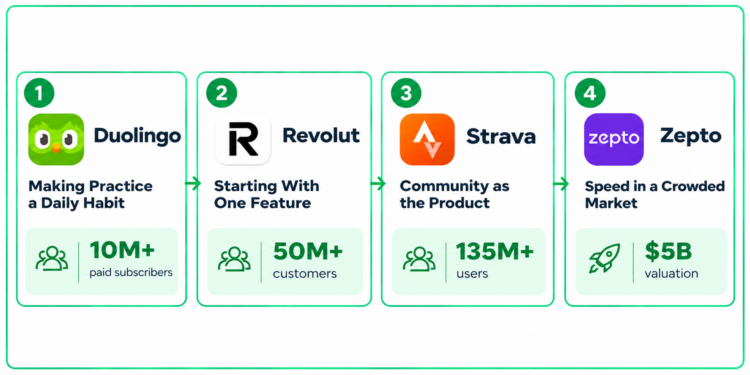
The apps below come from different sectors. They share one trait: each found a single habit worth paying for, then built around it. Here are some inspirations for your next mobile app business ideas:
1. Duolingo: Making Practice a Daily Habit
Duolingo’s streaks, reminders, and short lessons turned studying into a two-minute routine. The company reported more than 10 million paid subscribers by the end of 2024. Most users never pay, yet the free tier feeds the paid one.
Lesson: Retention features earn more than acquisition spending.
2. Revolut: Starting With One Feature
Revolut launched in 2015 as a cheap way to spend abroad without currency fees. It added stocks, crypto, and business accounts later. By 2024, it reported over 50 million customers and its most profitable year so far, with pre-tax profit above £1 billion.
Lesson: Solve one costly problem well before adding a second.
3. Strava: Community as the Product
Strava tracks runs and rides, but its real draw is the social feed and segment leaderboards. It reported more than 135 million users in 2024 and raised funding at a $2.2 billion valuation in 2025.
Lesson: Social features turn a utility into something people check daily.
4. Zepto: Speed in a Crowded Market
Founded in 2021 by two Stanford dropouts, Zepto entered India’s grocery market against much larger rivals. Its focus on dark stores and 10-minute delivery helped it reach a reported $5 billion valuation in 2024.
Lesson: A faster or simpler experience can beat bigger budgets.
How to Build a Mobile App That Makes Money?
A good mobile app development idea indeed fails without a product people enjoy using. The most common mistake is building ten features for launch. Two great ones will earn more than ten average ones.
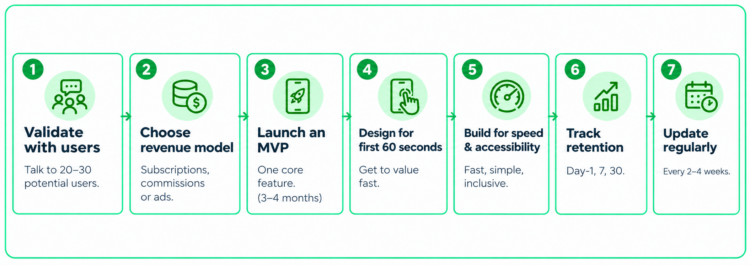
These seven steps explain how to build a profitable mobile app:
- Validate before you build. Talk to 20-30 potential users. Run a landing page or waitlist. If nobody signs up, change the idea, not the marketing.
- Pick your revenue model early. Subscriptions, commissions, and ads each need different screens and flows. Adding payments after launch usually means rework.
- Launch an MVP with one core feature. Ship the smallest version that solves the main problem. A focused MVP often takes 3-4 months.
- Design for the first 60 seconds. Users who do not reach value quickly tend to leave. Cut sign-up steps, ask for permissions only when needed, and show the main feature first.
- Plan for speed and accessibility. Slow load times and small tap targets cost you users. Follow Apple’s Human Interface Guidelines and Google’s Material Design to meet store expectations.
- Measure retention, not downloads. Track day-1, day-7, and day-30 retention. Tools like Firebase, Mixpanel, or Amplitude show where users drop off.
- Release updates on a schedule. Apps that update every two to four weeks with fixes and small features tend to hold better store ratings, which raises visibility in search.
Why Code Brew Labs for Your Next App Idea?
With 13+ years of experience and over 5,000 apps delivered, Code Brew Labs is an award-winning mobile app development firm. Our 350+ in-house engineers have shipped apps for clients including Airbus, ACWA Power, and BharatPe.
Many of the twenty mobile app ideas above are categories we already build in, including on-demand, medicine delivery, fintech, eCommerce, education, and AI-powered apps. Explore our portfolio to view apps across these categories.
Here is what working with us looks like:
- Discovery first. Every project starts with scoping workshops that turn your app startup idea into a feature list, a timeline, and a fixed estimate.
- Ready-made app solutions. For proven models like food delivery, taxi booking, or home services, our pre-built solutions cut launch time from months to weeks.
- AI built in where it pays off. Our team adds chatbots, recommendation engines, image recognition, and AI agents only where they improve retention or revenue.
- One team, full lifecycle. Product strategy, UI/UX design, development, QA, launch, and post-launch support stay under one roof.
- You own the code. Source code and intellectual property transfer to you.
Final Remarks
The high-demand app ideas for 2027 sit where daily habits meet a clear way to pay. The pattern behind great mobile app ideas is consistent. Each solves one problem, builds features that bring users back, and expands only after people pay. Before you commit a budget, test demand with real users, choose a revenue model from day one, and keep your first release small. The winners in 2027 will be the teams that choose the right problem and execute with focus.
Ready to Build Your Own Success Story?
Duolingo, Revolut, Strava, and Zepto all started with one focused idea. Tell us yours, and we will help you scope the MVP that gets you to market.
Frequently Asked Questions
Which type of app makes the most money in 2027?
Subscription apps in AI, health, finance, and education tend to earn the steadiest revenue. Marketplaces and on-demand apps can earn more in total but need higher upfront spending to attract both buyers and sellers. Lastly, it is always good to look at addictive simple apps business models, especially if your budget is tight.
How much does it cost to build a mobile app?
A focused MVP usually costs $25,000-$80,000. Apps with AI features, payments, or marketplace logic often range from $60,000 to $200,000. Ready-made solutions can lower the cost for common models like delivery or booking apps.
How long does it take to develop a mobile app?
A simple MVP takes 3-4 months. A feature-rich app with integrations takes 6-9 months. However, using a pre-built solution can shorten the launch to a few weeks.
What is the best monetization model for a new app?
It depends on the usage. Apps used daily suit subscriptions. Apps that connect buyers and sellers suit commissions. Free utility apps with large audiences can earn through ads, though ad revenue per user is usually low.
Should I build a native or cross-platform app?
Cross-platform app development solutions like React Native and Flutter suit most startups, since one codebase covers iOS and Android. Native development makes sense for apps that rely on heavy graphics, AR, or deep hardware access.
How do I protect my unique mobile app idea?
Sign NDAs with developers and partners, register your trademark, and make sure your contract assigns full code and IP ownership to you. For more clarity, feel free to connect with us!
Let's Convert Your Business Idea Into Success!
Free Consultation from Top Industry Experts
Let’s Build Your Dream App!
Share article on :


Ready To Fuel Your Vision With AI-Powered Innovation?


Level- 18, Dubai World Trade Centre Tower, Sheikh Rashid Tower, Sheikh Zayed Rd, Dubai, UAE
business@code-brew.com +971-55-645-7972
Plot no I - 36, Sector 83 Alpha, Mohali SAS Nagar 140308
business@code-brew.com +91-771-976-8427
Av. Miguel Hidalgo y Costilla 1995, Arcos Vallarta, 44600 Guadalajara, Mexico
business@code-brew.com +1(213)2614953
4231 Balboa Ave #512 San Diego, CA 92117 United States
business@code-brew.com +1(213)2614953
2nd floor, College House, 17 King Edwards Rd, London HA4 7AE, UK
business@code-brew.com +44 (20) 82644493
Partner With Experts Who Leverage AI & Tech To Transform Ideas Into Market-Leading Solutions.
Wait! Looking for Right Technology Partner For Your Business Growth?
It's Time To Convert Your Business Idea Into Success!
Get Free Consultation From Top Industry Experts:
I would like to keep it to myself