Table of Content

Quick Summary:
- AI automation for restaurants uses AI to answer guests, forecast demand, manage stock, and run back-office tasks.
- Just 26% of US operators use AI tools, and 6% let AI take customer orders.
- Returns for restaurant groups hinge on the integration layer, because per-location fees climb with each new unit.
- Published SaaS pricing runs about $79 to $350 per location each month for forecasting, phone, and back-office AI.
- McDonald's says its drive-thru voice AI passes 90% accuracy and will free 50 labor hours a week.
- Hybrid voice AI with human backup now runs in hundreds of Taco Bell and Bojangles drive-thrus.
- A single-site pilot of 60 to 90 days, with exit terms, protects the budget before a group rollout.
- Callers must hear about AI and recording at the start, given TCPA, wiretap, and state disclosure rules.
AI automation for restaurants covers guest-facing agents, voice ordering, forecasting, inventory, and back-office workflows across every location. Costs start near $79 per location per month for SaaS tools, and custom multi-unit builds reach six figures.
Table of Content
More than 9 in 10 operators call food, labor, and insurance costs significant challenges, per the NRA’s outlook. Yet just 26% run AI tools, according to Restaurant Dive, and 6% use AI to take orders.
In multi-unit groups, AI projects stall at the seams between POS, kitchen, guest, and finance systems. Integration decides the return. Twelve use cases, published prices, and a 1-, 5-, and 25-location cost model show where integration pays.
Want to know which restaurant workflows will pay back first, before you sign a vendor contract?
What does AI Automation for Restaurants include?
AI automation for restaurants applies machine learning, language models, and computer vision to front- and back-of-house work. The software answers calls, takes orders, forecasts demand, builds schedules, and reconciles invoices.
Fixed rules stay static, while AI models learn from POS history and adjust to each location.
Restaurant groups meet this technology in three forms, and each decides in its own way. That difference shapes cost, risk, and staff training.
AI vs Rule-Based Automation vs AI Agents
- Rule-based automation follows fixed instructions written by a person. One rule might send parties above eight guests to the events inbox. Such rules break when conditions change.
- Predictive AI learns patterns from history. A forecasting model reads two years of POS tickets, weather, and local events. It then predicts Friday covers by hour.
- AI agents pair a language model with tools and permissions. One agent can read a catering inquiry, check capacity, quote a menu, and book a planner call.
Action separates an agent from a chatbot. Agents write to your systems, so they need limits: confidence thresholds, spending caps, and a manager hand-off.
| Approach | How it decides | Restaurant example | Best for |
| Rule-based automation | Fixed if-then logic | Large parties go to the events inbox | Stable, low-risk routing |
| Predictive AI | Patterns in past data | Hourly cover forecast per store | Forecasting, scheduling, ordering |
| AI agent | Model plus tools and goals | Catering inquiry handled end to end | Multi-step guest and ops tasks |
What AI Workflow Automation for Restaurants Looks Like in a Real Shift
AI workflow automation for US restaurants strings these pieces into one loop. Picture a Thursday afternoon at a fast-casual store facing a heavy dinner forecast.
- Trigger. Avocado stock drops under the evening par level in the inventory system.
- Decision. The forecasting model projects a 40% dinner shortfall from recent Thursday sales.
- Action. An agent drafts a supplier order and flags guacamole as limited on every sales channel.
- Human check. A text reaches the general manager, who approves the order with one reply.
Nobody opened a spreadsheet. Similar loops appear across industries in these AI automation examples businesses run today.
What Pain Points Does AI Automation Solve for Restaurant Groups?
AI automation for restaurant operations targets six problems that grow heavier with every unit a group adds.
Labor Costs and Staff Turnover
Food service loses people faster than almost any sector. The BLS put its quit rate at 3.5% in August 2026, against 1.9% for all jobs.
In the NRA’s 2025 survey, 77% of operators still named recruiting a leading challenge. AI absorbs the tasks new hires dread most: phone duty, schedules, and invoice entry.
Food Cost Inflation and Waste
Ingredient costs keep climbing. USDA ERS reports food-away-from-home prices rose 3.8% in 2025, with 3.5% forecast for 2026. Margins leave little room for error, since 42% of operators were not profitable in 2025. Forecasting cuts the extra pans prepped each night that drain those margins.
Missed Calls and Lost Covers
Phones ring hardest when hosts are busiest. Data from phone-AI vendor Slang AI shows 71% of restaurant calls relate to revenue.
About 26% of calls land during another call or after closing. Every unanswered ring can mean a lost booking, catering order, or takeout ticket.
Disconnected Systems Across Locations
Operational losses cluster where two systems meet. A cancelled delivery order never reaches the kitchen screen, or a sold-out item keeps selling online. Groups running mixed POS brands after acquisitions feel this most. Closing those seams is the work of AI integration services that connect POS, payroll, and CRM data.
Uneven Guest Experience and Review Pressure
Ratings move revenue in measurable steps. A Harvard Business School study tied a one-star Yelp gain to 5% to 9% more revenue.
Multi-unit groups struggle to answer every review in one consistent voice. Slow replies to food-safety complaints carry legal and brand risk.
The Adoption Gap: Why Just 26% of Operators Use AI
Interest runs far ahead of use. Toast’s 2026 survey found 87% of operators comfortable with AI. Among restaurant executives, 82% expect AI spending to rise, per Deloitte.
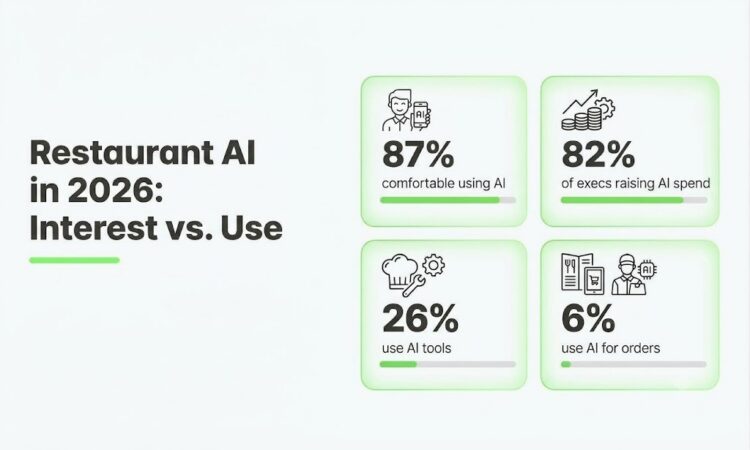
Usage lags well behind. NRA data shows 26% use AI tools, with marketing the top use and order-taking at 6%.
Non-adopters cite privacy (37%), accuracy (34%), and cost (29%) in Restaurant365’s 2026 research. Each barrier gets a direct answer in the sections ahead.
How AI Automation Works in Restaurant Group Systems: The Architecture
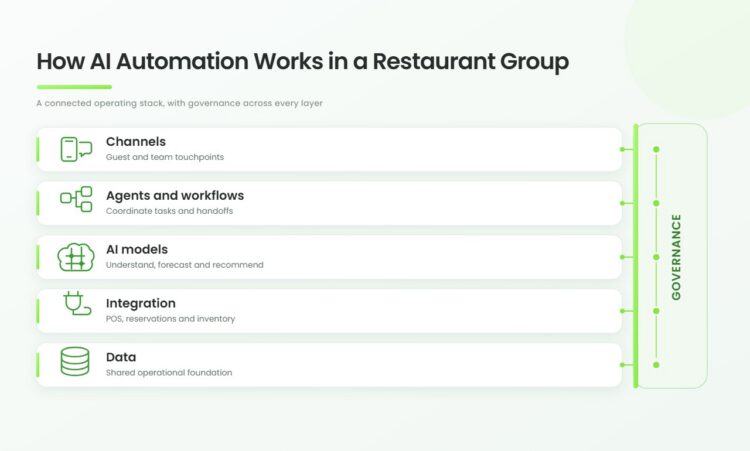
Every restaurant AI deployment runs on five layers plus a governance rail. Skipping one is the most common reason pilots stall after the demo.
-
Data layer
POS platforms such as Toast, Square, Oracle Simphony, NCR Aloha, and PAR Brink hold ticket history. Reservations sit in OpenTable, Resy, or SevenRooms, while delivery orders flow from DoorDash and Uber Eats.
-
Integration layer
APIs and webhooks move data between systems in near real time. A single menu and SKU master maps spoken names like “large spicy” to exact POS items.
-
Intelligence layer
Language models read and write text, while speech-to-text engines transcribe calls. Time-series models forecast demand, and computer vision checks food on the make line.
-
Orchestration layer
A workflow engine decides which model runs, in what order, with which permissions. Agents call tools such as “check table availability,” and low confidence triggers a staff hand-off.
-
Channel layer
Guests arrive by phone, drive-thru speaker, SMS, WhatsApp, web chat, or kiosk. AI assistants such as ChatGPT and Google AI Mode now book tables too.
-
Governance rail
Disclosure scripts, consent capture, and transcript redaction run beside every layer. Card data stays out of AI logs through pay links or keypad entry.
| Layer | Typical systems | What breaks without it |
| Data | POS, KDS, reservations, payroll | Models train on partial history |
| Integration | APIs, webhooks, menu master | Orders and stock fall out of sync |
| Intelligence | LLMs, speech, forecasting, vision | No predictions or language handling |
| Orchestration | Workflow engine, agents | Tasks stop at the first exception |
| Channels | Phone, SMS, chat, AI assistants | Guests cannot reach the system |
| Governance | Consent, logs, hand-offs | Legal exposure and silent errors |
Front-of-House Use Cases of AI Automation for Restaurants
Guest-facing automation earns trust or loses it within seconds. Six use cases carry most of the value at the front of the house, starting with the phone.
24/7 Customer Support and Reservation Management
An AI host answers every call and message, at 2 p.m. or 2 a.m. It handles hours, menu, and allergen questions, then books into OpenTable, Resy, or SevenRooms. AI-powered call automation systems reduce repeat calls with order-status texts and instant confirmations. Waitlists move to text-back, so guests can wait at the bar.
Choosing the best AI agents for automating restaurant reservations via messaging comes down to five checks:
- Live two-way sync with your reservation platform, so no one books a table that is gone.
- Channel coverage across SMS, web chat, and Instagram, with WhatsApp for guests on international numbers.
- Deposit links for large parties and peak slots, which protect the busiest covers.
- Human hand-off that passes the full conversation to a host.
- Consent capture that logs opt-in for every marketing message.
Deposits pay for themselves. OpenTable data shows deposits cut no-shows by 60%, and operators rate reminders as their most effective fix. Custom builds can start from this guide to building an AI voice assistant for phone orders.
Voice Ordering for Phone and Drive-Thru
Voice ordering turns speech into a POS ticket. The system transcribes the guest and matches words to menu items and modifiers. It then reads the order back and fires it to the kitchen.
Upselling comes built in, since a model never forgets to offer fries or a larger drink. Accents, engine noise, and prank orders remain the hard part. Operators exploring this channel often start with conversational AI for phone and drive-thru ordering in US restaurants.
AI Chatbots for Web, SMS and Messaging Apps
Text agents handle ordering, catering intake, and menu questions on the website and over SMS. Guests who prefer typing get the same answers in every store.
Allergen replies need one verified source. The FDA lists nine major food allergens, and outdated menus put guests at risk. Groups comparing options can review specialists in AI chatbot development for restaurant ordering and reservations.
AI-Powered CRM and Loyalty Programs
A restaurant CRM joins guest data from POS, online ordering, and reservations into one profile. AI then predicts each guest’s next order and the moment an offer will land. That prediction drives restaurant AI automation for repeat orders. A guest who orders a family meal most Fridays gets a one-tap reorder link on Thursday.
Loyalty already moves traffic. Per the NRA, 70% of operators with loyalty programs saw traffic rise. Loyalty check sizes grew over 10% at half of full-service brands, per Paytronix. Retention compounds. Bain research, reported in Harvard Business Review, links a 5% retention gain to 25% to 95% higher profit.
The best AI tools for restaurant sales automation build on this data with upsell prompts and lapsed-guest offers. A custom restaurant CRM built around guest visit history keeps that data yours.
WhatsApp and SMS Marketing and Broadcast Campaigns
AI marketing automation for restaurants writes offers by segment, picks send times, and tracks redemptions by store. Channel choice in the US needs care.
WhatsApp counts 100 million US users, and 32% of US adults use it. Marketing broadcasts follow other rules. Meta’s developer documentation states WhatsApp does not deliver marketing templates to US phone numbers. That pause began in April 2025 and still holds.
A workable US setup splits the load:
- SMS for broadcasts. Twilio lists $0.0083 per US message, plus carrier fees.
- WhatsApp for service messages. Order updates, booking confirmations and guests on international numbers stay here.
- Written consent for marketing. The TCPA requires it for promotional texts, as the compliance section explains.
Review Monitoring and Response
AI pulls Google, Yelp, and TripAdvisor reviews into one queue for the whole group. Drafted replies match brand voice, while food-safety complaints go straight to a manager. One line stays firm. The FTC’s rule on fake reviews bans AI-generated reviews and testimonials. AI-drafted replies to real guests remain allowed.
Back-of-House AI Workflow Automation for Restaurant Operations
Back-of-house tools earn less attention than guest-facing ones, yet they run every shift in every store. Kitchen, labor, and finance workflows deliver the steadiest returns.
Online Ordering and Kitchen Workflow Automation
Orders arrive from the brand app, website, DoorDash, Uber Eats, and Grubhub. AI merges them into one queue and sequences kitchen tickets by prep time.
When the line backs up, throttling slows online intake. Stock-outs sync to every channel at once. The best AI solution for restaurant kitchen automation passes three tests. Kitchen screens update in under a second, every channel is covered, and throttling rules stay editable.
Brands building their own channel can explore online ordering app development for US restaurant brands.
Demand Forecasting and Labor Scheduling
Forecasting models predict sales in 15-minute intervals from POS history, weather, holidays, and local events. Scheduling tools then build shifts that fit those forecasts within labor targets.
Accuracy can get tight. Bojangles reports sales forecasts within 0.5% to 0.75% of actuals. Across Restaurant365’s survey, 62% of AI users reported lower labor costs.
Predictive-scheduling laws in New York, Chicago, Seattle, and Oregon require advance notice and premium pay for late changes. Groups needing machine learning models for restaurant demand forecasting should build those rules into the scheduler.
AI Automation for Restaurant Inventory Management and Waste
AI automation for restaurant inventory management sets par levels from forecasts and drafts supplier orders. Waste gets logged by item and shift, and counts move faster with scanning.
Results show up in the bins. McDonald’s reported 15% less food waste from inventory tags. Across 250+ Jimmy John’s stores, Clear COGS reports a 53% average cut in bread waste. A restaurant management system with AI inventory tracking ties those counts to purchasing.
AI Automated Invoice Processing and Accounts Payable for Restaurants
AI automated invoice processing for restaurants reads supplier invoices by OCR and extracts every line item. Each invoice is then matched against purchase orders and receiving records.
Price alerts fire the moment a supplier raises a case price. AI automated payable software for restaurants also assigns GL codes and syncs to QuickBooks, Sage, or Restaurant365.
MarginEdge lists this category at $350 per location a month. Larger groups extend the same logic through intelligent process automation for restaurant back-office finance.
Menu Engineering and Dynamic Pricing
Menu engineering ranks every item by margin and popularity. AI refreshes that ranking each week and flags dishes to promote, reprice, or retire. Live price swings carry brand risk, because guests read them as surge pricing. Daypart specials and bundles capture most of the upside with less backlash.
Computer Vision, Food Safety and Predictive Maintenance
Cameras on the make line check portions and order accuracy before food leaves the kitchen. Sensors log cooler temperatures for food-safety records without clipboards.
Equipment data predicts fryer and ice-machine failures days ahead. Illinois operators should avoid face and voice biometrics under the state’s biometric privacy law. Payback windows in the table reflect Code Brew planning estimates for a mid-size group.
| Use case | Best-fit format | Payback (estimate) | Main risk |
| 24/7 support and reservations | Full service, fast casual | 2 to 4 months | Booking errors without live sync |
| Voice ordering | QSR, pizza, delivery-led | 6 to 18 months | Accents, noise, pranks |
| Chatbots | All formats | 2 to 4 months | Outdated allergen data |
| CRM and loyalty | Fast casual, cafés | 4 to 8 months | Thin first-party data |
| SMS and WhatsApp campaigns | All formats | 1 to 3 months | TCPA consent gaps |
| Review response | Multi-unit groups | 1 to 3 months | Generic replies |
| Online ordering and kitchen | QSR, ghost kitchens | 6 to 12 months | Peak-hour sync failures |
| Forecasting and scheduling | All multi-unit | 3 to 6 months | Scheduling-law breaches |
| Inventory and waste | All formats | 3 to 6 months | Bad counts, bad orders |
| Invoices and AP | Multi-unit finance teams | 2 to 4 months | GL mapping errors |
| Menu engineering | Full service, fast casual | 3 to 6 months | Guest pushback on price |
| Vision and maintenance | QSR at scale | 12 to 24 months | Biometric privacy |
What Advanced AI Automation Systems Are Shipped for Restaurants?
Use cases automate one task each. Advanced systems chain several, with an agent choosing the next step across POS, CRM, and reservation data.
These six systems show what mature AI automation for restaurant groups looks like in production. Most rely on AI agent development for multi-step restaurant workflows.
Multi-Location AI Phone Host With Call Scoring
One phone agent answers for every store and routes calls by location. A second model then scores each call for conversion, upsell, and brand tone, replacing sample-based QA.
Guest Enrichment at the Host Stand
Before a guest reaches the podium, the host tablet shows visit count, allergies, last order, and favorite table. Data-minimization rules decide which fields staff can see.
No-Show and Cancellation Save Desk
A model scores each booking for no-show risk from party size, lead time, and guest history. High-risk slots get deposit requests, and cancellations trigger instant waitlist offers.
Lapsed-Guest Reactivation Engine
The engine finds guests absent for 60 to 180 days and writes offers tied to their past orders. A holdout group proves which visits the campaign created.
Catering and Private-Event Qualifier
An agent captures headcount, date, budget, and dietary needs from a form or call. It checks kitchen capacity, sends a quote, and books a planner call for qualified leads.
Natural-Language Data Assistant for Executives
Leaders ask plain questions, such as which stores ran labor above 28% last week. Answers arrive as tables drawn from POS and payroll data. Code Brew Labs’ Kaizan AI build cut report preparation time by 70%.
How Is AI Workflow Automation Scaling Restaurant Groups?
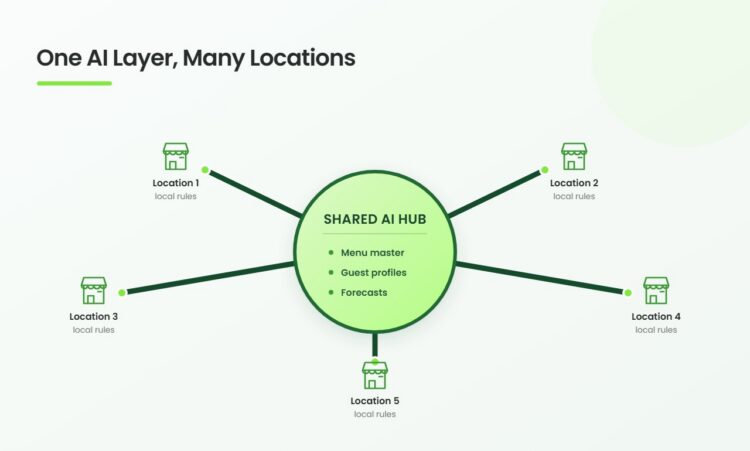
Scale changes AI economics more than any single feature. A tool that works in one store turns expensive across 40 if each store pays its own fee. For a restaurant group, AI cost scales with locations, while AI value scales with shared data.
One Central AI Layer With Location-Level Rules
Mature groups run one central layer holding the menu master, guest profiles, and forecasting models. Each store adds local rules for hours, menu exceptions, staffing, and promotions. New stores plug into a layer that already works. Groups building this setup often look for an AI automation partner for multi-location restaurant groups in the US.
Multi-Brand and Franchise Standardization
Multi-brand groups need one platform that speaks in several brand voices. Franchise systems also need clear rules on guest-data ownership and franchisor reporting.
Speed is possible at this scale. Yum Brands built voice agents in under four months through Byte by Yum, according to NVIDIA. Groups at that stage tend to need enterprise software for multi-unit restaurant operators.
AI Automation Apps for Restaurants and Cafes, by Format
Format decides the first move, since a burger chain and a fine-dining group share almost no starting point. Ghost kitchens differ again, and delivery-first operators can study cloud kitchen platforms for delivery-first brands.
| Format | Start here | Add next | Watch out for |
| Quick service | Voice AI with crew backup | Forecasting, kitchen throughput | Noise, accents, pranks |
| Fast casual | Unified online-order queue | CRM and loyalty | Channel stock-out sync |
| Full service | AI phone host, reservations | No-show desk, review replies | Guests expecting human hospitality |
| Cafés and coffee chains | Mobile ordering, loyalty | Bakery forecasting | Over-personalized offers |
| Ghost kitchens | Order consolidation | Per-brand forecasting | Marketplace data access |
Real-World Applications of AI Automation for Restaurants
Large chains have run the experiments smaller groups can learn from. Their record includes public wins and public failures.
McDonald’s: From the IBM Exit to 90% Voice Accuracy
McDonald’s tested IBM’s order taker in about 100 drive-thrus, then ended the test in 2024. Viral clips of misheard orders made the problems public. A Google Cloud partnership followed. At its September 2026 investor day, McDonald’s put new voice AI accuracy above 90% in two languages.
That system should free at least 50 labor hours per store each week. Inventory tags in the same program cut food waste by 15%.
Taco Bell and Yum Brands: Scale With Humans in the Loop
Taco Bell had processed over two million AI orders when a prank request for 18,000 waters went viral. Leadership responded by keeping humans in the loop at peak hours. Expansion continued. The system now runs in over 890 restaurants across 38 states, matching or beating staff on speed.
Wendy’s FreshAI and Bojangles: Drive-Thru Results by the Numbers
Wendy’s first FreshAI pilot handled 86% of orders without crew help. By May 2025, it ran in over 160 restaurants, with 500 targeted by year-end. Bojangles offers sharper numbers. Its voice AI runs in 452 stores, and staff step in on just 1% to 2% of orders. About 35% of drive-thru workload has moved off crew.
Taco Bell, Wendy’s and Bojangles all scaled voice AI with a crew member ready to step in.
Chipotle, Sweetgreen and Starbucks: AI Beyond the Order Point
Chipotle applied AI to hiring first. Its Ava Cado agent cut time to hire from 12 days to four. The chain also tested the Autocado and Hyphen makeline in California.
Sweetgreen sold Spyce to Wonder for $186.4 million but kept a license to its Infinite Kitchen. Starbucks is rolling out Green Dot Assist, a generative AI helper for baristas.
Where AI Fell Short, and When Not to Automate
Failures teach as much as wins. The SEC issued Presto a cease-and-desist order for overstating how much its voice AI handled alone. Chick-fil-A has chosen to keep its drive-thru human. That choice fits a brand whose guests come for the people at the window.
Automation should wait when any of these conditions hold:
- Personal hospitality is the brand promise, and guests visit for the staff interaction.
- Errors carry high stakes, such as allergen questions without a verified menu source.
- Menu and inventory data are messy, since models amplify bad inputs.
- Volume stays too low for savings to cover per-location fees.
- No human fallback exists during peak hours.
- Disclosure scripts cannot run at the start of every call.
How AI Automation for Restaurants Improves ROI and Revenue
Returns arrive from two directions: more revenue captured and less cost per order. Tracking both shows the full picture.
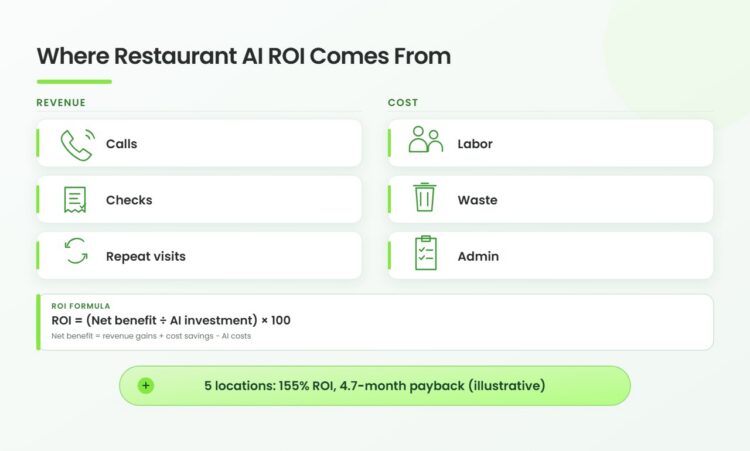
Revenue Levers: Captured Calls, Larger Checks, Repeat Visits
Answered calls turn into bookings and takeout orders that voicemail would have lost. Consistent upsell prompts lift average check, a gain Wendy’s leadership has credited to FreshAI.
Personalized offers bring loyalty members back sooner. Catering qualifiers close large orders that busy managers once missed.
Cost Levers: Labor Hours, Food Waste, Admin Time
Labor savings come from fewer phone hours and tighter schedules. Waste falls when prep follows forecasts instead of habit.
Admin time shrinks once invoices, payroll checks, and reports run without manual entry. In Restaurant365’s 2026 research, 88% of AI users reported time saved every week.
The ROI Formula, With a 5-Location Worked Example
Two formulas cover most decisions:
- ROI % equals annual gains minus annual AI cost, divided by annual AI cost, times 100.
- Payback months equal year-one AI cost divided by gains per month.
Consider a five-location fast-casual group running phone AI, forecasting, and invoice automation. Every input is illustrative, so swap in your own POS data.
- Phone orders: Fifteen extra orders a week, at $32 and 70% margin, add $17,470 per store.
- Labor: Six fewer scheduled hours a week at an $18 loaded rate saves $5,616 per store.
- Waste: A 1.5% cut on $350,000 of annual food purchases saves $5,250 per store.
Gains reach $141,680 across five stores against year-one costs near $55,500. That math returns 155% ROI, with payback in about 4.7 months.
KPIs to Track From Day One
Baselines matter more than dashboards. Capture four weeks of data before launch, then compare results each month.
| KPI | How to measure | Good direction |
| Answer rate | Answered calls divided by total calls | Up |
| Order accuracy | Orders completed with no staff correction | Up |
| Average check | Revenue divided by tickets, by channel | Up |
| Labor % of sales | Labor cost divided by net sales | Down |
| Food cost and waste | Cost of goods and waste log totals | Down |
| No-show rate | No-shows divided by bookings | Down |
| Repeat-visit rate | Guests returning within 30 days | Up |
| Payback months | Year-one cost divided by gains per month | Down |
How Much Does AI Automation for Restaurants Cost in 2026?
AI automation for restaurants costs $79 to $499 per location per month for most SaaS tools. Custom multi-unit platforms run about $60,000 to $350,000, based on Code Brew Labs planning estimates. US vendors price per location per month, then add setup work, usage overages, and per-order fees. Drive-thru voice AI is sold by quote.
Four Cost Tiers, From SaaS Add-Ons to Custom Builds
Most groups climb these tiers as they grow. SaaS add-ons suit single stores, while a custom layer pays off as brands, POS systems, and stores multiply. Enterprise buyers comparing builds can review AI development cost for enterprise projects in 2026.
| Tier | Typical cost | Best for |
| SaaS add-ons | $79 to $499 per location a month | 1 to 5 locations |
| Voice and chat platforms | $85 to $350+ per location a month, plus usage | Call-heavy formats |
| Integrated rollout | SaaS fees plus a $15,000 to $50,000 integration project | 5 to 15 locations |
| Custom AI layer | $60,000 to $350,000+ build | 15+ locations, several brands or POS systems |
Per-Location Prices From Published Vendor Pricing
Published prices set a reliable floor. Many vendors still hide pricing behind demos, so these figures cover the transparent end of the market.
| Category | Vendor | Published price |
| Forecasting and scheduling | Lineup.ai | $79 to $149 per location a month |
| Back office and invoices | MarginEdge | $350 per location a month |
| AI phone answering | Maple | $85 to $350 a month |
| AI phone answering | Popmenu | From $149 a month |
| Inventory | MarketMan | $249 to $449+ a month |
| Reservations | OpenTable | $149 to $499 a month, plus cover fees |
| Ordering and marketing | Owner.com | $249 a month plus 5% per order |
| AI suite in POS | Toast IQ Grow | $499 a month bundle |
Cost Model for 1, 5 and 25 Locations
This model compares two paths for one stack: phone AI, forecasting, and back-office automation. Buying uses published prices of about $800 per store a month, plus $1,500 per store for setup. Building assumes a $150,000 shared layer, $200 per store a month to run, and 20% maintenance each year.
| Locations | Buy: year 1 per store | Buy: year 2 per store | Build: year 1 per store | Build: year 2 per store |
| 1 | $11,100 | $9,600 | Not advised | Not advised |
| 5 | $11,100 | $9,600 | $38,400 | $8,400 |
| 25 | $11,100 | $9,600 | $9,600 | $3,600 |
Small groups should buy. At five stores, a custom layer costs over three times more per store in year one.
Large groups face a different equation. At 25 locations, a shared AI layer costs less per unit than separate SaaS tools in each store. By year two, the gap reaches 62%.
Hidden Costs That Inflate the Bill
Sticker prices seldom match the final invoice. Five costs catch groups off guard:
- POS integration, heaviest on older systems or mixed POS estates. A breakdown of POS system features and development cost explains why.
- Per-order and per-cover fees that grow with success, such as 5% of each order.
- Usage overages on phone minutes, with Loman listing $0.59 per extra minute.
- Training hours for managers and crew in every store.
- Contract lock-in through annual terms and limited data exports.
Opacity adds risk. Slang.ai removed public prices in October 2026, and trackers quote Loman at $199 to $529 per location.
Affordable AI Automation for Restaurants: Where Small Groups Start
Affordable AI automation for restaurants begins with Tier 1 tools and one workflow. A single store can run phone AI and forecasting for a few hundred dollars a month. Integration projects make sense from five locations upward. That first workflow builds the clean data a larger rollout will need later.
Build vs Buy: When Custom AI Development Services Pay Off
Buying works for one POS, one brand, and fewer than 15 stores. Custom AI development services pay off with several brands, mixed POS systems, or proprietary data worth protecting.
Rising per-order fees also tip the balance. Teams at that point often weigh AI-driven restaurant app development for US chains against another year of renewals.
How to evaluate an AI development company for this work:
- Delivered POS integrations, named and demonstrated on Toast, Square, Oracle Simphony, or NCR Aloha.
- Multi-unit references from restaurant or food-service clients.
- Data ownership terms that bar the vendor from training on your call data.
- Accuracy commitments backed by a designed human fallback.
- Compliance flows for consent, recording disclosure and payment data.
- Support hours that match service hours, weekends included.
- Exit terms covering data export and handover.
Shortlists can start with an AI development company in the USA that clears all seven.
Running 5 or 50 locations and need per-location AI costs mapped to your POS and current vendors?
How to Implement AI Workflow Automation for Restaurant Groups
A disciplined rollout protects budget and guest trust at the same time. Seven steps carry a group from pilot to scale.
-
One workflow tied to the largest cost line
Phone handling, scheduling, or invoice entry tends to top the list. Picking one keeps the pilot measurable.
-
A clean menu and SKU master
Every item, modifier, and spoken alias needs one record. Voice and inventory projects fail fastest on messy menus.
-
Four weeks of baseline KPIs
Answer rate, labor percentage, and waste totals give the pilot a number to beat.
-
POS and core system connections
Read access comes first, and write access follows once data matches store reports. Mature AI Automation services follow this sequence.
-
A 60- to 90-day pilot at one site
Code Brew Labs recommends exit terms that let the group walk away if targets slip.
-
Crew training and a human fallback
Staff practice on live tasks during quiet hours, with a takeover button for peak service.
-
Rollout in waves
Groups of three to five stores, sorted by format and region, let teams fix issues before they multiply.
Challenges of Restaurant AI Automation and How Groups Overcome Them
Every barrier has a working fix. Restaurant365’s data shows privacy, accuracy, and cost stop most non-adopters, and four operational issues follow close behind.
- Order accuracy
Drive-thrus test speech models harder than any call center. Confidence thresholds route unclear orders to crew, quantity caps block pranks, and bilingual models widen coverage.
- Legacy POS
Older POS builds often lack modern APIs. Middleware can read data first and write later, once outputs match store reports.
- Messy data
Duplicate items, stale prices, and missing modifiers confuse every model. A menu master with named owners and change logs fixes this before launch.
- Staff adoption
Crews resist tools that add steps during a rush. Role-based screens, off-peak training, and relief from phone duty win support.
- Trust and disclosure
Guests accept AI that announces itself and offers a person on request. Hidden AI damages trust and invites lawsuits.
- Vendor lock-in
Some contracts let vendors train on your recordings or limit exports. Ownership, training, and exit clauses belong in every agreement.
- Cost creep
Small per-order, per-cover, and per-minute fees grow with volume. Modeling them at peak-season traffic shows the true cost.
Is AI Phone Ordering Legal in the US? Compliance Rules for Restaurant Groups
AI phone ordering is legal in the US when guests get proper disclosure and consent rules are met. Several federal and state rules changed during 2025 and 2026.
TCPA Rules for AI Voice Calls and Texts
The FCC’s Declaratory Ruling 24-17 treats AI-generated voices as “artificial” under the TCPA. Outbound AI calls need prior express consent, while telemarketing calls require it in writing. Since April 2025, guests can opt out by any reasonable means. Businesses must honor that request within 10 business days.
FCC Order 26-67, adopted September 30, 2026, reshapes opt-out scope. The broader revoke-all rule is now delayed until January 31, 2027.
Call Recording Consent and Wiretap Lawsuits
All-party consent states include California, Florida, Illinois, Maryland, Massachusetts, Pennsylvania, and Washington. Each requires every party to agree before a call is recorded. California’s wiretap law, CIPA, now reaches AI vendors. In Taylor v. ConverseNow, a court let claims proceed over an AI assistant taking Domino’s orders. That case settled in June 2026.
A newer suit, Thompson v. SoundHound AI, targets AI phone orders at a Chipotle. Any AI phone agent should disclose the AI and the recording before it collects a name or card.
State AI Disclosure and Privacy Laws
California’s CCPA regulations took effect January 1, 2026, with automated decision-making rules from January 1, 2027. SB 1001 already bans undisclosed bots that drive sales. Utah narrowed its disclosure law in 2025, and Texas TRAIGA took effect January 1, 2026.
Colorado replaced its AI Act with SB 26-189, operative January 1, 2027. A separate Colorado law, HB 26-1263, requires disclosure for conversational AI.
Payment Data, Biometrics and Online Reviews
Card numbers must never land in AI recordings or transcripts. PCI DSS 4.0.1 requirements became mandatory on March 31, 2025. Voice agents therefore need pay links or keypad entry. Illinois biometric law targets voiceprints and face scans. McDonald’s won dismissal of a BIPA claim by showing its system transcribed speech without identifying speakers.
| Rule | What it requires | Action for restaurant groups |
| TCPA (FCC 24-17) | Consent for AI voice calls | Written consent for marketing |
| TCPA opt-out rules | Honor opt-outs within 10 business days | Automated opt-out handling |
| All-party consent states | Consent before recording | AI and recording disclosure upfront |
| CCPA regulations | Risk assessments, ADMT rules | Audit of AI uses before 2027 |
| PCI DSS 4.0.1 | Protected card data | Cards kept out of AI logs |
| BIPA | Consent for biometrics | No voiceprints or face scans |
This section summarizes public rules as of October 2026 and is not legal advice. Review your setup with US privacy counsel.
What Is the Future of AI Automation for Restaurants?
Over the next three years, AI moves from the back office to the front door of discovery. Signs already show how AI in the food industry is changing unit economics.
Guests Will Book and Order Through AI Assistants
Discovery is moving into chat. ChatGPT now books tables through OpenTable, Resy, and Yelp, per its August 2026 release notes. Google rolled out agentic booking in AI Mode across the US in November 2025. Restaurants need machine-readable menus, hours and availability to appear in those answers.
Voice AI Settles Into a Hybrid Model
Drive-thrus without any crew backup will stay rare. Crew takeover rate, now 1% to 2% at Bojangles, will become a standard metric. Brands such as Chick-fil-A will keep the window human by choice, and that remains a valid strategy.
Agentic Back Offices That Order, Schedule and Reconcile
AI Agents will place supplier orders, fill schedule gaps, and reconcile invoices with lighter human review. Gartner predicts agentic AI will resolve 80% of common service issues without humans by 2029.
Adoption remains early, as McKinsey finds 23% of organizations are scaling agents. POS makers are moving too, with Toast IQ and Square AI adding conversational assistants.
Computer Vision Moves Onto the Make Line
Cameras will check orders, portions, and food safety in real time. Yum Brands and NVIDIA have planned AI across 500 restaurants. Privacy design will decide how far vision spreads.
Loyalty Shifts to Predicted Next Orders
Points programs will give way to offers predicted from each guest’s habits. First-party data becomes the asset that delivery marketplaces cannot copy. CCPA rules will shape how far that personalization can go, so consent records matter as much as models.
Regulation Makes AI Disclosure the Default
January 2027 brings a cluster of deadlines. Colorado’s AI law, California’s automated decision-making rules, and the TCPA revoke-all rule all land within weeks.
What Restaurant Groups Should Do in the Next 12 Months
Five moves prepare a group for that future:
- Machine-readable menus and availability, so AI assistants can book and order for guests.
- A single menu and SKU master across every store and channel.
- One measured pilot with baselines and exit terms.
- Disclosure scripts and consent capture inside every AI channel.
- Data ownership clauses renegotiated before the next vendor renewal.
Why Choose Code Brew Labs for Production-Grade Restaurant AI Automation
Code Brew Labs builds AI automation solutions for restaurant, food delivery, and grocery brands. Governance is designed in from the first sprint, across ordering, forecasting, inventory, and executive reporting.
Results come from production systems. FrescoEats, an AI food delivery platform, reached 68% retention and a 23% lift in order value. Staffing efficiency on the same build improved 41%.
FreshMart’s predictive inventory build cut food waste by 65%. Kaizan AI made executive reporting 70% faster, and the Dlvrd ordering platform sped fulfillment by 65%.
Delivery aligns with PCI DSS 4.0.1, CCPA and CPRA, TCPA consent rules, and all-party recording disclosure. Our teams connect AI to POS, reservation, delivery, and payroll systems through one shared data layer.
Groups can start with a readiness assessment, a reference architecture, or a full build team. Our AI development services for restaurant and food brands take you from scattered tools to measurable, group-wide AI.
Ready to scope a 90-day AI pilot for your busiest location, with clear exit terms?
Conclusion
Just 6% of operators let AI take orders today. Meanwhile, McDonald’s, Taco Bell, and Bojangles already run it at scale. Winning groups treat AI as a shared layer across every store. A common menu master, guest profile, and forecasting model serve each location, so new stores cost less.
One workflow in one store, measured against a clean baseline, is the right first step. A human stays ready to step in, and exit terms protect the budget. Scale follows once the numbers hold.
Frequently Asked Questions
What is AI automation for restaurants?
AI automation for restaurants uses machine learning, language models, and computer vision to run front- and back-of-house tasks. Examples include AI phone hosts, forecasting-based schedules, and invoice coding. Unlike fixed rules, these systems learn from POS history and adapt to each location.
How much does AI automation cost per restaurant location?
Published SaaS prices run about $79 to $499 per location per month. Forecasting starts near $79, while back-office automation sits around $350. Drive-thru voice AI is sold by quote. Custom multi-unit platforms range from about $60,000 to $350,000, based on Code Brew Labs’ planning estimates.
What are the best AI agents for automating restaurant reservations via messaging?
The best AI agents for automating restaurant reservations via messaging sync live with OpenTable, Resy, or SevenRooms. They also cover SMS and web chat, take deposits, and run waitlists. Look for a clean hand-off to staff and consent capture for marketing. In the US, WhatsApp suits service updates, while SMS carries broadcasts.
Can AI answer restaurant phone calls and take orders accurately?
Yes, with human backup in place. McDonald’s reports its newest drive-thru voice AI exceeds 90% accuracy in English and Spanish. At Bojangles, crew steps in on 1% to 2% of AI orders. Accuracy depends on clean menu data, noise handling, and confidence thresholds.
Will AI replace restaurant staff?
AI shifts tasks more than it removes jobs. McDonald’s expects its voice AI to free 50 labor hours per store each week for service. Chick-fil-A keeps its drive-thru human by choice. With food service quits at 3.5%, AI fills gaps that hiring struggles to cover.
Is it legal to record AI phone orders in the US?
Recording is legal when callers get proper notice and consent rules are met. California, Florida, Illinois, and other states require all parties to consent. Recent wiretap suits have targeted AI ordering vendors at Domino’s and Chipotle stores. Disclose the AI and the recording at the start of every call.
How long does restaurant AI automation take to pay back?
Phone AI, forecasting, and invoice tools often pay back within two to six months. Drive-thru voice AI and kitchen systems need six to 18 months. A five-location example in this guide reaches payback in about 4.7 months. Call volume, labor rates, and waste levels drive the result.
Does AI automation work with my existing POS system?
Most modern AI tools connect through APIs to Toast, Square, Oracle Simphony, NCR Aloha, and PAR Brink. Older POS versions may need middleware that reads data before writing back. Ask each vendor for delivered integrations, and test order sync during a peak hour before signing.
Let's Convert Your Business Idea Into Success!
Free Consultation from Top Industry Experts
Let’s Build Your Dream App!
Share article on :


Ready To Fuel Your Vision With AI-Powered Innovation?


Level- 18, Dubai World Trade Centre Tower, Sheikh Rashid Tower, Sheikh Zayed Rd, Dubai, UAE
business@code-brew.com +971-55-645-7972
Plot no I - 36, Sector 83 Alpha, Mohali SAS Nagar 140308
business@code-brew.com +91-771-976-8427
Av. Miguel Hidalgo y Costilla 1995, Arcos Vallarta, 44600 Guadalajara, Mexico
business@code-brew.com +1(213)2614953
4231 Balboa Ave #512 San Diego, CA 92117 United States
business@code-brew.com +1(213)2614953
2nd floor, College House, 17 King Edwards Rd, London HA4 7AE, UK
business@code-brew.com +44 (20) 82644493
Partner With Experts Who Leverage AI & Tech To Transform Ideas Into Market-Leading Solutions.
Wait! Looking for Right Technology Partner For Your Business Growth?
It's Time To Convert Your Business Idea Into Success!
Get Free Consultation From Top Industry Experts:
I would like to keep it to myself