Table of Content

Key Takeaways
- The global outsourcing mobile app development market is valued at $889 million in 2026, growing at 8.4% CAGR to $1.75 billion by 2035.
- Over 72% of companies that build mobile apps rely on third-party outsourcing partners for full or partial development.
- Developer hourly rates span $20–$40/hr in India, $25–$55/hr in Eastern Europe, and $150–$250/hr in North America, with hybrid team models saving 35–42% over fully onshore builds.
- 54% of outsourced app projects now include AI-powered features, making vendor AI capability a primary selection criterion, not a secondary one.
- The single greatest predictor of outsourcing failure is inadequate due diligence before contract signing, not geography, not price, not technology.
Table of Content
The numbers leave no room for ambiguity. Outsourcing mobile app development takes you one step closer towards digital transformation. The global mobile app development market stands at $305 billion in 2026 and is projected to reach $618 billion by 2031, compounding at a 15.18% annual rate (Mordor Intelligence, 2026).
For any enterprise, scale-up, or startup, the mobile channel is no longer optional; it is the primary interface through which customers engage, transact, and build loyalty.
This guide covers the complete operational sequence, from requirements definition through vendor evaluation, contract structure, project governance, risk mitigation, cost management, and the 2026-specific trends, including AI-first development, hybrid engagement architectures, and compliance frameworks.
What does Outsourcing Mobile App Development mean?
Mobile app development outsourcing is the practice of delegating the design, development, testing, and/or maintenance of a mobile application to an external provider, whether an individual contractor, a specialized agency, or a dedicated offshore development centre, rather than building that capability internally.
The term covers a broad range of arrangements that differ in geographic proximity, engagement structure, commercial model, and control distribution. Getting these distinctions right before approaching a single vendor determines the coherence of every subsequent decision.
Discover how outsourcing your app can cut costs and save time
What are the Benefits of Outsourcing Mobile App Development?
The decision to outsource should be grounded in business logic, not cost-reduction instinct alone. Each of the following eight benefits carries a qualification that separates strategic outsourcing from underprepared delegation.
Significant and Predictable Cost Reduction
The cost arithmetic is direct. The same application that costs $120,000 with a US-based agency may cost $45,000–$70,000 with a high-calibre offshore team, with comparable quality outcomes when the vendor is properly vetted (Cynoteck, 2026).
Beyond hourly rate savings, outsourcing eliminates recruitment costs, employee benefits, office overhead, equipment expenditure, and the latent cost of attrition-driven knowledge loss.
Hybrid team models combining a US or European product lead with offshore engineers save 35–42% versus fully onshore teams while preserving decision quality where it creates the most business value.
Compressed Time-to-Market
Mobile app development outsourcing vendors maintain benched, immediately deployable teams with established onboarding processes. Where an internal hiring cycle for a mobile app development team takes three to six months, an experienced agency can operationalize a project within two to four weeks.
For product teams competing in markets where being second is commercially material, this acceleration is often the primary value driver, not the cost savings.
Scalability Without Structural Commitment
Business requirements shift at speeds that organizational headcount cannot match. A startup building an MVP needs three developers. The same company, six months post-launch and scaling rapidly, may need twelve.
Outsourcing vendors support this elasticity without the organizational overhead of rapid internal hiring or the financial and human cost of rapid reduction.
Focus on Core Business Competency
When leadership teams outsource mobile development, they redirect internal attention, product thinking, market analysis, customer relationships, and capital allocation toward the activities that create genuine competitive differentiation.
This reallocation of organizational intelligence is the dimension of outsourcing value that is most frequently underestimated.
Process Maturity Available Immediately
Established development agencies have invested years building delivery infrastructure: Agile sprint frameworks, code review protocols, security auditing pipelines, QA methodologies, and client communication cadences.
Internal teams building their first mobile product must construct these processes from scratch, absorbing the full cost of iteration and error. Outsourcing vendors bring institutional process maturity as a default.
Risk Distribution Through Accountability Structures
Reputable outsourcing vendors carry execution risk within contractually defined parameters: timeline commitments, quality guarantees, and milestone-based payment structures.
This distributes project risk in a way that internal teams, without equivalent accountability mechanisms, cannot structurally replicate.
Access to AI-Augmented Development Velocity
In 2026, AI coding assistants, GitHub Copilot, Cursor, and Anthropic Claude, are embedded in every professional developer’s workflow, raising individual throughput by approximately 20% (IBM, 2025).
Engaging the right partner provides access to AI-augmented development velocity without the requirement to build that internal capability independently.
Watch our video:
In-House vs. Outsourcing: Side-by-Side Comparison
Building a competitive mobile application demands capabilities that most organizations do not possess internally. Full-stack mobile engineers, UX architects, QA specialists, DevOps practitioners, and, critically in 2026, AI/ML integration engineers command a talent premium that creates a structural affordability challenge for most business models.
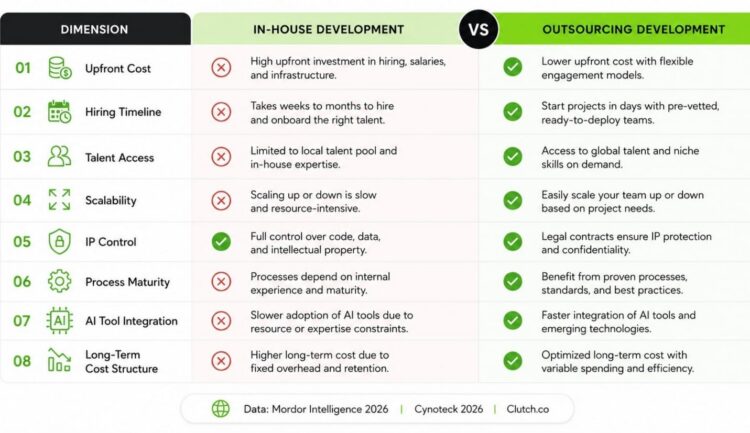
Outsourcing mobile app development has emerged as the structurally sound, commercially validated alternative. It provides immediate access to specialized talent, compresses time-to-market, and eliminates capital expenditure on permanent headcount.
In-House vs. Outsourcing: Side-by-Side Comparison
| Dimension | In-House Team | Outsourcing Partner |
| Upfront Cost | High (salaries, benefits, equipment) | Low to moderate (project or hourly fees) |
| Hiring Timeline | 3–6 months to staff | 2–4 weeks to onboard |
| Talent Access | Geographically constrained | Global, specialization-accessible |
| Scalability | Slow, high organizational friction | Fast, structurally flexible |
| IP Control | Direct | Contractually governed |
| Process Maturity | Must be built from scratch | Pre-existing, vendor-maintained |
| AI Tool Integration | Individual adoption | Systematic, team-level deployment |
| Long-Term Fixed Cost | High | Variable, scalable down |
Outsourcing Models: Which One Fits Your Business?
Choosing the wrong outsourcing model is the second most common cause of project failure. The model determines how the engagement is structured, how costs are incurred, how control is distributed, and how risk is allocated between client and vendor.
Two intersecting dimensions define the decision in 2026: geographic model and commercial engagement model.
Geographic Models
Onshore outsourcing
This places the external team within the same country as the client. It offers maximum cultural alignment, real-time collaboration, and native regulatory understanding.
It is the most expensive configuration and is justified for highly regulated industries; healthcare under HIPAA, financial services under SEC oversight, where geographic proximity carries genuine risk-mitigation value, not merely relational preference.
Nearshore outsourcing
In this setting, the development team is in an adjacent region with partial time-zone overlap. Nearshoring captures 40–60% cost savings relative to onshore while maintaining real-time collaboration windows that pure offshore models require deliberate architecture to replicate.
Offshore outsourcing
This setting places the team in a geographically distant region with significant time-zone separation. Offshore models offer the steepest cost reduction, India’s senior developers bill at $25–$50/hour, alongside access to the largest talent pools globally. They require intentional communication architecture to function at full effectiveness.
The hybrid model
The fastest-growing engagement configuration among technology-forward enterprises in 2026 assigns strategic functions, including product management, architecture, and UX leadership, to onshore or nearshore resources while delegating engineering execution to offshore teams.
Research from the index.dev confirms that hybrid models save 35–42% over fully onshore teams while preserving decision quality in the dimensions where it generates the most business value.
Regional Hourly Rates at a Glance (2026)
| Region | Senior Developer Hourly Rate | Best Suited For |
| North America (US/Canada) | $150–$250/hr | Regulated industries, compliance-sensitive applications |
| Western Europe | $90–$150/hr | EU-compliance-first builds, strong UX engineering |
| Eastern Europe (Poland, Romania, Ukraine) | $25–$55/hr | Highest quality-to-cost ratio; EU cultural alignment |
| Latin America (Colombia, Mexico, Brazil) | $30–$60/hr | US time-zone nearshoring; real-time collaboration |
| India | $20–$50/hr | Largest talent pool; dominant for AI/ML and volume |
| Southeast Asia (Vietnam, Philippines) | $15–$35/hr | Well-scoped, clearly specified execution |
Commercial Engagement Models
Fixed-price (project-based):
Scope, timeline, and cost are defined upfront and remain contractually fixed. This model transfers execution risk to the vendor and is appropriate when requirements are well-defined and unlikely to change substantially during delivery.
It is the preferred model for MVPs with contained feature sets and regulatory environments that resist mid-project scope expansion.
Time and material (T&M):
The client pays for actual hours worked at agreed-upon rates. This model offers maximum flexibility and is appropriate for products with evolving requirements.
It places budget risk on the client side, requiring rigorous sprint-level tracking and active project governance to prevent cost drift.
Dedicated team:
The vendor provides a fully constituted development team that works exclusively for the client, managed by the client’s product leadership. This model combines the agility of an internal team with the recruitment and HR efficiency of an external vendor.
It is the optimal model for ongoing product development where requirements evolve continuously and team continuity compounds in value over time.
Staff augmentation:
Individual engineers or specialists are embedded within the client’s existing team to fill defined capability gaps. This is external talent acquisition with internal management, not outsourcing in the end-to-end sense.
It is appropriate when the client has a functioning team that requires capability reinforcement rather than comprehensive delivery.
Engagement Model Comparison Table
| Model | Cost Predictability | Client Control | Flexibility | Best Use Case |
| Fixed-Price | High | Moderate | Low | Well-defined MVPs, bounded projects |
| Time & Material | Low | High | High | Evolving products, iterative development |
| Dedicated Team | Moderate | High | High | Sustained product development |
| Staff Augmentation | Moderate | Very High | Moderate | Capability gap-filling, internal team extension |
| Hybrid | Moderate-High | High | High | Complex products balancing cost and quality |
| 2026 Strategic Insight: Best-practice engagements in 2026 combine fixed-price discovery phases with T&M development and dedicated-team maintenance. This aligns commercial incentives to the genuine uncertainty profile of each project phase rather than applying a single commercial model to structurally different activities. |
The 8-Step Operational Guide to Outsourcing Mobile App Development
The following eight steps represent the complete sequence for outsourcing mobile app development with structural discipline. Each step identifies the specific actions, decision criteria, and red flags that separate successful outsourcing from expensive misalignment.
Step 1: Define Project Scope, Requirements, and Success Criteria
Estimated duration: 2–4 weeks
The single most reliable predictor of outsourcing failure is not vendor quality; it is scope ambiguity at project initiation. Vendors build what they are instructed to build. When instructions are vague, the delivered product will be technically adequate but commercially misaligned, regardless of the engineering talent applied.
What to document before approaching any vendor:
Product vision brief:
The problem the application solves, the target user persona, and the competitive context it must navigate. A one-page brief forces the clarity that a ten-slide presentation often obscures.
Feature inventory by priority tier:
Complete list of features categorized as MVP-essential, Phase 2, and future roadmap. Every feature not explicitly scoped for MVP extends the timeline and cost.
Platform decision:
iOS, Android, or cross-platform. In 2026, Flutter and React Native have matured to the point where cross-platform development delivers native-quality experiences in 90%+ of consumer and enterprise use cases.
The decision should be driven by user behaviour data and backend integration requirements, not developer familiarity or vendor preference.
Technical constraints documentation:
Existing infrastructure dependencies, APIs the application must integrate with, backend technology preferences, authentication requirements, and regulatory compliance obligations (GDPR, HIPAA, CCPA, India’s DPDP Act 2023).
Success metrics definition:
Downloads, Day-7 and Day-30 retention rates, conversion events, revenue per user, and load time benchmarks. Define what success looks like before development begins, not after launch, when definitions become negotiating positions.
Step 2: Establish Realistic Budget and Timeline Parameters
Estimated duration: 1–2 weeks
Budget and timeline are not inputs to the outsourcing process; they are outputs of requirements definition. Organizations that establish a budget before scope have the analytical logic inverted. The correct sequence is: scope → vendor research → realistic estimate → budget allocation.
2026 benchmark ranges by project complexity:
| Complexity Level | Feature Profile | Cost Range | Typical Timeline |
| Simple MVP | 5–8 screens, user auth, basic REST API | $25,000–$60,000 | 3–5 months |
| Mid-complexity | Real-time features, payments, push notifications, third-party APIs | $60,000–$150,000 | 5–9 months |
| Complex consumer | AI features, social layer, video/audio processing, multi-platform | $150,000–$300,000 | 8–14 months |
| Enterprise-grade | Custom AI models, ERP/CRM integrations, advanced security, compliance | $300,000–$600,000+ | 12–18 months |
Budget components to account:
- Core development (frontend + backend): 50–55% of total budget
- UI/UX design: 15–20%
- QA and testing: 15–20% (non-negotiable; never a line item to reduce)
- Project management: 8–10%
- Post-launch maintenance: 15–25% of development cost annually
- AI feature operational costs: $500–$10,000+/month at production scale
- Security penetration testing: $5,000–$30,000 per audit cycle
- Accessibility compliance (WCAG 2.1): $5,000–$20,000 one-time
Step 3: Research and Shortlist Qualified Partners
Estimated duration: 1–2 weeks
Vendor discovery has matured significantly. The following platforms represent the highest-signal sourcing channels in 2026:
Clutch.co:
The industry standard for verified agency reviews with client-authenticated ratings and detailed portfolio case studies. Filter by industry vertical, technology stack, project size, and geographic region.
GoodFirms:
Strong mid-market agency coverage with verified testimonials and independent editorial analysis.
Toptal:
Pre-vetted the top 3% of freelance engineers for staff augmentation engagements. Rigorous screening process; premium pricing reflects screening investment.
G2 and DesignRush:
Useful for design-forward agency discovery and multi-dimensional comparison tools.
Professional referrals:
The highest-quality sourcing channel available. A referral from a trusted peer who has successfully delivered an outsourced mobile application shortens due diligence by 40–60% and substantially reduces selection risk.
Shortlisting criteria — Apply in sequence:
- Portfolio relevance: Has the vendor built in your category at comparable complexity?
- Technology alignment: Demonstrable expertise in your required stack: Flutter, React Native, Swift, Kotlin, and specific AI/ML frameworks?
- Team scale and stability: Fewer than 20 engineers creates key-person dependency risk. Ask directly about attrition rates over the past 24 months.
- Communication quality: English proficiency, written communication clarity, and response speed during discovery predict project communication quality during delivery.
- Geographic compatibility: Time zone overlap sufficient for real-time synchronization during sprint reviews and blocker resolution.
Step 4: Conduct Structured Due Diligence
Estimated duration: 2–3 weeks
This is the step most organizations compress to their long-term detriment. Structured due diligence for any outsourced engagement above $50,000 in value requires a minimum of two to three weeks.
The Request for Proposal (RFP) process:
Issue a written RFP to shortlisted vendors that specifies technical requirements, expected deliverables, evaluation criteria, response format, and deadline. The quality of vendor responses reveals process maturity, communication discipline, and genuine technical understanding in ways that sales calls do not.
Vendors who respond with generic templates have not engaged with your specific requirements.
Paid technical discovery sprint:
For engagements above $100,000, commission a paid technical discovery sprint of one to two weeks. This produces a validated technical specification, architecture document, and database schema.
More importantly, it gives both parties a real collaboration sample under realistic working conditions. Vendors who perform well on paid discovery are meaningfully more likely to perform at that standard throughout full delivery.
Reference verification protocol:
Request three verified client references for projects of similar complexity in a related domain. Ask specifically: What went wrong during the engagement, and how did the vendor respond?
The answer to that question is not the success narrative, but it reveals vendor character, communication integrity, and problem-solving disposition.
NDA and IP verification:
Execute a non-disclosure agreement before sharing any proprietary product details. Confirm the development contract explicitly assigns all intellectual property to the client from the moment of creation, not upon final payment, not upon project completion.
Red flags at due diligence stage:
- Proposal turnaround under 48 hours for complex engagements (indicates template-based response, not genuine analysis)
- No questions about business context, target market, or competitive environment
- Vague timeline estimates without underlying task decomposition
- IP assignment language that is conditional, ambiguous, or absent
- Pressure to begin immediately without a structured discovery phase
- Inability to discuss technical architecture decisions in specific, defensible terms
Step 5: Select the Engagement Model and Negotiate the Contract
Estimated duration: 1–2 weeks
The contract is not administrative paperwork. It is the risk management instrument that governs the entire engagement.
An inadequately structured contract is the legal equivalent of a vague specification. It creates disputes that are costly to resolve and structurally impossible to prevent without the document itself.
Essential contract elements:
Intellectual property assignment:
All code, designs, documentation, and data models are the client’s exclusive property from the moment of creation. This must be unconditional, not contingent on payment completion.
Milestone-based payment schedule:
Tie payment tranches to specific, verifiable deliverables, not calendar dates. A payment schedule structured as 20% on kickoff, 30% at prototype approval, 30% at development completion, and 20% at QA sign-off creates accountability at every stage.
Service level agreements (SLAs):
Define bug fix response times by severity (critical in 4 hours, major in 24 hours, minor in 72 hours), post-launch support duration, and escalation pathways.
Source code escrow:
For mission-critical business applications, establish a source code escrow arrangement where code is deposited with a qualified third-party provider. This protects the client in the event of vendor insolvency or relationship termination.
Scope change management procedure:
Define explicitly the threshold above which a change requires a written change order with cost and timeline impact assessment. Changes approved verbally without written confirmation are the most common source of budget overrun disputes.
Termination and handover clause:
Specify conditions for termination by either party and the exact procedure for code, documentation, asset, and credentials handover. This clause protects both parties and should be negotiated with the same rigour as IP clauses.
Step 6: Establish Communication Architecture and Project Governance
Estimated duration: Week 1 of engagement
Projects do not fail in code review. They fail in communication gaps that compound into alignment failures. The operational effectiveness of a distributed development engagement depends on a communication architecture that is designed — not assumed, not evolved reactively.
Communication infrastructure:
Synchronous channel (Slack or Microsoft Teams):
Defined channel structures for each workstream; frontend, backend, design, QA, and project leadership. Response-time expectations documented and agreed upon at engagement launch.
Project tracking platform (Jira, Linear, or Asana):
All tasks, user stories, and defects tracked with assignees, priority levels, and due dates. The client team must have full, real-time read access, never mediated through weekly summary reports.
Video collaboration (Zoom or Teams):
Sprint reviews bi-weekly, steering committee calls monthly, and architecture reviews at each milestone. All sessions are recorded and archived. No exceptions.
Documentation repository (Confluence, Notion, or Google Workspace):
Product specification, architecture decision records, API documentation, and meeting records are maintained as living documents throughout the engagement.
Governance cadence:
| Meeting Type | Frequency | Duration | Attendees |
| Daily standup | Daily | 15 min | Development team + PM |
| Sprint review | Every 2 weeks | 60 min | Full team + client stakeholder |
| Steering committee | Monthly | 60 min | Client leadership + agency leadership |
| Architecture review | Per milestone | 90 min | Technical leads, both organizations |
| Security review | Quarterly | 60 min | Security lead + client engineering lead |
Time-zone management:
For offshore engagements, define a minimum two-hour daily synchronous window for real-time issue resolution. The follow-the-sun model, where offshore teams complete a working day’s progress available for client review at the client’s day-start, accelerates cycle times when managed with explicit discipline and overnight task-handoff protocols.
Step 7: Monitor Progress, Govern Quality, and Iterate
Estimated duration: Ongoing throughout development
Development governance is active risk management, not passive oversight. The discipline with which a client team exercises governance during development is the single variable most within client control that determines project outcome quality.
Agile sprint discipline:
Insist on two-week sprint cycles with defined goals, daily standups, mid-sprint synchronization, and formal retrospectives. Sprints that routinely extend without adjustment indicate either scope ambiguity or team performance issues.
Continuous integration and delivery:
The development team must operate a CI/CD pipeline from the first week of development. Automated testing should run on every code commit.
Clients should have access to a staging environment for continuous progress validation, not summary demos at milestone intervals.
QA as a concurrent discipline:
Quality assurance must run in parallel with development, not sequentially after it. Vendors who defer QA to a post-development phase accumulate technical debt that is expensive and schedule-threatening to resolve. A well-structured engagement maintains a QA-to-developer ratio of 1:3 to 1:4.
Weekly performance indicators to track:
- Sprint velocity (story points completed vs. committed)
- Bug discovery rate and severity distribution
- Test coverage percentage (minimum: 70% for core business logic)
- Build success rate on the CI pipeline
- Open blocker count and average resolution time
Escalation trigger: Three consecutive sprints with material underdelivery against commitment, or critical bug resolution times that exceed SLA parameters, warrant immediate written escalation to vendor leadership.
A vendor that responds to legitimate performance feedback with defensiveness rather than a structured remediation plan has revealed something important about how they will behave under greater pressure.
Step 8: Launch, Maintain, and Scale
Estimated duration: 4–8 weeks pre-launch; ongoing post-launch
A successful product launch requires coordination between development completion and operational readiness, which many outsourcing relationships leave inadequately addressed. The following must be explicitly scoped in the original contract.
Pre-launch requirements:
- App Store and Google Play submission preparation: metadata, screenshots, privacy policy, compliance with platform content guidelines, review response planning
- Performance testing under projected peak load conditions (not average load)
- Independent security audit and penetration testing
- Analytics implementation with baseline event tracking configured
- Data migration validation if legacy systems are involved
Post-launch support structure: A minimum three-month post-launch support period with SLA-bound bug fix commitments must be contractually defined — not agreed informally after launch. Budget 15–25% of development cost annually for ongoing maintenance, OS compatibility updates, security patches, and incremental feature releases.
An application that costs $100,000 to build requires at a minimum $20,000 per year to remain secure, compatible, and competitive.
Knowledge transfer requirements: At engagement completion or transition, require a formal knowledge transfer deliverable: architecture documentation, code annotation standards, deployment runbooks, third-party service credential documentation, and a recorded technical walkthrough with the incoming team.
This protects organizational continuity regardless of future vendor relationships.
Cost Breakdown: What Outsourcing Mobile App Development Actually Costs in 2026
The following framework reflects verified 2026 market data to address the variables that actually drive cost outcomes.
Cost by App Complexity
| App Type | Feature Profile | 2026 Cost Range | Timeline |
| Simple MVP | 5–8 screens, auth, basic backend | $25,000–$60,000 | 3–5 months |
| Mid-complexity | Real-time payments, third-party APIs | $60,000–$150,000 | 5–9 months |
| Complex consumer | AI features, social, video/audio | $150,000–$300,000 | 8–14 months |
| Enterprise-grade | Custom AI, ERP integrations, compliance | $300,000–$600,000+ | 12–18+ months |
Team Role Cost Breakdown (Offshore, Mid-Complexity App)
| Role | Monthly Cost (India) | Engagement Duration |
| Project Manager | $2,000–$4,000 | Full project |
| Senior Mobile Developer (×2) | $4,000–$8,000 each | Full project |
| UI/UX Designer | $2,000–$3,500 | Discovery + design phase |
| Backend Developer | $3,500–$6,000 | Full project |
| QA Engineer | $1,500–$3,000 | Development + launch |
| DevOps Engineer | $2,500–$4,500 | Setup + ongoing |
The AI Integration Cost Premium: What Vendors Do Not Tell You
In 2026, AI-powered features have migrated from premium differentiators to user expectations in categories including fintech, healthtech, retail, and on-demand services.
AI integration introduces two distinct cost layers that most outsourcing cost guides either omit or underestimate significantly.
Development cost premium:
Integrating AI features, recommendation engines, natural language interfaces, computer vision, and predictive analytics adds 25–40% to equivalent non-AI development cost, driven by the additional complexity of model integration, data pipeline architecture, prompt engineering, and AI-specific performance testing.
Operational cost premium:
AI features carry ongoing infrastructure costs that scale with user volume. An application with 10,000 daily active users processing AI requests can incur:
- API token charges: $500–$5,000/month (OpenAI, Anthropic, Google pricing, 2026)
- Vector database hosting (Pinecone, Weaviate): $70–$2,000/month
- Cloud GPU compute for custom model inference: $500–$10,000+/month
- AI model monitoring and retraining: $1,000–$5,000/quarter
These costs must be modelled at the budget-planning stage, not discovered post-launch when they represent unanticipated operating expenses.
The Complete Cost of Ownership (Not Just Development Cost)
| Cost Category | Typical Range | Frequency |
| Core development | $25,000–$600,000+ | One-time |
| UI/UX design | 15–20% of dev cost | One-time |
| QA and testing | 15–20% of dev cost | Per release cycle |
| Post-launch maintenance | 15–25% of dev cost | Annual |
| App Store fees | $99 (Apple) + $25 (Google) | Annual |
| Security penetration testing | $5,000–$30,000 | Annual |
| Accessibility compliance (WCAG 2.1) | $5,000–$20,000 | One-time |
| Third-party API licensing | $500–$10,000+/month | Monthly |
| AI operational infrastructure | $1,000–$20,000+/month | Monthly |
Budget optimization lever for 2026: Cross-platform development using Flutter reduces development cost by 30–40% compared to dual native builds (iOS + Android separately), enabling a single shared codebase while delivering near-native performance for the majority of use cases.
For most startups and mid-market products, cross-platform first is the correct default decision.
Risks, Challenges, and Mitigation Strategies to Outsourcing Mobile App Development
The following six risks represent the most material threats to outsourced mobile development engagements in 2026.
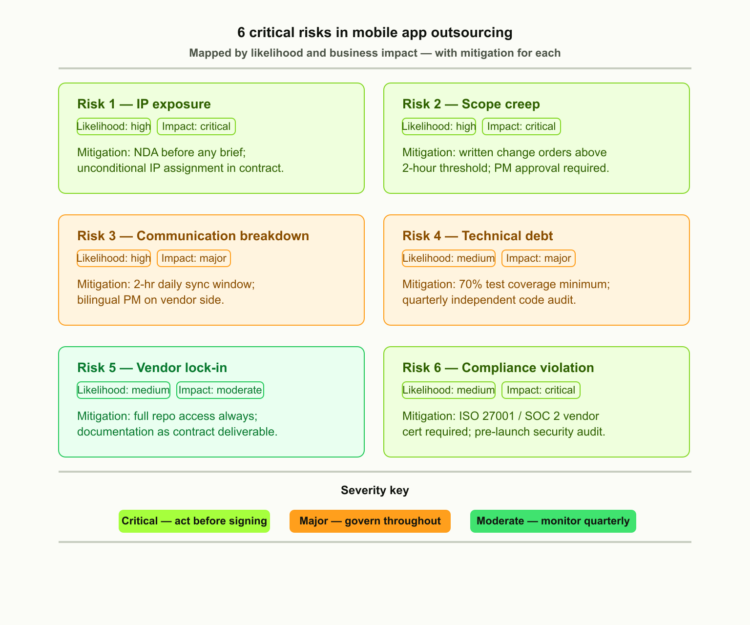
Risk 1: Intellectual Property Exposure
Actual probability: High without explicit contractual protection. Approximately 45% of enterprises reported breaches or IP-related issues in outsourced projects in 2024 (Market Growth Reports, 2025).
IP risk is structurally elevated in offshore engagements where contract enforcement across jurisdictions involves complexity and delay.
Mitigation: Execute NDAs before any technical conversation involving proprietary details. Ensure the development contract assigns all IP to the client from the moment of creation.
Register trademarks before development begins. For applications with particularly sensitive underlying logic, consider source code escrow with a reputable third-party provider such as Escrow.com.
Risk 2: Communication Breakdown and Cultural Misalignment
Actual probability: High without deliberate architecture. The 9–12-hour difference between US East Coast and Indian Standard Time means that a question raised at client day-end may not receive a response until the following morning, creating systematic 24-hour blocker cycles that compound across a six-month engagement into a significant schedule delay.
Mitigation: Architect a minimum two-hour daily synchronous window from project initiation. Assign a bilingual technical project manager on the vendor side with explicit accountability for cross-cultural communication clarity.
Document communication protocols at engagement launch, not after friction has emerged. Cultural briefings on working-style expectations, directness norms, escalation comfort, and feedback framing prevent misinterpretation that derails collaboration.
Risk 3: Scope Creep and Budget Overrun
Actual probability: Very high without formal change control. Unmanaged scope creep expands project budgets by 30–60% in outsourced mobile development engagements as a consistent pattern across the industry. It is not typically bad faith; it is the natural consequence of product learning during development applied without commercial discipline.
Mitigation: Establish a formal change control process at engagement launch. Any feature addition or modification above a defined effort threshold (typically two development hours) requires a written change order with cost and timeline impact assessment before work begins.
The product owner must have unambiguous, sole authority to approve or reject change requests in real time.
Risk 4: Technical Debt Accumulation and Quality Degradation
Actual probability: High with underpriced vendors. Vendors operating under cost or schedule pressure address that pressure through reductions in code quality, test coverage, and documentation.
The resulting technical debt is invisible during development and structurally expensive at scale. Rebuilding a technically compromised application typically costs 1.5–2× the original development budget.
Mitigation: Define code quality standards in the contract: minimum test coverage thresholds, mandatory code review requirements, static analysis tool usage, and documentation standards.
Conduct quarterly independent code audits for engagements exceeding six months. Never accept delivery of any milestone without demonstrated test coverage meeting agreed-upon minima.
Risk 5: Vendor Lock-In
Actual probability: Moderate, increasing with engagement duration. Vendors have a structural commercial incentive to make clients dependent on their continued engagement through proprietary tooling choices, undocumented codebases, or knowledge concentration in individual team members who become irreplaceable dependencies.
Mitigation: Require comprehensive technical documentation as a contractual deliverable, maintained continuously throughout the engagement, not compiled at the end.
Maintain direct access to all code repositories, deployment infrastructure credentials, and third-party service accounts throughout the engagement. Enforce documentation standards at each sprint review, not just at completion.
Risk 6: Data Security and Compliance Violations
Actual probability: Mobile applications in healthcare, fintech, and e-commerce process sensitive personal and financial data at scale. Regulatory frameworks — GDPR (EU), HIPAA (US healthcare), CCPA (California), and India’s DPDP Act impose significant compliance obligations with material financial penalties for breach.
Outsourcing to a vendor without demonstrable compliance expertise in the relevant frameworks transfers regulatory risk to the client organization.
Mitigation: For regulated industries, verify vendor compliance certifications, ISO 27001, and SOC 2 Type II before engagement. Include specific data handling, encryption, and access control requirements in the contract. Require that all data processing agreements comply with applicable regulations.
Commission an independent security audit before application launch — not as an optional quality check, but as a contractual delivery requirement.
How to Choose the Right Outsourcing Mobile App Development Partner?
The vendor selection process should be analytical, not relational. The following scorecard provides a structured evaluation framework for comparing vendors objectively. Score each dimension from 1 to 5 during the due diligence phase.
Vendor Evaluation Scorecard
| Evaluation Dimension | Weight | 5-Point Scoring Guidance |
| Portfolio relevance | 20% | 5 = Multiple projects in your category at comparable complexity; 1 = No relevant portfolio |
| Technical capability | 25% | 5 = Demonstrates architecture thinking, AI/ML experience, documented tech decisions; 1 = Generic capability claims |
| Communication quality | 20% | 5 = Proactive, precise, responsive; clear English; 1 = Vague, slow, communication effort visible |
| Process maturity | 15% | 5 = Agile evidence, CI/CD in every project, test coverage standards, documentation culture; 1 = No process evidence |
| Commercial transparency | 10% | 5 = Clear rate cards, detailed cost breakdowns, no ambiguous line items; 1 = Vague pricing, hidden terms |
| Post-launch support | 10% | 5 = Defined SLA structure, documented maintenance offering, formal KT process; 1 = Verbal commitments only |
Decision rule: Any vendor scoring below 3.5 weighted average should be eliminated from consideration, regardless of pricing. A vendor priced 30% below market, with a score of 2.8, will cost more than the market-rate vendor with a score of 4.2 by month six.
Questions to Ask Every Vendor Candidate
- Walk me through a project where something went seriously wrong. What did you do?
- What is your team’s average tenure? What is your 12-month attrition rate?
- Who specifically will work on my project, and can I meet them before signing?
- How do you handle scope change requests? Walk me through the last change order you processed.
- What CI/CD tools do you operate, and what is your minimum test coverage standard?
- What AI development tools does your team use, and how do you manage AI-assisted code review?
- How do you approach security for applications in regulated industries?
- What does your knowledge transfer process look like at the engagement end?
Freelancer vs. Agency vs. Dedicated Team
| Factor | Freelancer | Agency | Dedicated Team |
| Best suited for | Narrow, bounded tasks | End-to-end MVP and product builds | Sustained product development |
| Cost profile | Lowest hourly rate | Mid-range total project cost | Highest fixed monthly cost |
| Accountability level | Individual | Organizational | Organizational with exclusivity |
| Scalability | Low | Moderate | High |
| Risk level | Highest (key-person) | Moderate | Lowest |
| Time to operational start | 1–2 weeks | 2–4 weeks | 4–6 weeks |
| Recommended minimum budget | Under $20,000 | $25,000–$500,000 | $100,000+ annually |
Our team reviews outsourcing proposals and identify red flags before you sign
2026 Trends Reshaping Outsourcing Mobile App Development Strategy
The strategic context for outsourcing decisions is not static. The following seven trends are actively reshaping what effective outsourcing looks like in 2026 and will continue to define competitive differentiation through 2028.
AI-First Development Is Now a Baseline Requirement
Over 54% of outsourced app development projects now include AI-powered features (Market Growth Reports, 2025). AI personalization engines, predictive UX, conversational interfaces, and real-time behavioural analytics have migrated from premium features to user expectations in competitive app categories.
The global AI mobile app development market is estimated to reach $221.9 billion by 2034 (CMARIX, 2026), with 63% of mobile app developers already integrating AI features. When evaluating vendors in 2026, AI integration capability is a primary selection criterion.
Ask vendors specifically about experience with LLM API integration (OpenAI, Anthropic, Google), retrieval-augmented generation (RAG) architecture, vector database implementation, AI cost management at production scale, and AI safety and bias testing protocols.
Cross-Platform Development as Native Parity
Flutter and React Native have matured to the point where cross-platform development delivers near-native performance for 90%+ of consumer and enterprise mobile use cases.
Over 48% of outsourced mobile development projects now involve cross-platform frameworks (Market Growth Reports, 2025). Flutter, in particular, has achieved dominant adoption due to its single-codebase model, Dart language performance characteristics, and Google’s continued investment in the ecosystem.
The decision calculus has shifted: native is now the exception requiring justification, not the default requiring no explanation.
5G and Edge Computing
16% of global mobile connections were powered by 5G in 2025, growing toward 30%+ by 2028 (Mordor Intelligence, 2026). Asia-Pacific is adding 5G infrastructure at ten times the rate of any other region through 2030.
Ultra-low-latency 5G connections are enabling application architectures that were not previously commercially viable at consumer scale: real-time AR collaboration, autonomous device-to-device communication, industrial IoT mobile management, and sub-50-millisecond transactional interfaces.
Edge computing, processing data near the point of generation rather than routing to centralized cloud, is becoming essential for latency-sensitive applications.
Security-by-Design
The mobile application threat landscape has intensified materially. High-profile breaches have increased regulatory scrutiny in every major market simultaneously.
Security-by-design, embedding security considerations at architecture, development, code review, dependency management, and deployment levels, is now a procurement requirement for enterprise buyers, not an optional quality dimension.
Vendors should demonstrate security practice evidence, specifically: OWASP Mobile Top 10 compliance in their development checklist, automated dependency vulnerability scanning in their CI pipeline, and documented penetration testing engagement history.
The Hybrid Engagement Model
Pure offshore outsourcing, where all functions, including product strategy, UX architecture, and engineering leadership, are delegated to a single geographic team, is declining among sophisticated buyers.
The hybrid model, which retains strategic and decision-making functions onshore or nearshore while executing engineering offshore, is the fastest-growing engagement configuration among technology-forward enterprises.
Early 2026 data indicates hybrid models save 35–42% over fully onshore while preserving quality in the dimensions where quality creates the most commercial value (index.dev, 2026).
Low-Code and No-Code Integration in Professional Development Engagements
Low-code platforms are growing at a 29.65% CAGR (Mordor Intelligence, 2026), and sophisticated outsourcing vendors are integrating low-code and no-code components, reducing development time and cost for back-office workflows, administrative interfaces, CMS-driven content sections, and non-performance-critical utility features.
This is a disciplined tool selection decision that experienced vendors make with architectural judgment.
ESG and Responsible AI
Enterprise procurement standards are expanding to include environmental, social, and governance (ESG) dimensions with increasing rigour. Technology vendors, including mobile development agencies, are being evaluated on carbon footprint, workforce diversity, ethical AI practices, and data governance posture.
For large enterprise buyers procuring outsourcing engagements in 2026, vendor ESG posture is transitioning from a reputational consideration to a formal procurement criterion.
Responsible AI practices, bias testing, explainability documentation, and data privacy by design are increasingly required in vendor qualification documentation.
Real-World Case Study: How INGENI Outsourced an AI Healthcare App with Code Brew Labs
INGENI’s AI-Powered Healthcare Companion for Geriatric Care — built in partnership with Code Brew Labs. It illustrates every principle this guide has outlined, from requirements discipline through AI integration to post-launch governance, in a domain where product failure carries consequences that extend beyond commercial loss.
The Challenge: Geriatric Care Deserves a Better Interface:
Geriatric care management sits at the intersection of healthcare complexity and technology accessibility; two dimensions that rarely coexist comfortably. Caregivers managing older adult patients navigate medication schedules, appointment calendars, emergency protocols, and real-time health indicators simultaneously.
Existing solutions addressed one or two of these requirements. None integrated all four into a single, genuinely accessible experience.
INGENI identified this gap as a significant product opportunity and a meaningful social responsibility. The challenge was execution: the product required advanced voice AI, intelligent automation, real-time health monitoring, and a user experience sensitive enough to serve older adult users who may have limited motor function, declining vision, or cognitive variability.
Building this internally was neither fast nor cost-effective. Outsourcing it to the wrong partner would be worse.
The Solution: A Four-System Healthcare Companion
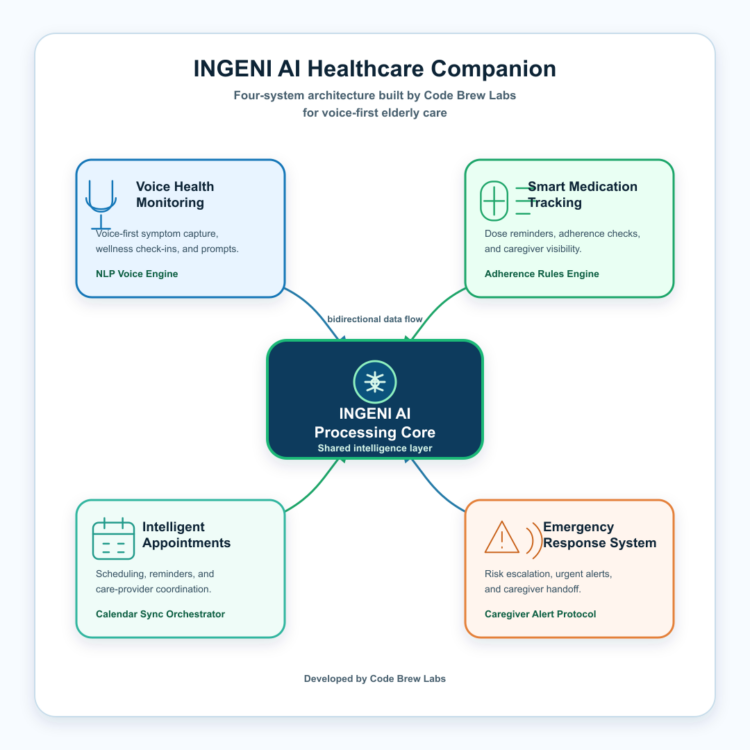
Code Brew Labs developed the INGENI Healthcare Companion as a unified platform with four deeply integrated core systems.
System 1 — Voice-Powered Health Monitoring
The application’s primary interface is voice, not touch. Code Brew Labs integrated advanced natural language processing to enable users to report symptoms, request health summaries, and interact with the system through conversational voice commands without the cognitive and motor demands of a traditional mobile interface.
.System 2 — Smart Medication Tracking
Medication non-adherence in older adult populations is responsible for 125,000 preventable deaths annually in the United States (New England Journal of Medicine, 2025).
The INGENI medication management system addresses this through intelligent tracking, contextual reminders, and caregiver-facing compliance reporting. The system understands dosing schedules, interaction risks, and real-time adherence rates without requiring users to navigate complex data entry interfaces.
Voice confirmation of medication administration is the primary input mechanism, reducing the interface friction that causes non-compliance in competing solutions.
System 3 — Intelligent Appointment Management
The appointment management module integrates with provider calendars and caregiving schedules to create a unified, conflict-aware scheduling system that operates intelligently, rescheduling, reminding, and confirming appointments through voice interaction without requiring the users to manage the underlying logistics.
Caregivers receive automated status updates. The system learns scheduling preferences over time, reducing the administrative burden that frequently falls on family caregivers managing multiple care relationships simultaneously.
System 4 — Emergency Response System
In geriatric care, response time in a health emergency is clinically determinative. The INGENI emergency response system provides automated escalation through pre-configured alert pathways: voice-triggered SOS, fall detection integration, anomalous vital-sign alerts, and geofencing-based safety monitoring.
Alert delivery reaches designated emergency contacts, caregivers, and emergency services through a tiered escalation protocol that prioritizes response speed without creating unnecessary alarm fatigue in the caregiver network.
The Outsourcing Architecture: Why It Worked
The INGENI engagement with Code Brew Labs exemplifies the principles that distinguish successful outsourcing from costly failure.
Requirements specificity:
The specificity of the brief enabled Code Brew Labs to propose solutions rather than respond to ambiguity.
AI capability alignment:
Code Brew Labs’ AI/ML engineering depth made this a matched-capability engagement, not a stretch assignment.
Healthcare domain sensitivity:
Code Brew Labs’ experience with healthcare applications, security protocols, data privacy requirements, and UX standards for accessibility was directly applicable.
Unified platform delivery:
Rather than delivering four separate features, Code Brew Labs architected the application as an integrated system where each module shares data context with the others.
The INGENI Healthcare Companion represents what mobile app outsourcing delivers at its highest level of execution: a technically sophisticated, commercially differentiated product that a healthcare enterprise could not have built faster, more cost-effectively, or at higher quality through any alternative model.
Why Code Brew Labs is your Trusted Partner for Outsourcing Mobile App Development?
The mobile opportunity is real, it is large, and it is not waiting. The global app development market reaches $618 billion by 2031. Consumer expectations for mobile experiences are compounding in sophistication every quarter.
The organizations that build the right products, with the right partners, governed with the right disciplines, will capture disproportionate value from that growth.
The organizations that optimize for the wrong variables, hourly rate, fastest response, and lowest commitment threshold, will fund the rework cycles that vindicate everyone who told them to choose differently.
Code Brew Labs brings demonstrable expertise across the technology domains that define competitive mobile products in 2026; AI-first application architecture, voice interface development, cross-platform engineering, healthcare technology, and enterprise-grade security frameworks.
Your product deserves a partner who treats it as their own
Frequently Asked Questions
Is outsourcing mobile app development safe for my business?
Outsourcing is safe when structured with appropriate contractual protections, verified vendor credentials, and active project governance. The primary risks, IP exposure, quality degradation, and communication failure, are all mitigable through deliberate process design. Over 72% of companies that develop mobile apps rely on outsourcing partners; the risk is inherent to poor execution, not to the model itself.
How long does it take to outsource a mobile app from start to App Store launch?
The full timeline from requirements definition to App Store launch ranges from three months for a simple MVP with a well-constituted team to twelve to eighteen months for a complex enterprise application.
- Discovery and planning require two to four weeks.
- MVP development takes eight to sixteen weeks.
- QA, App Store review, and launch preparation add four to six weeks.
Factor a 15–20% schedule buffer for scope adjustments and third-party integration delays.
Should I use a fixed-price contract or a time and material contract?
Fixed price is appropriate for well-defined MVP builds with stable requirements. Time and material is appropriate for evolving products where the full feature set cannot be specified up front. Best practice in 2026 is a hybrid: fixed-price discovery and architecture phases, followed by T&M development, with dedicated-team maintenance.
How do I protect my app idea when outsourcing?
Execute a mutual NDA before sharing any proprietary details. Ensure the development contract explicitly assigns all IP to the client from the moment of creation. Register trademarks before development begins. For particularly sensitive applications, establish a source code escrow arrangement and consider partitioned development.
What are the biggest mistakes first-time outsourcers make?
The five most consequential mistakes are:
(1) selecting vendors on price alone without portfolio verification,
(2) beginning development without a detailed specification,
(3) failing to invest in communication architecture at engagement launch,
(4) neglecting post-launch maintenance planning in the original budget
(5) treating the contract as an administrative formality rather than the primary risk management instrument.
Can I outsource just the development while handling design in-house?
Yes, this is a viable model when your internal team has mobile-specific UI/UX design capability, not general graphic design. Ensure design handoff processes are explicitly defined before development begins, including design file formats (Figma is the 2026 standard), component library specifications, interaction documentation, and responsive behaviour guidance.
How much does it cost to maintain a mobile app after launch?
Post-launch maintenance typically costs 15–25% of the original development cost annually. A $100,000 app requires $15,000–$25,000 per year for OS compatibility updates, security patches, third-party API changes, performance optimization, and minor feature iterations. Applications with AI-powered features carry additional monthly operational costs for model inference, API tokens, and vector database infrastructure.
What is the difference between nearshore and offshore outsourcing?
Nearshore outsourcing places the development team in a geographically adjacent region with partial time-zone overlap. Offshore places the team in a geographically distant region with significant time-zone separation. Nearshore offers better real-time collaboration at a higher cost; offshore offers deeper cost reduction with deliberate communication architecture requirements.
What questions should I ask an outsourcing vendor before signing?
The highest-value questions are:
- What went wrong in your last three engagements, and what did you do?
- Who exactly will work on my project — can I meet them before signing?
- How do you handle scope change requests?
- What is your team’s attrition rate over the past 24 months?
- What is your minimum automated test coverage standard?
- How do you structure knowledge transfer at the engagement end?
Is outsourcing mobile app development suitable for enterprise organizations or only startups?
Outsourcing is structurally appropriate across organizational scales. Startups use it for MVP development speed and capital efficiency. Scale-ups use it for acceleration and specialized capability access. Enterprises use dedicated offshore development centres for sustained product development while maintaining internal teams for strategic architecture and product ownership.
Let's Convert Your Business Idea Into Success!
Free Consultation from Top Industry Experts
Let’s Build Your Dream App!
Share article on :



Ready To Fuel Your Vision With AI-Powered Innovation?


Level- 18, Dubai World Trade Centre Tower, Sheikh Rashid Tower, Sheikh Zayed Rd, Dubai, UAE
business@code-brew.com +971-55-645-7972
Plot no I - 36, Sector 83 Alpha, Mohali SAS Nagar 140308
business@code-brew.com +91-771-976-8427
Av. Miguel Hidalgo y Costilla 1995, Arcos Vallarta, 44600 Guadalajara, Mexico
business@code-brew.com +1(213)2614953
4231 Balboa Ave #512 San Diego, CA 92117 United States
business@code-brew.com +1(213)2614953
2nd floor, College House, 17 King Edwards Rd, London HA4 7AE, UK
business@code-brew.com +44 (20) 82644493
Partner With Experts Who Leverage AI & Tech To Transform Ideas Into Market-Leading Solutions.
Wait! Looking for Right Technology Partner For Your Business Growth?
It's Time To Convert Your Business Idea Into Success!
Get Free Consultation From Top Industry Experts:
I would like to keep it to myself