Table of Content

Quick Summary:
- To build a beauty and wellness app, choose a business model first, then engineer booking, payments, and loyalty as one connected system.
- A beauty app styles you. A beauty and wellness app connects that look to your sleep, stress, and skin health.
- Three models shape the build: a marketplace, a single-brand salon app, or a white-label SaaS platform.
- Deposits collected at booking through Stripe pull salon no-shows from around twenty percent down toward five.
- The booking engine is the hard part, since it juggles staff, rooms, buffers, and real-time availability.
- Loyalty pays for itself, because a five percent retention lift can raise profit by 25 to 95 percent.
- A lean, launch-ready MVP usually runs 20,000 to 80,000 dollars before you add heavier custom work.
- Wellness data pulls med-spa apps into HIPAA, PCI-DSS, and state privacy laws that ordinary booking apps escape.
Beauty and wellness app development in the USA starts with one decision most founders rush past: what kind of platform you are building. Get that wrong, and every later choice inherits the mistake.
Table of Content
The stakes are real. Booksy reported more than 260 million appointments and over 10 billion dollars in bookings during 2024, per its own business figures. Your customer already books at midnight, pays a deposit, and expects points.
Two products hide inside one label. A beauty app books a service. The wellness kind links it to sleep, stress, and skin health. Founders now chase the second, for reasons that this guide makes clear.
Ready to build a beauty app your customers rebook on, not just download once?
How a beauty and wellness app differs from a niche beauty app
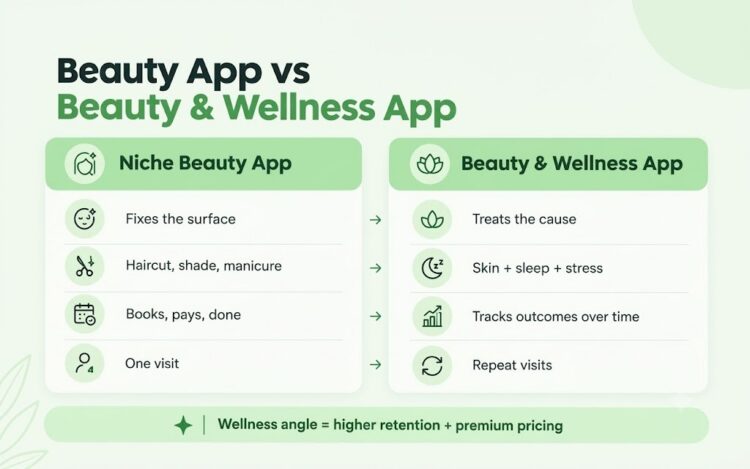
A niche beauty app fixes one thing you can see. The wellness version treats the reason behind it. That difference reshapes the roadmap, the data model, and the price you can charge.
What a niche beauty app does
A niche beauty app handles a single surface need. You book a haircut, match a foundation shade, or schedule a gel manicure.
The loop is short. Browse, book, pay, and leave. Value ends when the appointment does.
What a beauty and wellness app adds
A wellness-led product looks under the surface. It asks why skin dulls, why hair thins, and why a facial keeps fading fast.
The app assesses beauty and physical wellness inside one profile. Sleep, stress, hydration, and diet sit beside services and skin goals. Users see how their body shapes their appearance.
The correlation founders are building around
Stress raises cortisol, and higher cortisol worsens acne, dullness, and flare-ups. A wellness app can surface that link for the user.
Picture a client booking facials every month with no visible gain. Her app ties three weeks of poor sleep to a fresh breakout. That one insight sells the next visit better than any coupon.
- Shared health signals: Sleep, water intake, stress check-ins, and cycle data sharpen the skin and hair advice a user sees.
- Two-way guidance: A calming treatment gets suggested during a hard week, with hydration nudged before a big event.
- Outcome tracking: Progress photos sit beside wellness logs, so results read as clear cause and effect.
- Practitioner context: An esthetician opens one profile and reads lifestyle, allergies, and past outcomes at a glance.
Why founders are cashing in on this angle now
Buyers now fold beauty into everyday self-care. That shift shows up in the money.
The US medical spa market reached 8.39 billion dollars in 2025. It grows nearly 14 percent a year, per Expert Market Research. Wellness apps in North America pulled about 38 percent of a 4.2 billion-dollar market, per Market.us. Demand keeps flowing toward products that connect looks to health.
Beauty service owners feel it firsthand. Clients ask for results tied to how they sleep, eat, and recover over months.
How the angle pays off for founders
Owners adopt the wellness frame because it changes the economics.
- Higher retention: Health goals pull clients back across a season, not a lone booking.
- Premium pricing: Visible outcomes justify a rate a walk-in haircut cannot reach.
- Stronger differentiation: A wellness layer sets the brand apart from plain booking clones.
- A data moat: Lifestyle and skin history compound into advice rivals struggle to copy.
- More visits per client: One profile spanning beauty and wellness opens cross-sell without discounts.
Build around outcomes people feel, and price stops being the battleground.
The US beauty and wellness market in 2026: a closer look
The opportunity here is large, uneven, and still fragmented, which is good news for a sharper product. Break the numbers apart, and the openings become obvious.
A market measured in tens of billions
Hair and nail services in the United States generate roughly 90 billion dollars a year, spread across more than a million salons, per Boulevard’s industry data and IBISWorld’s salon count. Volume at that scale still runs on phone calls, paper books, and walk-ins.
Wellness apps tell a parallel story. The category sat near 4.2 billion dollars worldwide in 2025, and North America held about 38 percent of it, reports Market.us. American users lead adoption because smartphone habits and health tracking already overlap.
Salon software, the layer powering bookings behind the scenes, was valued at 0.84 billion dollars in 2025. It heads toward 1.29 billion by 2030, per Mordor Intelligence. Plenty of that spend is up for grabs.
Why the demand keeps climbing
Behavior shifted, and it did not shift back. Around 67 percent of consumers prefer booking online over calling, and roughly 70 percent favor a business that offers self-booking, according to SimplyBook.me.
Timing makes the case sharper. Only about half of all appointments get booked during business hours. Salons without round-the-clock booking lose the other half to whoever answers first.
The fragmentation you can exploit
No single player owns this space. Booksy leads on volume, Vagaro and StyleSeat hold ground with independents, and Fresha and Mindbody chase larger chains. Each leaves gaps.
- Independents feel squeezed by commission fees and want an owned channel.
- Med-spas and wellness studios need treatment records and consent flows most booking apps ignore.
- Multi-location brands want their own app, not a marketplace where rivals sit one tap away.
Read those gaps carefully, and your model choice starts to write itself. That is the next decision.
Which beauty and wellness app model should you build: marketplace, single-brand, or SaaS
Everything downstream depends on this call: your revenue, risk, build cost, and marketing. Pick before you design a single screen.
The marketplace model, or Uber for beauty services
A marketplace connects many customers with many independent professionals. You earn a commission on each booking and a cut of add-ons.
The upside is scale. The catch is liquidity: you need clients and providers at once, in the same city, or neither shows up. Seed one side too slowly, and the flywheel stalls.
Glamsquad and StyleSeat live here. This route fits founders chasing a category position and ready to fund two-sided growth.
The single-brand salon or spa app
Here one business gives its own clients an app. Bookings, deposits, memberships, and loyalty all flow to a single brand.
Liquidity risk drops away, since the clients already exist. Retention and rebooking drive the payoff. Chains and premium studios choose this path most often.
The white-label SaaS platform
A SaaS product sells booking software to other salons on a subscription. You build once and serve thousands of tenants.
Revenue recurs, though the engineering bar sits higher. Multi-tenant architecture, billing, and onboarding all need real rigor. Founders with product experience tend to win here.
| Model | You earn from | Main risk | Build weight | Best fit |
| Marketplace | Commissions, add-ons | Two-sided liquidity | High | Category-builder founders |
| Single-brand app | Bookings, memberships | Adoption by your base | Medium | Salons, spas, chains |
| White-label SaaS | Subscriptions | Multi-tenant complexity | High | Experienced SaaS builders |
Weigh liquidity against recurring revenue, then commit. Want a second view on your model before design? Our team ships each of these, from a marketplace for beauty professionals to an owned salon channel.
Types of beauty and wellness apps you can build
Model sets the business shape. Type sets what the user actually taps. Both should agree.
-
Salon and spa booking apps
Calendar-first products for haircuts, nails, facials, and massage, built around appointments and reminders.
-
On-demand beauty apps
At-home services where a professional travels to the client, with live tracking and location logic.
-
Makeup and salon styling apps
Shade matching, virtual try-on, and look libraries that pair well with retail.
-
Skincare and routine trackers
Daily logging, progress photos, and product guidance tied to skin goals over weeks.
-
Wellness and med-spa platforms
Treatment records, consent forms, and health context for Botox, laser, and IV therapy clients.
-
Beauty retail and DTC apps
Product catalogs, subscriptions, and replenishment for brands selling direct.
Most winning products blend two of these. A single-brand spa app that adds skincare tracking, for example, earns more visits per client than either alone.
Core features of beauty & wellness app
A beauty and wellness platform is really three apps sharing one backend. Each audience needs its own surface, and each surface needs real depth.
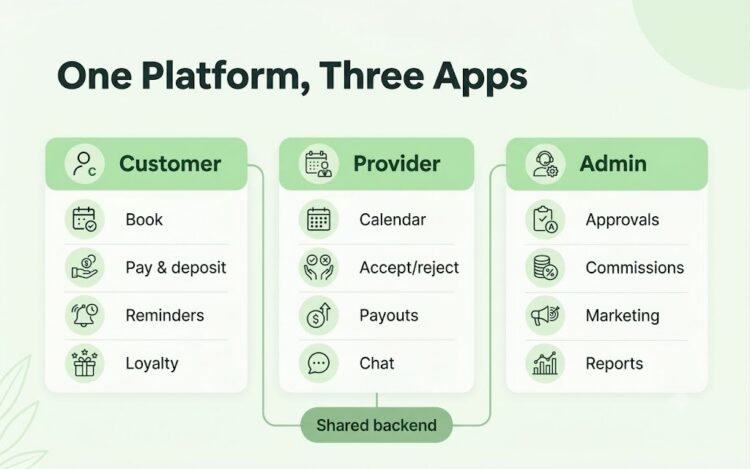
The customer app
This is where retention is won or lost, so friction has to disappear.
- Profile and health context
Preferences, allergies, past services, and optional wellness logs that sharpen recommendations.
- Search and discovery
Filters by service, price, distance, availability, and provider rating.
- Real-time booking
Live slots, instant confirmation, easy rescheduling, and a visible cancellation policy.
- Payments and deposits
Saved cards, in-app checkout, deposits, and tipping without a redirect.
- Reminders and rebooking
Push and SMS nudges that cut no-shows and prompt the next visit.
- Reviews and loyalty
Ratings after each visit, plus points or tiers the client can watch grow.
The service provider app
Providers stay on your platform only when it runs their day, so treat this app as a workhorse.
- Calendar and availability
Personal schedule, blocked time, and control over which services they offer.
- Booking control
Accept, reject, or reschedule requests, with buffer time between clients.
- Service menu and pricing
Self-managed offerings, durations, and rates.
- Payouts and history
Clear earnings, tips, and a record of past clients and notes.
- Client communication
In-app chat for confirmations and pre-visit questions.
The admin dashboard
Owners run the business from here, so analytics have to be honest and fast.
- Approvals and management
Vet providers, manage users, and handle disputes.
- Payments and commissions
Track flows, set fees, and reconcile payouts.
- Marketing tools
Offers, referral campaigns, and push scheduling.
- Reporting
Revenue, retention cohorts, no-show rates, and provider performance.
How to build a beauty and wellness app, step by step
The path below moves from idea to a live product, with real focus on the three modules that decide rebooking.
Step 1: Validate the idea and scope the MVP
Start with the smallest version that proves demand. Interview salon owners and clients, map their day, and find the one friction worth removing first.
Write down the core loop: search, book, pay, return. Anything outside that loop waits for version two. A lean MVP keeps cost and timeline honest.
Step 2: Design the experience for two audiences
Sketch the customer flow and the provider flow side by side. A screen that delights a client can ruin a stylist’s morning if it hides the calendar.
Prototype early, test with five real users per side, and fix the confusing steps before code begins. Good UI and UX groundwork saves expensive rework later.
Step 3: Set the architecture and stack
Choose cross-platform (React Native or Flutter) for reach, or native for the heaviest animation and AR work. Pair it with a Node.js or Django backend and a PostgreSQL or MongoDB database.
Plan the integration layer now: payments, maps, messaging, and calendars. Retrofitting these hurts.
Step 4: Build the booking and scheduling module
This is the engine, and it is harder than it looks. A calendar that double-books will bleed trust in a week.
- Real-time availability. Slots update the instant a booking lands, with locking to stop two clients grabbing the same time.
- Resources as bookable units. Staff, chairs, rooms, and equipment each carry their own schedule and constraints.
- Buffers and cleanup. Automatic gaps between appointments for turnover and sanitation.
- Recurring and group bookings. Standing weekly slots, plus multi-guest parties for events.
- Calendar sync. Two-way Google and Apple calendar links so providers never miss a change.
Get this right, and you capture the off-hours demand phones lose. Need this engine done well? See how a salon booking and management app handles the load.
Step 5: Build the payments and deposits module with Stripe
Payments are where revenue leaks stop. Stripe gives you the pieces, and the deposit logic protects your calendar.
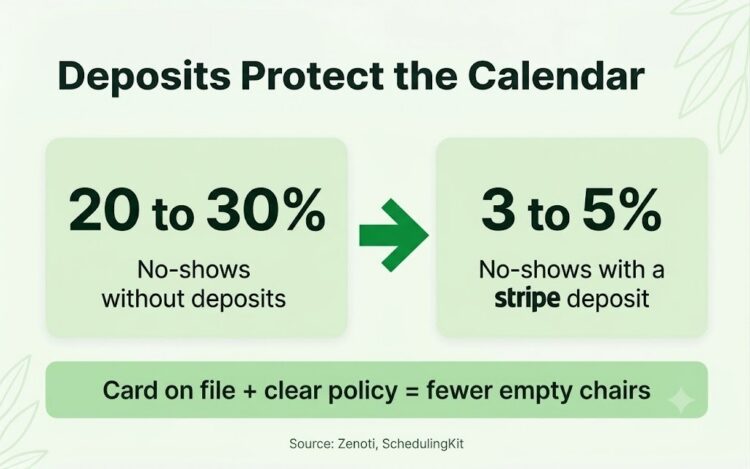
- Deposits at booking: Take a partial or full deposit up front, then capture the balance after the service.
- No-show protection: Card-on-file plus a clear policy turns empty chairs into charged appointments.
- Marketplace payouts. Stripe Connect splits each payment between the professional and your commission on its own. See Stripe Connect for the flows.
- Memberships and subscriptions. Recurring billing for packages, unlimited plans, or product boxes.
- Tipping and refunds. In-app tips and clean refund rules for cancellations inside your window.
- PCI scope reduction. Tokenized cards mean raw numbers never touch your servers.
The payoff is measurable. Salons lose 15 to 20 percent of revenue to no-shows, and deposit requirements cut that to 3 to 5 percent, per Zenoti and SchedulingKit.
| Booking setup | Typical no-show rate | Monthly impact for a busy salon |
| No deposit, no reminders | 20 to 30 percent | Thousands in lost chair time |
| Reminders only | 10 to 15 percent | Meaningful recovery |
| Deposit at booking | 3 to 5 percent | Most revenue protected |
Want a Stripe-ready booking and payments build scoped before you commit budget?
Step 6: Build the loyalty and offers module
Acquisition is expensive, so retention has to carry the model. Loyalty is the machine that brings clients back.
- Points and tiers: Earn on spend, unlock perks, and climb levels that feel worth chasing.
- Memberships: Monthly plans that guarantee visits and smooth your revenue.
- Referral loops: Give a reward, get a friend, tracked inside the app.
- Automated win-back: A gentle offer fires when a regular goes quiet for six weeks.
- Review capture: Prompt a rating after a completed visit, then route happy clients to public reviews.
The economics justify the effort. A five percent lift in retention can raise profit by 25 to 95 percent, per Bain and Company research in HBR.
Step 7: Test, then launch in stages
Run QA across devices, payment edge cases, and timezone shifts before anyone downloads it. Soft-launch in one city or one salon, watch the data, and fix what real use exposes.
Roll wider once bookings, payouts, and reminders behave under load.
AI and personalization features that fit a 2026 build
AI is the layer that turns a booking tool into a wellness advisor. Used with intent, it lifts revenue and deepens the beauty-and-wellness link at the center of this build. Personalization at this level lifts revenue 5 to 15 percent and can cut acquisition cost by half, per McKinsey.
Personalized routines and recommendations
This is the core of a wellness-led product, where beauty advice bends to the individual.
-
Personalized beauty routines
The app builds a morning and night routine from skin type, goals, and past results, then updates it as the skin changes.
-
Skincare, fitness, and wellness recommendations
One engine reads skin logs, workouts, and sleep, then suggests treatments, products, and habits that work together.
-
Preference analysis for better suggestions
Every booking, rating, and skipped offer trains the model to recommend the next service a client will accept.
AI-driven consultations and virtual assistance
A smart assistant answers questions and guides the client before a human ever steps in.
-
AI consultations and virtual assistance
A chatbot asks about skin concerns, finishes, and allergies, then routes the client to the right treatment or product. Sephora’s assistant follows this pattern, per DigitalDefynd.
-
Skin and hair analysis
A selfie feeds a model that flags acne, pigmentation, wrinkles, pores, and hydration in seconds. These scans agree with a dermatologist’s visual read more than 80 percent of the time, per ScanSkin AI.
AR try-on and shade matching
Augmented reality removes the guesswork that kills online beauty sales.
-
Virtual makeup try-on
Real-time AR renders lipstick, blush, and eyeshadow on the live camera. Top engines such as ModiFace score near 98 out of 100 on accuracy, per BM Fitt’s 2026 comparison.
-
Foundation shade matching
Camera-based matching reads undertone and lighting, reaching 85 to 90 percent accuracy against 60 percent from self-selection, per GlamAr.
-
Inclusive tone mapping
Tools built on the Monk Skin Tone Scale match a wider range of skin depths to real product SKUs.
Smarter operations and engagement
AI works behind the counter as much as in front of it.
-
Smart booking and reminders
Predictive prompts nudge clients toward open slots and confirm risky appointments before they slip.
-
No-show prediction
The model flags bookings likely to cancel, so staff can confirm or overbook with intent.
-
Dynamic scheduling and pricing
Quiet hours fill through gentle offers, while peak demand holds firm rates.
-
Engagement, retention, and lifetime value
Behavior signals trigger win-back offers and tier upgrades that keep clients active and spending longer.
Emerging AI features in futuristic beauty and wellness apps
Newer capabilities are moving from labs into shipping products, and early adopters gain the differentiation.
-
Smart mirror and wearable sync
Data from wearables and connected mirrors adjusts routines around sleep, stress, and activity, per EveLab Insight.
-
3D face mapping
Dense facial meshes, like Sephora’s 100-point map, place products with real precision.
-
Generative AI content
The app writes personalized skin reports, routine summaries, and coaching messages on its own.
-
Progress prediction
Models forecast how skin or hair responds to a plan, then set honest expectations for the client.
-
Voice and multimodal search
Users describe a look or concern in plain language and get matched services and products back.
Our AI-driven salon and beauty app development work covers scans, try-on, chat assistants, and recommendation engines from end to end.
Architecture and tech stack for a platform that scales
A weekend-friendly stack breaks at 10,000 bookings a day. Build for the second year, not the first week.
The choices below balance speed, cost, and headroom. Cross-platform frameworks cover two app stores from one codebase, while a real-time layer keeps calendars honest under pressure.
| Layer | Common choice | Why it fits |
| Mobile front end | React Native or Flutter | One codebase, near-native feel |
| Backend | Node.js or Django | Fast APIs, strong ecosystem |
| Database | PostgreSQL or MongoDB | Reliable bookings and flexible profiles |
| Real-time | WebSockets, Firebase | Live availability, instant updates |
| Payments | Stripe, Stripe Connect | Deposits, payouts, subscriptions |
| Notifications | FCM, Twilio | Push and SMS reminders |
| Cloud | AWS or Google Cloud | Elastic scale, managed services |
The integration layer deserves early attention. Maps, calendars, POS links, and messaging all touch the booking flow, and a clean contract between them prevents fragile spaghetti later. For teams validating fast, an MVP-first approach proves the core before the heavy build.
Compliance for beauty and wellness apps: PCI-DSS, HIPAA, and privacy
Compliance is where a wellness product parts ways with a plain booking app. Ignore it, and a launch can turn into a liability.
PCI-DSS for every app that takes payment
Any app touching card data falls under PCI-DSS. Tokenizing through Stripe shrinks your obligations, since sensitive numbers stay off your systems.
HIPAA for treatment and health data
A med-spa app that stores Botox records or skin conditions may handle protected health information. When it does, HIPAA’s security and privacy rules apply, and encryption, access controls, and breach plans become mandatory. The HIPAA Journal outlines how these overlap with PCI safeguards.
State privacy and consent laws
- CCPA governs how you collect and share Californian user data.
- Washington’s My Health My Data Act can reach wellness apps outside HIPAA.
- Biometric laws demand explicit consent before an AR feature scans a face.
Decide early which category your product lives in. A simple booking app and a wellness platform with health logs answer to different rulebooks.
How much does beauty app development cost in 2026?
Cost tracks scope, model, and integrations more than anything else. A tighter build costs less because it does less, on purpose.
A lean, launch-ready product usually runs 20,000 to 80,000 dollars, while richer, feature-heavy builds climb toward 200,000 dollars, per Fullestop and Topflight. The range is wide because a single-salon app and a national marketplace share almost no scope.
| Build tier | Typical US cost | What you get |
| MVP | 20,000 to 80,000 dollars | Booking, payments, profiles, one platform |
| Mid-complexity | 80,000 to 150,000 dollars | Loyalty, chat, dual apps, richer admin |
| Complex marketplace | 150,000 to 200,000-plus | AI, AR, multi-tenant, payouts at scale |
Do not forget what comes after launch. Stripe charges around 2.9 percent plus 30 cents per transaction, and hosting, maintenance, and support are ongoing lines. Budget for the running platform, not the handover alone.
How long does it take to build a beauty app?
Timelines follow scope as closely as budgets do. A focused MVP reaches the store faster because it carries less.
Most MVPs land in three to four months. Fuller platforms with loyalty, AI, and dual apps take six to nine. Discovery and design fill the first several weeks, and rushing them costs more down the line.
Phasing helps. Ship the booking and payment core, learn from real users, then layer loyalty and AI once demand is proven.
How to launch and grow a beauty & wellness app in the US market
A great build with no users is a hobby. US growth needs its own plan, and marketplaces need it most.
Seed the marketplace city by city
Two-sided products live or die on local density. Pick one metro, recruit a strong provider base, then drive clients to them. Thin coverage kills trust before word of mouth starts.
Win the app stores
App store optimization decides discovery. Target US search terms, gather early reviews, and keep screenshots benefit-led. Ratings compound.
Compete on what incumbents skip
Booksy, Vagaro, and Fresha own broad booking. You win by going deeper on the wellness link, on owned branding for single salons, or on treatment records med-spas need.
Monetize on more than one line
- Commissions on marketplace bookings.
- Subscriptions for memberships and SaaS tenants.
- Featured listings for providers wanting reach.
- In-app retail for products and replenishment.
- Brand partnerships for sponsored placements.
A single-brand play leans on memberships and rebooking, while a marketplace mixes commission and ads. Ready to digitize a wellness business end to end? The channel you own beats the one you rent.
Common mistakes that sink beauty & wellness app builds
Most failures repeat a short list of avoidable errors. Spot them early, and you protect the budget.
-
Over-building before proof
Heavy custom features before real user data waste months. Ship the core loop first.
-
Neglecting the provider app
A client-friendly app that annoys stylists loses supply, and supply is half your product.
-
Weak no-show policy
Skipping deposits leaves money on empty chairs every week.
-
Late compliance
Bolting on HIPAA or PCI after launch means costly rework and real risk.
-
Ignoring retention
Chasing installs while regulars churn burns cash with nothing to show.
Fix these in planning, not in a panic after launch. Prevention is cheaper than repair.
Why choose Code Brew Labs for beauty and wellness app development
Choosing a build partner is a product decision as much as a technical one, and our record in this exact space is why founders shortlist us. Code Brew Labs has shipped on-demand beauty platforms that reach clients at home, including the Glam360 build we walk through in our note on how on-demand beauty reaches a customer’s doorstep. Real launches sit behind the claims, so you are hiring proof rather than a pitch deck.
The work stays under one roof from first sketch to store listing. Strategy, design through our Allurive studio, engineering, and QA move as a single team, which means fewer handoffs and fewer details lost between them. That continuity matters most on the hard parts of a beauty app, where the booking engine, payouts, and reminders all have to agree.
Newer capabilities come standard, not as an upsell. Recommendation engines, skin and hair analysis, virtual try-on, and multi-tenant SaaS architecture are part of how we build, so the wellness angle at the heart of a 2026 product has real technology behind it. Payments and compliance get the same early attention, with Stripe Connect payouts, deposit logic, PCI tokenization, and HIPAA-conscious data handling designed in from the first sprint rather than patched on before launch.
Reach rounds out the case. Teams across the US and the GCC ship products tuned to their market, whether you launch in Miami or bring the same platform to Riyadh through our app development team in Riyadh. One partner covers the model choice, build, and market you are actually selling into.
Ready to launch a salon, spa, or on-demand beauty platform built to scale from day one?
Conclusion
Build the model first, then the modules. A beauty and wellness app earns its keep when booking, payments, and loyalty behave as one system, and when the product ties how a client looks to how they live.
The market is large and still fragmented, which favors a sharper, wellness-aware product over another generic booking clone. Nail the scheduling engine, protect the calendar with Stripe deposits, and let loyalty carry retention.
Do that, and you launch a platform people reopen, not one they forget.
Frequently asked questions
How much does it cost to build a beauty and wellness app?
A launch-ready MVP usually costs 20,000 to 80,000 dollars. Mid-complexity products with loyalty and dual apps run 80,000 to 150,000. Full marketplaces with AI and payouts pass 200,000. Your model and integrations move the number more than anything else.
How long does beauty app development take?
Most MVPs ship in three to four months. Richer platforms with AI, loyalty, and provider apps take six to nine months. Discovery and design fill the early weeks, and skipping that stage tends to cost time later, rather than save it.
What features must a salon booking app have?
Real-time booking, deposits, in-app payments, reminders, provider calendars, reviews, and loyalty form the base. The scheduling engine matters most, since double-booking erodes trust. Wellness products add health logs and treatment records on top of that core.
Is a marketplace or a single-brand beauty app better?
It depends on your goal. Marketplaces scale across many providers but must solve two-sided liquidity. Single-brand apps skip that risk and lean on retention. Founders chasing category size pick a marketplace, while established salons usually own their client base first.
Does a wellness app need to be HIPAA compliant?
Only when it handles protected health information, such as med-spa treatment records or medical skin data. Pure booking and styling apps generally fall outside HIPAA, though PCI-DSS and state privacy laws still apply. Decide your data category early to scope compliance right.
How do beauty apps make money?
Revenue comes from booking commissions, memberships and subscriptions, featured provider listings, in-app product sales, and brand partnerships. Marketplaces favor commission and ads, while single-brand apps lean on memberships and rebooking. Most mature products run two or three of these together.
Let's Convert Your Business Idea Into Success!
Free Consultation from Top Industry Experts
Let’s Build Your Dream App!
Share article on :



Ready To Fuel Your Vision With AI-Powered Innovation?


Level- 18, Dubai World Trade Centre Tower, Sheikh Rashid Tower, Sheikh Zayed Rd, Dubai, UAE
business@code-brew.com +971-55-645-7972
Plot no I - 36, Sector 83 Alpha, Mohali SAS Nagar 140308
business@code-brew.com +91-771-976-8427
Av. Miguel Hidalgo y Costilla 1995, Arcos Vallarta, 44600 Guadalajara, Mexico
business@code-brew.com +1(213)2614953
4231 Balboa Ave #512 San Diego, CA 92117 United States
business@code-brew.com +1(213)2614953
2nd floor, College House, 17 King Edwards Rd, London HA4 7AE, UK
business@code-brew.com +44 (20) 82644493
Partner With Experts Who Leverage AI & Tech To Transform Ideas Into Market-Leading Solutions.
Wait! Looking for Right Technology Partner For Your Business Growth?
It's Time To Convert Your Business Idea Into Success!
Get Free Consultation From Top Industry Experts:
I would like to keep it to myself