Table of Content

New York has one of the most competitive business environments in the United States. From fintech startups and healthcare providers to retail brands and on-demand service businesses, companies across industries are investing in mobile applications to reach customers, improve operations, and create new revenue opportunities.
Table of Content
However, building a successful mobile application involves much more than having an idea and finding someone who can write code. Businesses need to consider product strategy, user experience, technical architecture, data security, development costs, and long-term maintenance. Choosing the wrong development partner can result in missed deadlines, unexpected expenses, performance issues, and an application that fails to meet customer expectations.
This makes selecting the right app development company in New York an important business decision. Whether you are a startup preparing to launch your first MVP or an established organization planning to expand its digital services, the development partner you choose will influence how your product is designed, developed, and maintained.
This blog covers 12 important points to consider before hiring app developers in New York, along with common hiring mistakes, questions to ask during consultations, and five companies worth considering.
12-Point Checklist Before Hiring App Developers in New York
Finding an experienced app development agency requires more than comparing company websites or looking at portfolio screenshots. You need to understand how a company approaches product development, manages projects, handles technical challenges, and supports applications after launch.
The following 12-point checklist can help you evaluate potential development partners and make a more informed decision.
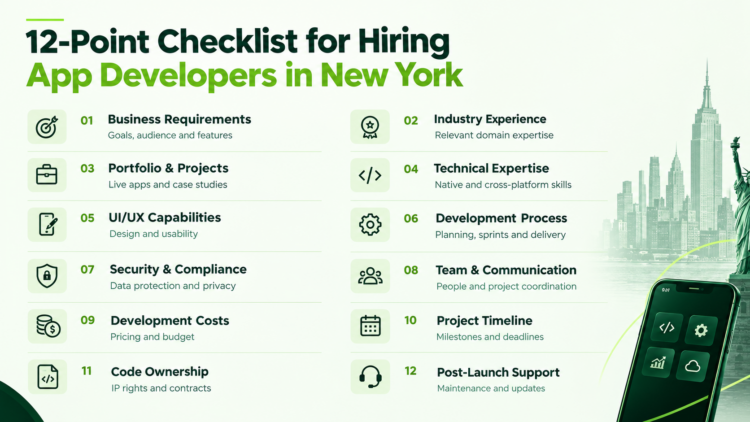
1. Define Your App Requirements and Business Goals
Before contacting app developers, establish what you want your application to accomplish. A development company can help refine your idea, but having a clear understanding of your business objectives will make initial discussions more productive.
Start by identifying the problem your application will solve and the audience it will serve. For example, a healthcare business might need an application that allows patients to book appointments, access medical records, and communicate with healthcare professionals. An eCommerce company may need product browsing, personalized recommendations, payment processing, and order tracking.
Once you understand the purpose, identify the essential features and distinguish them from features that can be introduced later.
Having these requirements documented helps development companies prepare more accurate proposals, recommend appropriate technologies, and estimate the time and resources needed.
What to prepare before contacting developers:
- A clear description of your business idea and target audience.
- A list of essential and optional application features.
- Examples of applications with similar functionality.
- Your preferred platforms, such as iOS, Android, or both.
- An estimated development budget and expected launch timeline.
2. Evaluate Their Industry Experience and Expertise
Technical experience matters, but industry knowledge can make a significant difference in how effectively a development team understands your requirements.
Different industries have different operational processes, customer expectations, and regulatory considerations. For example, developing a fintech application involves payment processing, transaction security, identity verification, and financial data management. A healthcare application may require secure patient information handling, appointment management, and integration with existing healthcare systems.
When reviewing a company’s experience, look beyond the number of applications it claims to have developed. Check whether it has worked on projects involving similar business models, user requirements, and technical challenges.
What to verify:
- Previous projects in your industry.
- Experience with similar application features and business models.
- Knowledge of industry-specific security and compliance requirements.
- Experience integrating external services and enterprise systems.
- Ability to recommend improvements based on previous projects.
3. Review Their Portfolio and Previous Projects
A company’s portfolio provides a practical understanding of its development capabilities. It allows you to assess the type of applications the team has built, the complexity of its projects, and the industries it has served.
However, do not evaluate a portfolio based only on attractive screenshots or website presentations. Whenever possible, download the applications from the Apple App Store or Google Play Store and explore their actual functionality.
Pay attention to how easily users can navigate the application, how quickly its main features respond, and whether the overall experience feels consistent. Look at customer reviews as well, particularly comments about usability, performance, and recurring technical issues.
Case studies are equally important. A useful case study should explain the client’s original requirements, the development challenges, the solution implemented, and the results achieved. This gives you a clearer understanding of how the company approaches real business problems.
Questions worth asking:
- Can you share applications similar to my project?
- Are these applications currently available on app stores?
- What challenges did your team solve during development?
- Can I speak with a previous client?
- Can you provide a detailed case study rather than only screenshots?
4. Check Their Technical Expertise and Technology Stack
The technology stack determines how an application is developed, how it communicates with backend systems, and how easily it can be maintained as the business grows.
A suitable mobile app development company should understand different technologies and recommend an approach based on your product requirements rather than automatically choosing the tools it uses for every project.
For native iOS applications, developers commonly work with Swift and Apple’s development frameworks. Android applications are typically developed using Kotlin and Android’s native development tools.
Backend development is another important consideration. Technologies such as Node.js, Python, Java, and .NET can support application logic, user authentication, APIs, and database operations. Cloud platforms such as Amazon Web Services, Microsoft Azure, and Google Cloud provide infrastructure for hosting, storage, and application scaling.
| Technology | Common Use |
| Swift | Native iOS application development |
| Kotlin | Native Android application development |
| Flutter | Cross-platform mobile applications |
| React Native | Cross-platform iOS and Android applications |
| Node.js | Backend development and APIs |
| Python | Backend systems, data processing, and AI integrations |
| AWS | Cloud hosting, storage, and infrastructure |
| Firebase | Authentication, databases, notifications, and app services |
Do not choose a development company simply because it works with a popular framework. Instead, assess whether its technical recommendations are appropriate for your application’s requirements and long-term maintenance.
Unsure which technology fits your app?
Tell us about your idea, and we’ll explain which approach suits your project idea and why.
5. Evaluate Their UI/UX Design Capabilities
An application can have excellent functionality and still struggle to attract users if the interface is difficult to understand or navigate. UI/UX design plays an important role in how customers interact with an application and whether they continue using it.
A capable app development company in New York should have a structured design process that starts with understanding user expectations and business requirements.
This usually involves user research, information architecture, wireframing, interactive prototypes, and visual design. Before development begins, you should have a reasonable understanding of how users will move between screens and complete important actions.
6. Understand Their App Development Process
A well-defined development process helps keep projects organized and reduces misunderstandings between the business and development team.
Before hiring app developers in New York, understand how it manages each stage of the project, from initial discussions to final deployment.
A typical mobile app development process includes:
Discovery and Planning: The team studies your business model, target audience, competitors, application requirements, and technical expectations. This stage helps establish the project scope and development roadmap.
UI/UX Design: Designers prepare user flows, wireframes, and interface prototypes to establish how the application will look and function.
Development: Developers build the frontend, backend, database, APIs, and required integrations. Depending on the project, development may happen in multiple sprints.
Testing and Quality Assurance: QA engineers check functionality, performance, compatibility, security, and usability. Issues are documented and resolved before release.
Deployment: The development team prepares the application for submission to the Apple App Store and Google Play Store, following their respective publishing requirements.
Maintenance: After launch, the team monitors performance, resolves issues, and provides updates as operating systems, devices, and business requirements change.
Ask whether the company follows Agile development practices, how often it provides working demonstrations, and how it manages changes in project requirements.
7. Assess Security, Data Privacy, and Compliance
Application security should be considered from the beginning of development, particularly if your product handles personal information, financial transactions, healthcare records, or confidential business data.
A security issue can affect customer trust, interrupt business operations, and create legal or financial consequences. Therefore, ask potential developers how they protect application data and prevent unauthorized access.
Important security measures may include encrypted data transmission, secure authentication, role-based access controls, protected API endpoints, secure database configurations, and regular vulnerability testing.
Security points to discuss:
- Data encryption during transmission and storage.
- Secure login, authentication, and authorization.
- API and database security.
- Regular security testing and vulnerability assessments.
- Backup and recovery procedures.
- Relevant privacy and industry compliance requirements.
8. Evaluate the Development Team and Communication Process
When hiring app developers in New York, understand who will actually work on your application and how you will communicate with them.
Some companies provide a complete development team consisting of project managers, UI/UX designers, frontend and backend developers, and QA engineers. Others may assign a smaller team depending on the project’s complexity.
The important thing is to ensure that the proposed team has the right skills and sufficient availability to handle your project.
Ask whether you will communicate directly with developers or through a dedicated project manager. Understand how frequently progress updates will be shared, which project management tools will be used, and how quickly the team typically responds to questions.
Time-zone differences should also be considered when working with development teams outside the United States. If you are based in New York, confirm that the team can arrange regular meetings during suitable Eastern Time working hours.
9. Compare App Development Costs and Pricing Models
The cost of developing a mobile application in New York depends on several factors, including feature complexity, platform selection, design requirements, backend architecture, integrations, and the experience of the development team.
A basic MVP with limited functionality will generally require fewer resources than an enterprise application with multiple user roles, payment processing, real-time features, and complex integrations.
For planning purposes, the following are broad illustrative project budget ranges, not fixed New York market quotations:
| Application Type | Illustrative Budget | Typical Scope |
| Basic MVP | $15,000–$40,000 | Core features and essential functionality |
| Mid-level application | $40,000–$100,000 | Multiple features, backend, integrations |
| Complex application | $100,000–$250,000+ | Advanced architecture and enterprise functionality |
Actual quotations can fall outside these ranges. Always request a project-specific estimate before making a decision.
You should also understand the pricing model offered by the development company.
Fixed-price model: The company agrees to a defined scope, budget, and delivery schedule. This can work well when the requirements are clearly documented and unlikely to change significantly.
Time-and-material model: You pay for the actual development time and resources used. It is useful for projects where requirements may evolve during development.
Dedicated development team: You hire a team of professionals who work on your product over an agreed period. This approach can be suitable for long-term projects, continuous product development, and businesses that need ongoing engineering support.
When comparing proposals, look beyond the total amount. Check whether UI/UX design, testing, deployment, third-party services, hosting, maintenance, and future updates are included.
A lower initial quotation may not represent the lowest overall project cost if important services are excluded.
10. Verify Project Timelines and Delivery Commitments
Development timelines affect product launches, marketing plans, investment decisions, and business operations. Before hiring a development company, understand how it estimates project duration and manages delivery milestones.
The timeline depends on the number of features, application complexity, platform requirements, integrations, and the availability of project resources.
Ask the development company to divide the project into stages and provide estimated completion dates for major deliverables.
Avoid making decisions based on promises of extremely fast delivery without understanding the resources and development approach behind them.
11. Clarify Source Code Ownership and Contract Terms
Before development begins, make sure the agreement clearly defines who owns the application, its source code, design assets, and other project deliverables.
This is particularly important for startups and businesses building app in New York. Without clear contractual terms, ownership disputes can create problems when you want to change development partners, introduce new features, or expand the product.
Your agreement should explain intellectual property ownership, source code access, payment milestones, confidentiality obligations, project deliverables, and termination conditions.
It is also worth confirming whether the client receives access to source code repositories throughout development or only after the project is completed.
Other important details include ownership of design files, documentation, databases, domain accounts, cloud infrastructure, and third-party service credentials.
Before signing, review the agreement carefully and seek legal advice when necessary. Do not assume that paying for development automatically gives you unrestricted ownership of every component used in the application.
12. Check Post-Launch Support and Maintenance
Launching an application is an important milestone, but development responsibilities do not end when it becomes available on the app stores.
Applications need ongoing attention to maintain performance, security, compatibility, and usability. Operating system updates, device changes, third-party API modifications, and evolving customer expectations can all require technical updates.
Before hiring a mobile app development company in New York,, understand what support it provides after launch.
Some companies offer maintenance packages covering bug fixes, security updates, performance monitoring, and technical assistance. Others provide support through a separate agreement or charge for additional development hours.
Ask about response times, support availability, escalation procedures, and the costs associated with additional work.
Have questions about your own app project?
If this checklist raises questions about your idea, scope, or timeline, you can book a short call with app experts.
Red Flags to Watch Out for When Hiring App Developers in New York
Even after reviewing portfolios and comparing proposals, it is possible to overlook warning signs that may affect the project later. Paying attention to these issues before signing a contract can help you avoid unnecessary expenses and delays.
- Unrealistically Low Development Quotes
A quotation that is significantly lower than competing proposals deserves closer examination. It may exclude important services such as testing, UI/UX design, deployment, or post-launch maintenance. Ask for a detailed breakdown before comparing prices.
- No Verifiable Portfolio or Case Studies
If a company cannot provide examples of previous applications, explain its contribution to completed projects, or demonstrate relevant technical experience, it becomes difficult to assess its capabilities.
- Unclear Project Scope and Deliverables
A professional proposal should explain what will be developed, what is included in the budget, and which milestones need approval. Vague commitments can lead to disagreements about additional costs and responsibilities.
- No Defined Communication Process
If a company cannot explain who will manage the project, how progress will be reported, or how issues will be escalated, you may struggle to maintain visibility once development begins.
- No Clear Source Code or IP Ownership Terms
Never leave ownership arrangements until the end of development. Your agreement should clearly explain access to the codebase, intellectual property rights, and project handover.
- No Proper Testing or Security Plan
An application should not be considered ready simply because its main screens are working. If a development company cannot explain its QA process, device testing, security checks, and release procedure, ask for more details before proceeding.
- Unrealistic Delivery Guarantees
Development involves technical dependencies, client approvals, and third-party services. A team that guarantees an extremely short timeline without understanding your requirements may be underestimating the actual work involved.
Questions to Ask Before Hiring an Mobile App Development Company in New York
An initial consultation is an opportunity to understand how a development company approaches your project. Instead of focusing only on its services and pricing, ask questions that reveal its technical capabilities, project management practices, and willingness to take responsibility.
Here are seven useful questions to ask:
- Have you developed applications similar to my business idea?
Ask for examples of relevant projects and find out what responsibilities the company handled. This helps establish whether the team understands your business requirements.
- Who will be working on my application?
Understand the proposed team structure, the experience of its developers, and whether you will have access to the project manager and technical leads.
- Which technology stack would you recommend and why?
The company should be able to explain why a particular technology is suitable for your application’s performance, scalability, budget, and maintenance requirements.
- How will you manage project progress and communication?
Discuss reporting frequency, sprint reviews, project management tools, and the process for addressing delays or technical issues.
- What is included in the development quotation?
Confirm whether the estimate covers research, design, development, integrations, QA, deployment, documentation, and post-launch support.
- Who will own the source code and intellectual property?
Ask how code ownership, repository access, design assets, and project handover will be handled under the agreement.
- What support do you provide after the application is launched?
Understand the maintenance options, bug-fixing policy, support availability, and costs of future improvements.
The answers should help you determine whether the company is simply offering development resources or is prepared to take responsibility for the complete product development process.
Freelance App Developers vs. App Development Companies
Businesses planning a mobile application often have to decide whether to hire independent developers or work with an established mobile app development company.
Both options can work, but the right choice depends on your project scope, available budget, technical requirements, and long-term plans.
Freelance developers can be a practical option for smaller projects, individual features, prototypes, or businesses that already have someone managing the technical work. They may offer flexible engagement arrangements and lower initial costs.
However, larger applications often require several different skills. Managing design, frontend development, backend architecture, testing, deployment, and maintenance through multiple independent freelancers can become difficult.
An app development company generally provides access to a coordinated team that can manage different stages of development. This can simplify project communication and make it easier to handle applications with complex requirements.
| Comparison Factor | Freelance Developers | App Development Companies |
| Initial Cost | Often lower | Generally higher |
| Team Structure | Usually individual professionals | Multiple specialists |
| Project Management | May require client involvement | Included ( Dedicated project manager ) |
| Technical Expertise | Depends on individual skills | Access to different technical roles |
| Scalability | Requires hiring additional resources | Can easily expand the assigned team |
| Quality Assurance | May need separate QA resources | Dedicated QA support available |
| Long-Term Maintenance | Depends on freelancer availability | Maintenance agreements available |
If you are building a simple prototype or need help with a specific feature, a freelancer may be sufficient.
However, if your application requires multiple integrations, advanced functionality, a dedicated QA process, and continuous development, an experienced app development company may provide a more structured approach.
Before deciding, compare the actual team, scope, responsibilities, and support arrangements rather than assuming that either option is automatically better.
List of Top App Developers in New York
New York businesses have access to a wide range of app development companies, from product engineering firms and design-led agencies to companies specializing in enterprise applications.
The following five companies are worth considering when evaluating potential development partners. The selection is intended as a practical shortlist, not an independently audited ranking. Each company has different strengths, service offerings, and engagement models, so the best fit will depend on your project requirements.
1. Code Brew Labs
Code Brew Labs is a top mobile app development company in New York that works with startups and established businesses on mobile applications, web platforms, and custom software solutions. Its New York-focused service offering covers the application development lifecycle, including product planning, UI/UX design, iOS and Android development, backend engineering, integrations, testing, and post-launch support.
The company works across several industries, including fintech, healthcare, eCommerce, education, food delivery, fitness, and on-demand services. This range of experience can be relevant to businesses that need more than a basic mobile application, particularly when the product involves multiple user roles, payment systems, or connected digital platforms.
Code Brew Labs reports more than 5000+ business applications delivered, over 13 years of experience, and work across 35+ industries. These are company-reported figures and should be evaluated alongside the portfolio and client feedback.
Key Services:
- iOS and Android application development.
- Flutter and React Native development.
- Custom software and web application development.
- UI/UX design and product strategy.
- AI-enabled application development.
- API development and third-party integrations.
- Application testing, deployment, and maintenance.
Notable Projects and Portfolio Examples
Code Brew Labs highlights several projects that demonstrate its work across different application categories:
Gradeup: An interactive education platform designed to support live classes, mock examinations, and student engagement. The company describes its work on a high-concurrency learning platform with live streaming, testing functionality, and offline study capabilities.
ProteinHouse: A fitness-focused meal ordering and subscription platform. The project includes mobile ordering, recurring subscriptions, nutritional filters, menu management, and online checkout.
Yummy: A food delivery platform built around restaurant discovery, online ordering, delivery coordination, and order tracking. The company highlights personalized recommendations and delivery management capabilities.
Grintafy: A football talent discovery and scouting platform designed to connect players, coaches, academies, and scouts. Its functionality includes player profiles, performance statistics, and communication features.
Attorney Shield: A legal services platform designed to connect users with verified attorneys. The project includes attorney matching, voice and video consultations, document templates, and payment functionality.
These examples demonstrate experience across education, food technology, sports, legal services, and on-demand platforms.
Check Code Brew Labs Complete Portfolio Here
Clutch Profile: https://clutch.co/profile/code-brew-labs
2. Fueled
Fueled is a digital product agency with a New York presence, known for its work in mobile application development, product design, and digital experiences. The company works with startups, established businesses, and consumer brands that want to develop or improve digital products.
Its services combine product strategy, design, and engineering. This makes Fueled relevant to businesses that want support not only with application development but also with product positioning, user experience, and the overall digital strategy.
Fueled has experience with consumer-facing products and established brands. Its portfolio and company materials highlight work across mobile applications, digital platforms, and product experiences.
Key Services:
- iOS and Android application development.
- Product strategy and consulting.
- UI/UX design.
- Web application development.
- Digital product engineering.
- Product modernization.
Best Suited For: Businesses and established brands looking for a design-focused product development partner with experience building consumer applications.
3. BlueLabel
BlueLabel is a New York-based digital product and software development company that works with businesses on mobile applications, web platforms, and AI-enabled products.
The company combines product strategy, design, and engineering to help organizations develop new digital experiences and modernize existing products. Its work spans different business requirements, including enterprise platforms and consumer applications.
BlueLabel may be worth considering if your project involves product discovery, complex workflows, or the integration of modern technologies into an existing business environment.
Key Services:
- Mobile application development.
- Custom software development.
- Product strategy and consulting.
- UI/UX design.
- AI and machine learning solutions.
- Web application development.
Best Suited For: Startups and established businesses looking for product strategy, application development, and custom digital solutions.
4. Goji Labs
Goji Labs is a digital product agency that works with startups, nonprofits, and established organizations on product design and software development. The company has a presence in the New York market and is known for its emphasis on user experience and product strategy.
Its approach typically involves understanding the business problem before moving into product planning, interface design, and engineering. This can be useful for companies that are still refining their application concept or need help validating product requirements before development.
Goji Labs offers services across mobile and web application development, UX/UI design, and product strategy.
Key Services:
- Mobile app development.
- Web application development.
- Product strategy and discovery.
- UI/UX design.
- Software development.
- Product consulting.
Best Suited For: Startups and businesses that need support with product discovery, application design, and development.
5. Dom & Tom
Dom & Tom is a digital product development agency based in New York, working with businesses on mobile applications, web platforms, and custom software solutions.
The company focuses on combining business strategy, design, and engineering to develop digital products. Its services cover the development lifecycle, from early product planning and prototyping to application development and ongoing improvements.
Dom & Tom can be considered by organizations that need a development partner with experience in building digital products for business and consumer use cases.
Key Services:
- iOS and Android app development.
- Web application development.
- Custom software development.
- UX/UI design.
- Product strategy.
- Digital transformation and modernization.
Best Suited For: Businesses seeking a digital product agency for mobile applications, web platforms, and custom software projects.
Conclusion
Hiring app developers in New York is an important decision that can influence your product’s quality, development cost, launch timeline, and long-term success. The right development partner should bring together technical knowledge, industry experience, structured project management, and an understanding of your business objectives.
Before making a commitment, take the time to review previous projects, assess the proposed technology stack, compare pricing models, and understand how the company handles security, communication, and post-launch support. Clear agreements around project scope, delivery milestones, and intellectual property ownership can also prevent problems during and after development.
There is no single development company that is the right choice for every business. The best partner is the one whose experience, working approach, and technical capabilities align with your product requirements.
Frequently Asked Questions
1. How much does it cost to hire app developers in New York?
The cost of hiring app developers in New York depends on the application’s complexity, number of features, selected technology, design requirements, and development team’s experience. A basic MVP may require an investment of around $20,000 to $40,000, while a mid-level application may cost $40,000 to $100,000. Complex applications involving advanced integrations, enterprise infrastructure, and multiple user roles can exceed $100,000. These are broad planning estimates rather than guaranteed market rates.
2. How long does it take to develop a mobile application?
A basic mobile application or MVP may take approximately two to four months, depending on its scope and complexity. Applications with multiple integrations, advanced functionality, and more extensive testing requirements can take six months or longer. The timeline also depends on how quickly requirements are finalized, designs are approved, and feedback is provided.
3. Should I hire freelance app developers or an app development company?
Freelance developers can be suitable for small projects, prototypes, or specific development tasks. An app development company may be a better option when your project requires multiple specialists, including designers, frontend and backend developers, QA engineers, and project managers. Your decision should depend on project complexity, budget, and the level of ongoing support required.
4. What should I look for when hiring mobile app developers?
Look for relevant project experience, a verifiable portfolio, technical expertise, UI/UX design capabilities, a transparent development process, and clear communication. You should also check client reviews, security practices, source code ownership terms, project timelines, and post-launch maintenance options before signing an agreement.
5. Is it better to hire local or remote app developers?
Both local and remote development teams can deliver successful applications. A local team may offer easier in-person collaboration and convenient meeting schedules, while a remote team can provide access to a broader talent pool and different pricing options. Consider communication, project management, technical capabilities, data protection, and contractual arrangements when choosing between them.
6. Which technologies are commonly used for mobile app development?
Common mobile development technologies include Swift for native iOS applications, Kotlin for native Android applications, and Flutter or React Native for cross-platform development. Backend technologies such as Node.js, Python, Java, and .NET are used to support application functionality, databases, and integrations. The appropriate technology depends on the application’s requirements and long-term plans.
7. Who owns the source code after app development?
Source code ownership depends on the agreement between the client and development company. A properly structured contract should clearly establish intellectual property rights, access to source code repositories, design assets, documentation, and other deliverables. Businesses should confirm these terms before development begins rather than assuming ownership transfers automatically.
8. Do app development companies provide post-launch support?
Many app development companies offer post-launch services such as bug fixes, security updates, performance monitoring, compatibility updates, and feature improvements. However, the scope and cost of support vary by provider. Before hiring a company, confirm whether maintenance is included in the original agreement or provided through a separate support contract.
Let's Convert Your Business Idea Into Success!
Free Consultation from Top Industry Experts
Let’s Build Your Dream App!
Share article on :



Ready To Fuel Your Vision With AI-Powered Innovation?


Level- 18, Dubai World Trade Centre Tower, Sheikh Rashid Tower, Sheikh Zayed Rd, Dubai, UAE
business@code-brew.com +971-55-645-7972
Plot no I - 36, Sector 83 Alpha, Mohali SAS Nagar 140308
business@code-brew.com +91-771-976-8427
Al Akaria 2, 6926 Olaya Street, RHOA2566, Riyadh, Saudi Arabia.
business@code-brew.com
Av. Miguel Hidalgo y Costilla 1995, Arcos Vallarta, 44600 Guadalajara, Mexico
business@code-brew.com +1(213)2614953
4231 Balboa Ave #512 San Diego, CA 92117 United States
business@code-brew.com +1(213)2614953
2nd floor, College House, 17 King Edwards Rd, London HA4 7AE, UK
business@code-brew.com +44 (20) 82644493
Partner With Experts Who Leverage AI & Tech To Transform Ideas Into Market-Leading Solutions.
Wait! Looking for Right Technology Partner For Your Business Growth?
It's Time To Convert Your Business Idea Into Success!
Get Free Consultation From Top Industry Experts:
I would like to keep it to myself