Table of Content

Quick Summary:
- A Format Built for Mobile-First Monetization: Micro drama apps are purpose-built 60–120-second vertical episodes engineered to drive engagement and in-app purchases.
- The Coin Economy: These apps generate higher conversion rates by utilizing in-app coin wallets rather than direct episode pricing.
- Product Mechanics Drive Revenue: The success of a micro-drama app relies heavily on technical execution, specifically 9:16 playback and precise paywall triggers.
- AI as a Strategic Differentiator: AI enables cost-effective localization through automated subtitles and improves retention via predictive churn modeling.
- Investment and Cost Realities: A functional MVP costs $35k–$70k, while a fully integrated, AI-driven platform demands an investment exceeding $160k.
- Custom Build vs. White Label: Custom builds provide full architectural control, ownership, and scalability for unique business models. White-label solutions offer rapid market entry and lower upfront costs.
Ninety seconds. That is the whole game in micro drama; an industry forecasted to hit $2.8 billion by 2035—up from $1.2 billion in 2027 (7.1% CAGR). Most teams approach micro drama app development as a smaller Netflix. Strip out the long episodes, shrink the library, and ship a video player. Unfortunately, that framing fails within the first sprint.
Table of Content
Luckily, this guide covers what it takes to build a competitive micro or short drama app like ReelShort or DramaBox. It covers the core features that make the format work, the business model that drives revenue, and what micro app development costs look like.
Watch How to Build a Micro Drama App
What Is a Micro Drama App and Why It Matters?
A micro drama app is a mobile streaming platform built around serialized short-form video content. It typically ranges from 60 to 120 seconds per episode, presented in vertical orientation and structured around cliffhanger episode endings. The format is purpose-built for phone screens, not adapted from television or film.
The mechanics are simple. A show might have 60 to 100 episodes. The first few are free. After that, users either pay per episode using in-app coins or unlock the full series through a subscription. Each episode ends at a moment of high tension. This pushes the purchase decision into a moment of genuine emotional engagement.
For businesses evaluating video streaming app development, micro or short drama sits at the intersection of three crucial things:
- Mobile-first video
- Serialized storytelling
- Microtransactions
The micro drama format combines all three in a product that is operationally cheaper to produce than long-form OTT content and easier to monetize than ad-supported short video.
What Are the Features of a Micro Drama App?
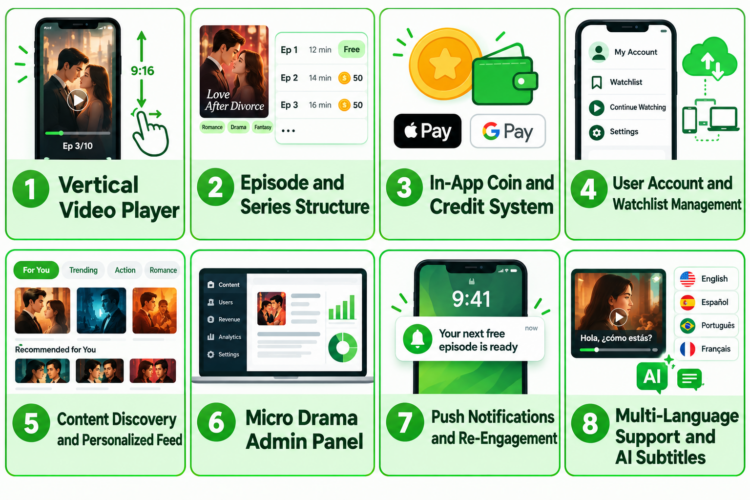
Based on how popular short drama apps like ReelShort and DramaBox operate, here are the features a successful OTT or micro drama app development project needs to include:
1. Vertical Video Player
The player is the most important technical component. It needs smooth vertical playback at 9:16, fast buffering to prevent drop-off at episode transitions, swipe-to-next-episode gesture navigation, and precise episode boundary controls, so the paywall triggers at exactly the right moment. Player performance on mid-range Android devices (not just flagship phones) determines whether your app works for a global audience.
2. Episode and Series Structure
The content model is series-based, not flat. Each series has a title, genre tags, cover image, synopsis, and a numbered episode list. Individual episodes have their own titles, duration, coin cost, and free or paid status. The data model needs to support batch publishing, scheduled releases, and adding episodes to a running series without disrupting user attention.
3. In-App Coin and Credit System
A coin wallet is standard across every major micro drama platform. Users see their balance on every screen that requires payment. The coin purchase flow needs to be frictionless, as Apple Pay and Google Pay support reduces drop-off significantly. The system also needs to handle coin expiry, bonus coin promotions, and refund edge cases cleanly.
4. User Account and Watchlist Management
Users need to track what they are watching, where they left off, and what they have already paid for. Cross-device sync is expected. Social login via Apple, Google, or phone number reduces onboarding friction at the top of the funnel.
5. Content Discovery and Personalized Feed
New users who cannot find a series they want in their first session do not return. A well-designed home feed, genre browsing, trending sections, and a basic recommendation engine based on watch history are not premium features; they are table stakes. The strongest retention comes from combining editorial curation with algorithmic personalization.
6. Micro Drama Admin Panel
The admin panel is where content teams run the platform. It needs to handle series and episode creation, publisher account management, paywall configuration per episode, coin price management, user support tools, and analytics covering revenue per series, episode completion rates, paywall conversion, and daily active users. A weak admin panel forces manual workarounds and slows content operations.
7. Push Notifications and Re-Engagement
The daily free episode mechanic only works if users actually come back. Timed push notifications like “Your next free episode is ready” drive a significant share of daily active usage. The notification system needs to be series-aware, user-preference aware, and compliant with iOS and Android permission models.
8. Multi-Language Support and AI Subtitles
ReelShort’s growth outside its core English-speaking market was driven partly by automated subtitle generation in Spanish, Portuguese, and other languages. For a new platform targeting international audiences, AI-powered subtitle tools like OpenAI Whisper reduce localization costs significantly compared to manual translation at scale.
Planning your micro drama app project?
Don’t let hidden costs derail your launch. Get a custom estimate for your specific micro-drama app features and timeline.
How Do Micro Drama Apps Make Money?
The micro drama business model is one of the more unusual in mobile entertainment, and understanding it is important before you get into short drama app development.
-
Coin-Based Microtransactions (Main Revenue)
This is the dominant model. Users purchase coins in packs, typically ranging from $1.99 for a small bundle to $29.99 for a large one. They spend those coins to unlock individual episodes. A single episode typically costs 8 to 15 coins, and a full 80-episode series might require 500 to 700 coins to unlock completely.
The economics work because the coin purchase creates advance commitment. Once a user has coins loaded, the friction to unlock the next episode is near zero. They are spending coins that they already bought, not making a new payment decision. That psychology is why platforms using coin systems consistently outperform those using direct episode pricing.
-
Subscription Tier
Most mature platforms add a subscription option alongside coins, typically priced at $9.99 to $14.99 per month. This gives subscribers a daily coin allowance and access to a library of fully unlocked older series. This creates a second revenue stream and a retention mechanism for high-frequency users who find per-episode purchasing cumbersome.
-
Free with Advertising
Some micro drama platforms offer a fully free tier supported by pre-roll and mid-roll ads. This works for audience building in price-sensitive markets but delivers lower revenue per user than the coin model. Most successful platforms use advertising as a fallback for users who will not pay, not as a primary revenue strategy.
-
White Label Licensing
A growing secondary revenue model for companies that build micro drama platforms is white label licensing. This means selling a configurable version of the platform to content studios, broadcasters, or regional media companies that want their own branded app. For a mobile app development project targeting the entertainment space, a white label micro drama app is a repeatable commercial offering with recurring licensing or revenue-share income.
Micro Drama App Development Cost in 2026–27
Cost ranges depend primarily on whether you are building a basic MVP, a mid-tier platform with a creator portal, or a full AI micro drama app with recommendation and personalization features.
| Build Type | What Is Included | Estimated Cost | Timeline |
| MVP (admin-managed content, coin paywall, basic discovery) | iOS + Android apps, admin panel, coin system, CDN setup | $35,000 – $70,000 | 3–5 months |
| Mid-tier app (+ creator portal, subscriptions, AI subtitles) | All MVP features + creator upload portal, subscription tier, subtitle tool | $80,000 – $160,000 | 5–8 months |
| Full AI micro drama app (personalization, recommendation, analytics) | All mid-tier features + recommendation engine, engagement analytics, multi-language AI dubbing | $160,000 – $300,000+ | 8–14 months |
| White label micro drama app | Configurable platform for licensing to content studios | $90,000 – $200,000 | 6–10 months |
Ongoing costs include CDN and video storage (typically $0.01–$0.05 per GB delivered, scaling with content volume), app store fees, payment processing (Apple takes 30% on IAP for the first year, dropping to 15% after 12 months of subscriptions), and content acquisition or production if you are running an original content model.
How to Build a Micro Drama App? 6 Key Steps
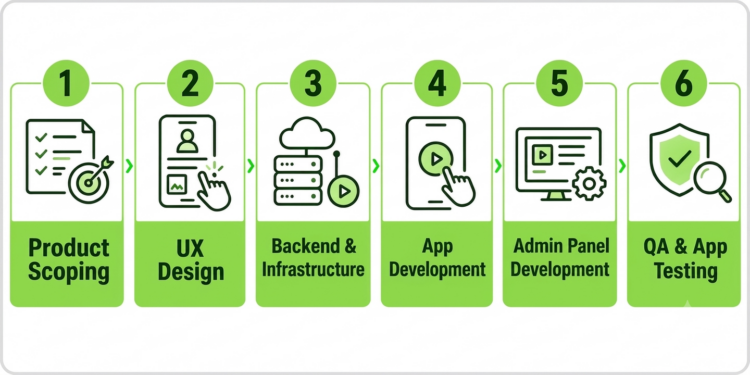
Building a short or vertical drama app follows the same broad stages as any mobile product, but there are specific decision points that affect how long it takes and what it costs.
Step 1: Product Scoping (2–3 weeks)
Define the content model (originals, creator-submitted, or licensed), the target market and language, the monetization approach (coins only, subscription, hybrid), and whether the first version needs a creator-facing upload portal or only admin-side content management. These decisions determine the scope of the admin panel and the complexity of the backend.
Step 2: UX Design (3–4 weeks)
The user experience on a micro drama app is largely determined by three flows: onboarding, content discovery, and the episode-to-paywall transition. Each needs to be designed and tested before development starts. The paywall moment (the screen a user sees when they reach the end of their free episodes) is particularly important. A poorly designed paywall screen kills conversions regardless of how good the content is.
Step 3: Backend and Infrastructure Setup (4–6 weeks)
This phase covers the video storage and transcoding pipeline, the coin transaction system, the content delivery infrastructure, and the API layer connecting the mobile apps to the backend. The video transcoding pipeline needs to produce multiple bitrate versions of each episode for adaptive streaming. What plays on a strong Wi-Fi connection should not be the same file delivered on a 4G connection in an emerging market.
Step 4: Mobile App Development (8–12 weeks)
Frontend development covers the video player, browsing and discovery interfaces, user account and watchlist management, the in-app purchase flow, and the push notification system. The player integration (particularly the paywall trigger and the swipe-to-next-episode behavior) requires careful testing across a wide range of devices and OS versions.
Step 5: Admin Panel Development (4–6 weeks)
The micro drama admin panel should be built alongside the mobile app, not after. Content teams need to be able to start loading series and configuring the paywall before the app launches. However, keep in mind that building the admin panel as an afterthought extends the content lead time and delays launch.
Step 6: QA, Performance Testing, and Launch
Load testing the video delivery infrastructure before launch catches bottlenecks that only appear at real user scale. Video buffering issues that do not appear in a 10-person QA session appear immediately when 5,000 users open the app on launch day. App Store and Google Play submissions typically add 1–2 weeks to the timeline.
What Are the Best Short Drama Apps? What Makes Them Successful?
For users looking for free micro drama content or paid platforms, ReelShort, DramaBox, Shortmax, GoodShort, and FlexTV are the most popular options. All of them work on the “micro drama app free” model. They come with a limited number of episodes, with payment required for the full series.
Before scoping a build, it is better to understand exactly what makes these leading micro drama platforms work.
-
Content Format Discipline
Every episode on ReelShort is shot vertically at a 9:16 aspect ratio, with close-up framing and fast pacing. The content is not repurposed on horizontal footage; it is produced specifically for phone screens. That design decision affects what gets shot, how it is edited, and what emotional beats work at two-minute intervals.
-
Genre Concentration
ReelShort and DramaBox focus on genres with proven engagement patterns: billionaire romance, revenge drama, werewolf and supernatural romance, and family conflict. These genres generate the kind of emotional investment that drives episode-by-episode purchases. Building a broad genre library before you pay users is expensive and unnecessary. Thus, the apps that work start narrow.
-
The Coin Economy
ReelShort uses an in-app coin system rather than direct per-episode pricing. Users buy coin packs, then spend coins to unlock episodes. Coin systems create a psychological separation between real money and in-app spending that consistently increases purchase frequency. It’s the same mechanic mobile games have used for years. DramaBox uses a similar credits model.
-
Daily Free Episode Drops
Most platforms give users one free episode per day per show they have started. This creates a daily return habit without destroying the paywall. Users come back. Some pay to skip the wait. Both outcomes serve the platform. Here, the quality of the admin panel determines how fast the content library can grow.
How AI is Shaping Micro Drama Apps?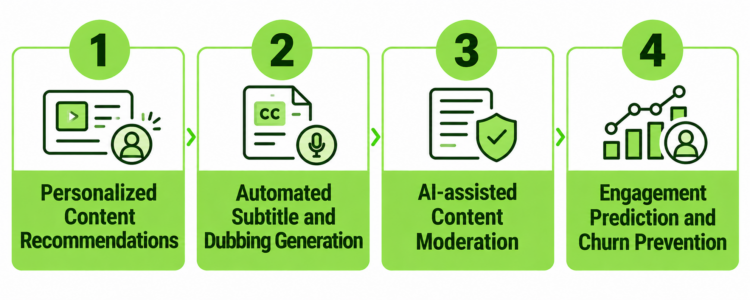
AI integration is not mandatory for a first-version micro drama app, but it is increasingly what separates platforms with strong retention from those that barely grow after the initial content push. Here’s how AI influences micro drama:
-
Personalized Content Recommendations
A recommendation engine that learns from watch history, genre preference, completion rate, and time-of-day viewing patterns can surface the right series to the right user at the right moment. For micro drama apps, where the first episode watched determines whether a user becomes a paying customer, recommendation quality has a direct impact on revenue.
-
Automated Subtitle and Dubbing Generation
OpenAI Whisper and similar models can generate accurate transcripts and subtitles from uploaded video files, reducing localization time from days to minutes. AI dubbing tools can replace on-screen audio with a synthesized voice in the target language. They are still improving in quality but are already viable for certain market segments.
-
AI-assisted Content Moderation
As user-generated content (UGC) or creator-submitted content enters the micro drama app, automated moderation tools can help flag policy violations before human review. Ultimately, they reduce the staff burden and compliance risk.
-
Engagement Prediction and Churn Prevention
Models trained on platform-specific data can identify users who are likely to disengage, based on declining session frequency, incomplete episodes, or reduced coin purchases. This can trigger targeted retention actions: a bonus coin offer, a push notification about a new series in their preferred genre, or a limited discount on a subscription upgrade.
Custom Build vs. White Label Micro Drama App
| Factor | Custom Build | White Label |
| Time to launch | 3–14 months | Weeks to a few months |
| Upfront cost | $35,000–$300,000+ | Lower; licensing or revenue-share |
| Ownership | You own the code | Vendor owns it |
| Flexibility | Full control | Vendor’s use cases only |
| Monetization | Any model, your pricing | Vendor’s structure |
| Vendor dependency | None | Tied to their roadmap |
| Licensing to others | Must be architected upfront | Often built in |
| Best fit | Specific strategy, full control | Market testing, speed |
Businesses entering this market have two viable approaches: custom app development and white label app development. A custom build gives you full control over the feature set, the content model, the UX, and the technical architecture. It takes longer and costs more upfront but produces a platform you own completely, with no dependency on a third-party vendor’s roadmap or licensing terms.
A white label micro drama app is a faster route to market. A pre-built platform configurable with your branding, content, and pricing is deployable in weeks rather than months, and at a lower initial cost. The trade-off is flexibility: white label platforms are designed for common use cases, and anything outside those parameters requires custom development anyway.
For businesses that plan to test a market before making a larger investment, a white label solution makes sense. For platforms with a specific content strategy, a differentiated monetization model, or plans to license their own platform to others, a custom build is the better foundation.
Concluding Thoughts
The micro drama format works because it follows the mechanics of mobile gaming: short sessions, emotional investment, and microtransaction paywall at the moment of peak engagement. The apps that built on that insight first are now generating tens of millions in revenue with content that costs a fraction of a standard streaming production budget.
The market outside China and Southeast Asia is still early. ReelShort proved the model works in English-speaking markets. The category now has multiple competitors, but the library depth and product quality of most platforms leave room for new entrants with strong content.
Ready to capture the micro-drama market?
Code Brew Labs handles custom micro-drama app development, from coin mechanics to AI integrations.
Frequently Asked Questions
What is a micro drama app?
A micro drama app is a mobile streaming platform built around short, serialized video content. It is typically 60 to 120 seconds per episode and delivered in a vertical (9:16) format. Content is organized into series with 40 to 100 episodes, with the first few episodes free, and the rest unlocked through an in-app coin or subscription system.
How do I build a micro drama app like ReelShort?
Building a micro drama app requires a vertical video player, a series and episode content management system, and an in-app coin purchase flow integrated with Apple IAP and Google Play Billing.
You will also need a content delivery network for video hosting, a recommendation engine, and an admin panel for content operations. The development timeline for a production-ready MVP is typically 3–5 months.
How much does micro drama app development cost?
A basic MVP with a coin-based paywall, admin panel, and CDN integration costs approximately $35,000–$70,000. A mid-tier platform with a creator portal and subscription tier runs $80,000–$160,000. A full AI micro drama platform with personalization and multi-language support ranges from $160,000 to $300,000+.
Is a micro drama app safe and legit?
Yes. Established apps like ReelShort and DramaBox operate within standard App Store and Google Play policies. Payments run through Apple and Google’s in-app purchase systems. The main user concern is pricing transparency, where well-built platforms display coin costs and episode unlock prices clearly before purchase.
What short drama apps are free?
All major micro drama apps are free to download. Most offer the first 3–10 episodes of each series at no cost, with subsequent episodes requiring coin purchases or a subscription. Shortmax and GoodShort offer the most ad-supported free content among current major platforms.
What is the best short drama app?
ReelShort has the largest English-language library and the most polished product among Western-market platforms. DramaBox has strong genre depth across romance and thriller. Shortmax is ideal for users who prefer more free content before committing to a purchase. The best choice depends on genre preference and willingness to pay.
Can I build a white label micro drama app?
Yes. A white label micro drama app is a configurable platform. It comes with a content management system, coin economy, and user-facing apps that can be branded and deployed for a specific content studio or regional market without building from scratch. It is a faster, lower-cost route to market than a custom build, with less flexibility on feature customization.
What is a ReelShort clone or DramaBox clone?
A ReelShort clone or DramaBox clone refers to a micro drama platform built with the same core mechanics: vertical video player, episodic content with a coin paywall, genre-based discovery, and push notification-driven re-engagement.
It does not mean an identical copy; it means a platform built on the same proven product model, with differentiated content and branding. For more details, feel free to reach out to us.
Let's Convert Your Business Idea Into Success!
Free Consultation from Top Industry Experts
Let’s Build Your Dream App!
Share article on :



Ready To Fuel Your Vision With AI-Powered Innovation?





Level- 18, Dubai World Trade Centre Tower, Sheikh Rashid Tower, Sheikh Zayed Rd, Dubai, UAE
business@code-brew.com +971-55-645-7972
Plot no I - 36, Sector 83 Alpha, Mohali SAS Nagar 140308
business@code-brew.com +91-771-976-8427
Al Akaria 2, 6926 Olaya Street, RHOA2566, Riyadh, Saudi Arabia.
business@code-brew.com
Av. Miguel Hidalgo y Costilla 1995, Arcos Vallarta, 44600 Guadalajara, Mexico
business@code-brew.com +1(213)2614953
4231 Balboa Ave #512 San Diego, CA 92117 United States
business@code-brew.com +1(213)2614953
2nd floor, College House, 17 King Edwards Rd, London HA4 7AE, UK
business@code-brew.com +44 (20) 82644493
Partner With Experts Who Leverage AI & Tech To Transform Ideas Into Market-Leading Solutions.
Wait! Looking for Right Technology Partner For Your Business Growth?
It's Time To Convert Your Business Idea Into Success!
Get Free Consultation From Top Industry Experts:
I would like to keep it to myself