Table of Content

Quick Summary:
- HIPAA applies to your app if it creates, receives, stores or sends patient health information on behalf of a healthcare provider, health plan or another business that handles that data. An app that people download and use on their own, with no provider involved, usually falls outside HIPAA.
- There is no official "HIPAA certification" for apps. The US Department of Health and Human Services (HHS) does not certify products. Compliance is something you show through your design, your policies and your signed agreements.
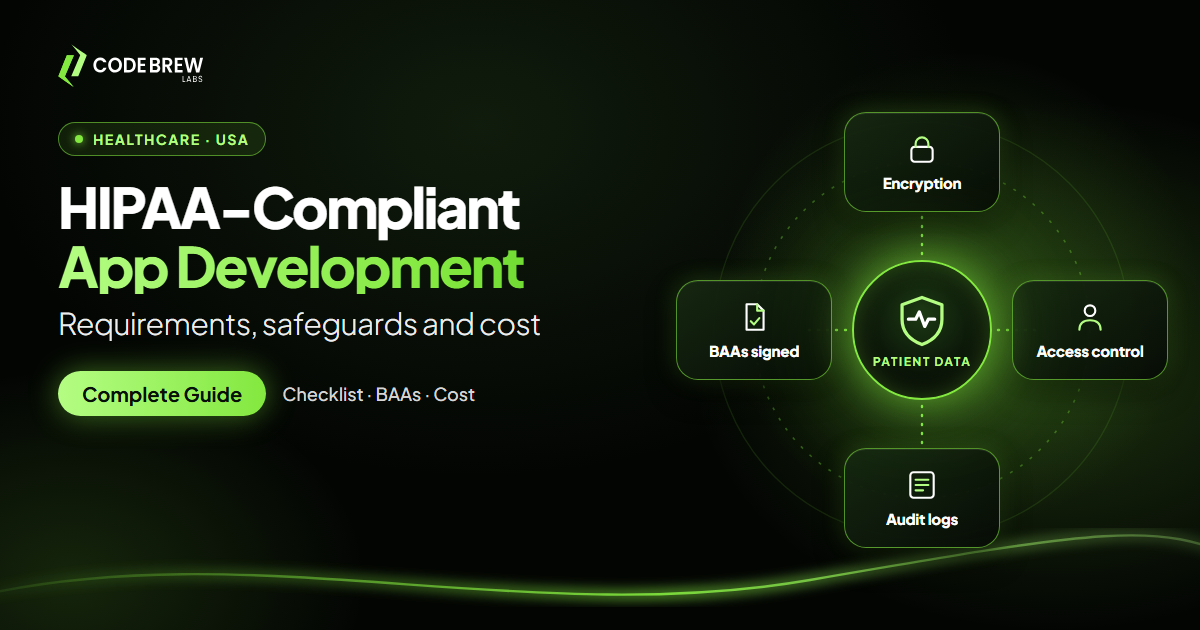
- Three things drive the build: protect data with encryption, access control and audit logs; sign a business associate agreement (BAA) with every vendor that touches patient data; and run a documented security risk analysis.
- Compliance typically adds 20 to 40% to a base app build, plus yearly security reviews. A telemedicine app with a $40,000 to $80,000 base build lands at roughly $48,000 to $112,000 once compliance is included.
- Many breaches come from small choices: patient names in push notifications, health data in analytics tools, and unsecured logs. Plan for these on day one.
Patient data is among the most sensitive data an app can handle, and a mistake is expensive. It can mean a breach notice to every affected patient, an investigation by federal regulators and a lost contract with the hospital that hired you.
Table of Content
The good news is that HIPAA is less mysterious than it looks. It is a set of rules about who may see patient data and how it must be protected. This guide explains when HIPAA applies to your app, what the rules ask of you, how to design an app that meets them, what it costs and how to choose a development partner. If you are still planning your product, start with our guide on how to create a healthcare app.
This article is general information, not legal advice. Have a healthcare attorney or HIPAA compliance consultant review your specific situation.
What HIPAA Is, in Plain Terms
HIPAA (the Health Insurance Portability and Accountability Act) is a US federal law. Four parts matter to app builders:
| Part | What it covers | What it means for your app |
|---|---|---|
| Privacy Rule | Who may use or share protected health information (PHI), and when | Limit access to what each user needs. Let patients see their own data. Do not use PHI for marketing without permission. |
| Security Rule | How electronic PHI (ePHI) must be protected | This is where most technical requirements come from: access control, encryption choices, audit logs, risk analysis. |
| Breach Notification Rule | What to do when unsecured PHI is exposed | You need an incident process and a way to find out what was exposed, and to whom. |
| Enforcement | How violations are investigated and penalised | Penalties are tiered by how much care you took, and they are adjusted each year. Keep records that show you acted in good faith. |
PHI is health information that can be linked to a person. HHS lists 18 kinds of identifier that make data identifiable, including names, addresses, dates, phone numbers, email addresses, medical record numbers and device IDs. In practice, if you can tie a health detail to a person, treat it as PHI.
Building a healthcare app that handles patient data? Talk to Code Brew Labs.
Tell us what your app does and who uses it. We will tell you whether HIPAA applies, which safeguards to build in, and what it costs. No commitment required. NDA on request.
Does Your App Need to Be HIPAA Compliant?
HIPAA applies to two groups. Covered entities are healthcare providers, health plans and healthcare clearinghouses. Business associates are companies that handle PHI on behalf of a covered entity. If a hospital hires you to build or run an app, you are a business associate, and HIPAA applies to you directly.
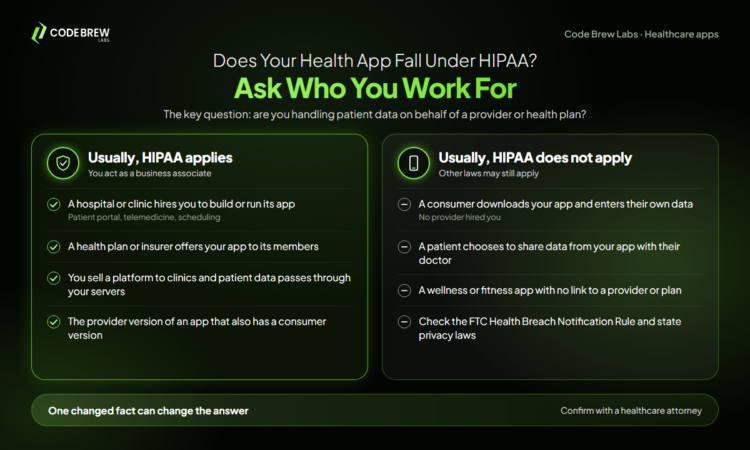
HHS’s own guidance on health apps asks two questions: did a covered entity hire or pay you, and does the consumer choose the app and control where the data goes? Here is how that plays out:
| Your app | HIPAA applies? | Why |
|---|---|---|
| A clinic or hospital hires you to build a patient portal or telemedicine app | Yes, you are a business associate | You handle PHI for a covered entity. |
| A health plan or insurer offers your app to its members | Yes | The plan is a covered entity and you work on its behalf. |
| You sell a platform to clinics, and patients’ data goes through your servers | Yes | The clinics are covered entities and your platform handles their PHI. |
| A consumer downloads your app and types in their own data, with no provider involved | Usually no | You are not acting for a covered entity. |
| A consumer app that sends data to a doctor only because the patient chooses to share it | Usually no | The patient is directing their own data. |
| You offer a consumer version and a separate provider version of the same app | Provider version yes, consumer version usually no | Keep the two data sets separate. |
You can read the scenarios on the HHS page for mobile health app developers.
If HIPAA Does Not Apply, Other Rules May
- The FTC Health Breach Notification Rule covers many health apps that sit outside HIPAA. It requires them to notify people after a breach of health data. See the FTC’s page on the Health Breach Notification Rule.
- State laws such as California’s privacy laws and Washington’s My Health My Data Act can apply to consumer health data.
- Your own promises. A privacy policy that says “we never share your data” is enforceable. Make sure your code matches your policy.
What Your App Must Do: The Security Rule Safeguards
The Security Rule groups its requirements into three kinds of safeguards. Developers mostly own the technical ones. Your client (or your own company) owns the administrative and physical ones.
| Safeguard type | Examples | Who usually owns it |
|---|---|---|
| Administrative | Risk analysis, policies, staff training, access approvals, incident response, vendor agreements | The business, supported by your team |
| Physical | Controls on servers, devices and workstations | Your cloud provider and the business |
| Technical | Access control, audit logs, integrity checks, secure transmission, encryption | Your development team |
One detail trips up many teams. Some Security Rule specifications are required and others are addressable. Addressable does not mean optional. It means you must put the control in place or document why another measure protects the data equally well. Encryption is addressable under the current rule, and in practice you should treat it as mandatory.
Technical Safeguards: What to Build In
| Area | What to do |
|---|---|
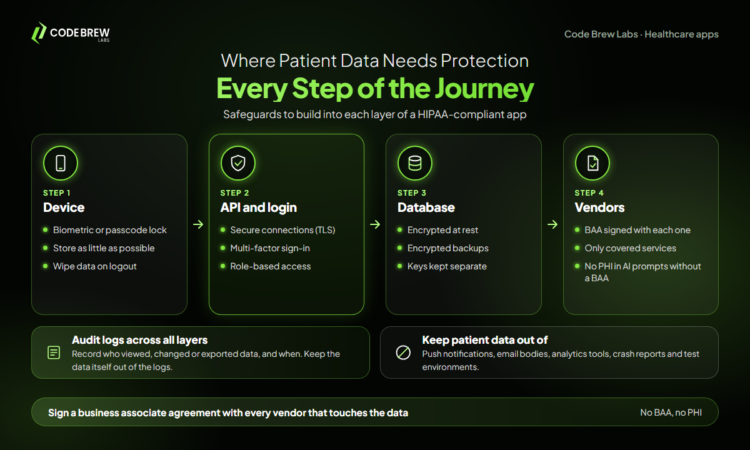
| Encryption in transit | Use current TLS for every connection between the app, your servers and any vendor. Do not allow unencrypted fallbacks. |
| Encryption at rest | Encrypt databases, file storage and backups. Keep encryption keys apart from the data and manage them in a key service. |
| Authentication | Unique user IDs, strong passwords and multi-factor authentication for staff and admin accounts. Offer biometrics and passcodes on the device. |
| Access control | Role-based access so each user sees only what they need (the “minimum necessary” idea). Review access on a schedule. |
| Audit logs | Record who viewed, changed, exported or deleted PHI, and when. Protect the logs from tampering. Keep PHI itself out of the logs. |
| Session management | Automatic logoff after inactivity and short-lived tokens. |
| Data on the device | Avoid storing PHI on the phone where you can. If you must, encrypt it, protect it with the device lock and wipe it on logout or remote request. |
| Push notifications and email | Send no PHI. “You have a new message” is fine. “Your test result for diabetes is ready” is not. |
| Analytics, crash reports and SDKs | Do not send PHI to tools that have no signed BAA. HHS has issued guidance on online tracking technologies, so review every SDK and tag. |
| Backups and disaster recovery | Encrypted backups, tested restores and a documented recovery plan. |
| Data retention and deletion | Define how long data is kept and how it is deleted. HIPAA requires you to keep your compliance documents for six years. Medical record retention is usually set by state law. |
| Secure messaging and video | Use vendors that sign a BAA, and make sure recordings and transcripts are protected like any other PHI. |
The Proposed Security Rule Update
In January 2025, HHS proposed changes to the Security Rule that would remove the “addressable” category and require measures such as encryption and multi-factor authentication. As of late 2026, reports indicate it is still a proposal, and the timeline for a final rule has moved more than once. Nothing in the proposal is enforceable until a final rule is published. The sensible approach is to build to the stricter standard now, because it is also the safer design.
Business Associate Agreements (BAAs)
A BAA is a contract in which a vendor agrees to protect PHI the way HIPAA requires. You need one with every vendor that creates, receives, stores or sends PHI for you, and your client needs one with you.
| Vendor type | BAA needed if it touches PHI? | Watch out for |
|---|---|---|
| Cloud hosting and storage | Yes | Major cloud providers sign BAAs, but only for listed services. Use only those services for PHI. |
| Database and backup services | Yes | Make sure backups and replicas are covered too. |
| Email, SMS and chat providers | Yes | Keep PHI out of message bodies where you can. |
| Video and telehealth providers | Yes | Check recording and transcript settings. |
| Analytics, crash and marketing tools | Yes, or keep PHI out of them | Most standard analytics products do not sign BAAs. |
| AI and LLM APIs | Yes, or keep PHI out of the prompts | Do not paste PHI into a model that has no BAA. Ask about data retention and model training. |
| Subcontractors and offshore developers | Yes, if they can access PHI | Give developers de-identified test data, not real patient data. |
HHS publishes guidance on HIPAA and cloud computing that explains how BAAs work with cloud vendors.
Features That Need Extra Care
- Telemedicine. Video, chat, e-prescriptions and visit notes all contain PHI. See our guides to telemedicine app development and how to build a telemedicine app like Zocdoc.
- EHR and EMR integration. Connecting to a records system means careful access rules, logging and standards such as FHIR and HL7. Read about EHR software development.
- AI features. Symptom checkers, scribes and chatbots can expose PHI if prompts and logs are not controlled. See AI chatbots in healthcare and our AI healthcare software development service.
- Wearables and remote monitoring. Device data tied to a patient is PHI once it reaches a provider’s system. See IoMT and IoT in healthcare.
- Hospital systems. Apps that sit inside a hospital’s network have extra approvals and security reviews. See healthcare app development for hospitals.
How to Build a HIPAA-Compliant App: 8 Steps
- Decide whether HIPAA applies. Use the table above and ask counsel to confirm.
- Map your PHI. List every place patient data is collected, stored, sent and logged. This map drives every later decision.
- Run a security risk analysis. The Security Rule requires one. Record the risks and what you did about each.
- Design with minimum data. Collect only what you need. Prefer storing less on the device and in third-party tools.
- Choose compliant infrastructure and sign BAAs. Use only cloud services that are covered by the provider’s BAA.
- Build the safeguards. Encryption, access control, audit logs and secure messaging from the table above.
- Test and review. Security testing, penetration testing and a review of logs, SDKs and notifications for accidental PHI.
- Prepare for incidents and keep records. Write an incident response plan, train staff and keep documents for six years.
Start small to learn fast. A focused first version can prove your idea before you invest in the full platform. See our MVP development service.
What If There Is a Breach?
Under the HIPAA Breach Notification Rule, a breach of unsecured PHI must be reported. The timing for covered entities is:
| Who | Deadline |
|---|---|
| Affected individuals | Without unreasonable delay, and no later than 60 calendar days after discovery |
| HHS, breach affects 500 or more people | At the same time as the notice to individuals |
| HHS, breach affects fewer than 500 people | Annually, within 60 days after the end of the calendar year of discovery |
| Media, breach affects more than 500 residents of a state | Same 60-day limit, to prominent media outlets in that state |
As a business associate, your contract will usually require you to tell your client much sooner, so they can meet their own deadlines. Data that was properly encrypted is generally not “unsecured” PHI, which is one more reason to encrypt. Read the HHS Breach Notification Rule page for the details.
HIPAA-Compliant App Development Cost
There is no separate price list for “HIPAA apps”. The cost is your base app plus the work to make it compliant. Our own cost guides put the compliance work at roughly 20 to 40% on top of the base build, plus a security review. For general pricing, see our mobile app development cost guide and our AI app development cost in the USA guide.
| Example | Base build | With compliance (+20 to 40%) | Timeline |
|---|---|---|---|
| Patient portal or appointment app (one platform) | $40,000 – $80,000 | $48,000 – $112,000 | 4 – 7 months |
| Telemedicine app with video, chat and an admin panel | $40,000 – $80,000 | $48,000 – $112,000, plus a security audit | 4 – 7 months |
| Advanced app with AI features and EHR integration | $100,000 – $300,000+ | $120,000 – $420,000+ | 6 – 12 months |
What Pushes the Cost Up
- Number of integrations: EHR, labs, pharmacies, payment and insurance systems.
- Real-time video and messaging.
- AI features that must run without exposing PHI.
- Hosting model: a dedicated, audited environment costs more than a shared one.
- Audits and testing: penetration testing, security reviews and any customer-required audits such as SOC 2.
Yearly Costs After Launch
- Maintenance and updates: plan for 15 to 25% of the build cost each year.
- Hosting on compliant services, logging and monitoring.
- An updated risk analysis and a security test at least once a year, or after major changes.
- Staff training and policy reviews.
Want a cost estimate for your HIPAA-compliant app?
Share your idea, your users and the systems you need to connect. Code Brew Labs will send back a scoped plan with a cost range and a timeline.
Common HIPAA Mistakes in App Development
- Thinking a cloud provider makes you compliant. A compliant data centre does not make your app compliant. Your configuration and your code count too.
- Using PHI in test environments. Use fake or de-identified data in development and testing.
- Putting PHI in push notifications, emails or logs. Keep messages generic.
- Adding analytics or advertising SDKs without checking them. They can send identifiers and health details to third parties.
- Skipping the BAA. One missing vendor agreement is a violation, even if nothing leaks.
- Treating compliance as a one-time project. Rules, vendors and your own features change, so review regularly.
- Claiming “HIPAA certified”. No government body certifies apps. Say “built to meet HIPAA requirements” and show your safeguards.
How to Choose a HIPAA-Compliant App Development Partner
Ask every company these questions before you sign:
- Have you built an app for a covered entity or business associate, and can I speak to that client?
- Will you sign a BAA with us, and which of your tools and subcontractors would touch PHI?
- Where is our data stored, and which cloud services are covered by a BAA?
- How do you keep PHI out of test data, logs, analytics and notifications?
- Who does the security risk analysis, and what is your testing process?
- What happens during an incident, and how fast will you tell us?
- Who owns the source code and the data?
Be wary of anyone who says they are “HIPAA certified” or promises that using one tool makes your app compliant. For a wider view of healthcare partners, see our healthcare app development company page.
Why Healthcare Teams Choose Code Brew Labs
Code Brew Labs designs and builds healthcare apps for providers, startups and health-tech companies, from telemedicine and patient portals to AI-assisted tools. We start with a scoped plan and a data map, so you know what is protected, where, and what it costs before you commit. If you want a team that treats privacy as part of the design, not a late add-on, see our healthcare app development company page.
Ready to build a healthcare app that protects patient data?
Partner with Code Brew Labs to plan your safeguards, your integrations and your launch. We will tell you what to build now and what to add later.
Frequently Asked Questions
What is HIPAA-compliant app development?
It means designing and building an app so that it protects patient health information as HIPAA requires. That covers access control, encryption, audit logs, signed agreements with vendors, a documented risk analysis and an incident plan.
Does my health app need to be HIPAA compliant?
If your app handles patient data for a healthcare provider, health plan or another covered entity, yes. If people download it and use it on their own with no provider involved, HIPAA usually does not apply, but other laws such as the FTC Health Breach Notification Rule and state privacy laws may.
Is there a HIPAA certification for apps?
No. HHS does not certify or endorse apps or software as “HIPAA compliant”. Be careful with vendors that claim to be certified.
What is a business associate agreement?
A BAA is a contract in which a vendor agrees to protect patient data as HIPAA requires. You need one with every vendor that touches PHI, and your client needs one with you if you are a business associate.
How much does it cost to build a HIPAA-compliant app?
Compliance typically adds 20 to 40% to the base build, plus a security review. For example, a telemedicine app with a $40,000 to $80,000 base build would cost about $48,000 to $112,000 with compliance. Advanced apps with AI and EHR integration cost more.
Do I have to encrypt data to meet HIPAA?
Encryption is an “addressable” specification under the current Security Rule, which means you must either implement it or document an equal alternative. In practice, you should encrypt data in transit and at rest. HHS has proposed making it a requirement.
Can I use AI or ChatGPT-style tools in a HIPAA app?
Yes, but only if you control what data goes in. Use an AI provider that will sign a BAA, or keep PHI out of the prompts. Check how long the provider keeps data and whether it uses it for training.
Can I send patient information in push notifications or email?
You should not. Keep notifications generic, such as “You have a new message”, and show the details only after the user signs in.
What happens if my app has a data breach?
You must follow the breach notification process. Covered entities must notify affected people within 60 days of discovery and also notify HHS, and sometimes the media. As a business associate you must tell your client under the terms of your contract. Properly encrypted data is generally not treated as unsecured PHI.
How long does it take to build a HIPAA-compliant app?
A focused patient portal or telemedicine app typically takes 4 to 7 months, including the risk analysis and security testing. Advanced apps with AI and EHR integration take 6 to 12 months.
Final Thoughts
HIPAA-compliant app development comes down to three habits: know where patient data goes, protect it at every step, and write down what you did. Decide early whether HIPAA applies, map your data, sign agreements with every vendor and build the safeguards in from day one. It costs more up front and far less than fixing a breach.
If you want a plan and a price for your own healthcare app, talk to the Code Brew Labs team, and we will scope it with you.
Let's Convert Your Business Idea Into Success!
Free Consultation from Top Industry Experts
Let’s Build Your Dream App!
Share article on :



Ready To Fuel Your Vision With AI-Powered Innovation?


Level- 18, Dubai World Trade Centre Tower, Sheikh Rashid Tower, Sheikh Zayed Rd, Dubai, UAE
business@code-brew.com +971-55-645-7972
Plot no I - 36, Sector 83 Alpha, Mohali SAS Nagar 140308
business@code-brew.com +91-771-976-8427
Al Akaria 2, 6926 Olaya Street, RHOA2566, Riyadh, Saudi Arabia.
business@code-brew.com
Av. Miguel Hidalgo y Costilla 1995, Arcos Vallarta, 44600 Guadalajara, Mexico
business@code-brew.com +1(213)2614953
4231 Balboa Ave #512 San Diego, CA 92117 United States
business@code-brew.com +1(213)2614953
2nd floor, College House, 17 King Edwards Rd, London HA4 7AE, UK
business@code-brew.com +44 (20) 82644493
Partner With Experts Who Leverage AI & Tech To Transform Ideas Into Market-Leading Solutions.
Wait! Looking for Right Technology Partner For Your Business Growth?
It's Time To Convert Your Business Idea Into Success!
Get Free Consultation From Top Industry Experts:
I would like to keep it to myself