Table of Content

Quick Summary:
- Bond tokenization represents a bond or legally defined bond interest digitally using blockchain or distributed ledger technology.
- Smart contracts can support the bond lifecycle, including issuance, ownership transfers, coupon calculations, maturity events, and redemption.
- Coupon automation depends on accurate payment data and sufficient funds. Smart contracts can apply payment rules, but they cannot create money or guarantee that an issuer will meet its obligations.
- Delivery-versus-payment (DvP) links securities delivery to payment. When implemented correctly, it helps reduce the risk of one party delivering an asset without receiving the corresponding payment.
- Investor eligibility and compliance must be built into the platform design. Token standards such as ERC-3643 can support permissioned transfers, but they do not automatically make an offering legally compliant.
- Blockchain selection depends on the use case. Privacy, interoperability, settlement assets, transaction costs, governance, and regulatory requirements all matter.
- Development costs depend on the full operating model. A bond issuance platform with investor onboarding, coupon servicing, DvP settlement, and secondary trading requires more work than a basic token contract.
Bonds have long been used by governments and businesses to raise capital from investors. Traditionally, issuing and managing a bond involves several parties, including issuers, banks, custodians, paying agents, and securities settlement systems.
Table of Content
Bond tokenization introduces blockchain technology into this process. Instead of relying entirely on conventional securities records and separate transaction systems, a tokenized bond can be issued or represented digitally, with smart contracts supporting ownership records, coupon payments, transfer restrictions, and other lifecycle activities.
However, building a digital bond issuance platform involves more than creating a token. The platform must account for the legal rights attached to the bond, investor eligibility, payment obligations, settlement arrangements, and the responsibilities of financial intermediaries.
This guide explains how bond tokenization works, how traditional and tokenized bonds differ, how coupon payments and delivery-versus-payment settlement can be automated, and what businesses should consider when developing a bond tokenization platform.
What Is Bond Tokenization?
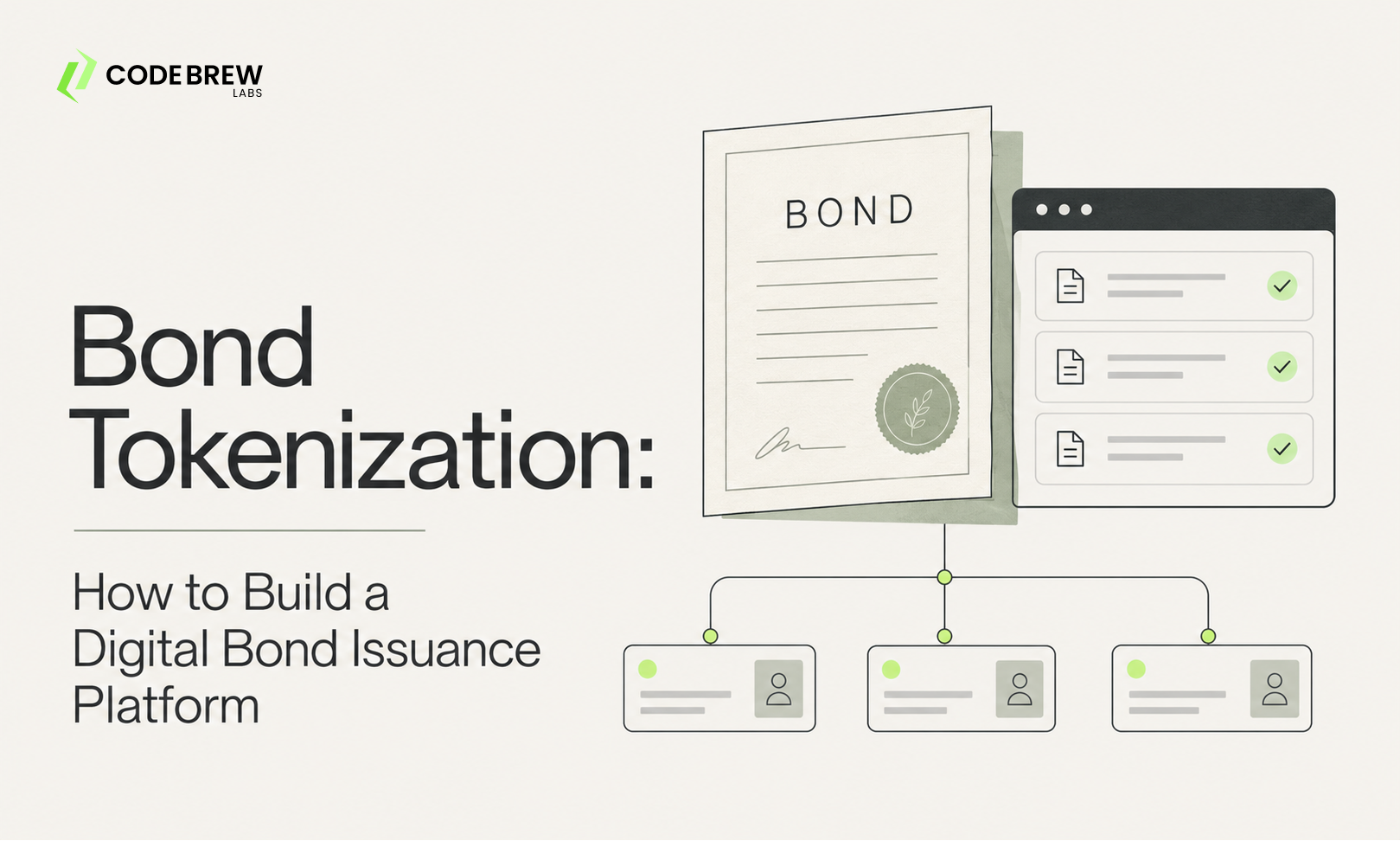
Bond tokenization is the process of representing a bond or a legally defined interest in a bond through a digital token on a blockchain or distributed ledger. Depending on the structure, the bond may be issued natively on the digital platform or represented through a token connected to an existing securities record. Smart contracts can support issuance, ownership transfers, coupon payments, compliance checks, and redemption. The legal documents and applicable laws determine the rights of bondholders.
For example, a company could issue a digital bond with a defined principal amount, maturity date, interest rate, and payment schedule. The platform could record eligible investor holdings and help calculate coupon payments on scheduled dates.
The token is not the entire bond arrangement. The issuer’s obligations, bondholder rights, payment terms, and legal ownership arrangements must be established through the relevant documentation and legal framework.
Tokenization can also take different forms. Some bonds are issued and managed natively on a distributed ledger, while others use digital tokens alongside existing custodians or securities settlement infrastructure.
Traditional Bonds vs. Tokenized Bonds
Both traditional and tokenized bonds can represent debt obligations with defined payment terms. The difference lies primarily in how issuance, records, transfers, and servicing are managed.
| Feature | Traditional bond infrastructure | Tokenized bond infrastructure |
|---|---|---|
| Ownership records | Maintained through established registries, custodians, or securities depositories | May be recorded on a distributed ledger, or linked to an existing official record |
| Issuance | Uses conventional issuance, allocation, and settlement processes | Can use smart contracts and digital issuance workflows alongside required intermediaries |
| Investor onboarding | Managed through banks, brokers, custodians, and other service providers | Can connect onboarding systems to digital identity and permission controls |
| Coupon payments | Usually processed through paying agents and established payment systems | Can use smart contracts to calculate or coordinate payments, subject to funding and payment infrastructure |
| Transfers | Processed through securities accounts and settlement systems | May use permissioned token transfers and integrated settlement workflows |
| Settlement | Depends on the applicable securities and payment infrastructure | May support DvP on a shared platform or through connections between separate systems |
| Audit trail | Records distributed across relevant institutions and systems | Distributed ledger records can provide a shared transaction history |
| Compliance | Managed through legal, operational, and financial market controls | Requires the same underlying obligations, potentially supported by programmable controls |
Tokenization does not automatically eliminate intermediaries or reduce every operational cost. The outcome depends on the architecture, the legal recognition of digital records, the settlement asset, and how well the platform connects to existing financial infrastructure.
The Bank for International Settlements has identified potential efficiency benefits from tokenized bonds while also highlighting the regulatory and infrastructure challenges that must be addressed. Its research emphasizes that the benefits depend on how the technology is implemented. Read the BIS assessment of government bond tokenization.
How Does Bond Tokenization Work? The Bond Lifecycle
A digital bond issuance platform must support the bond from initial creation through maturity or another defined termination event.
Step 1: Structure the bond
The issuer defines the bond’s commercial and legal terms, including:
- Principal amount and currency.
- Interest rate and coupon frequency.
- Issue date and maturity date.
- Repayment terms.
- Investor eligibility requirements.
- Transfer restrictions.
- Applicable law and disclosure obligations.
These terms form the basis of the tokenization architecture. Smart contracts should implement approved terms rather than independently determine the issuer’s legal obligations.
Step 2: Complete legal and investor onboarding requirements
Before issuing the bond, the issuer and relevant service providers must determine the applicable offering rules, required documentation, eligible investor categories, and operational responsibilities.
Investor onboarding may include identity verification, sanctions screening, investor classification, and other checks where required.
The platform can connect these processes to the token’s permission system so that only eligible participants can receive or transfer the bond tokens.
Step 3: Create and issue the digital bond
Once the issuance structure is approved, the platform deploys or configures the relevant smart contracts and creates the authorized token supply.
The platform may record:
- Bond identifiers and key terms.
- Authorized issuance amounts.
- Investor allocations.
- Issuance dates.
- Contract addresses and transaction references.
- Links to supporting documentation.
Sensitive legal and investor records should not automatically be stored in public blockchain transactions. The architecture should determine what belongs on-chain and what should remain in secure off-chain systems.
Step 4: Allocate tokens and settle the initial issuance
Eligible investors subscribe to the bond according to the offering terms. The platform then coordinates the transfer of the bond tokens and the corresponding funds.
Where DvP is supported, the delivery of the bond and the payment are linked so that the transaction completes only when the required conditions for both sides are met.
The settlement design depends on the payment asset and infrastructure. It may involve tokenized commercial bank money, another approved digital settlement asset, or connections to conventional payment systems.
Step 5: Manage coupon payments
During the bond’s life, the issuer must meet its interest payment obligations according to the bond documentation.
A smart contract can calculate coupon amounts, identify eligible holders under the agreed record-date rules, and coordinate payment instructions. Actual payment requires sufficient funds and a functioning settlement or payment mechanism.
Step 6: Support secondary transfers and ongoing servicing
If the bond can be transferred, the platform checks whether each proposed transfer complies with applicable restrictions.
Other lifecycle activities may include investor communications, reporting, corrections, approved corporate actions, and changes to servicing arrangements.
Step 7: Redeem the bond at maturity
At maturity, the issuer’s principal repayment obligation becomes due under the bond terms. The platform can calculate the redemption amount, coordinate payment, and record the redemption or retirement of tokens.
Burning a token or marking it as redeemed does not itself complete repayment. The process must reconcile the token records with the actual payment and legal obligations.
How Coupon Automation Works in a Tokenized Bond Platform
A coupon is the interest payment made to bondholders according to the bond’s terms. For example, a bond may pay interest every six months, annually, or at another specified frequency.
Smart contracts can help automate the calculations and workflow surrounding these payments.
Example: A bond with semiannual coupon payments
Assume a bond has the following terms:
- Total principal: $1,000,000.
- Annual coupon rate: 6%.
- Payment frequency: Twice a year.
- Assumed coupon calculation: Two equal six-month periods.
The annual coupon amount would be $60,000, and each six-month coupon would be $30,000 under these simplified assumptions.
The actual calculation must follow the bond’s day-count convention, payment calendar, principal balance, and contractual terms.
The coupon payment workflow
1. Store the bond terms: The platform records or references the coupon rate, payment dates, maturity date, and calculation method.
2. Determine eligible holders: The platform identifies the bondholders entitled to the payment under the applicable record-date rules.
3. Calculate payment amounts: The system calculates each eligible holder’s share according to their holdings and the bond documentation.
4. Verify funding: The issuer or paying agent arranges the funds needed to meet the payment obligation.
5. Execute or coordinate payments: A smart contract can distribute an approved digital settlement asset, or trigger a workflow involving an external payment system.
6. Record the outcome: The platform records payment status, transaction references, failures, and any reconciliation requirements.
What should the coupon smart contract include?
| Function | Purpose |
|---|---|
| Coupon schedule | Stores or references payment dates and frequency |
| Interest calculation | Applies the approved rate and day-count convention |
| Holder snapshot | Determines which holdings qualify for a payment |
| Payment allocation | Calculates each eligible holder’s amount |
| Funding and payment controls | Ensures payments follow the configured funding and authorization process |
| Failed-payment handling | Records failures and supports an appropriate retry or exception process |
| Audit trail | Records calculation inputs, approvals, and payment outcomes |
Not all of these functions must reside in a single contract. In some designs, the calculation and payment logic are divided among contracts and off-chain services.
Important: Automation does not guarantee that a bond issuer has sufficient funds or will pay on time. A reliable platform needs funding procedures, exception handling, and reconciliation with the official payment records.
Delivery-versus-Payment (DvP) Settlement Explained
Delivery-versus-payment, commonly called DvP, is a settlement mechanism that links the delivery of a security to the corresponding payment. The transaction is structured so that the security is delivered if and only if the payment condition is met.
The Bank of Japan describes DvP as a link between securities transfer and funds transfer that helps prevent one side of a transaction from completing without the other.
Why DvP matters for tokenized bonds
Consider an investor purchasing a tokenized bond from a seller.
Without a properly linked settlement mechanism, the seller could deliver the bond while payment remains incomplete, or the buyer could send funds without receiving the bond. Settlement arrangements are designed to manage this counterparty risk.
A DvP workflow connects the two sides of the transaction.
1. Trade agreed
Buyer and seller agree on the bond quantity and price
2. Validate both sides
Check investor eligibility, available bond tokens, funds, and settlement conditions
3. Link delivery and payment
The settlement mechanism coordinates the bond transfer and corresponding funds transfer
4. Confirm settlement
Record the completed transaction or handle the failed settlement according to the agreed process
Atomic settlement and smart contracts
When both the security token and the settlement asset can be transferred within the same atomic transaction, a smart contract may coordinate the exchange so that both transfers complete together or neither completes.
This is one way to implement DvP. Other designs coordinate settlement across separate ledgers or existing financial infrastructure.
The exact settlement guarantees depend on the system design. A tokenized bond platform should not claim atomic DvP if the payment leg depends on a separate system that can fail independently without a suitable linking mechanism.
What can be used as the payment leg?
Depending on the jurisdiction and platform, the payment side may involve:
- Tokenized commercial bank money.
- An approved digital settlement asset.
- A central bank digital currency or wholesale central bank money arrangement where available.
- A conventional bank payment system connected to the digital securities platform.
The choice affects settlement finality, counterparty exposure, liquidity requirements, integrations, and regulatory considerations.
For a bond tokenization project, DvP should be designed together with the payment and settlement infrastructure, not added as an isolated smart contract feature.
Who Does What? Issuers, Investors, and Regulators
A bond tokenization platform brings technology into an established financial activity. It does not remove the responsibilities of the parties involved.
| Participant | Main responsibilities |
|---|---|
| Bond issuer | Defines the bond terms, meets payment obligations, provides required disclosures, and authorizes issuance and lifecycle actions |
| Investors | Complete required onboarding, review the bond terms and risks, fund subscriptions, and manage their holdings |
| Arranger or underwriter | Supports structuring, distribution, pricing, and placement where involved |
| Custodian or securities intermediary | Safeguards assets or maintains relevant records and performs other duties under the applicable arrangement |
| Paying agent | Coordinates coupon and principal payments according to the bond terms |
| Platform operator | Maintains the technology, permissions, integrations, records, and operational controls assigned to it |
| Smart contract administrator | Performs authorized contract actions under the governance framework |
| Regulators and relevant authorities | Establish and supervise applicable legal, securities, market, and financial requirements |
Some projects combine several roles, while others rely on multiple independent institutions. The exact structure depends on the type of bond, issuance jurisdiction, target investors, and settlement arrangements.
The platform architecture should clearly identify who has authority to approve issuance, update permitted settings, correct records, pause activity, and manage exceptional events.
Choosing a Blockchain for Bond Tokenization
There is no universally best blockchain for tokenized bonds. The right choice depends on the issuance model, investor base, privacy requirements, settlement arrangements, and the need to connect with existing financial market infrastructure.
Public blockchain
A public blockchain may offer broad infrastructure access, established tooling, and transparent transaction records.
Potential advantages include:
- Access to established smart contract ecosystems.
- Publicly verifiable transaction history.
- Integration with compatible wallets and development tools.
Considerations include transaction fees, data privacy, network governance, operational dependencies, and how permissioned securities rules will be enforced.
A public blockchain does not mean the bond itself must be freely transferable. Permissioned token contracts can restrict who may hold or transfer it.
Private or permissioned distributed ledger
A private or permissioned network can restrict participation at the network level and may offer more control over transaction visibility and governance.
Potential advantages include:
- More controlled access to the network.
- Configurable privacy and governance arrangements.
- Easier alignment with certain institutional operating models.
Considerations include network administration, interoperability, participant onboarding, and the cost of operating or connecting to the infrastructure.
EVM-compatible networks and layer 2s
EVM-compatible networks may allow projects to reuse Ethereum development tools and compatible token standards. Layer 2 networks can offer different transaction cost and throughput characteristics.
However, lower transaction costs alone should not determine the network choice. The project must assess security assumptions, settlement design, institutional support, operational resilience, and the needs of investors and service providers.
A practical blockchain selection checklist
Before selecting a network, evaluate:
1. Legal recognition: Does the legal and operating model support the proposed digital bond records and transfers?
2. Settlement design: Can the network support the intended DvP workflow and payment asset?
3. Privacy: What information will be visible on-chain, and what must remain confidential?
4. Investor access: Which wallets, custodians, and institutions must connect?
5. Compliance: Can the token enforce the necessary holding and transfer restrictions?
6. Interoperability: Does the platform need to connect to existing securities depositories, banks, or other ledgers?
7. Security and governance: Who operates the network and controls critical infrastructure?
8. Operating cost: What are the transaction, infrastructure, integration, and ongoing maintenance costs?
The best choice is the network that supports the complete bond lifecycle and operating model, not necessarily the one with the lowest transaction fee.
Token Standards for Digital Bonds: ERC-3643 vs. ERC-1400
Token standards provide reusable interfaces and design patterns for creating and managing digital assets. For bonds that require investor eligibility checks or restricted transfers, security token standards can help structure the required functionality.
Two standards often discussed in this context are ERC-3643 and ERC-1400.
ERC-3643: Permissioned security tokens
ERC-3643 is a standard for security tokens that extends ERC-20-style token functionality with identity and compliance mechanisms. It defines components such as an identity registry and compliance controls that can be used to check whether a proposed transfer meets the configured rules.
Depending on the implementation, ERC-3643-based systems can support:
- Verified holder requirements.
- Transfer eligibility checks.
- Configurable compliance rules.
- Token issuance and burning.
- Pausing or freezing functions.
- Authorized administrative roles.
For a bond platform, this can be useful when only approved investors may hold or transfer the token.
However, ERC-3643 does not itself establish that a bond offering is legally compliant. The offering’s terms, legal structure, investor onboarding, and operating procedures still need to meet applicable requirements.
Read the ERC-3643 specification for the technical interfaces and controls.
ERC-1400: Security token framework
ERC-1400 is a security-token framework proposal associated with features for representing regulated securities. The related standards and proposals include concepts such as partitions and controlled token transfers, which can be useful for securities with different conditions or restrictions.
A project considering ERC-1400-related designs should assess the exact specification, implementation, tooling, and ecosystem support available for its requirements. The label alone does not guarantee that a particular implementation includes every feature the bond needs.
Which standard should a bond platform use?
| Requirement | ERC-3643 | ERC-1400-related approach |
|---|---|---|
| Investor eligibility controls | Identity and compliance interfaces are central to the standard | Depends on the specific implementation and integrated controls |
| Permissioned transfers | Designed to validate holder eligibility and configured compliance rules | Can support controlled security-token transfer models, depending on implementation |
| Token partitions or differentiated classes | Requires a suitable design for the intended asset structure | Partition-related concepts are part of the broader ERC-1400 proposal family |
| Administrative controls | Includes defined issuer and agent roles and token-management functions | Depends on the chosen specifications and implementation |
| Legal compliance | Does not independently establish compliance | Does not independently establish compliance |
The decision should be based on the actual requirements for investor permissions, token classes, lifecycle management, compatibility, and long-term maintenance. In some cases, a standard implementation may be adapted or combined with other components, subject to careful design and review.
Green Bond Tokenization: Does the Process Differ?
Green bonds raise funds for projects or activities intended to deliver environmental benefits, subject to the applicable framework and the issuer’s commitments. Tokenization can provide digital issuance and servicing infrastructure for a green bond, but it does not automatically make the bond green or verify its environmental impact.
A tokenized green bond may use the same core components as other digital bonds:
- Digital issuance and ownership records.
- Investor eligibility and transfer controls.
- Coupon and principal payment workflows.
- DvP settlement where supported.
- Reporting and lifecycle management.
The additional requirements relate to the green bond’s stated use of proceeds, reporting commitments, and relevant verification or assurance arrangements.
A platform may support the collection and publication of project data or sustainability reports. However, the issuer and relevant independent parties remain responsible for the accuracy of claims and compliance with the applicable green bond framework.
How Much Does Bond Tokenization Platform Development Cost?
Bond tokenization development costs depend on whether the project needs a basic issuance workflow or an end-to-end platform that manages investors, coupon payments, secondary transfers, settlement, and reporting.
A useful estimate must distinguish smart contract development from the wider platform and financial infrastructure.
Main cost drivers
| Cost factor | What affects the cost |
|---|---|
| Bond structure | Fixed-rate, floating-rate, multiple classes, maturity rules, and other contractual features |
| Token issuance | Minting, allocation, supply controls, investor records, and issuance approvals |
| Compliance | Identity integrations, investor eligibility, transfer restrictions, and jurisdiction-specific rules |
| Coupon servicing | Interest calculations, record dates, payment schedules, funding checks, and exception handling |
| DvP settlement | Payment asset, atomic settlement requirements, external banking connections, and settlement finality |
| Secondary transfers | Transfer eligibility, trading integrations, order management, and settlement workflows |
| Investor and issuer portals | Onboarding, subscriptions, holdings, transaction history, documents, and reporting |
| Security and audits | Smart contract testing, independent reviews, key management, monitoring, and operational resilience |
| Integrations | Custodians, paying agents, banks, registries, securities depositories, and other service providers |
| Ongoing operations | Infrastructure, maintenance, support, reporting, upgrades, and compliance changes |
Why costs vary between projects
A prototype that demonstrates token issuance on a test network is not equivalent to a production bond platform that handles real investor funds and payment obligations.
A production platform may require legal and financial infrastructure, investor onboarding, integration with existing systems, independent security reviews, and ongoing operational support. These items can represent a significant portion of the overall budget.
Before requesting a development estimate, define:
- The type of bond and its legal structure.
- The intended issuer and investor categories.
- The required token standard and transfer rules.
- The coupon and redemption logic.
- The intended DvP model and settlement asset.
- Required banking, custody, registry, or paying-agent integrations.
- The jurisdictions in which the bond will be offered.
- The security, audit, and ongoing support requirements.
A detailed scope allows the development team to estimate the technical work without confusing a basic token deployment with a full digital bond issuance platform.
How Code Brew Can Support Bond Tokenization Development
A digital bond issuance platform needs to connect token issuance, investor access, smart contracts, payment workflows, and reporting in a single operating model.
Code Brew can support the technology development of a bond tokenization project according to the agreed scope and requirements. Potential areas of work may include:
- Platform architecture: Defining the components needed for issuance, investor access, transaction records, and lifecycle management.
- Smart contract development: Implementing approved token issuance, transfer restrictions, coupon calculation, and redemption workflows.
- Compliance integrations: Connecting identity verification and eligibility systems to the relevant token permissions.
- Payment and settlement integration: Designing technical connections to the agreed payment and settlement infrastructure.
- Investor and issuer applications: Building interfaces for subscriptions, holdings, transaction history, and reporting.
- Testing and maintenance: Testing core workflows, addressing technical issues, and supporting ongoing platform operations.
For a broader view of the infrastructure involved, explore Code Brew’s asset tokenization platform development services.
For projects that need a wider tokenization solution, including asset representation and supporting workflows, learn more about Code Brew as an RWA tokenization development company.
Bond platforms may also share technical components with other tokenized asset use cases. For example, IP tokenization may involve contractual rights and revenue distributions, while invoice tokenization may require receivable records, eligibility checks, and payment-status tracking. The underlying legal and commercial models are different, but some platform components can overlap.
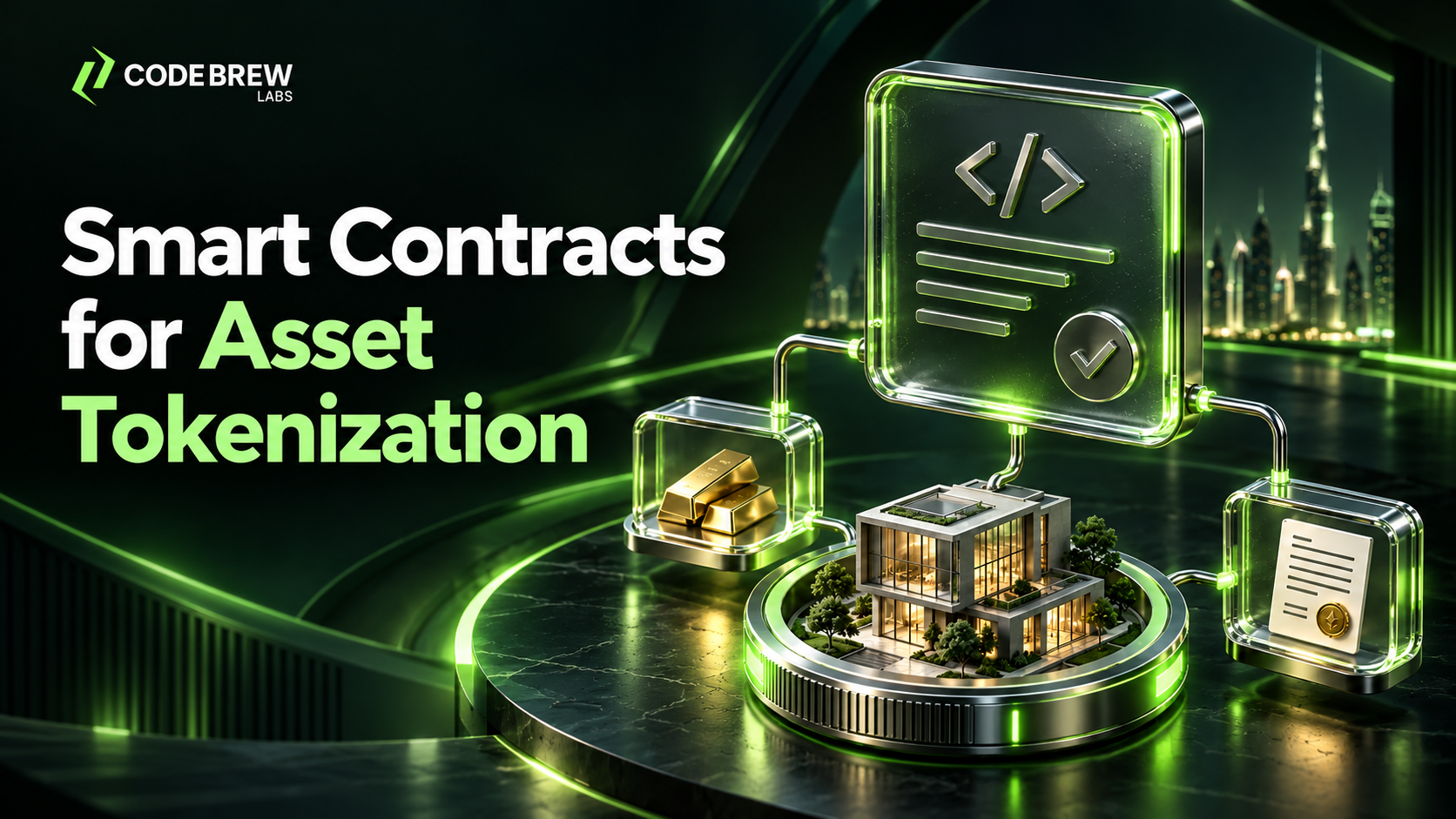
For more detail on issuance, transfer permissions, distributions, and the wider smart contract lifecycle, read smart contracts for asset tokenization.
The final architecture should be determined by the bond’s legal structure, target market, settlement model, and operational requirements.
Conclusion
Bond tokenization can introduce programmable digital infrastructure into bond issuance and servicing. Smart contracts can support token creation, investor permissions, coupon calculations, transfers, and redemption, while DvP settlement can link the delivery of a bond to its corresponding payment.
The technology alone, however, is not enough. A successful digital bond issuance platform must align the token with legally defined bondholder rights, establish reliable payment and settlement arrangements, enforce the required investor restrictions, and provide appropriate security and operational controls.
Start by defining the bond structure and its full lifecycle. Then select the blockchain and token standard that fit the requirements, design coupon and settlement workflows around the agreed financial infrastructure, and validate the system with qualified legal, compliance, and security specialists.
Frequently Asked Questions About Bond Tokenization
1. What is bond tokenization?
Bond tokenization is the process of representing a bond or a legally defined interest in a bond through digital tokens on a blockchain or distributed ledger. The platform can support issuance, ownership records, investor permissions, coupon servicing, transfers, and redemption, depending on its design. The governing documents and applicable laws determine the bondholder’s rights.
2. How does a tokenized bond work?
A tokenized bond follows the same underlying debt arrangement as the legally defined bond it represents. The issuer sets the terms, eligible investors subscribe, tokens are issued or allocated, and coupon and principal payments are managed according to the bond documentation. Smart contracts may automate selected processes, while external institutions and payment systems can remain involved.
3. What is a digital bond issuance platform?
A digital bond issuance platform is a system used to create, issue, allocate, and manage bonds through digital infrastructure. A tokenization-enabled platform may include investor onboarding, smart contract deployment, token allocation, payment workflows, compliance controls, transaction records, and lifecycle servicing.
4. How are coupon payments automated for tokenized bonds?
Smart contracts can store or reference coupon terms, determine eligible holders, calculate payment amounts, and coordinate distributions. The process requires accurate bond data, sufficient funds, and an appropriate payment mechanism. The smart contract does not guarantee that an issuer will have the money required to meet its obligations.
5. What is DvP settlement in bond tokenization?
Delivery-versus-payment settlement links the transfer of a bond to the corresponding payment. When properly implemented, the bond is delivered if and only if the required payment condition is met. DvP can reduce principal risk, but the level of protection depends on how the security and payment systems are connected.
6. What is the difference between ERC-3643 and ERC-1400?
ERC-3643 is a permissioned security token standard with identity and compliance interfaces designed to support controlled transfers. ERC-1400 refers to a broader security-token framework proposal and related standards that include concepts such as token partitions. The appropriate choice depends on the required functionality, implementation maturity, and ecosystem support. Neither standard independently establishes legal compliance.
7. Can bonds be issued on a public blockchain?
Yes, depending on the legal structure and operating model. A public blockchain can support tokenized bond records while smart contracts restrict who may hold or transfer the tokens. Privacy, regulatory requirements, settlement arrangements, custody, and integration with existing financial infrastructure must be assessed before choosing this approach.
8. What is green bond tokenization?
Green bond tokenization uses blockchain or distributed ledger technology to issue or represent a bond intended to finance eligible environmental projects. The tokenization process can support issuance, servicing, and reporting, but it does not itself validate the environmental claims or guarantee that proceeds are used as promised.
9. How much does bond tokenization platform development cost?
The cost depends on the bond structure, token standard, investor onboarding, coupon automation, settlement design, integrations, security reviews, and ongoing operational requirements. A basic issuance prototype and a production platform with DvP settlement and financial institution integrations can have very different budgets. A detailed requirements assessment is needed for a meaningful estimate.
10. Does bond tokenization remove the need for banks and custodians?
Not necessarily. Some operating models continue to rely on banks, custodians, paying agents, and securities depositories. Tokenization can change how records and transactions are handled, but the roles required depend on the legal structure, regulatory framework, and settlement architecture.
Let's Convert Your Business Idea Into Success!
Free Consultation from Top Industry Experts
Let’s Build Your Dream App!
Share article on :


Ready To Fuel Your Vision With AI-Powered Innovation?





Level- 18, Dubai World Trade Centre Tower, Sheikh Rashid Tower, Sheikh Zayed Rd, Dubai, UAE
business@code-brew.com +971-55-645-7972
Plot no I - 36, Sector 83 Alpha, Mohali SAS Nagar 140308
business@code-brew.com +91-771-976-8427
Al Akaria 2, 6926 Olaya Street, RHOA2566, Riyadh, Saudi Arabia.
business@code-brew.com
Av. Miguel Hidalgo y Costilla 1995, Arcos Vallarta, 44600 Guadalajara, Mexico
business@code-brew.com +1(213)2614953
4231 Balboa Ave #512 San Diego, CA 92117 United States
business@code-brew.com +1(213)2614953
2nd floor, College House, 17 King Edwards Rd, London HA4 7AE, UK
business@code-brew.com +44 (20) 82644493
Partner With Experts Who Leverage AI & Tech To Transform Ideas Into Market-Leading Solutions.
Wait! Looking for Right Technology Partner For Your Business Growth?
It's Time To Convert Your Business Idea Into Success!
Get Free Consultation From Top Industry Experts:
I would like to keep it to myself