Table of Content

Introduction
The pharmaceutical and biotechnology industries are standing at a turning point, with artificial intelligence (AI) redefining how drugs are discovered, developed, and delivered. What once took years of painstaking research and billions of dollars can now be accelerated by algorithms capable of analyzing vast datasets in hours. From mapping disease pathways to optimizing clinical trials and tailoring treatments for individual patients, AI in healthcare is no longer a distant innovation — it’s the engine driving a new era of medicine.
Table of Content
The numbers make this transformation impossible to ignore. AI is projected to generate between $350 billion and $410 billion annually for the pharmaceutical sector by 2026, fueled by innovations in drug development, clinical trials, precision medicine, and commercial operations. For an industry often criticized for high costs and lengthy development cycles, AI represents not just a technological leap, but an economic and strategic revolution.
And 2026 is the year to watch. With regulatory frameworks becoming clearer, investments pouring in, and real-world AI use cases proving their value, this year marks the transition from experimental adoption to large-scale implementation. Leading biopharma firms, agile biotech startups, and healthcare innovators are racing to embed AI into their pipelines — not as a support tool, but as the foundation of next-generation healthcare solutions.
At Code Brew Labs, we’ve seen firsthand how AI can shorten development timelines, reduce costs, and unlock breakthroughs that were once out of reach. As a trusted partner in AI-powered healthcare development and biotech solutions, our role is to help pharmaceutical and biotech companies embrace this wave of innovation with scalable, compliant, and future-ready technologies.
The Current State of AI Adoption in Pharma and Biotech
AI adoption in pharmaceuticals and biotechnology has moved from being a bold experiment to a business necessity. The global AI in pharma market is expected to reach $1.94 billion in 2026, with forecasts suggesting it could grow to $16.49 billion by 2034, at a staggering CAGR of over 27%. This growth underscores not only the appetite for AI innovation but also the confidence that it delivers measurable results.
Global and Regional Adoption Trends
- By 2026, pharma and biotech companies are expected to spend over $3 billion annually on AI initiatives, a sharp rise from just a few years ago.
- Partnerships focused on AI-driven drug discovery have skyrocketed — growing more than tenfold between 2015 and 2021.
- In regions like North America and Europe, regulatory clarity and strong research ecosystems have accelerated AI adoption. Meanwhile, emerging markets in the Asia-Pacific are investing heavily in AI infrastructure to remain competitive.
Planning to integrate AI into your drug discovery or clinical trial processes?
Key Players Leading the Shift
AI adoption varies across the industry, but a few names stand out as leaders:
- Pfizer – Leveraging partnerships with Tempus, CytoReason, and Gero, Pfizer has integrated AI into drug discovery, patient analysis, and clinical development.
- AstraZeneca – Collaborating with BenevolentAI and Qure.ai to accelerate treatments for chronic diseases.
- Roche – Ranked at the top of the Statista AI readiness index in 2023, thanks to both in-house capabilities and strategic acquisitions.
- Insilico Medicine – A biotech innovator using AI for deep learning–based drug design and synthesis.
These organizations are proof that AI is not just about speeding up processes — it’s about rethinking the scientific and business models that drive pharma and biotech.
Where Adoption Stands Today
Despite these advances, the industry is still at different maturity levels:
- AI-first biotech startups are leading the charge, with around 75% of them integrating AI into core drug discovery processes.
- Traditional pharma companies, though slower to adapt, are beginning to prioritize AI adoption, with 53% of industry finance leaders identifying it as a top priority for automation and efficiency.
- The barriers? Legacy IT systems, fragmented data, high upfront costs, and the challenge of shifting traditional mindsets to embrace AI-driven approaches.
Real Impact Already Visible
Even in its early phases, AI has shown the ability to:
- Cut drug discovery timelines by 40%
- Reduce R&D costs by up to 30%
- Improve the probability of clinical success, with AI models predicting trial outcomes and optimizing patient recruitment
The message is clear: whether large or small, companies that fail to embrace AI risk falling behind in a market that is moving faster than ever before. For innovators ready to leap, the opportunity is extraordinary, and this is exactly where Code Brew Labs comes in, helping pharma and biotech organizations bridge the gap between potential and execution.
AI in Biotechnology and Pharma Trends for 2026
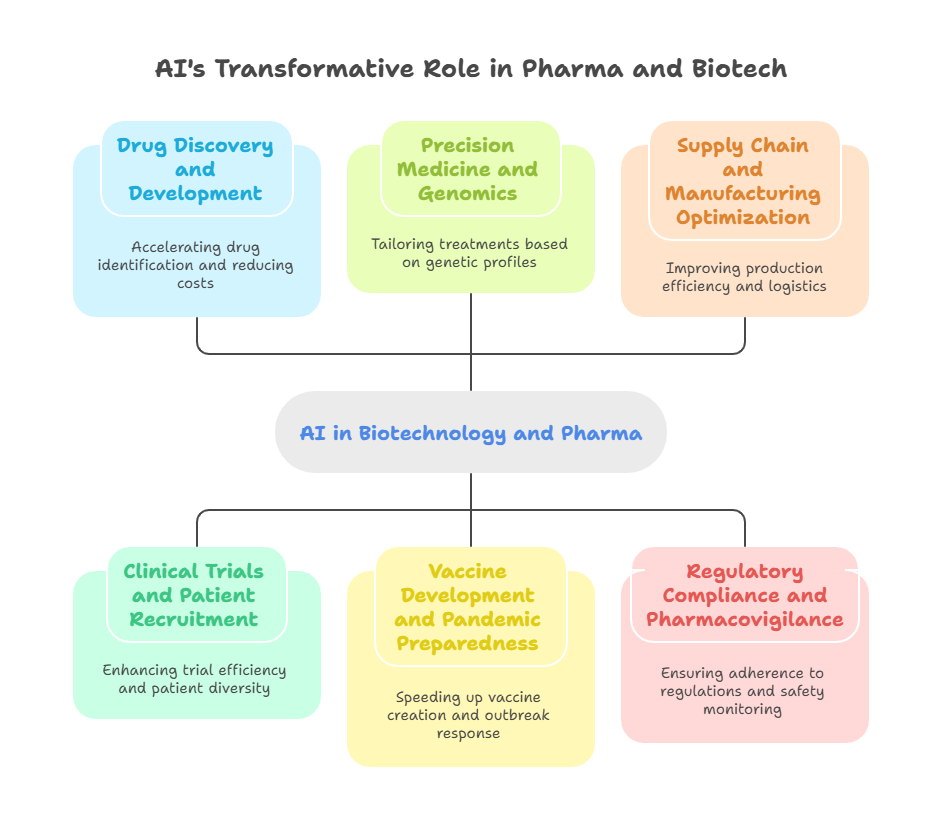
Artificial intelligence is no longer a supporting tool in life sciences — it’s becoming the backbone of innovation. By 2026, AI is expected to transform nearly every stage of the pharmaceutical and biotech value chain, from molecule discovery to post-market surveillance. Let’s explore the key trends shaping this revolution.
AI-Driven Drug Discovery and Development
Traditional drug discovery takes an average of 14 years and billions of dollars. AI is rewriting that equation. Platforms like Exscientia’s Centaur Chemist and Insilico Medicine’s deep learning models are reducing discovery timelines to as little as 12–18 months, cutting costs by up to 40%. By analyzing chemical structures, predicting drug-target interactions, and simulating outcomes, AI is helping scientists identify promising molecules faster and with greater precision.
At Code Brew Labs, we partner with biotech firms to build AI solutions that accelerate molecular design and lead optimization, ensuring that innovative therapies can move from lab to trial at record speed.
AI in Clinical Trials and Patient Recruitment
One of the biggest bottlenecks in clinical research is finding and retaining the right participants. AI is tackling this with predictive recruitment models that analyze electronic health records (EHRs), demographics, and genetic profiles to identify eligible patients in days rather than months.
Even more transformative is the rise of Decentralized Clinical Trials (DCTs). Powered by AI and telehealth technologies, these trials reduce travel burdens, expand diversity in participation, and enable real-time monitoring through wearable devices. The result? Faster, more inclusive trials with higher success rates.
AI-Powered Precision Medicine and Genomics
We’re entering the era of personalized medicine, where treatments are tailored to the unique genetic and lifestyle profiles of patients. AI algorithms can analyze massive genomic datasets to identify disease risks, predict drug responses, and recommend individualized therapies.
Take AlphaFold by DeepMind, which solved one of biology’s biggest challenges: predicting 3D protein structures from amino acid sequences. Today, researchers are leveraging this knowledge to design new therapies for cancer, neurodegenerative disorders, and rare diseases.
By 2026, we’ll see a surge in AI-driven genomics platforms that make precision medicine a reality for millions.
AI in Vaccine Development and Pandemic Preparedness
The COVID-19 pandemic proved that speed saves lives. AI tools like machine learning–driven epidemiological models and vaccine candidate screening algorithms drastically shortened development cycles during the crisis. In 2026 and beyond, AI will remain central to preparing for future outbreaks — enabling rapid vaccine design, identifying viral mutations in real-time, and scaling up production efficiently.
AI for Supply Chain and Manufacturing Optimization
Pharma manufacturing is being revolutionized by intelligent automation and digital twins. AI in supply chain and manufacturing can predict equipment failures, optimize batch production, and monitor storage conditions, ensuring that drugs remain effective and safe. Predictive analytics also helps pharma companies anticipate demand, reducing waste and avoiding shortages.
Leaders like Pfizer and Roche have already shown how AI-enabled logistics can prevent delays in temperature-sensitive shipments. By 2026, these technologies will be standard across the industry.
AI for Regulatory Compliance and Pharmacovigilance
AI isn’t just improving R&D — it’s also helping companies stay compliant. Algorithms can scan regulatory frameworks, flag potential compliance risks, and even automate pharmacovigilance by monitoring adverse event reports. Generative AI is being applied to create automated submission documents for regulatory bodies, cutting months off approval timelines.
At Code Brew Labs, we help pharma firms integrate AI-powered compliance systems, reducing human error while staying aligned with evolving global regulations.
Challenges and Opportunities of AI in Pharma & Biotech Industry
While the opportunities are immense, the path to AI maturity in life sciences isn’t without hurdles. Understanding the balance of challenges and opportunities is key to unlocking AI’s full potential.
Key Challenges
- Data Privacy and Security: Sensitive health and genomic data require airtight protection. Concerns around HIPAA, GDPR, and other data regulations remain a major barrier to adoption.
- Integration with Legacy Systems: Many pharma firms still operate with outdated infrastructure, making it difficult to integrate modern AI platforms without expensive overhauls.
- High Costs and Long Timelines: Building AI solutions for drug discovery or clinical trials often involves high upfront investment, specialized expertise, and long development timelines before ROI is visible.
- Regulatory Uncertainty: Although progress has been made, clear global standards for AI-driven drug approvals and compliance frameworks are still evolving.
- Talent Gaps: The intersection of AI, biology, and pharmaceutical science requires highly specialized talent — a workforce that is still scarce and expensive.
Key Opportunities
- Personalized Treatments: AI enables therapies designed for the individual, improving patient outcomes and reducing adverse effects.
- Faster Approvals: AI-driven trial designs, predictive analytics, and real-time monitoring can reduce regulatory review times and accelerate market entry.
- Cost Reduction: By cutting R&D timelines, optimizing supply chains, and reducing trial failures, AI can save companies billions annually.
- Collaboration Across Industries: Partnerships between tech firms and pharma companies are becoming a driving force. By combining scientific expertise with AI innovation, the industry can achieve breakthroughs at scale.
At Code Brew Labs, we see these challenges as opportunities for transformation. Our AI solutions are designed to bridge gaps in legacy systems, ensure compliance, and reduce costs, while empowering pharma and biotech companies to innovate faster and smarter.
Regulatory and Ethical Considerations of AI in Biotech
Artificial intelligence is redefining the landscape of pharmaceuticals and biotechnology, but its rapid adoption also introduces a complex set of regulatory and ethical challenges. As life-saving drugs and therapies increasingly rely on machine learning algorithms, regulators and industry leaders must walk a fine line between innovation and patient safety.
FDA, EMA, and Global Guidelines for AI in Drug Development
Regulatory authorities such as the U.S. Food and Drug Administration (FDA) and the European Medicines Agency (EMA) are moving quickly to establish frameworks for AI-driven drug development. The FDA has rolled out initiatives like the Digital Health Software Precertification Program, aimed at speeding up approvals for AI-enabled platforms while maintaining strict safety standards. Similarly, the EMA has published guidelines emphasizing transparency, reproducibility, and model validation.
Globally, we are seeing alignment toward a unified approach: countries such as Japan, Singapore, and the UK are drafting AI-specific health regulations, ensuring that pharmaceutical companies can scale AI innovations across borders without facing conflicting compliance requirements.
AI Explainability and Transparency Requirements
One of the most pressing concerns is the “black box problem.” Many AI systems, especially deep learning models, make accurate predictions but fail to explain how they reached their conclusions. In a domain as sensitive as drug development, regulators and clinicians require explainable AI (XAI). Future guidelines will likely mandate that algorithms provide interpretable insights, enabling researchers and doctors to trust and verify AI-driven recommendations.
Ethical Dilemmas in AI-Based Genetic Research
AI is unlocking new frontiers in genomics and gene editing, but it also raises significant ethical dilemmas. Should AI be allowed to suggest modifications to human DNA? How do we prevent algorithmic bias from excluding certain populations in genetic research? If AI identifies high-risk groups for genetic diseases, what are the implications for insurance, employment, or reproductive decisions? These questions highlight the urgent need for bioethical frameworks that evolve alongside AI technologies.
Patient Data Protection Under HIPAA, GDPR, and Beyond
AI thrives on data, but pharmaceutical data often includes highly sensitive patient information. Regulatory frameworks like the Health Insurance Portability and Accountability Act (HIPAA) in the U.S. and the General Data Protection Regulation (GDPR) in Europe set the gold standard for protecting personal health data. Moving forward, federated learning—where AI models are trained across decentralized datasets without transferring raw data—will likely become a cornerstone of ethical AI in biopharma.
In short, Regulators are adapting, but the burden is also on pharmaceutical and biotech firms to design AI systems that are transparent, fair, and respectful of patient privacy.
AI in Biopharma Beyond 2026
The story of AI in biopharma does not end with today’s breakthroughs. The next 5 to 10 years will usher in an era where AI becomes not just a supporting tool but a central driver of biopharmaceutical innovation.
The Next 5–10 Years Outlook
By 2030, AI will likely underpin the majority of drug discovery, clinical trials, and manufacturing processes. Companies that integrate AI early will enjoy faster regulatory approvals, stronger patient engagement, and reduced R&D costs. Meanwhile, late adopters risk falling behind in an industry where time-to-market directly impacts patient survival and market share.
Quantum Computing + AI for Molecular Modeling
One of the most exciting frontiers is the convergence of AI and quantum computing. While AI can analyze complex datasets, quantum computing can process molecular interactions at unprecedented speed and scale. Together, they could solve challenges like protein folding, drug resistance, and even multi-drug interaction simulations that are impossible with today’s classical computing power.
Integration with IoT, Blockchain, and Robotics
The future of biopharma will be hyperconnected:
- IoT-powered wearables will continuously monitor patient health, feeding real-time data into AI systems for early disease detection.
- Blockchain will secure pharmaceutical supply chains and patient records, ensuring data integrity across international borders.
- AI-driven robotics will transform drug manufacturing, enabling fully automated production lines that minimize errors and maximize efficiency.
This convergence will not only make drug development more efficient but also create end-to-end ecosystems where diagnosis, treatment, and monitoring happen seamlessly.
Rise of Autonomous AI Drug Discovery Platforms
Beyond 2026, we may see the rise of autonomous AI platforms that can independently identify disease targets, generate candidate molecules, simulate clinical trials, and predict regulatory outcomes. These systems could reduce the traditional 10–15 year drug development cycle to less than 5 years, radically altering the economics of pharmaceutical innovation.
The big picture: AI in biopharma is moving from assisting humans to partnering with humans, and eventually, to operating autonomously under ethical and regulatory guardrails. The companies that embrace this shift will not just develop drugs faster—they will redefine the future of medicine.
Need future-ready, scalable AI solutions tailored for Pharma and Biotech?
How to Build AI Solutions for Pharma and Biotech
Building AI solutions for pharma and biotech isn’t just about coding algorithms; it’s about creating an ecosystem that can handle sensitive data, comply with strict regulations, and ultimately deliver life-saving impact. Here’s a step-by-step framework to guide organizations:

1. Define Objectives
The first step is clarity. What problem is the AI meant to solve?
- Drug discovery: accelerating the identification of new compounds.
- Diagnostics: improving disease detection accuracy.
- Patient engagement: tailoring treatments and monitoring adherence.
- Supply chain optimization: reducing delays and ensuring quality control.
Clearly defining objectives ensures the AI project has measurable outcomes aligned with business and clinical goals.
2. Data Collection and Preprocessing
AI thrives on quality data. Pharma and biotech firms have access to vast datasets:
- Clinical trial data
- Research publications
- Electronic Health Records (EHRs)
- Genomic sequencing data
However, raw data is often fragmented, unstructured, or inconsistent. Preprocessing—standardizing formats, anonymizing sensitive information, and cleaning errors—is critical before feeding it into AI systems.
3. Choosing the Right AI Models
Different problems demand different AI approaches:
- Machine Learning (ML): pattern recognition in drug trials or supply chains.
- Natural Language Processing (NLP): extracting insights from medical literature.
- Deep Learning: analyzing images from pathology or radiology.
- Generative AI: designing new molecules or predicting protein folding.
The choice of model should balance accuracy, interpretability, and scalability.
4. Building Scalable Infrastructure
Pharma and biotech companies deal with petabytes of data. Infrastructure must scale seamlessly.
- Cloud-based AI (AWS, Azure, Google Cloud): flexible, cost-efficient.
- Hybrid models: balancing data security with scalability.
- On-premises systems: often required for ultra-sensitive genomic or clinical data.
Scalability ensures the AI solution remains effective as datasets grow and projects expand globally.
5. Integrating with Existing Systems
AI doesn’t exist in isolation. It must integrate with legacy pharma IT systems, lab equipment, and research databases. Interoperability is crucial to avoid bottlenecks and ensure that AI insights are usable in real-world workflows.
6. Testing, Validation, and Regulatory Compliance
Unlike consumer apps, AI in pharma cannot be deployed without rigorous testing. Each model must undergo:
- Validation against real-world data
- Bias testing to ensure fairness across patient groups
- Compliance checks under FDA, EMA, HIPAA, and GDPR
This step is essential for trust and adoption—both by regulators and healthcare providers.
7. Tools & Technologies
A growing suite of tools supports AI in pharma and biotech:
- AI Frameworks: TensorFlow, PyTorch, Scikit-learn
- Cloud Platforms: AWS SageMaker, Azure ML, Google Vertex AI
- Bioinformatics APIs: Ensembl, OpenTargets, DeepChem
- Data Pipelines: Apache Spark, Snowflake
Choosing the right stack depends on project scope, compliance needs, and available expertise.
Building AI for pharma is a structured process—clear objectives, robust data, ethical AI models, scalable infrastructure, and compliance-first validation. Done right, it transforms innovation speed and patient outcomes.
Exploring how AI can reshape your pharmaceutical and biotech operations?
How Much Does It Cost to Build AI Solutions in Pharma and Biotech?
The investment required to develop AI solutions in pharma and biotech can vary dramatically. Some projects may start at $10,000–$50,000 for small-scale pilots, while advanced platforms for drug discovery or large-scale clinical applications can climb into the millions of dollars.
Key Factors Influencing Cost
- Project Scope
- AI for drug discovery is typically more resource-intensive than supply chain AI.
- Clinical trial optimization sits somewhere in between, with a focus on predictive analytics.
- Data Complexity and Availability
- Access to clean, structured data reduces costs.
- Noisy or fragmented datasets increase preprocessing expenses.
- Integration Requirements
- Simple stand-alone AI models cost less.
- Full integration into legacy systems, lab infrastructure, and global compliance frameworks can multiply expenses.
- Team Expertise
- Costs rise with the need for specialized teams: AI engineers, data scientists, bioinformaticians, and regulatory experts.
- Regulatory & Compliance Testing
- Meeting HIPAA, GDPR, FDA, and EMA requirements involves additional testing and validation.
- This step ensures safety but adds significant costs.
Estimated Cost Ranges
- AI Pilot Project (Proof of Concept): $10,000 – $150,000
- Example: AI for analyzing small clinical trial datasets or literature mining.
- Mid-Scale AI Systems: $150,000 – $500,000
- Example: predictive patient recruitment platform or AI-based diagnostic support.
- Full-Scale AI Drug Discovery System: $500,000 – $5M+
- Example: end-to-end AI platforms that design molecules, simulate clinical trials, and integrate with lab systems.
- Example: end-to-end AI platforms that design molecules, simulate clinical trials, and integrate with lab systems.
Cost-Saving Approaches
- Outsourcing: Partnering with AI vendors or biotech-focused development firms.
- Cloud-Based AI: Reducing infrastructure overhead by leveraging AWS, Azure, or Google Cloud.
- Strategic Partnerships: Collaborating with universities or AI startups to share costs and expertise.
AI in pharma can start small, with pilot projects around $10K—but scaling to full-fledged drug discovery platforms requires multi-million-dollar investments. The key is to balance ambition with budget, starting lean and scaling as results are validated.
Conclusion
As we bring this discussion to a close, one thing is clear: Artificial Intelligence is now a key player in pharma and biotech. AI is helping companies shorten drug discovery timelines, improve clinical trial outcomes, and create more personalized treatment options for patients.
The big takeaway is simple: organizations that adopt AI today will have a strong advantage tomorrow. They’ll move faster, operate more efficiently, and stay prepared for the changing healthcare landscape.
At Code Brew Labs, we understand both the technology and the industry. Our team builds AI solutions that are not only innovative but also practical, compliant, and designed to make a real impact.
If you’re ready to explore what AI can do for your business, now is the time to take the first step. Together, we can shape the future of pharma and biotech.
Let’s build it — connect with Code Brew Labs today.
Let's Convert Your Business Idea Into Success!
Free Consultation from Top Industry Experts
Let’s Build Your Dream App!
Share article on :



Ready To Fuel Your Vision With AI-Powered Innovation?


Level- 18, Dubai World Trade Centre Tower, Sheikh Rashid Tower, Sheikh Zayed Rd, Dubai, UAE
business@code-brew.com +971-55-645-7972
Plot no I - 36, Sector 83 Alpha, Mohali SAS Nagar 140308
business@code-brew.com +91-771-976-8427
Av. Miguel Hidalgo y Costilla 1995, Arcos Vallarta, 44600 Guadalajara, Mexico
business@code-brew.com +1(213)2614953
4231 Balboa Ave #512 San Diego, CA 92117 United States
business@code-brew.com +1(213)2614953
2nd floor, College House, 17 King Edwards Rd, London HA4 7AE, UK
business@code-brew.com +44 (20) 82644493
Partner With Experts Who Leverage AI & Tech To Transform Ideas Into Market-Leading Solutions.
Wait! Looking for Right Technology Partner For Your Business Growth?
It's Time To Convert Your Business Idea Into Success!
Get Free Consultation From Top Industry Experts:
I would like to keep it to myself