Table of Content

Quick Summary:
-
White-label tokenization platforms generally offer faster implementation because core functionality is already developed, although configuration and integrations still take time.
-
Custom tokenization platforms provide greater architectural flexibility for complex asset structures, investor workflows, and third-party integrations.
-
White-label pricing varies considerably. Some vendors charge one-time setup fees and monthly subscriptions, while others offer enterprise licensing.
-
Compliance is not guaranteed by either approach. The platform must support the applicable legal and operational requirements of the intended offering.
-
A hybrid model can reduce development work by combining existing tokenization infrastructure with custom applications and workflows.
-
Long-term costs matter as much as launch costs. Licensing, transaction charges, maintenance, security, and migration expenses should all be evaluated.
Building a real-world asset (RWA) tokenization platform starts with an important decision: should you buy ready-made software or develop a platform specifically for your business?
Table of Content
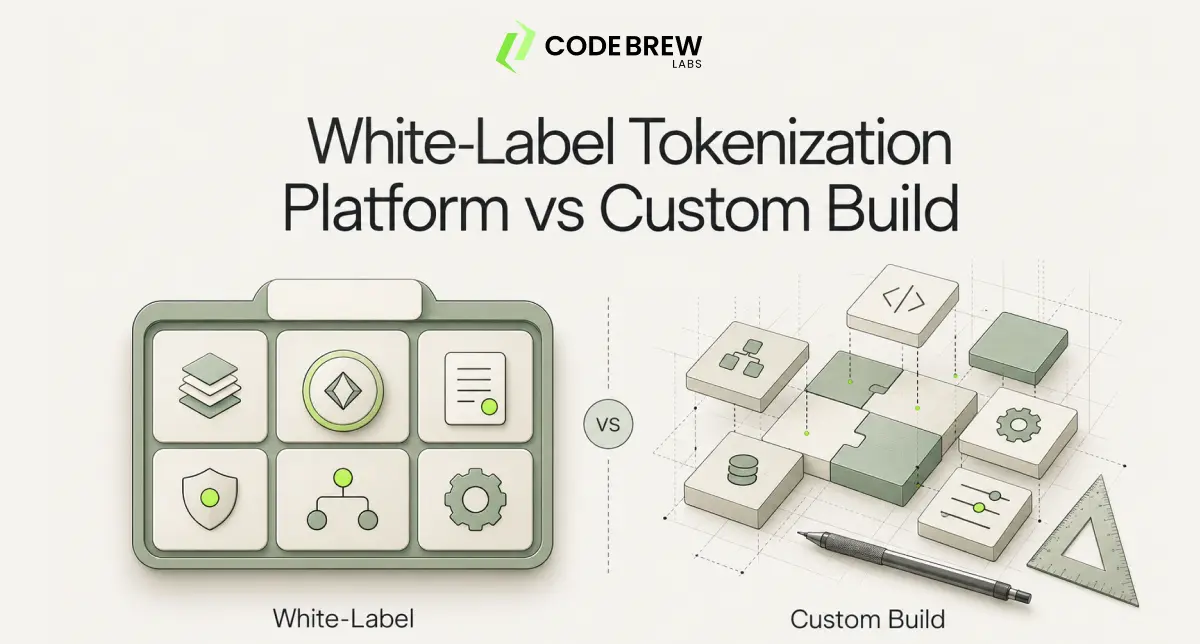
A white label tokenization platform provides existing technology that you can configure and launch under your brand. A custom-built platform is developed around your asset types, investor workflows, compliance requirements, and business model.
Both approaches can support asset tokenization, but they differ in development costs, implementation timelines, customization, software ownership, and ongoing maintenance.
For example, a real estate investment company launching its first tokenized property may benefit from white-label software. However, a financial institution building a multi-asset tokenization platform with specialized settlement, custody, and compliance requirements may need custom development.
This guide compares both approaches, explains their costs, and helps you determine which model makes more sense for your project.
White-Label vs Custom Tokenization Platform: Which Should You Choose?
A white-label tokenization platform is generally better for businesses that need standard token issuance, investor onboarding, and asset management features with a faster initial launch. Custom development is better for complex asset structures, specialized integrations, and greater technical control. A hybrid approach can balance speed, flexibility, and long-term costs.
White-Label vs Custom Tokenization Platform: Comparison Table
| Factor | White-Label Platform | Custom-Built Platform |
|---|---|---|
| Upfront investment | Usually lower for standard features | Usually higher |
| Time to market | Faster technical implementation | Longer development cycle |
| Customization | Limited by available features and APIs | Built around business requirements |
| Compliance | Prebuilt controls may be available | Requirements can be implemented through tailored workflows |
| Source code ownership | Typically governed by vendor licensing | Negotiable under the development agreement |
| Branding | Logo, colors, domain, and supported interface changes | Complete interface design flexibility |
| Blockchain integration | Limited to supported networks or extensions | Networks selected during architecture design |
| Asset support | Based on vendor capabilities | Can be designed for specific asset types |
| Scalability | Depends on vendor architecture and service limits | Can be engineered for expected workloads |
| Maintenance | Often partly managed by the vendor | Managed by the business or development partner |
| Vendor dependency | Generally higher | Can be lower with portable architecture |
| Best for | MVPs and standardized issuance workflows | Complex platforms and differentiated products |
The comparison highlights an important point: white-label technology can reduce development work, but it does not automatically eliminate operational complexity.
A platform that looks inexpensive initially may become costly if your business requires extensive customization or additional integrations.
What Is a White Label Tokenization Platform?
A white label tokenization platform is prebuilt software that allows businesses to issue, manage, and administer tokenized assets under their own brand without developing every component from scratch.
The platform typically provides a combination of token issuance tools, investor management features, blockchain integrations, and administrative controls.
Depending on the provider and package, businesses may be able to customize the interface, configure supported workflows, and connect external services.
Core Features of a White-Label RWA Tokenization Platform
| Feature | Purpose |
|---|---|
| Asset onboarding | Register assets and associated documentation |
| Token issuance | Create and issue blockchain-based tokens |
| Investor onboarding | Collect investor information and integrate identity verification |
| Wallet integration | Support compatible blockchain wallets and custody services |
| Smart contract management | Configure and administer supported token contracts |
| Transfer restrictions | Apply eligible-investor or jurisdiction-based transfer rules |
| Investor dashboard | Display holdings, transactions, and asset information |
| Distribution management | Support income, dividend, or other payment workflows |
| Administrative dashboard | Manage assets, investors, permissions, and platform operations |
| Reporting | Maintain operational records and generate reports |
How Does a White-Label Tokenization Platform Work?
Typical white-label implementation process
1. Select the platform
Evaluate asset support, features, integrations, and licensing
2. Configure branding and workflows
Set up dashboards, roles, supported assets, and platform settings
3. Connect external services
Integrate identity verification, wallets, custody, and payments
4. Test security and operations
Validate contracts, access controls, investor flows, and asset servicing
5. Deploy and operate
Launch after technical, legal, and operational readiness checks
For example, a property investment firm may select a platform that already supports investor registration, ownership records, token issuance, and periodic distributions.
Instead of building those modules from scratch, the firm can configure the available features and focus its development work on missing functionality.
However, asset ownership structures, legal documentation, investor eligibility, and custody arrangements must still be established.
How Much Does a White Label Tokenization Platform Cost?
The cost of a white label tokenization platform depends on the features, customization requirements, supported asset classes, blockchain integrations, and level of technical support needed.
White-label solutions generally require a lower initial investment than fully custom platforms because core features such as token issuance, investor management, and administrative dashboards are already developed.
However, the final cost can increase when businesses need additional integrations, specialized compliance workflows, or changes to the existing software.
Estimated White-Label Tokenization Platform Development Costs
| Platform Type | Estimated Cost (USD) | What’s Included |
|---|---|---|
| Basic White-Label Platform | $15,000–$30,000 | Branding, standard token issuance, investor dashboard, basic administration |
| Standard White-Label Platform | $30,000–$60,000 | KYC integrations, wallet connectivity, asset management, reporting |
| Advanced White-Label Platform | $60,000–$100,000 | Custom workflows, additional integrations, enhanced administrative features |
| Enterprise White-Label Platform | $100,000–$150,000+ | Multi-asset support, complex integrations, advanced permissions, enterprise requirements |
What Is Included in the Cost of a White-Label Tokenization Platform?
The total investment typically depends on six major components:
- Platform Setup and Branding: Configuring the existing software with your business identity, domain, interface, and administrative settings.
- Token Issuance and Smart Contracts: Setting up supported token standards, issuance workflows, and asset management functions.
- Investor Onboarding and Compliance: Integrating identity verification, investor eligibility checks, and applicable transfer restrictions.
- Blockchain and Wallet Integrations: Connecting the platform to supported blockchain networks, wallets, and custody services.
- Customization and Additional Features: Adding business-specific dashboards, reporting tools, distribution workflows, and integrations.
- Testing, Deployment, and Maintenance: Validating the implementation, preparing production infrastructure, and supporting ongoing updates.
How Much Does a Custom Tokenization Platform Cost?
The cost of custom tokenization platform development typically depends on the platform’s complexity, supported asset classes, smart contract functionality, compliance requirements, and third-party integrations.
Unlike white-label software, a custom tokenization platform is built around your specific business requirements. This gives you greater flexibility over platform features, user experience, blockchain infrastructure, and long-term scalability.
For initial budgeting, a custom tokenization platform may cost $40,000 to $300,000 or more, depending on the scope and complexity of development.
Estimated Custom Tokenization Platform Development Costs
| Platform Type | Estimated Cost (USD) | What’s Included |
|---|---|---|
| Basic Custom Tokenization Platform | $40,000–$80,000 | Single asset class, token issuance, investor dashboard, basic smart contracts, wallet integration |
| Mid-Level Custom Tokenization Platform | $80,000–$150,000 | Custom smart contracts, KYC/AML integrations, asset management, payment workflows, reporting |
| Advanced RWA Tokenization Platform | $150,000–$300,000 | Multiple asset classes, complex tokenization workflows, advanced compliance controls, third-party integrations |
| Enterprise Custom Tokenization Platform | $300,000+ | Multi-asset infrastructure, institutional integrations, advanced security controls, complex administration and reporting |
What Is Included in Custom Tokenization Platform Development Costs?
The total development cost generally includes the following components:
- Business Analysis and Platform Architecture: Defining the asset tokenization model, investor workflows, platform features, blockchain selection, and technical requirements.
- UI/UX Design: Creating custom investor dashboards, asset management interfaces, administrative panels, and user journeys.
- Smart Contract Development: Developing and testing smart contracts for token issuance, ownership transfers, restrictions, distributions, and other asset-specific functions.
- Blockchain and Third-Party Integrations: Connecting the platform with blockchain networks, wallets, identity verification services, payment systems, and custody providers.
- Compliance Features: Implementing investor verification workflows, eligibility checks, transfer restrictions, audit logs, and reporting capabilities based on the project’s requirements.
- Testing and Security: Conducting functional testing, integration testing, access-control reviews, and coordinating independent security assessments where required.
- Deployment and Maintenance: Setting up production infrastructure, deploying the platform, monitoring performance, and providing ongoing technical support.
White-Label vs Custom: Development Cost Breakdown
| Cost Component | White-Label | Custom Build |
|---|---|---|
| Product discovery | Requirements mapping and vendor assessment | Full product and architecture discovery |
| UI/UX design | Branding and supported interface changes | Custom interface and user journeys |
| Smart contracts | Vendor-provided contracts or extensions | Contract selection, development, testing, and deployment |
| KYC/AML | Existing integrations, potentially with usage fees | Custom integration and workflow implementation |
| Payment and custody | Vendor-supported providers | Provider selection and integration |
| Security testing | Vendor assurance plus implementation-specific review | Application, contract, and infrastructure testing |
| Maintenance | Recurring vendor fees and support | Internal or outsourced engineering and support |
| Feature upgrades | Dependent on vendor capabilities and pricing | Managed through the product roadmap |
The largest cost difference often comes from how much business-specific functionality needs to be developed.
What Factors Affect Tokenization Platform Development Costs?
Whether you select white-label software or custom development, several factors can increase the total investment.
1. Asset Type and Tokenization Model
Different assets have different ownership, servicing, and reporting requirements.
For example:
- Real estate: Property ownership structures, rental distributions, investor eligibility, and property records.
- Bonds: Coupon schedules, maturity dates, redemption, and transfer restrictions.
- Private credit: Repayment schedules, loan servicing, defaults, and investor reporting.
- Intellectual property: Licensing rights, royalty calculations, and revenue distribution.
- Investment funds: Subscription, redemption, valuation, and investor reporting workflows.
A platform designed for a single property offering may be simpler than one supporting multiple asset classes with different lifecycle requirements.
2. Smart Contract Development and Security
Smart contracts may handle token issuance, transfers, restrictions, distributions, and administrative actions.
Costs increase when the platform requires specialized contract logic, multiple token standards, upgrade mechanisms, or complex access controls.
Independent reviews and testing should be budgeted according to the risks of the implementation.
3. Compliance Requirements
Investor verification, sanctions screening, eligibility rules, reporting, and record retention can affect both development and operating costs.
The required features depend on the asset and applicable laws. Neither white-label nor custom software automatically provides regulatory authorization.
4. Blockchain Network Selection
The selected blockchain affects supported token standards, transaction fees, wallet compatibility, infrastructure, and integration requirements.
Multi-chain functionality may require additional development, testing, and maintenance.
5. Wallet, Custody, and Payment Integrations
A platform may need to connect with custodians, banks, payment processors, wallet providers, and identity verification services.
Each integration can introduce implementation costs, ongoing charges, and operational dependencies.
6. Investor and Administrative Features
A simple investor dashboard may only display holdings and transactions.
A more advanced platform might support multiple investor categories, approvals, distributions, document signing, reporting, and different administrator roles.
7. Secondary Market Functionality
Supporting secondary transfers or marketplace functionality can substantially increase project complexity.
Businesses may need order management, settlement workflows, liquidity-provider integrations, and additional legal or regulatory arrangements.
Adding a marketplace interface alone does not establish a compliant or liquid secondary market.
8. Maintenance and Platform Upgrades
Development costs continue after deployment.
Businesses should account for security patches, software upgrades, infrastructure monitoring, incident response, new integrations, and changing business requirements.
How Long Does It Take to Launch a Tokenization Platform?
White-label platforms generally require less technical development time because their core software already exists. Custom projects require additional discovery, design, development, integration, and testing.
The following are illustrative technical implementation timelines, not guaranteed launch dates.
| Platform Type | Planning Timeline |
|---|---|
| Basic white-label configuration | 2–8 weeks |
| Advanced white-label implementation | 6–16 weeks |
| Hybrid platform | 3–6 months |
| Custom tokenization MVP | 4–9 months |
| Complex enterprise platform | 9–18+ months |
Legal structuring, regulatory approvals, banking arrangements, and asset onboarding can extend the overall launch schedule.
What Does the Custom Development Process Include?
1. Discovery and requirements
Define asset rights, target investors, jurisdictions, features, and integrations.
2. Architecture and UI/UX
Design the application, data model, blockchain integrations, and user experience.
3. Smart contract and application development
Build the required contracts, investor portals, administrative tools, and backend services.
4. Integration and security testing
Connect service providers and test the application, contracts, permissions, and recovery procedures.
5. Deployment and ongoing support
Prepare production infrastructure, release the platform, monitor operations, and maintain the software.
When Should You Choose a White-Label Tokenization Platform?
White-label software is a practical option when your requirements fit an established product.
You Want to Validate a Tokenization Business Model
A startup launching its first tokenized asset may prefer to test investor demand before funding extensive custom development.
A suitable white-label product can provide the initial infrastructure without requiring the company to develop every module.
You Need Standard Issuance and Investor Management
If your workflow involves familiar processes such as investor registration, token issuance, document management, and periodic distributions, an existing platform may already support much of the functionality.
You Have Limited Internal Technical Resources
A vendor-managed platform can reduce the need to maintain all application infrastructure internally.
However, your business still needs clear responsibility for security, operations, investor support, and compliance.
You Prefer Predictable Software Fees
Published subscription plans can make initial software budgeting easier, particularly when the provider clearly defines usage limits and additional charges.
This advantage is reduced when extensive customization or usage-based pricing is involved.
When Is Custom Tokenization Platform Development Better?
Custom development is worth considering when your platform must support requirements that existing software cannot handle efficiently.
You Need Specialized Asset Lifecycle Management
A business tokenizing bonds, private credit, or intellectual property may need specialized servicing rules.
For example, a bond platform may require coupon calculations, redemption processes, and integration with financial service providers.
A generic issuance platform may not support these workflows without significant modification.
You Are Building a Multi-Asset Tokenization Business
A platform supporting real estate, funds, debt, and other assets may need different investor rules, contract configurations, and reporting processes for each asset class.
Custom architecture can make it easier to define those workflows as part of one product.
You Need Deep Enterprise Integrations
Financial institutions may need to connect tokenization software with existing custody systems, identity management, accounting software, payment infrastructure, and internal databases.
These requirements may be difficult to accommodate through a vendor’s standard interfaces.
You Want Greater Technical and Product Control
Custom development allows businesses to make more decisions about their architecture, interfaces, integrations, and product roadmap.
Source code and intellectual property rights must still be clearly addressed in the development agreement.
For businesses evaluating a tailored platform, Code Brew Labs provides asset tokenization platform development services for projects requiring business-specific tokenization workflows and integrations.
Can You Combine White-Label Software With Custom Development?
Yes. A hybrid approach uses existing infrastructure for standard functions while developing the features that make the platform unique.
For example, a business could use a third-party token issuance engine while building its own investor portal, compliance workflow, asset management system, and reporting tools.
Example: Hybrid Real Estate Tokenization Platform
A real estate investment business wants to tokenize several properties and offer a branded investment experience.
Instead of developing everything from scratch, it could use:
| Existing Technology | Custom Development |
|---|---|
| Token issuance infrastructure | Branded investor portal |
| Identity verification service | Property investment workflows |
| Wallet connectivity | Rental distribution calculations |
| Blockchain node provider | Property performance dashboard |
| Payment gateway | Internal administration and reporting |
This approach reduces unnecessary development work while allowing the company to control its customer experience and specialized operations.
However, the integration architecture must be carefully planned. Vendor dependencies, data portability, contract administration, and service availability remain important considerations.
How to Reduce Tokenization Platform Development Costs
Cost optimization should focus on removing unnecessary development work without compromising essential security and operational controls.
Start With One Asset Class
Launching with one clearly defined asset type can simplify smart contracts, onboarding, servicing, and reporting.
Additional asset classes can be introduced after the initial workflow is tested.
Build an MVP Before a Full Platform
Identify the minimum features needed to support the first offering.
For example, a tokenization MVP may initially focus on asset onboarding, investor verification, token issuance, ownership records, and basic reporting.
Advanced marketplace functionality or additional asset classes can be considered later.
Reuse Established Infrastructure
Existing wallet services, identity verification providers, blockchain node infrastructure, and appropriate smart contract libraries can reduce development effort.
Any reused components should still be reviewed for security and suitability.
Avoid Unnecessary Blockchain Integrations
Supporting multiple networks increases integration and testing requirements.
Choose networks based on your actual business needs rather than adding multi-chain functionality solely as a marketing feature.
Define Compliance Requirements Before Development
Changing investor eligibility rules, transfer restrictions, or reporting architecture late in the project can lead to expensive rework.
Early legal and technical discovery helps identify requirements before implementation begins.
Plan for Future Integrations
Even if you begin with a white-label platform, confirm that you can export data, connect external systems, and replace components where necessary.
This can reduce migration costs as your business grows.
How Code Brew Labs Can Help You Build a Tokenization Platform
Choosing between white-label and custom tokenization software requires more than comparing prices.
Your business needs to understand which components can be reused, which workflows require custom development, and how the architecture will support future requirements.
Code Brew Labs can work with businesses to evaluate their platform requirements and plan a suitable development approach.
Tokenization Platform Services
- Platform discovery and architecture: Define the asset model, users, workflows, integrations, and technical requirements.
- Custom tokenization development: Develop business-specific applications, smart contracts, dashboards, and administration tools.
- White-label customization: Assess existing software and implement supported configurations and integrations.
- Hybrid platform development: Combine established infrastructure with custom application components.
- Smart contract development: Implement token issuance, transfer controls, and asset-specific logic.
- Integration development: Connect supported wallets, identity providers, payment systems, and other services.
- Testing and maintenance: Support application testing, security review coordination, deployment, and ongoing improvements.
Final Verdict: White-Label or Custom Tokenization Platform?
A white label tokenization platform is a sensible option when your business needs established issuance and investor management features without developing a complete software product.
Custom development is more suitable when the platform must support specialized asset structures, integrations, and workflows that are difficult to implement using existing software.
A hybrid approach can provide a balance by reusing proven infrastructure while developing the functionality that makes your product different.
Before making the final decision, compare not only development costs and launch timelines but also software ownership, vendor dependency, security, ongoing maintenance, and the complete asset lifecycle.
The right tokenization platform is not necessarily the one that launches fastest or costs the least upfront. It is the one that supports your business model without creating unnecessary technical and operational limitations.
Frequently Asked Questions
1. What is a white label tokenization platform?
A white label tokenization platform is prebuilt software that businesses can customize and launch under their own brand. It typically supports token issuance, investor onboarding, asset management, wallet integrations, and administrative controls without requiring development from scratch.
2. How much does a white label tokenization platform cost?
A white label tokenization platform may cost $15,000 to $150,000 or more, depending on customization, supported asset classes, blockchain integrations, and platform features. Basic solutions may cost $15,000–$30,000, while advanced and enterprise implementations can exceed $100,000.
3. How much does a custom tokenization platform cost?
Custom tokenization platform development may cost $40,000 to $300,000 or more, depending on the project scope. A basic platform may cost $40,000–$80,000, while advanced platforms with multiple asset classes, complex smart contracts, and specialized compliance workflows can cost $150,000–$300,000 or more.
4. Is a white-label tokenization platform cheaper than custom development?
White-label platforms generally have lower upfront costs because the core software is already developed. However, subscription fees, customization, integrations, and ongoing maintenance can increase long-term expenses. Custom development requires a higher initial investment but may provide greater flexibility and control over future development.
5. How long does it take to launch a white-label tokenization platform?
A basic white-label tokenization platform may take approximately 2–8 weeks to configure and deploy, while advanced implementations may require 6–16 weeks. The timeline depends on customization, integrations, testing, and operational requirements. Legal approvals and asset structuring can extend the overall launch schedule.
6. Can a white-label tokenization platform support real estate tokenization?
Yes. A white-label tokenization platform can support real estate tokenization through features such as property onboarding, investor verification, token issuance, ownership records, and rental income distribution. However, businesses should verify that the software supports their specific property ownership structure and applicable legal requirements.
7. Can I customize a white-label RWA tokenization platform?
Yes, many white-label RWA tokenization platforms support branding, dashboard configuration, third-party integrations, and selected workflow changes. The level of customization depends on the software architecture and licensing agreement. Businesses requiring specialized smart contracts or complex asset management may benefit from custom development.
8. Does a white-label tokenization platform include KYC and AML features?
Some white-label platforms include integrations for KYC, AML screening, investor eligibility verification, and transaction monitoring. However, these features vary by solution. Businesses must ensure the platform supports their specific compliance requirements and applicable regulations.
9. Can I migrate from a white-label platform to a custom platform later?
Yes, migration may be possible if the existing platform supports data exports, API access, and suitable token administration arrangements. Before selecting a white-label solution, businesses should confirm their rights to investor records, asset data, smart contract administration, and technical documentation.
10. Which is better for enterprise RWA tokenization: white-label or custom development?
Custom development is often more suitable for enterprise RWA tokenization projects involving multiple asset classes, specialized compliance workflows, institutional integrations, and advanced administrative requirements. However, a white-label or hybrid solution may be more cost-effective when existing software meets the business’s technical and operational needs.
Let's Convert Your Business Idea Into Success!
Free Consultation from Top Industry Experts
Let’s Build Your Dream App!
Share article on :



Ready To Fuel Your Vision With AI-Powered Innovation?





Level- 18, Dubai World Trade Centre Tower, Sheikh Rashid Tower, Sheikh Zayed Rd, Dubai, UAE
business@code-brew.com +971-55-645-7972
Plot no I - 36, Sector 83 Alpha, Mohali SAS Nagar 140308
business@code-brew.com +91-771-976-8427
Al Akaria 2, 6926 Olaya Street, RHOA2566, Riyadh, Saudi Arabia.
business@code-brew.com
Av. Miguel Hidalgo y Costilla 1995, Arcos Vallarta, 44600 Guadalajara, Mexico
business@code-brew.com +1(213)2614953
4231 Balboa Ave #512 San Diego, CA 92117 United States
business@code-brew.com +1(213)2614953
2nd floor, College House, 17 King Edwards Rd, London HA4 7AE, UK
business@code-brew.com +44 (20) 82644493
Partner With Experts Who Leverage AI & Tech To Transform Ideas Into Market-Leading Solutions.
Wait! Looking for Right Technology Partner For Your Business Growth?
It's Time To Convert Your Business Idea Into Success!
Get Free Consultation From Top Industry Experts:
I would like to keep it to myself