Have you ever felt like building your own AI model is something only giant tech companies with huge research teams and million-dollar budgets can pull off? You’re not alone. Many beginners, and even seasoned developers, believe they need endless computing power, cutting-edge algorithms, or a PhD in machine learning just to get started.
Table of Content
But here’s the good news: creating your own open-source AI model is no longer a distant dream reserved for Silicon Valley elites. Thanks to the rise of open-source frameworks, cloud-based compute resources, and collaborative developer communities, you can actually build and train your own model—even from scratch—if you follow the right process.
And the momentum is real. For instance, as of February 2025, DeepSeek reached over 61.81 million monthly active users, an astounding 83.4% jump in just one month. This explosive growth shows the world’s hunger for customizable, open AI solutions—and highlights the opportunities for developers like you to create something impactful.
In this guide, I’ll walk you step by step through what it takes to build an open-source AI model similar to LLaMA—breaking down the process into simple, actionable parts. Whether you’re a curious beginner or an AI enthusiast ready to go deeper, this roadmap will help you move from idea to real-world deployment without getting lost in complexity.
Let’s dive in.
At its core, an open-source AI model is simply an artificial intelligence system that’s made freely accessible for anyone to view, use, modify, and distribute. Unlike closed-source models (such as OpenAI’s GPT-4 or Anthropic’s Claude), open-source models put the power directly in the hands of developers, researchers, and organizations worldwide.
Most open-source AI models are pretrained on massive datasets—spanning text, images, or other modalities—and can then be fine-tuned to perform specific tasks, such as:
Here are some key features that make open-source AI models especially powerful:
In short, open-source AI models combine accessibility with flexibility, making them a cornerstone for innovation in today’s AI-driven world.
Before jumping into code, training, and flashy AI demos, it’s important to pause and lay the groundwork. Building an open-source AI model—especially one as ambitious as something like LLaMA—is not just about downloading a framework and pressing “run.” It’s about ensuring you have the right mix of skills, tools, people, and goals in place.
Here are the key prerequisites to consider before you start:
At the heart of AI development lies programming expertise and mathematical intuition. You don’t need to be a machine learning professor, but you do need a strong foundation in:
Without these skills, building a model from scratch can feel overwhelming. If you’re missing some, consider upskilling through online courses or collaborating with others who complement your strengths.
Training modern AI models is computationally heavy. A standard laptop will struggle to process billions of parameters. That’s why you need:
Remember: training efficiency is directly tied to the quality of your hardware. A weak setup can turn weeks of training into months.
AI development isn’t a solo sport—it’s more like a relay race. A well-rounded team often includes:
If you’re working solo, start small. But for more ambitious projects, building a cross-functional team is non-negotiable.
The old saying in AI still holds true: “garbage in, garbage out.” Your model is only as good as the data it’s trained on. That means:
High-quality data isn’t just about size—it’s about accuracy and diversity.
Don’t build an AI model just because it sounds exciting. Ask yourself:
For example, maybe your goal is to automate customer support, detect fraudulent activity, or personalize recommendations. A clear objective acts as your north star, ensuring the final product is practical and impactful.
Last but not least—responsibility matters. Training AI models comes with ethical and legal responsibilities. You must:
Skipping this step can not only damage your reputation but also lead to serious legal consequences.
Now that you know what it takes to prepare, let’s roll up our sleeves and actually build. The following roadmap outlines the major steps you’ll take to move from concept to deployment:
Before writing any code, get crystal clear on the “why.” Ask yourself:
This step may sound simple, but it’s essential. Without a clear use case, you risk building something impressive but ultimately useless.
Your model’s brain is its dataset. Start by gathering data that matches your problem space—this might be text documents, images, audio files, or sensor data. Then, clean it up:
This step is tedious but critical. A sloppy dataset guarantees sloppy results.
Not all models are built the same. The architecture you choose depends on your use case:
The good news? You don’t have to invent from scratch. Start with existing open-source architectures, then fine-tune them for your purpose.
Here’s where the magic begins. Feed your dataset into the model and let it learn patterns. Use frameworks like TensorFlow or PyTorch to manage training. Expect this step to take hours, days, or even weeks depending on complexity and hardware.
Don’t “set it and forget it.” Keep monitoring your model’s progress, adjusting learning rates, and testing configurations. Training is as much an art as it is a science.
Once training finishes, test your model against unseen data. Key metrics to check include:
This step ensures your model is truly learning, not just memorizing (a problem known as overfitting).
A trained model is good. An optimized model is better. Optimization techniques like:
These steps make your model practical—so it can run not just in research labs but also on real devices with limited resources.
Congratulations—you’ve built your model! Now it’s time to put it in the hands of users. Deployment options include:
Use APIs or simple user interfaces to make interaction easy. Post-deployment, keep monitoring performance and collecting feedback. Over time, you’ll want to scale your model to serve more users while maintaining accuracy and speed.
Building an open-source AI model like Llama can cost anywhere between $10,000 for fine-tuning an existing model to over $20 million for developing a large-scale model from scratch. The exact figure depends on the approach you take, the scale of the project, and the infrastructure required.
For most businesses, the practical path is fine-tuning an existing open-source model such as Llama. This involves training the base model on your own industry-specific data so it performs better for your use cases. Costs here typically range from $10,000 to $200,000, depending on factors like the size of your dataset, the complexity of the task, and the cloud infrastructure or GPU resources required. Fine-tuning is faster, far more cost-efficient, and allows companies to see ROI in months rather than years.
On the other hand, building a model entirely from scratch is a massive undertaking. Training a foundation model similar to Llama requires access to billions of data points, high-performance compute clusters, and a dedicated team of AI researchers and engineers. The cost for such projects can start at $2 million and scale well beyond $20 million, which is why this route is usually reserved for global tech companies, large research labs, or governments investing in frontier AI research.
It’s also important to factor in hidden costs that businesses often overlook—data preparation and labeling, storage, ongoing monitoring, compliance (especially in regulated sectors), and security frameworks to safeguard sensitive data. These can add significant overhead even in fine-tuning projects.
Open-source AI is evolving at lightning speed. What started as a movement to make AI accessible has now become one of the biggest forces shaping technology, business, and society. Over the next few years, we can expect some groundbreaking shifts that will influence not just developers, but entire industries. Let’s look at the key trends shaping the future of open-source AI:
Gone are the days when AI models required massive cloud clusters just to function. The trend now is miniaturization—building smaller, more efficient models that can run directly on laptops, smartphones, or even IoT devices. This makes AI more accessible and sustainable by:
This shift will allow individuals and small businesses to use AI without huge budgets, democratizing the technology even further.
One of the most exciting trends is the growth of autonomous AI agents. Unlike chatbots that wait for commands, AI agents can initiate actions and make decisions independently. Tech giants like Microsoft are already pioneering this space, allowing companies to create agents that can:
In the near future, AI agents will be as common in businesses as spreadsheets and CRMs.
Open-source AI isn’t just a tech trend—it’s an economic enabler. By reducing the costs of accessing powerful models, small and medium-sized businesses (SMEs) can innovate without breaking the bank. This levels the playing field, especially in emerging markets where resources are limited.
This means open-source AI isn’t just shaping industries—it’s shaping global economic growth.
There’s growing demand for publicly owned AI models in critical areas like healthcare, education, and public services. Why? Because when AI is public:
This trend signals a shift from profit-driven AI to people-first AI. Expect to see more governments, NGOs, and communities pushing for models that are open and accessible to all.
One of the biggest challenges in AI today is fragmentation—different models, platforms, and tools that don’t always play nicely together. The Model Context Protocol (MCP) is changing that by creating a standardized way for AI engines to interact across platforms.
Think of it as the “common language” that allows different AI models to collaborate seamlessly.
The open-source movement has always thrived on community, and AI is no exception. A new generation of developers—many of them young, curious, and highly collaborative—are driving innovation by:
According to Stack Overflow, participation in open-source AI development has been steadily increasing, proving that the future of AI will be built not just by corporations, but by developers everywhere.
Creating an open-source AI model like DeepSeek, LLaMA, or the many models hosted on Hugging Face might feel intimidating at first. But as we’ve explored, the process becomes manageable when you break it down into steps: prepare properly, collect high-quality data, pick the right architecture, train carefully, optimize for performance, and finally deploy at scale.
The real magic happens when you combine the right data, tools, and community support. That’s when you go from building “just another model” to creating something truly impactful.
Remember, open-source AI isn’t just about writing code—it’s about collaboration, transparency, and innovation. Whether you’re a solo developer tinkering with a small idea or a team aiming to build the next breakthrough, the playing field is wide open.
Take, for instance, AI-Build’s collaboration with Code Brew Labs to revolutionize CAD product development. By leveraging generative AI and ML models, Code Brew Labs created a scalable architecture that automated design generation, improved error detection, and enhanced productivity. The result was smarter workflows, less manual effort, and higher-quality designs.
If you’re inspired to create your own open-source AI model but aren’t sure where to start, Code Brew Labs can help. As an experienced AI development company, we provide the guidance, technical expertise, and scalable solutions to turn your ideas into reality.
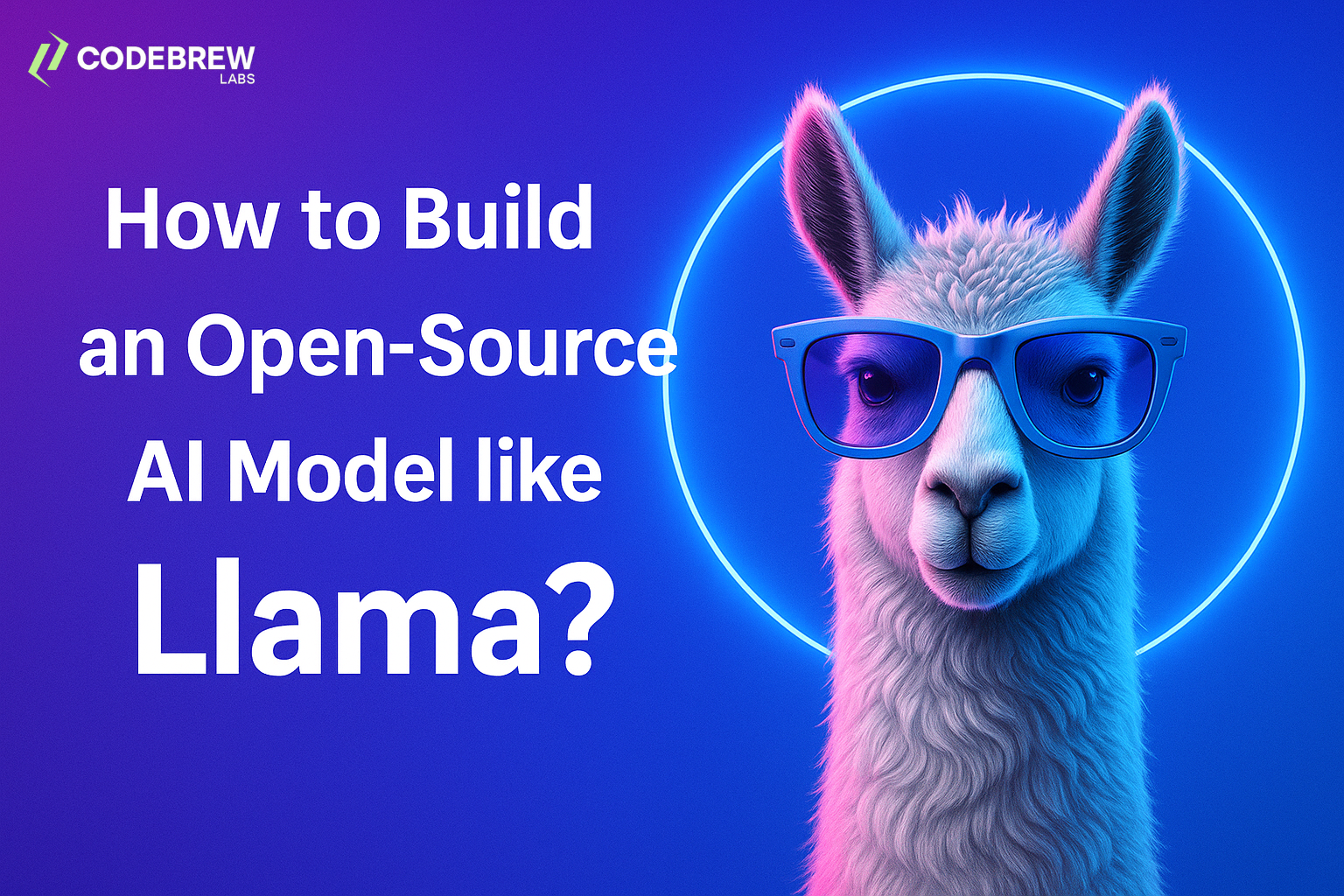
Llama is an open-source large language model (LLM) developed by Meta. It’s popular because it provides powerful natural language processing capabilities while being open and customizable for developers and businesses.
Yes, but building from scratch requires huge datasets, advanced infrastructure, and expert AI engineers. Most businesses instead fine-tune or customize existing open-source models like Llama to save time and costs.
You’ll need high-quality datasets, strong computing resources (GPUs/TPUs), machine learning frameworks (like PyTorch), and a skilled AI development team to handle training, fine-tuning, and deployment.
For most companies, fine-tuning an existing model is more practical. It’s faster, cost-effective, and already comes with pre-trained knowledge. Building from scratch is usually only done by research labs or large enterprises.
The cost depends on your approach. Fine-tuning can cost in the range of thousands of dollars, while building a new large model from scratch can cost millions. Partnering with an AI development company can help optimize costs with the right strategy.
An AI development company can provide end-to-end support — from model selection and dataset preparation to training, fine-tuning, and deployment — saving you time, reducing costs, and ensuring the model is aligned with your business needs.


 Contact Us
Team Up With Us Today For An Unforgettable Service Experience












 Book Free Consultation