Table of Content


Introduction
The real estate market of 2026 looks very different from just a few years ago. Tight inventory levels, rapidly changing buyer preferences, and a growing reliance on digital-first experiences have pushed the industry into an era where AI isn’t a luxury—it’s a necessity. Consumers now expect instant insights, smarter recommendations, and frictionless transactions, while real estate professionals demand tools that reduce manual work and enhance productivity.
Table of Content
Agents and property managers juggle multiple listings, lead sources, and client conversations every day. Without intelligent automation, they risk losing valuable leads and time. Buyers, on the other hand, face information overload—thousands of listings that may not truly fit their needs or budgets. Add increasing fraud risks, privacy concerns, and data overload, and it’s clear why traditional real estate apps are no longer enough.
That’s where partnering with an AI real estate app development company becomes essential. These specialized firms build platforms that blend machine learning, computer vision, natural language processing (NLP), and predictive analytics to deliver smarter, more personalized property experiences. Instead of simply displaying listings, modern AI-driven apps can understand buyer intent, forecast property values, and automate workflows for agents and brokers—redefining how real estate is bought, sold, and managed in 2026 and beyond.
In this guide, we’ll explore:
- The fundamentals of what makes a real estate app truly AI-driven.
- Why AI features are reshaping the property industry in 2026.
- Core technologies and stacks behind next-generation apps.
- The development roadmap—from planning to launch.
- Cost considerations and success metrics to measure ROI.
Whether you’re a startup planning to launch a proptech platform or an established brokerage looking to modernize, this comprehensive guide will help you understand how to strategize, design, and build an AI-powered real estate app ready for 2026 and beyond.
What Is an AI Real Estate App?
An AI real estate app is a next-generation property platform that uses artificial intelligence technologies—such as machine learning, natural language processing (NLP), and computer vision—to transform how people buy, sell, rent, or invest in properties. Unlike traditional real estate apps that rely on static filters and manual data entry, AI-powered apps learn from user behavior, market data, and visual inputs to deliver personalized, faster, and more efficient experiences for every stakeholder in the ecosystem.
In simple terms, an AI real estate app doesn’t just display listings—it understands context and intent. It predicts what a user might be looking for, even before they explicitly search for it, and recommends the most relevant properties based on preferences, lifestyle patterns, and budget. For example, if a user repeatedly searches for “2-bedroom apartments with a balcony near downtown,” the AI learns these patterns and curates a list of matching properties, complete with dynamic pricing insights, walkability scores, and neighborhood analytics.
At its core, an AI real estate app combines:
- Machine Learning (ML) – To analyze past behavior and predict future preferences.
- Natural Language Processing (NLP) – To interpret conversational searches like “Show me 2-bedroom apartments near downtown with high walkability.”
- Computer Vision – To assess property photos or videos, identifying room types, design quality, or renovation needs.
- Predictive Analytics – To forecast pricing trends or calculate property appreciation.
- Automation Engines – To streamline repetitive workflows such as lead qualification, contract generation, and appointment scheduling.
How It Differs from Smart Search Apps:
Smart search apps simply match queries to database filters. AI-powered apps go a step further—they understand intent, context, and emotion. For example:
- A traditional search might return every “3-bedroom apartment under $500k.”
- An AI app learns from your clicks, previous searches, and budget behavior to recommend “3-bedroom apartments under $480k in quiet neighborhoods with access to good schools and low crime rates.”
Multimodal intelligence also makes AI real estate apps more human-like. Users can:
- Upload a photo of a house exterior and get listings with similar architecture (“photo-to-value” search).
- Speak naturally into the app and get precise matches via voice search.
- Receive automatic property valuations, mortgage calculations, and energy-efficiency scores—instantly generated by the AI.
- Use contract assistants powered by large language models to review terms, summarize clauses, and highlight risks.
In essence, an AI real estate app transforms data into understanding. It doesn’t just show properties—it guides decisions, automates processes, and builds trust by delivering insights in seconds.
Planning to Integrate AI Into Your Real Estate Business? Let’s Make It Happen.
Why Add AI to Your Real Estate App?
AI isn’t just a buzzword in 2026—it’s the competitive edge driving performance across all segments of real estate. Here’s how AI impacts different stakeholders in the ecosystem:
For Buyers and Tenants
AI enhances every step of the buyer journey:
- Personalized Property Discovery – ML algorithms learn user preferences from past activity to surface relevant listings automatically.
- Smarter Recommendations – AI ranks listings based on value-for-money, commute time, neighborhood sentiment, and amenities.
- Affordability Insights – Predictive models assess long-term costs (loan rates, insurance, maintenance) for better budgeting.
- Virtual Assistance – Chatbots powered by NLP handle questions 24/7, schedule visits, and summarize key property highlights.
The result? Buyers find their ideal property faster, often in 30–40% less time compared to manual searching.
For Sellers and Landlords
AI optimizes listings and improves market outcomes:
- Dynamic Pricing – Automated Valuation Models (AVMs) compare comps, demand, and market timing to suggest accurate, competitive prices.
- Smart Staging Advice – Computer vision can assess property photos and recommend visual improvements or detect quality issues.
- Instant Lead Qualification – AI categorizes incoming inquiries based on purchase intent, credit risk, and readiness to act.
This leads to 15–25% higher engagement and faster closing times.
For Brokers and Agents
AI acts as an intelligent assistant:
- Lead Scoring – Predictive algorithms prioritize high-intent leads.
- Listing Drafting – Generative AI tools auto-write engaging descriptions and headlines from minimal data.
- Route Optimization – Apps can suggest optimal tour schedules based on location, client availability, and traffic conditions.
Agents using AI see a 20% boost in productivity and a 30% reduction in administrative overhead.
For Marketplaces and Platforms
AI transforms user retention and revenue growth:
- Conversion Lift – Personalized recommendations improve engagement rates.
- Content Moderation & Fraud Detection – Vision and NLP models flag duplicate, misleading, or fake listings in real time.
- Churn Prevention – Predictive analytics identify at-risk users and trigger re-engagement campaigns automatically.
Key Performance Metrics (KPIs) Impacted by AI
|
KPI |
Traditional App | AI-Driven App | Improvement |
|
Lead-to-Tour Conversion |
10–12% | 15–18% | +20% |
|
Time to Find a Suitable Property |
~14 days | ~9–10 days | –30% |
| Property Listing Accuracy | 85% | 95%+ |
+12% |
| User Retention (Month 3) | 45% | 60–65% |
+15–20% |
| Agent Productivity | Baseline | +25–30% |
— |
AI in real estate apps bridges the gap between human intuition and data-driven accuracy. It allows buyers to feel understood, sellers to feel empowered, and platforms to operate smarter. In the next sections, we’ll explore the business models, AI feature sets, and technology stack that power successful AI-driven real estate apps in 2026—and how you can build one from the ground up.
Who Is This Guide For?
This guide is designed for anyone looking to leverage AI to transform the real estate experience — whether you’re building a new proptech platform or modernizing an existing one.
- Startups & Marketplaces: If you’re launching a real estate platform that connects buyers, sellers, and agents, this guide will help you integrate AI features that make your product stand out in a competitive market.
- Real Estate Brokerages: Traditional brokerages aiming to digitize operations can use AI to improve lead management, automate listings, and offer personalized recommendations to clients.
- Property Managers & Rental Platforms: For those managing large property portfolios, AI can simplify tenant screening, rent collection, maintenance scheduling, and vacancy forecasting.
- SaaS Vendors & Tech Providers: Companies offering property-related software or tools can use AI APIs and widgets for search, pricing, or valuation to enhance their product capabilities.
In short, if your business deals with property data, listings, or customer interaction in real estate, this guide is for you. It will walk you through how to plan, build, and scale an AI-powered real estate app that meets modern user expectations.
Business Models Supported (2026)
AI-powered real estate apps in 2026 can support multiple business models, depending on your audience, services, and monetization strategy. Let’s explore the key ones driving growth across the industry:
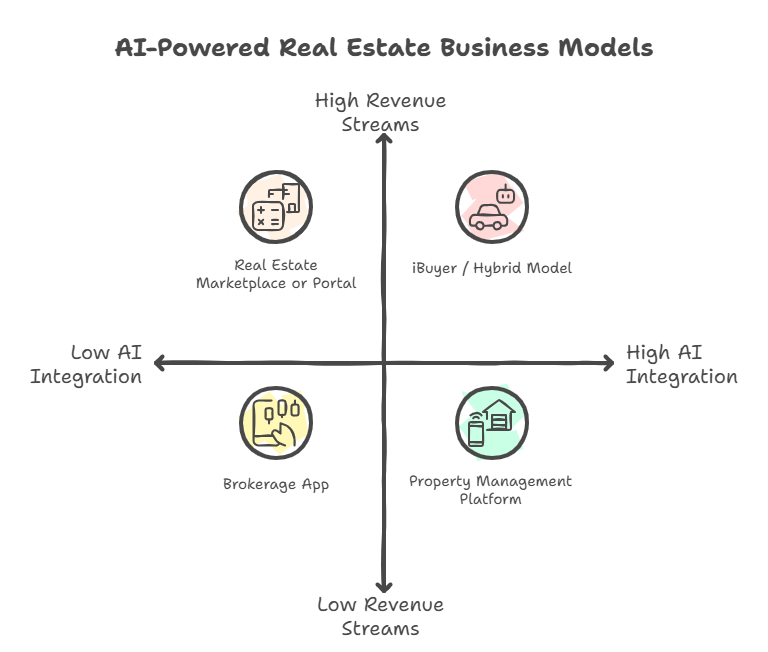
1. Real Estate Marketplace or Portal
This is the most common model, where the platform connects buyers, sellers, and agents.
- Revenue streams: Advertising placements, subscription tiers for agents, featured listings, and lead generation fees.
- AI advantage: Smarter property matching, predictive pricing, and lead quality scoring to boost conversions.
- Example: Zillow, Realtor.com, and Bayut are moving toward AI-driven personalization and data transparency.
2. Brokerage App
This model serves a real estate firm’s internal and client-facing needs.
- Agents use AI tools for CRM, scheduling, and client communication.
- Clients benefit from personalized listing recommendations and instant chat assistance.
- AI impact: Predicts client preferences, drafts property descriptions, and automates follow-ups.
- Revenue model: Brokerage commissions, premium client services, or subscription access to agent productivity tools.
3. Property Management Platform
Ideal for rental agencies, landlords, and property managers overseeing multiple properties.
- AI features: Tenant screening using predictive scoring, rent prediction models, automated maintenance scheduling, and smart reminders.
- Revenue streams: Subscription fees, usage-based plans, or per-property management charges.
- AI benefit: Saves time, reduces human errors, and improves tenant satisfaction.
4. Mortgage & Financing Companion App
An AI-powered companion app that helps users calculate affordability, compare loan options, and pre-qualify for mortgages.
- AI role: Document extraction, income verification, and real-time rate comparison.
- Revenue streams: Referral commissions from lenders, subscription models for users seeking financial planning tools.
- AI edge: Offers personalized loan recommendations and risk analysis.
5. iBuyer / Hybrid Model
iBuyers use AI to evaluate homes, predict resale value, and assess market risks—allowing them to make instant offers to sellers.
- AI applications: Automated Valuation Models (AVMs), renovation cost estimation, and market risk prediction.
- Revenue: Transaction fees, service charges, and resale profit margins.
- Advantage: AI enables faster, more accurate pricing decisions and reduces investment risks.
6. B2B SaaS Widgets and APIs
Some companies don’t build full apps—instead, they provide AI-powered modules for others to integrate.
- Examples include APIs for property search, valuation, fraud detection, or document summarization.
- Monetization: Pay-per-API call, monthly subscription, or usage-based billing.
- AI benefit: Scalability, lower integration costs, and plug-and-play intelligence for other platforms.
Monetization Ideas for 2026
- Lead Generation Fees: Charge per qualified buyer or seller lead.
- Premium AI Packs: Offer paid access to advanced analytics, property forecasts, or investment tools.
- Pay-per-Valuation: Charge users or agents per automated home valuation request.
- Subscription Tiers: Offer different AI features for agents, brokerages, or investors.
- Usage-Based API Pricing: For B2B SaaS companies offering valuation or search APIs.
No matter which model you choose, AI enhances efficiency, engagement, and profitability, helping your platform stay competitive in the fast-evolving real estate tech landscape.
Looking to Build an Intelligent Real Estate App That Converts Leads into Clients?
Must-Have Core Features (Non-AI)
Before layering AI functionality, your real estate app needs a solid foundation of essential features that ensure smooth navigation, seamless interactions, and trust. These non-AI features form the base upon which intelligent tools operate.
1. User Authentication & Profiles
Secure login and profile management for buyers, sellers, and agents.
- Options: Email/phone sign-up, social media logins, and two-factor authentication.
- Benefit: Personalized dashboards and saved preferences.
2. Advanced Property Search & Filters
A robust search engine with filters like location, price range, property type, amenities, and square footage.
- Map and list views should be integrated for easy navigation.
- Users should be able to combine multiple filters and view instant results.
3. Interactive Map View
A dynamic map that displays nearby schools, transport links, restaurants, and neighborhood ratings.
- Geolocation helps users find properties near their current location.
4. Favorites & Saved Searches
Allow users to bookmark listings and save custom search preferences for future reference.
- Push notifications can alert them when similar listings appear or when prices change.
5. Real-Time Alerts & Notifications
Keep users informed about new listings, price reductions, upcoming tours, or messages from agents.
- Real-time alerts help maintain engagement and improve retention.
6. Appointment Scheduling
A built-in calendar for users to book property visits or virtual tours directly through the app.
- Integrated reminders help reduce no-shows and streamline scheduling for agents.
7. In-App Messaging & Chat
Secure, real-time communication between buyers, sellers, and agents.
- Helps reduce dependency on external apps and keeps all discussions centralized.
8. Payments & Deposits
Enable online transactions for booking fees, deposits, or rent payments.
- Integration with secure payment gateways like Stripe or PayPal ensures reliability.
9. Reviews & Ratings
Allow users to review agents, landlords, or properties.
- Builds trust and credibility across the platform.
10. Listing Management Dashboard
For property owners and agents to upload, edit, or remove listings easily.
- Includes photo uploads, video tours, pricing, and description editing.
11. Admin Panel & Analytics
Admin dashboards to monitor listings, transactions, user engagement, and platform performance.
- Analytics help platform owners make data-backed improvements.
These core features create a reliable user experience and establish the base functionality needed before adding advanced AI modules like automated valuations, predictive pricing, or chat-based search.
Signature AI Features for 2026
In 2026, artificial intelligence will no longer be a novelty in real estate — it will be the backbone of every competitive app. Buyers, sellers, and agents now expect smart recommendations, instant insights, and faster decisions. Below are the key AI-driven features that can set your real estate app apart in today’s tech-driven housing market.
Conversational Property Search
Modern users prefer to talk to their apps the same way they’d talk to an agent. Instead of typing filters, they can simply ask questions like, “Find a three-bedroom house near good schools under $800,000 with a home office.”
The AI then uses natural language understanding and data grounding from your property listings, local school data, crime statistics, and neighborhood scores to provide ranked results.
To ensure trust, the system can also explain why a property matches the query — for example, highlighting nearby schools or low HOA fees. This feature saves users time while making searches feel intuitive and personalized.
Vision-Powered Insights
AI vision models can analyze images and videos of properties to identify room types, interior styles, and potential renovation needs. These systems can detect problems like water damage or suggest improvements such as repainting or adding better lighting.
Buyers benefit from “image-to-estimate” features that roughly calculate renovation costs, while sellers get advice on how to improve their listing’s visual appeal. It’s also possible to offer “show more like this kitchen” options, which enhance discovery and engagement.
Dynamic Pricing and Automated Valuation Models (AVM)
Accurate pricing is crucial in real estate. AI-powered valuation models analyze comparable sales, neighborhood trends, seasonal factors, and renovation data to estimate a property’s fair value.
These models can adjust dynamically to reflect new listings, changing demand, or market fluctuations. The best ones also include transparent explanations, showing which features most affected the price. This not only builds user confidence but also helps agents justify pricing strategies with data-backed insights.
Lead Scoring and Routing
AI can track how users browse listings, their budget ranges, and engagement patterns to score leads automatically. Instead of relying on manual sorting, high-value leads are sent directly to the best-matched agents or teams.
This results in faster follow-ups, fewer missed opportunities, and higher conversion rates. For brokerages or marketplaces handling thousands of inquiries, AI routing can easily improve efficiency by 25–30%.
AI Listing Assistant
Creating property descriptions can be time-consuming. An AI-powered listing assistant automatically drafts catchy headlines, writes detailed descriptions, and highlights key amenities. It can even generate alt texts for accessibility and suggest photo improvements, such as lighting or staging.
This helps agents upload listings faster and maintain consistent quality across the platform, while ensuring every property gets the professional polish it deserves.
Financial Copilot
Home buyers often struggle to understand affordability. The financial copilot simplifies this by calculating real monthly costs — including taxes, HOA fees, and insurance. It can also compare “rent vs. buy” scenarios, simulate different down payment options, or suggest mortgage plans.
This helps users make informed decisions while reducing the need for manual calculations or third-party tools.
Fraud and Moderation
AI moderation tools can identify fake or duplicate listings, detect deepfake documents, and flag suspicious interactions. By scanning for unusual activity patterns or inconsistencies, the system protects users from scams.
It’s also useful for content moderation — ensuring uploaded images, listing text, and messages comply with platform standards.
Document AI and Workflow Automation
Managing real estate documents is complex. AI can extract critical terms from leases, purchase agreements, and inspection reports. It can also generate addenda, compare clauses, and prepare e-sign checklists.
With a human review layer in place, this feature speeds up transactions, reduces errors, and simplifies compliance.
Multilingual and Accessibility Support
To reach global audiences, AI can translate listings, chats, and documents in real time. Voice-first interfaces allow users to search or interact hands-free, while text simplification makes content accessible to users with dyslexia or limited reading proficiency.
This inclusivity not only enhances user experience but also broadens the app’s potential audience.
Agent Productivity Tools
AI assistants for agents can summarize client calls, suggest follow-ups, and automatically log notes into CRM systems. It can even optimize tour routes based on traffic and availability.
These automations free up valuable time, allowing agents to focus on relationship-building and closing deals — not paperwork or manual data entry.
How to Build It: Step-by-Step Roadmap
Building an AI-powered real estate app in 2026 requires a structured approach. From defining goals to launching and refining your product, every phase plays a vital role in delivering a reliable and scalable solution. Below is a simplified roadmap for startups, brokerages, or SaaS builders planning to enter the market.
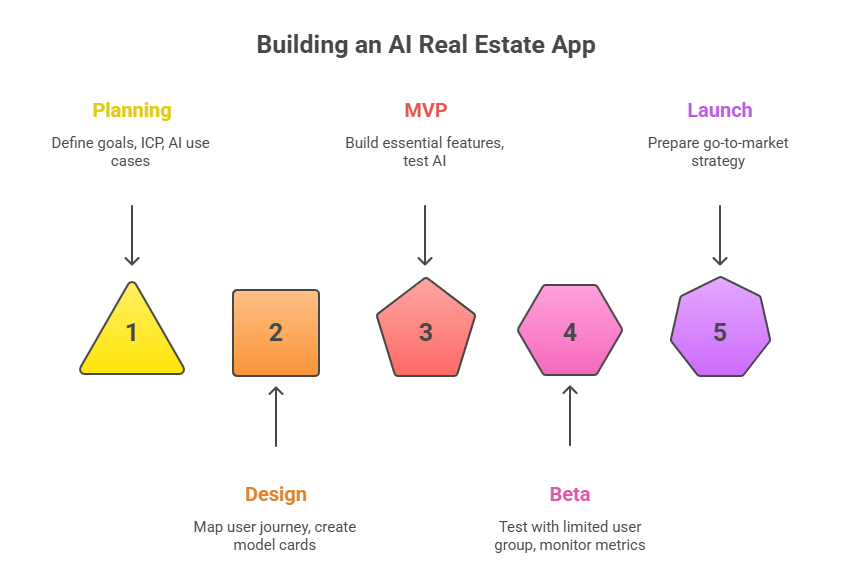
1. Plan (Weeks 0–2)
Start by identifying your ideal customer profile (ICP) — are you building for buyers, agents, or enterprise clients? Then choose your top three AI use cases, such as conversational search or dynamic pricing.
Audit your available data sources, like property listings, customer histories, and external APIs. Prepare a compliance checklist for privacy, consent, and regional data laws (GDPR, CCPA, etc.).
Finally, set measurable KPIs such as “reduce time-to-list by 30%” or “increase lead-to-tour conversion by 20%.”
2. Design (Weeks 2–5)
Map the complete user journey and define where AI adds value. Create model cards that describe how each model works, what data it uses, and how bias is mitigated.
Design user interfaces with transparency — for example, showing why a listing is recommended. Include clear consent prompts and data usage explanations to build user trust.
Focus on a clean, intuitive UX that simplifies discovery, comparisons, and transactions.
3. MVP (Weeks 5–12)
Build your minimum viable product with essential non-AI features (login, search, listings) plus two signature AI differentiators, such as a conversational search and AI listing assistant.
Use synthetic or anonymized data to test early models safely. Implement human-in-the-loop validation so experts can review AI outputs before going live.
This MVP phase focuses on functionality and validation rather than scaling.
4. Beta (Weeks 12–18)
Invite a limited user group — agents, property managers, or select buyers — to test your beta version. Monitor metrics like search accuracy, price estimation precision, and response latency.
A/B test different recommendation strategies and adjust ranking logic or AVM models as needed. Keep a close eye on server costs and optimize for efficiency.
5. Launch (Weeks 18–22)
Prepare your go-to-market strategy with clear communication about your app’s AI value. Set up an incident response playbook, define model rollback options, and establish a support desk for user feedback.
Ensure uptime reliability, data protection, and moderation are fully in place before scaling.
6. Iterate and Scale (Ongoing)
Post-launch, collect user feedback continuously and use it to refine features. Every user interaction can feed your “data flywheel” — improving personalization, recommendations, and pricing accuracy.
As your user base grows, add advanced capabilities like predictive maintenance for property managers or localized AVMs for new cities.
This continuous improvement cycle ensures your app evolves with market trends and user expectations.
Ready to Transform Your Property Platform with Smart AI Features?
Simple RACI Matrix
|
Role |
Responsibility |
|
Product Manager (PM) |
Defines goals, features, and KPIs |
|
Lead Engineer |
Architecture, integrations, performance |
|
Data Scientist |
Model design, training, and evaluation |
| Designer (UX/UI) |
User experience, interface consistency |
| Compliance Officer |
Legal checks, data governance |
| DevOps Engineer |
Deployment, scalability, and monitoring |
Team & Budget: What It Really Costs (2026)
Building an AI-powered real estate app in 2026 requires not just good ideas but a balanced, skilled team and a realistic budget. The cost depends heavily on the scope — whether you’re developing a single-region MVP or a multi-region production-grade platform — and the level of AI integration you plan to achieve.
A typical team includes key roles across strategy, engineering, data, and compliance:
- Product Manager (PM): Oversees roadmap, feature priorities, and delivery timeline.
- Frontend & Backend Developers: Build the core app architecture, APIs, and user interface.
- Data Scientist / Machine Learning Engineer: Develop and fine-tune AI models for recommendations, valuations, and automation.
- Data Engineer: Handles data pipelines, cleaning, and integration with external sources.
- QA Engineer: Ensures functionality, accuracy, and performance through continuous testing.
- DevOps Engineer: Manages cloud infrastructure, CI/CD pipelines, and model deployment.
- UI/UX Designer: Crafts intuitive, user-friendly interfaces with clear AI explanations.
- Legal & Compliance Expert: Oversees data privacy, user consent, and AI transparency policies.
Estimated Cost Ranges (2026)
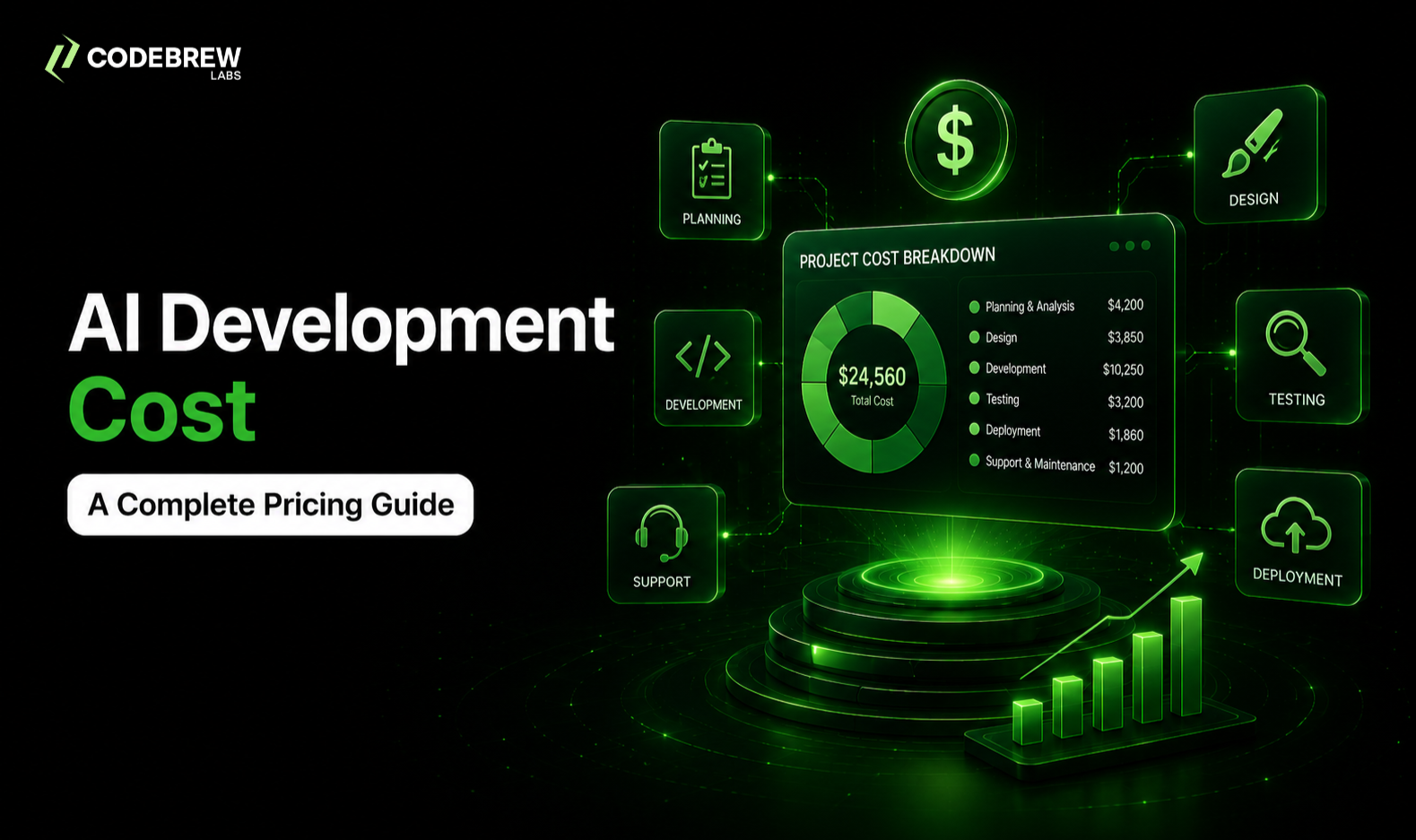
For an MVP (single region, 2 AI features) such as conversational search and AI listing assistant, expect a budget between $50,000 and $400,000 over approximately 4–6 months.
A production-ready version (multi-region, 5+ AI features with MLOps pipelines) may range between $100,000 and $1.2 million in the first year, depending on scale, integrations, and cloud usage.
Beyond development, factor in ongoing costs such as:
- Infrastructure (servers, storage, API calls)
- Data licenses (market feeds, geospatial datasets)
- AI model retraining and monitoring
- Moderation and security audits
- Support and product updates
Investing in a capable team and solid data foundation upfront ensures that your AI features perform reliably and scale smoothly as your app grows.
Conclusion
AI is redefining how real estate apps connect people to properties. By combining intelligent search, predictive insights, and automation, developers can create platforms that feel more personal, transparent, and efficient than ever before.
As you plan your AI real estate app for 2026, focus on solving real user pain points — not just adding trendy tech. Start small, validate fast, and refine your models through real-world feedback.
Whether you’re a startup exploring your first MVP or an established marketplace scaling globally, the next step is clear: define your AI vision, assemble the right team, and collaborate with an experienced AI development company to turn your data into a competitive advantage.
FAQs
- How long does it take to build an AI real estate app?
An MVP with core features and basic AI (like smart search) usually takes 4–6 months, while a full-scale platform may require 9–12 months or more.
- What tech stack is best for real estate apps?
Commonly, React or Flutter for front-end, Node.js or Python for backend, and TensorFlow/PyTorch for AI models. Cloud services like AWS, Azure, or GCP support scalable data and ML pipelines. - How can small startups afford AI features?
You can start with third-party APIs for search, pricing, or chat, then gradually replace them with in-house models as your data grows. - Are AI-based valuations accurate?
AI valuations (AVMs) are highly useful but depend on data quality. It’s best to combine AI insights with expert review for transparency and trust. - What about data privacy and compliance?
Ensure you follow local data laws like GDPR or CCPA, use anonymized training data, and always obtain user consent for AI-driven recommendations.
Let's Convert Your Business Idea Into Success!
Free Consultation from Top Industry Experts
Let’s Build Your Dream App!
Share article on :




Ready To Fuel Your Vision With AI-Powered Innovation?


Level- 18, Dubai World Trade Centre Tower, Sheikh Rashid Tower, Sheikh Zayed Rd, Dubai, UAE
business@code-brew.com +971-55-645-7972
Plot no I - 36, Sector 83 Alpha, Mohali SAS Nagar 140308
business@code-brew.com +91-771-976-8427
Av. Miguel Hidalgo y Costilla 1995, Arcos Vallarta, 44600 Guadalajara, Mexico
business@code-brew.com +1(213)2614953
4231 Balboa Ave #512 San Diego, CA 92117 United States
business@code-brew.com +1(213)2614953
2nd floor, College House, 17 King Edwards Rd, London HA4 7AE, UK
business@code-brew.com +44 (20) 82644493
Partner With Experts Who Leverage AI & Tech To Transform Ideas Into Market-Leading Solutions.
Wait! Looking for Right Technology Partner For Your Business Growth?
It's Time To Convert Your Business Idea Into Success!
Get Free Consultation From Top Industry Experts:
I would like to keep it to myself