| Quick Summary Table of Content Launching a successful fantasy sports app development project in 2026 requires far more than just a good idea or attractive design. With the global fantasy sports market projected to surpass $56 billion by 2030 and India contributing 180+ million users, the opportunity is massive—but so is the competition. Users now expect real-time scores, seamless payments, engaging contest formats, and a smooth mobile experience. This guide covers fantasy sports app development cost, features, timeline, technology stack, monetization strategies, and launch planning to help you build a profitable platform. |
Fantasy sports app development in 2026 has emerged as a high-growth digital opportunity driven by real-time engagement, mobile-first users, and scalable revenue models. With millions of active users and strong global adoption, the space continues to expand rapidly.
This guide breaks down everything you need to know—including development cost, features, timeline, technology stack, and monetization strategies—to help you build a scalable fantasy sports platform.
A fantasy sports app is a digital platform where users create virtual teams by selecting real-world players and earn points based on their performance in live matches.
These apps operate on a skill-based model where users compete in contests, join leagues, and track real-time scores through live data integrations. Common features include team creation, live scoring, leaderboards, and secure wallet systems for paid contests.
Modern fantasy sports apps also integrate AI-based recommendations, analytics dashboards, multiple contest formats, and personalized engagement tools to improve user retention and monetization.
Fantasy sports app development is growing rapidly across cricket, football, basketball, baseball, and esports, with India emerging as one of the largest markets globally.
According to industry reports, the fantasy sports market was valued at $24.8 billion in 2024 and is projected to reach $56.3 billion by 2030, growing at a 15.2% CAGR.
India is emerging as one of the fastest-growing markets, expected to reach $2.3 billion by 2030 with a CAGR of over 20%, making it a major region for fantasy sports app development.
Understanding these core market catalysts is essential for developers looking to capture the next wave of high-value users.
Most fantasy sports users access platforms via mobile apps, making app-based experiences the dominant segment.
Users expect live scoring, instant updates, and real-time gameplay, increasing reliance on APIs and backend performance.
Integrated wallets, entry fees, and in-app purchases are turning fantasy apps into scalable revenue platforms.
This segment continues to grow due to higher disposable income and strong interest in skill-based gaming.
Fantasy sports app development is not limited to one format. Different fantasy sports apps are built based on sport type, contest model, and monetization strategy. Understanding these categories helps businesses choose the right fantasy sports app model before starting development.
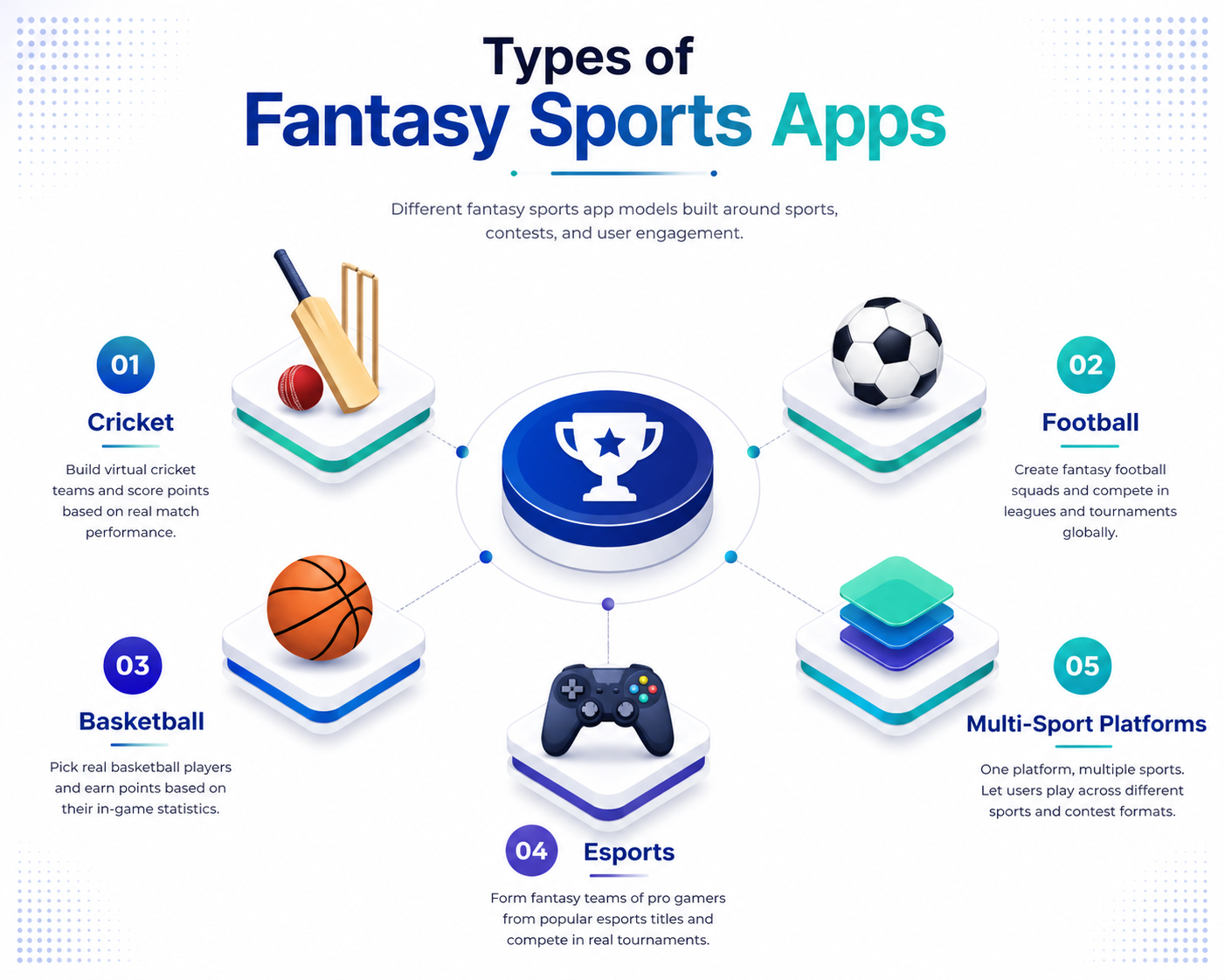
Different types of fantasy sports apps categorized by sport and platform model
Most fantasy sports platforms are built around specific sports based on regional demand and audience preferences.
Cricket Fantasy Apps
Cricket fantasy apps dominate markets like India and the UK. These apps focus on match contests, leagues, and tournament formats.
Football Fantasy Apps
Popular in Europe and North America, football fantasy apps often include season-long leagues and live scoring.
Basketball & Baseball Apps
Common in North America, these apps rely heavily on player statistics and frequent match cycles.
Esports Fantasy Apps
A fast-growing category where users create teams around professional gamers in FPS and MOBA titles.
Fantasy sports apps are also categorized by how contests are structured.
Daily Fantasy Sports (DFS)
Short-term contests based on single matches or events. High engagement and faster monetization cycles.
Season-Long Fantasy Platforms
Users manage teams across a full season with long-term strategy and recurring engagement.
Peer-to-Peer & Private Leagues
Users create custom contests and invite friends, helping increase retention and organic growth.
Modern fantasy sports apps are expanding into larger ecosystems.
Single-Sport Apps
Focused on one sport such as cricket. Easier to launch but limited in long-term scalability.
Multi-Sport Platforms
Support multiple sports in one app, increasing engagement across seasons.
Hybrid Gaming Platforms
Combine fantasy sports with casual gaming, social features, and regionally compliant real-money mechanics.
Fantasy sports app development requires a fast, reliable, and scalable technology stack. These platforms require high-performance backend systems for live data and transactions
A strong backend architecture helps maintain performance during peak traffic, especially during major sports events.
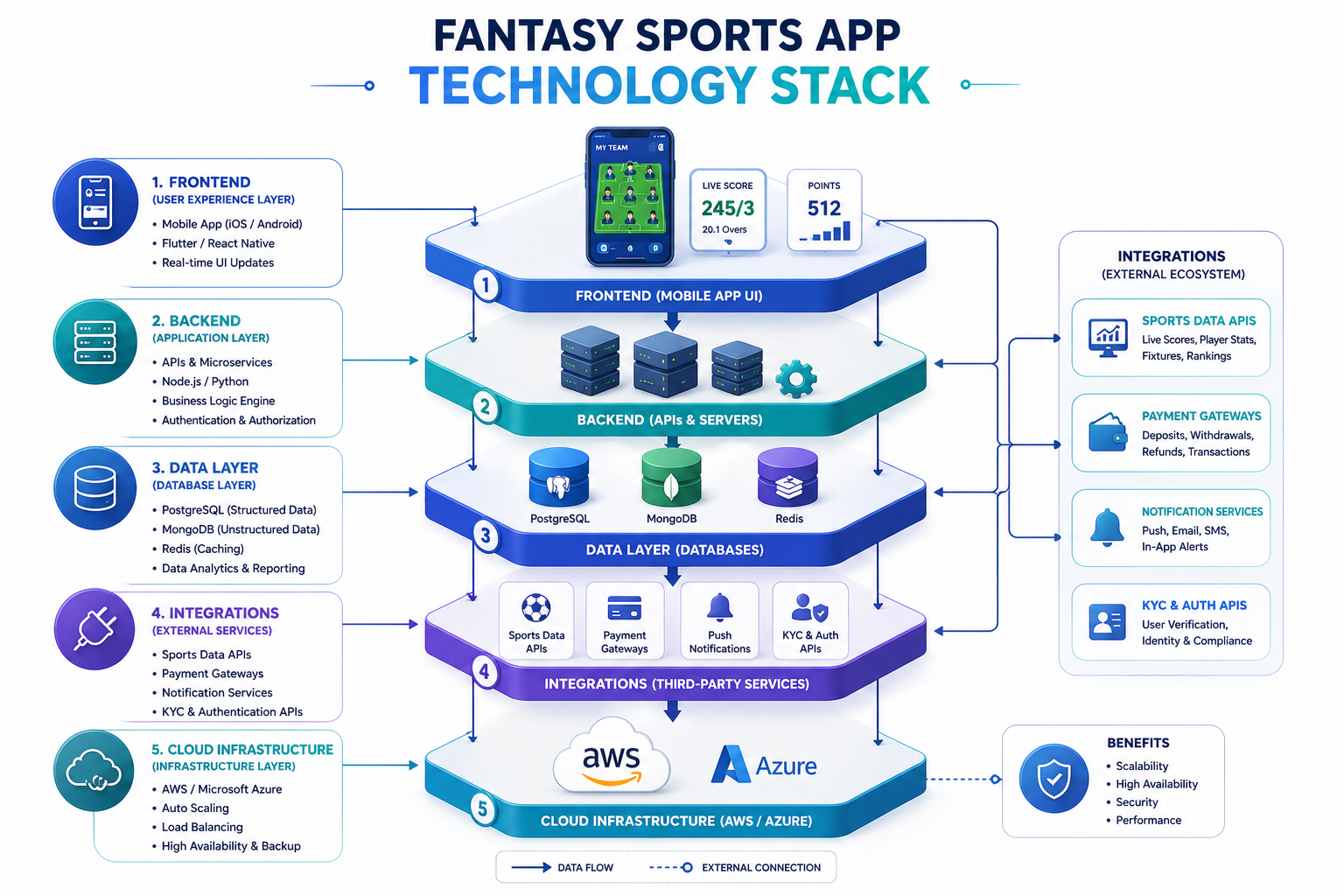
Technology architecture of a fantasy sports app including frontend, backend, APIs, and cloud infrastructure
The frontend is what users interact with daily, so speed and usability matter. Many businesses choose Flutter or React Native for cross-platform development, while Swift and Kotlin are preferred for premium native performance.
Key priorities include smooth navigation, quick team creation, and instant score refreshes during live matches.
The backend powers contests, wallets, scoring engines, and user accounts. Technologies like Node.js are commonly used for fast APIs, while Python is popular for analytics and automation.
A reliable backend becomes critical when traffic spikes during tournaments.
Fantasy sports platforms store user profiles, transactions, player stats, and contest history. Many apps use PostgreSQL for structured data and MongoDB for dynamic records.
To reduce lag, systems often use caching tools like Redis.
Third-party APIs connect the platform with live sports data, payment gateways, and KYC verification tools. Without reliable integrations, users may experience delayed scores or failed transactions.
Cloud platforms such as AWS and Microsoft Azure help apps scale automatically during traffic surges. Security layers like encryption, fraud detection, and DDoS protection help protect payments and user data.
Watch how a fantasy sports app is built end-to-end →
Building a fantasy sports app goes beyond adding features. It requires a platform that can manage live data, growing user traffic, and secure transactions without performance issues.
A structured development process helps ensure the product is scalable, compliant, and launch-ready from day one.
This stage defines the product roadmap and business goals.
Teams usually identify:
Clear planning reduces delays and costly revisions later.
Fantasy sports apps must feel simple and intuitive despite complex backend systems.
Design priorities include:
A strong user experience improves engagement and retention.
Our approach to MVP development focuses on launching core features quickly to validate demand while keeping costs optimized. .
Typical MVP features:
This phase helps test the product before larger investment.
External integrations turn the app into a live operating platform.
Key integrations:
Reliable APIs are essential for smooth performance.
Fantasy sports apps need extensive testing, especially when payments are involved.
Key checks include:
Security should be continuous, not only pre-launch.
Once approved, the app is launched across production environments.
Key steps:
A stable launch creates a better first user experience.
After launch, the focus shifts to growth, optimization, and retention.
Ongoing improvements may include:
Successful fantasy sports apps continue evolving with user behavior and sports seasons.
Fantasy sports app development in 2026 typically costs $20,000 to $300,000+, depending on features, platforms, and scalability requirements.
MVPs are cheaper, while enterprise platforms require advanced infrastructure and real-time systems.
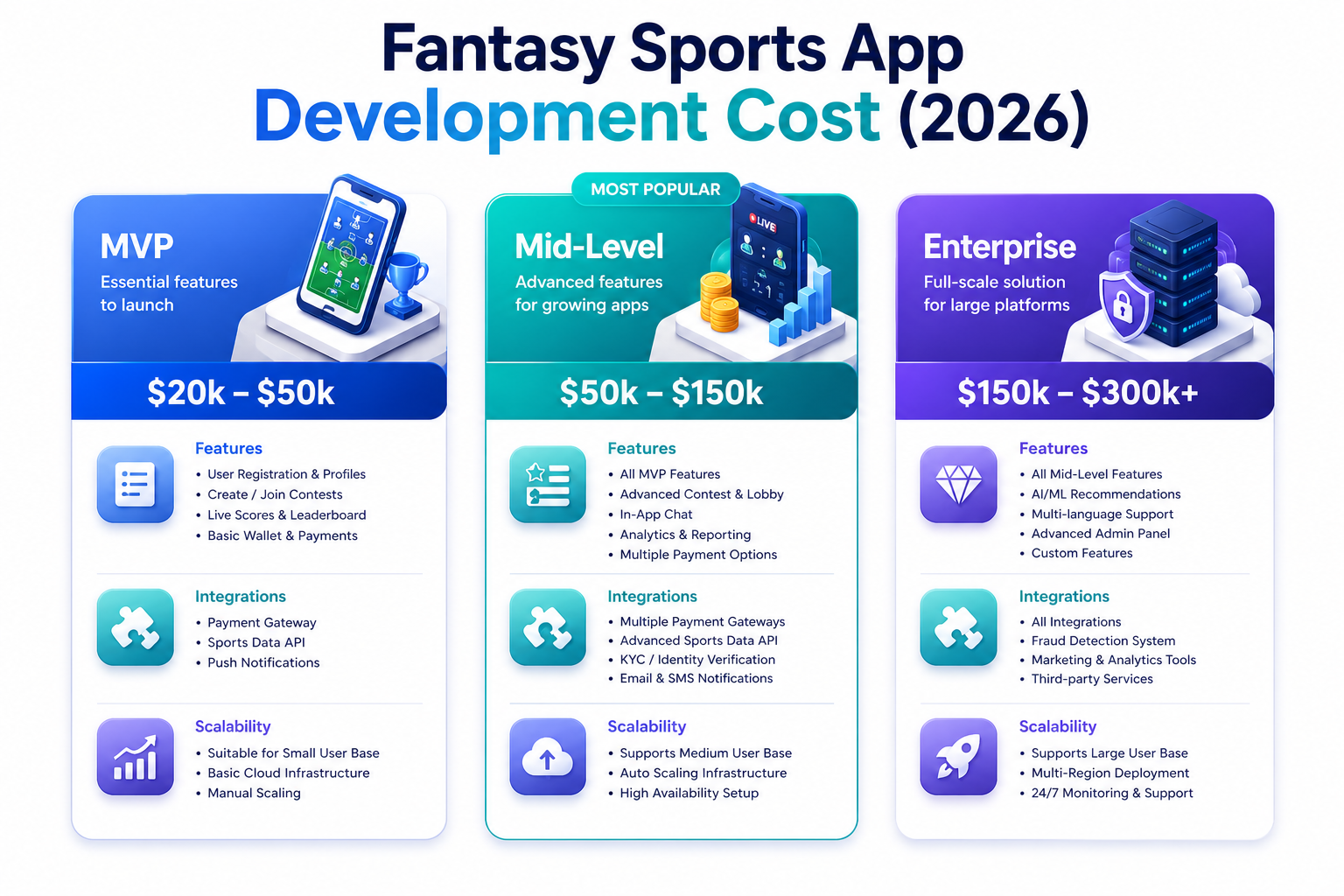
Estimated cost to build a fantasy sports app based on features, integrations, and platform scale
Fantasy sports app development costs vary based on product complexity and feature requirements.
Fantasy sports app development costs vary based on product complexity, features, and scalability requirements. Below is a clear breakdown of each build type to help you choose the right approach.
A lightweight version designed to validate your idea quickly and enter the market with core functionality.
Includes:
Best for startups testing product-market fit or launching a first version quickly.
A scalable product with stronger engagement features and monetization capabilities.
Includes:
Best for growing businesses aiming for user acquisition and revenue generation.
A high-performance, fully scalable platform built for large user bases and peak traffic handling.
Includes:
Best for established brands targeting large-scale adoption and long-term expansion.
The cost of fantasy sports app development depends on several technical and product-level factors. Understanding these helps you estimate your budget more accurately and avoid unexpected expenses.
Based on budget and business goals, fantasy sports apps can be built in different models — from MVPs to full-scale enterprise platforms.
Understanding the difference between an MVP, clone app, and enterprise fantasy sports platform helps businesses choose the right development approach based on budget, speed, and scalability goals.
An MVP (Minimum Viable Product) is a simplified version built to validate your idea in the market quickly.
Best for: Startups testing demand or entering the market fast
Key Features:
Pros:
Limitations:
A clone app is a pre-built solution modeled after successful platforms like Dream11, modified with branding and minor feature changes.
Best for: Businesses wanting faster launch with proven structure
Key Features:
Pros:
Limitations:
An enterprise platform is a fully custom-built software solution designed for long-term growth and high-concurrency traffic.
Best for: Established brands or funded startups aiming for scale
Key Features:
Pros:
Limitations:
| Factor | MVP | Clone App | Enterprise |
| Cost | Low | Medium | High |
| Timeline | 8–12 weeks | 2–4 months | 6–9+ months |
| Customization | Low | Medium | Very High |
| Scalability | Limited | Moderate | Very High |
| Best For | Validation | Fast launch | Long-term growth |
Fantasy Sports App Cost Calculator (Quick Estimate Block)
Use this simple feature-based calculator to estimate your fantasy sports app development cost based on what you want to build.
Every fantasy sports app starts with a core MVP foundation:
Base Cost: $20,000 – $50,000
Add features based on your business goals:
| Feature | Add to Cost |
| Multi-sport support | + $20,000 – $40,000 |
| Real-time scoring engine | + $10,000 – $25,000 |
| Wallet & payment system | + $15,000 – $30,000 |
| Push notifications system | + $5,000 – $12,000 |
| AI recommendations / analytics | + $20,000 – $60,000 |
| Advanced admin dashboard | + $10,000 – $20,000 |
| High-scale cloud infrastructure | + $20,000 – $80,000 |
Estimated Cost: $20,000 – $50,000
Estimated Cost: $60,000 – $150,000
Estimated Cost: $150,000 – $300,000+
Fantasy sports app development costs are shaped by technical scope, integrations, and long-term scalability rather than design alone.
Advanced features such as multi-sport support, AI recommendations, analytics dashboards, and referral systems increase development effort.
Live sports APIs, instant score syncing, and low-latency systems add technical complexity and infrastructure costs.
Building for iOS, Android, or both platforms affects budget, timeline, and testing requirements.
Custom interfaces, animations, and smooth user journeys require additional design and frontend development work.
Payment gateways, KYC tools, analytics platforms, and push notification systems can increase total project cost.
Apps built for large traffic volumes need stronger cloud infrastructure, load balancing, and performance optimization.
Grintafy is a football-centric sports app built for users in Saudi Arabia that helps players create profiles, organize matches, and connect with other football enthusiasts.
The platform focuses on real-world sports engagement, allowing users to discover local games, build their football identity, and join community-driven matches.
Grintafy demonstrates how sports engagement platforms are built at scale, focusing on user profiles, real-time interaction, and community networking—core foundations also used in fantasy sports app development.
The development timeline depends on feature scope, integrations, and platform complexity.
Most fantasy sports apps take 8 weeks to 9+ months to build, depending on whether the goal is an MVP or a full enterprise platform.
Technology architecture of a fantasy sports app including frontend, backend, APIs, and cloud infrastructure
Instead of a fixed duration, timelines are better understood in phases.
An MVP focuses on launching quickly with core features.
Common features:
Best for validating demand and entering the market early.
This stage expands the MVP into a complete product.
Common features:
This is where the platform becomes market-ready.
Enterprise builds require more time due to scale and custom systems.
Common features:
Designed for large user bases and peak traffic events.
Advanced functionality increases planning, development, and testing time.
Sports APIs and live syncing require setup, monitoring, and accuracy testing.
Launching on both iOS and Android extends development cycles.
Custom UI/UX takes longer but can improve retention and conversions.
Real-money apps need extensive validation before release.
Fantasy sports apps generate revenue through multiple channels. Most successful platforms combine contest fees, subscriptions, ads, and partnerships to build recurring income streams.
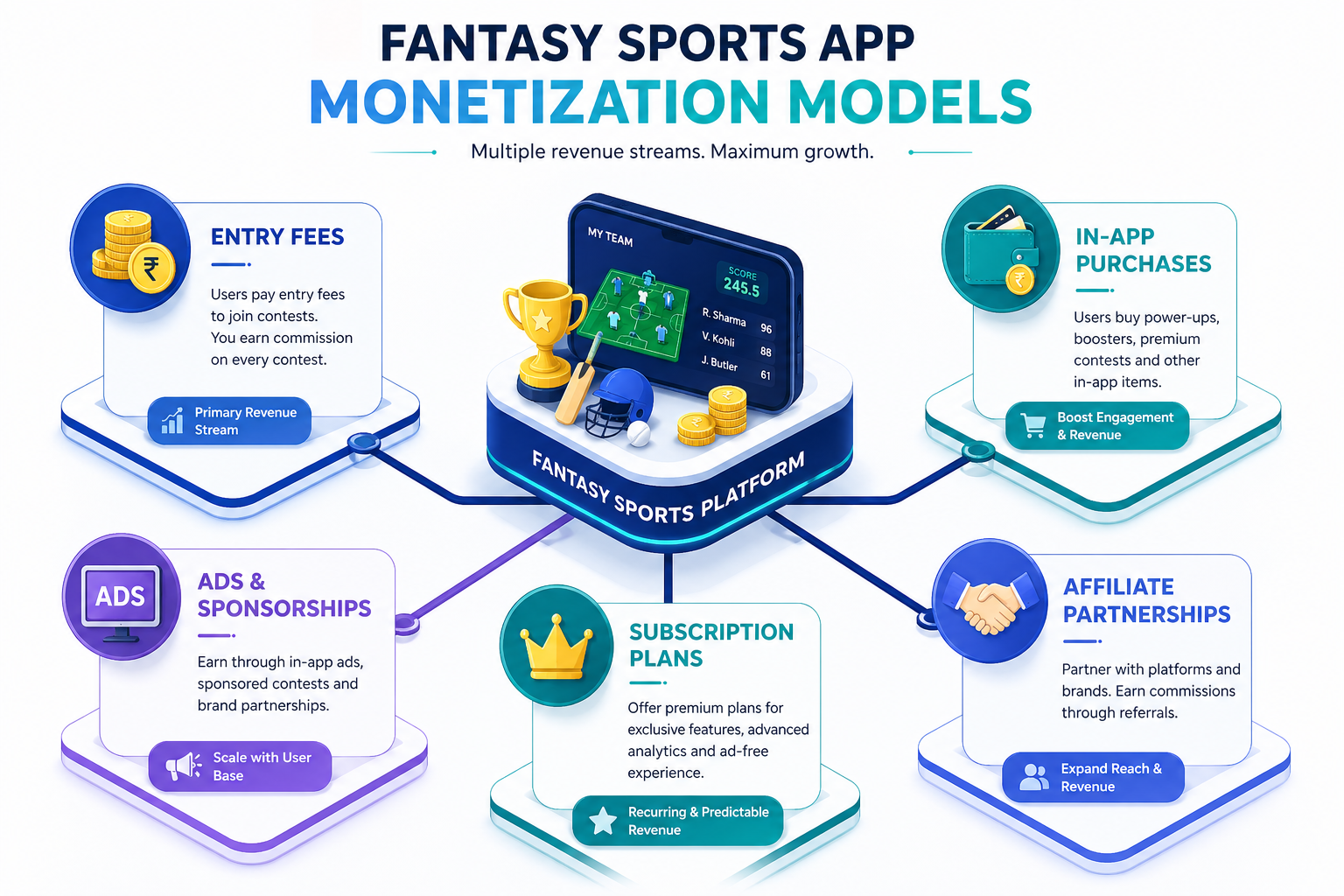
Key monetization strategies used by fantasy sports apps to generate revenue
Users pay to join contests, while the platform keeps a percentage of each pool.
Optional premium features can increase average revenue per user.
High-traffic platforms can monetize through brand exposure.
Recurring plans help create predictable monthly revenue.
Strategic partnerships can create additional income.
Fantasy sports apps handling real-money contests must follow local regulations, payment laws, and user verification rules.
Legal classification often depends on whether outcomes rely on user skill or luck.
Most platforms require identity verification.
Rules vary by country and state, so geo-based controls are often necessary.
Building a fantasy sports app goes beyond adding features. With the global fantasy sports market projected to exceed $56 billion by 2030, competition is rising—but so are technical and operational challenges. These platforms must manage live data, heavy traffic, and secure financial transactions at the same time. Even small issues can affect user trust, engagement, and revenue.
Fantasy apps rely on accurate live scores, player stats, and instant updates.
Common challenges include:
Even minor delays can damage user experience and platform credibility.
User activity often spikes before and during major games.
Common issues include:
Scalable cloud architecture is essential to maintain performance.
Real-money fantasy apps need smooth and secure payment systems.
Key risks include:
Transaction issues can quickly reduce user confidence.
Acquiring users is only the first step. Long-term retention is often harder.
Common challenges include:
Strong retention strategies include gamification, rewards, and personalized experiences.
Fantasy sports platforms are common targets for abuse and fraud.
Typical threats include:
Platforms need strong authentication, fraud detection systems, and continuous monitoring.
Operating across multiple markets increases regulatory complexity.
Common issues include:
Apps must adapt quickly to remain compliant across jurisdictions.
Fantasy sports app development usually costs $20,000 to $300,000+ depending on features, platforms, UI/UX design, real-time APIs, and scalability needs.
Typical development timelines are:
Timelines depend on app complexity, integrations, and testing requirements.
Core features often include:
Common monetization models include:
Yes, fantasy sports apps can be profitable when backed by strong user engagement, recurring contests, effective monetization, and scalable infrastructure.
Popular choices include:
Fantasy sports legality in India depends on state laws and whether the platform qualifies as a game of skill. Legal consultation is recommended before launch.
Yes. Many businesses launch with a cricket fantasy sports app first, then expand into football, kabaddi, basketball, or multi-sport formats.
The biggest cost factors include:
An MVP helps validate demand, reduce upfront investment, gather user feedback, and launch faster before scaling into a full-feature platform.
Launching a successful fantasy sports platform requires more than design. It needs real-time performance, secure payments, and scalable infrastructure built for peak match traffic.
Code Brew Labs helps startups and enterprises build high-performance fantasy sports apps. Explore our portfolio of digital solutions to see how we’ve helped brands scale globally.
From idea validation to post-launch growth, our team helps businesses launch faster and scale smarter.
Whether you need an MVP or enterprise platform, Code Brew Labs delivers secure, scalable fantasy sports app development tailored for growth.


 Contact Us
Team Up With Us Today For An Unforgettable Service Experience












 Book Free Consultation