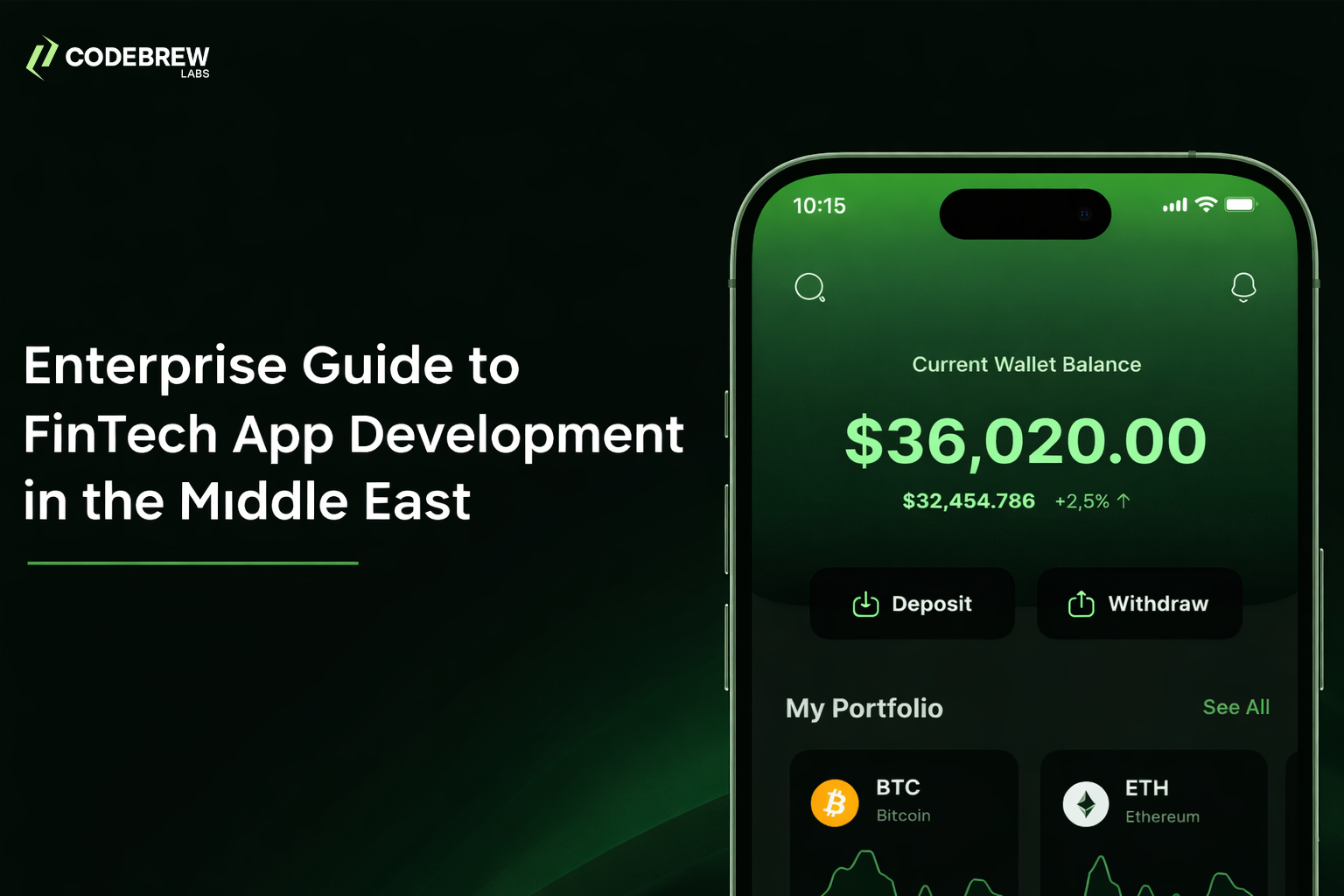
Government leaders in the Middle East are placing fintech at the center of their national growth plans. Initiatives like Saudi Vision 2030 are removing the old barriers to digital banking. The region is currently undergoing a massive shift in how money moves, how businesses get paid, and how consumers save. According to the Central Bank of the UAE (CBUAE), the national economy is projected to expand by 5.4% in 2026, driven by a buoyant financial system and aggressive digital transformation.
Table of Content
This growth provides a stable foundation for market leaders to be decided. This guide provides a detailed blueprint for enterprises to steer through this $6 billion market. We cover everything from the latest 2026 compliance laws to the technical architecture required for success to dominate the Middle Eastern sector.
The Middle East is one of the fastest growing fintech markets in the world. What was once an oil-driven economy is now becoming a digital-first financial hub. Governments are pushing for cashless societies and consumers are demanding better mobile experiences.
For enterprises looking at banking app development in UAE, this shift represents a prime opportunity to enter a high-growth sector backed by state-level support.
The numbers tell a very clear story of rapid expansion. According to reports from Mordor Intelligence and Research and Markets (January 2026), the MENA fintech market size is estimated at $6.35 billion in 2026. This is a significant jump from the $5.65 billion value recorded in 2025.
Investor confidence is at an all-time high. Venture capital funding for regional fintech has surged, with the average deal size in sectors like crypto and blockchain increasing by 90% year-over-year (CB Insights, State of Fintech 2025).
The shift toward mobile is the primary engine of this growth. In Gulf Cooperation Council (GCC) states, smartphone penetration now exceeds 80% (Mordor Intelligence). This has turned the mobile phone into the default banking channel. In the UAE alone, digital wallets are on track to cover 33% of all point-of-sale spending by 2027.
While the entire region is growing, three specific countries are leading the charge.
The UAE is the epicenter of the region’s digital economy. According to Mordor Intelligence (2026), the UAE is the epicenter of the region’s digital economy, with digital payment transaction values projected to exceed $52 billion in 2026. This reflects a massive ecosystem that includes digital payments, insurtech, and neobanking. The Central Bank of the UAE has noted that 69% of users now favor digital wallets over traditional cards.
Saudi Arabia is the largest market by volume and is moving at a record pace. The Saudi Central Bank (SAMA) reported that electronic payments accounted for 79% of all retail transactions in 2024. Under the Vision 2030 mandate, the Kingdom aims to have 525 fintech companies operating in the country by 2030, up from just 10 in 2018 (P&S Intelligence).
Egypt is the leader in North Africa for financial inclusion. The Central Bank of Egypt (CBE) recently announced that the country’s financial inclusion rate reached 77.6% by the end of 2025. This means 54.7 million citizens now have active transaction accounts. This is a growth of over 219% since 2016, creating a huge market for mobile wallets and micro-finance apps.
Investing in the Middle East fintech sector is no longer about testing the waters. It is about entering a mature ecosystem backed by massive capital and state-level support. For enterprises, the region offers a rare combination of high growth and high security.
The demand for banking app development in UAE and Saudi Arabia is skyrocketing because government initiatives are actively removing the barriers to entry for large-scale digital players.
The region has moved past the experimental phase. Venture capital funding for fintech reached $4.2 billion recently, proving that investors see the Middle East as a global leader (Mordor Intelligence, 2026). In 2025 alone, the region recorded 635 completed deals, which is a 33% increase year-over-year (PwC, TransAct Middle East 2026).
This inflow of cash is not just for startups. Large enterprises are using these funds to build massive ecosystems. The goal is to move from small apps to full-scale financial platforms that can compete with traditional banks.
In the Middle East, the government is the biggest driver of technology. Through initiatives like Saudi Vision 2030 and the UAE Digital Economy Strategy, governments are actively removing the barriers to digital adoption.
The UAE aims to grow its digital economy from 12% to 20% of its non-oil GDP by 2030 (Global CIO, 2025). Meanwhile, Saudi Arabia has already achieved a 79% electronic payment rate for retail transactions (Saudi Central Bank, SAMA). When the government builds the infrastructure and mandates digital payments, the risk for enterprise investors drops significantly.
There is a huge gap in the market that traditional banks have missed. In Egypt, the financial inclusion rate reached 77.6% by the end of 2025, but this still leaves millions of people and small businesses looking for better tools (Central Bank of Egypt).
Small and Medium Enterprises (SMEs) are a particularly high-yield target. These businesses are seeking cost-efficient ways to handle cross-border payments and payroll. In the UAE, the business segment of the fintech market is expanding at a 12.85% CAGR through 2031 (Mordor Intelligence). Apps that solve problems for these businesses can capture a loyal and growing customer base.
One of the biggest fears for any enterprise is legal risk. The Middle East has addressed this by creating some of the most advanced regulatory frameworks in the world. Special zones like the Dubai International Financial Centre (DIFC) and Abu Dhabi Global Market (ADGM) provide “sandboxes” where companies can test products under the supervision of regulators.
Furthermore, the UAE Federal Decree-Law No. (6) of 2025 has provided a clear roadmap for technology providers. By creating transparent rules for data residency and licensing, the region has made it much easier for enterprises to predict their compliance costs and timelines.
The Middle East sits at the center of the world’s most active trade corridors. The cross-border payments market in the Middle East & Africa is expected to reach over $31 billion by 2030 (Grand View Research).
Countries like the UAE are pioneering bilateral digital currency arrangements with major partners like India and China. These “payment corridors” reduce friction and cut the cost of international transfers. For an enterprise, building a platform in this region means you are perfectly positioned to facilitate trade between the East and the West.
The Middle East is moving beyond simple payment apps. Enterprises are now building complex platforms that serve as the backbone for entire industries. Whether it is a neobank or a compliance tool, the focus is on automation and scale.
Digital banking is the most prominent sector in the region. The GCC digital banking market is estimated to reach $47.8 billion by 2032, growing at a record pace (P&S Intelligence, 2026).
The UAE is currently the leader in this space. Nearly half of all banking customers in the UAE now maintain accounts with digital banks. Institutions like Wio and Zand are examples of how neobanks are capturing the market by offering 24/7 access and instant account opening. By 2026, the digital banking market in the UAE alone is valued at over $3.08 billion (Grand View Research).
Cash is no longer the king in the Gulf. Dubai has set an aggressive goal for 90% of all transactions to be cashless by 2026 (P&S Intelligence).
This push has made digital wallets the fastest growing category in fintech. In the UAE, digital wallets are projected to handle 33% of all point-of-sale spending by 2027. In Saudi Arabia, the shift is even more dramatic. Electronic payments accounted for 79% of all retail transactions in 2024 (SAMA). This creates a massive opening for enterprises to build wallets that integrate with retail, transport, and government services.
Traditional lending in the Middle East has often been slow due to a lack of traditional credit history. FinTech is solving this through alternative credit scoring.
The global lending market is expected to grow to $13.07 trillion in 2026 (Research and Markets). In the Middle East, the focus is on “embedded finance.” This allows retailers to offer Buy Now, Pay Later (BNPL) services at the checkout. BNPL transactions are expected to grow to 6% of global e-commerce value by 2026 (Mordor Intelligence). Apps that use AI to analyze mobile data or utility bills to score users are becoming vital for financial inclusion.
Large corporations and SMEs are moving away from manual accounting. They need systems that can handle real-time cash flow and automated payroll.
The corporate banking segment is seeing a high growth rate of over 21%. This is driven by the need for better treasury operations and trade finance digitization. In the UAE, the business segment for these fintech solutions is growing at a 12.85% CAGR through 2031 (Mordor Intelligence). These systems help companies reduce errors and comply with local tax laws automatically.
With the introduction of strict laws like the Federal Decree-Law No. (6) of 2025, compliance has become a major expense for businesses. RegTech (Regulatory Technology) solves this by automating the “Know Your Customer” (KYC) and Anti-Money Laundering (AML) processes.
The global RegTech market is projected to reach $23.43 billion in 2026 (Fortune Business Insights). For enterprises in the Middle East, these apps are essential for managing country-specific rules across borders. In fact, large enterprises are expected to hold a 66% market share in the RegTech space by 2026 because they are the ones most affected by complex global regulations.
Building a fintech app for the Middle East requires a different approach than standard software. You are not just building an interface. You are building a secure financial vault that must talk to government systems and local banks.
The Middle East is not a single market. Saudi Arabia has different spending habits than Egypt. Your research must identify specific “pain points” like high remittance fees or slow SME lending.
According to a Deloitte 2026 Consumer Survey, Gen Z and Millennials in the region now exhibit the highest risk of switching banks, as they no longer view banking as a relationship with a single institution but as an interconnected ecosystem of apps.
Furthermore, research from the World Economic Forum (2025) highlights that over half of the population in the Middle East is under the age of 25. These digital natives are early adopters who prioritize speed and flexibility, meaning your research should focus on “digital-first” features that legacy banks are too slow to launch.
Do not try to build everything at once. Focus on a “Minimum Viable Product” (MVP) that solves one big problem.
For an enterprise app, your architecture must be “API-first.” This allows you to plug into regional payment rails like Mada in Saudi Arabia or Magnati in the UAE. Using microservices is also vital. This ensures that if your “Payment” service goes down, your “Account Balance” service still works.
You need a stack that is fast but also highly secure.
This is the most critical step. In the UAE, you must align with the CBUAE mandate. By March 2026, advanced authentication (like biometrics and passkeys) will be the mandatory standard.
You should also look into “Regulatory Sandboxes.” The CBUAE Sandbox allows you to test your app with real customers for up to 12 months before you need a full license. In Saudi Arabia, SAMA requires payment firms to have a minimum capital of SAR 5 million to 10 million, depending on the activity.
In the Middle East, design is about more than just colors. You must support Right-to-Left (RTL) layouts for Arabic.
The Middle East ranks second globally for the average cost of a data breach, which is estimated at over $7 million per incident (PwC, 2026).
Your app must include:
Fintech apps cannot have “bugs.” You must perform “Penetration Testing” where ethical hackers try to break into your system.
You also need to conduct “Load Testing.” In 2026, users expect instant transactions. If your app slows down during peak hours (like Ramadan or salary days), users will delete it. 88% of regional organizations now measure the financial impact of cyber risks, highlighting how seriously you should take this phase (PwC).
Don’t just launch on the App Store. Partner with local retailers or telecom companies to gain instant trust.
In Saudi Arabia, connecting to national platforms like SARIE (for instant payments) is a requirement for a successful launch. You should also plan for “Saudization” in your operations, which means hiring local talent to manage the platform.
Or, Get it Developed From an Expert AI Development Company
Building a secure, compliant, and scalable fintech app in 2026 requires more than just standard coding. You need a partner that understands the specific regulatory hurdles of the Middle East and has the technical depth to integrate advanced AI and blockchain.
Code Brew is a leading fintech development firm with a physical presence in the heart of the region at the Dubai World Trade Centre. We have helped over 10,000 brands worldwide and have extensive experience launching successful platforms in the Saudi and UAE markets.
Our expertise includes:
Whether you are building a neobank in Riyadh or a digital wallet in Dubai, Code Brew provides the high-end technology stack and local market insights needed to lead the pack.
The cost of building a fintech app in 2026 varies significantly based on the complexity of the product and the regulatory requirements of the country you are targeting. While a simple tool can be built relatively quickly, an enterprise-grade platform requires a deeper investment in security and legal compliance.
In the Middle East, you must also factor in the cost of local data residency and specific regional integrations like UAE PASS or Saudi Arabia’s Mada payment network.
Based on 2026 market data from research of Mordor Intelligence, here is how budgets are typically distributed across different types of financial applications.
|
App Type |
MVP Cost (Basic) | Enterprise Cost (Full Featured) | Development Timeline |
|
Digital Wallet & Payments |
$40,000 – $80,000 | $150,000 – $250,000+ | 4 – 6 Months |
|
Neobanking Platform |
$80,000 – $150,000 | $250,000 – $500,000+ | 8 – 12 Months |
| Lending & BNPL Engine | $50,000 – $100,000 | $180,000 – $300,000+ |
6 – 9 Months |
| Investment & Trading | $70,000 – $130,000 | $200,000 – $450,000+ |
7 – 10 Months |
| Crypto & Blockchain | $80,000 – $150,000 | $300,000 – $600,000+ |
9 – 12 Months |
Security is not an area where you can cut corners. Mandatory features like Biometric Authentication (FaceID/TouchID) can add $20,000 to $30,000 to your budget. Additionally, meeting the UAE Personal Data Protection Law (PDPL) requirements often involves a readiness audit costing between AED 10,000 and AED 40,000.
Setting up a regulated fintech entity involves specific fees. In the Dubai International Financial Centre (DIFC), a regulated license can range from AED 250,000 to over AED 900,000 depending on the category of financial activity (Setup Dubai Business, 2026).
Adding “Agentic AI” for personalized financial advice or automated fraud detection is a major trend for 2026. This can increase your development costs by $40,000 to $80,000 but significantly improves user retention and security.
Your budget should not end at launch. Industry benchmarks suggest setting aside 15% to 20% of the original build cost every year for updates and bug fixes. For a medium-sized app, this typically totals $2,000 to $5,000 per month.
Even with massive growth, building a fintech app in the Middle East comes with specific hurdles. Success depends on how well you navigate these four key areas.
The Middle East does not have a single set of rules. Each country has its own central bank and its own set of standards. For example, while the UAE uses the CBUAE framework, Saudi Arabia follows SAMA mandates.
One of the biggest challenges in 2026 is Data Residency. Saudi Arabia’s Personal Data Protection Law (PDPL) and the UAE’s data laws often require that sensitive financial data stay on servers located within the country.
How to Overcome: Partner with a developer who understands “Modular Compliance.” This means building an app where the core logic stays the same, but the data storage and reporting modules can be swapped out based on the country where the app is launched. Using regulatory sandboxes like the ADGM RegLab also helps you test your app legally before a full launch.
Many traditional banks in the region still run on older backend systems. These systems are often “closed,” making it difficult for new fintech apps to pull real-time data or process instant payments. According to IBS Intelligence (2026), 73% of Saudi financial institutions believe that managing these disconnected platforms is a major barrier to innovation.
How to Overcome: Use a robust API Middleware Layer. Instead of trying to rewrite the bank’s old system, build a modern bridge that sits on top of it. This allows your app to communicate with the legacy backend through secure APIs, ensuring fast performance without risking the bank’s core stability.
The Middle East is a high-value target for cybercrime. The average cost of a data breach in the financial sector is now $5.9 million. Furthermore, phishing attacks in the region have increased significantly, often driven by sophisticated AI tools that mimic official bank communications.
How to Overcome: Move beyond simple passwords. Implement Zero-Trust Architecture, where every request is verified regardless of where it comes from. By 2026, the standard for fintech apps is Biometric Behavioral Modeling. This monitors how a user interacts with the app (like typing speed or swipe patterns) to detect if an account has been hijacked.
There is a massive demand for developers who understand both high-end tech and Middle Eastern finance. According to McKinsey, up to 40% of the regional workforce may require retraining to keep up with the demands of AI and fintech by 2026. Finding experts in Sharia-compliant coding or SAMA-approved security is particularly difficult.
How to Overcome: Instead of trying to build an entire in-house team from scratch, work with an established development partner. Look for companies that already have a proven track record in the GCC, like Code Brew Labs. This gives you immediate access to a team that already knows the local laws, the language requirements, and the technical standards needed for a successful launch.
The Middle East has reached a tipping point where fintech is no longer a luxury but the standard for doing business. In 2026, the combination of aggressive government mandates and a digitally native population has created a “make or break” year for enterprises. Those who launch compliant, AI-driven platforms now will capture a market that is projected to grow by over 12% annually through the next decade (Research and Markets).
The window to establish trust and secure a license under the current regulatory “sandboxes” is closing. To win in this region, yo
A basic MVP (Minimum Viable Product) usually takes 4 to 6 months. However, a full enterprise-scale platform with advanced AI and multi-country compliance can take 8 to 14 months.
Beyond standard encryption, you must include Biometric Authentication (like FaceID), Multi-Factor Authentication (MFA), and Device Binding. Advanced apps now also use AI-based fraud detection to monitor transaction patterns in real time.
While you can own 100% of a company in most free zones, having a local partner or expert can significantly speed up the licensing process. They help you navigate relationships with central banks and ensure you meet “Saudization” or “Emiratization” requirements in your operations.
Sharia-compliant apps must avoid interest (Riba) and gambling-related transactions. This requires building specific modules for profit-sharing models and Zakat calculators. Your developer must ensure the backend logic supports these unique financial structures.
Expect to spend 15% to 20% of your initial build cost every year. This covers security patches, cloud hosting fees, and regular updates to stay compliant with changing central bank laws.


 Contact Us
Team Up With Us Today For An Unforgettable Service Experience












 Book Free Consultation