| Quick Summary: Table of Content The UAE aviation AI market is rapidly expanding and is projected to reach over AED 3.2 billion by 2027, growing at a 30–35% CAGR as airlines and airports adopt intelligent automation systems. Dubai International Airport alone handles more than 87 million passengers annually, creating a strong demand for AI-driven operational efficiency. Agentic AI is emerging as a key transformation layer in aviation, enabling real-time decision-making for flight scheduling, predictive maintenance, and passenger management. Predictive AI systems are already reducing Aircraft on Ground (AOG) events by 35–45%, while smart airport systems are cutting passenger wait times by 25–30%. The shift is being driven by increasing air traffic, UAE government digital transformation initiatives like Dubai D33, and regulatory frameworks from the GCAA, DHA, and MOHAP, which ensure safety and compliance in AI adoption. Airlines using AI-based automation and predictive analytics report 50–70% faster operational decision cycles and significantly improved fleet utilization. As aviation systems become more connected, agentic AI is becoming essential for scalable, compliant, and efficient airport operations. The UAE is positioning itself as a global leader in AI-powered aviation transformation. |
In 2024, UAE carriers recorded over 1,200 minutes of delay per 1,000 flights during peak disruptions (General Civil Aviation Authority). With Dubai and Abu Dhabi airports handling millions of passengers annually, even minor inefficiencies can cascade into major operational and financial challenges.
Airlines like Emirates and Etihad Airways are moving beyond traditional automation. Currently, staff spend hours reacting to delays, maintenance issues, and passenger disruptions. This creates bottlenecks in high-pressure environments.
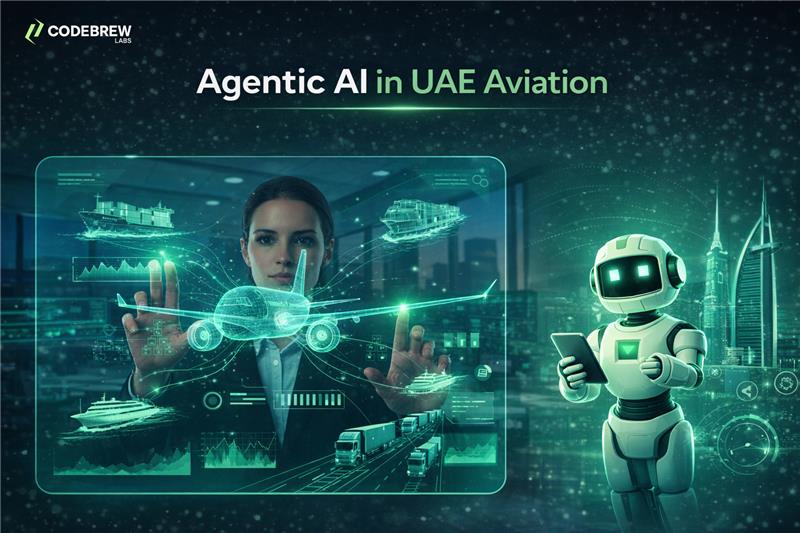
This is where agentic AI in aviation UAE is transforming operations. Instead of just identifying problems, these systems act in real time—rescheduling flights, reallocating gates, and notifying passengers automatically. Airlines are increasingly adopting AI automation solutions for aviation operations to enable faster decision-making and more efficient workflows across the aviation ecosystem.
Simply put, agentic AI allows airlines and airports to act instantly on data, minimizing disruptions while enhancing passenger experience. This shift positions UAE carriers and MRO providers at the forefront of global aviation innovation.
Definition: Agentic AI in aviation UAE refers to intelligent systems that analyze operational data and take autonomous actions in real time—from rescheduling flights to coordinating airport operations without human intervention.
Traditional systems detect issues—delays, maintenance alerts, gate conflicts—but rely on human teams to respond. Agentic AI closes this gap by executing decisions instantly. For example:
Across Dubai and Abu Dhabi hubs, these systems are already improving punctuality and operational efficiency. Businesses looking to implement similar capabilities can explore AI agent development and AI automation solutions with Code Brew Labs, a leading AI automation agency in Dubai.
In simple terms: Agentic AI acts like an autonomous operations manager, handling repetitive and urgent decisions while human teams focus on strategy and passenger care.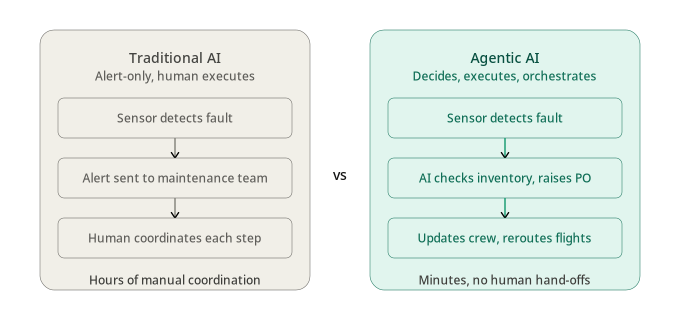
The UAE’s aviation sector is one of the most advanced and high-volume ecosystems globally, making operational efficiency a necessity. Airports across Dubai, Abu Dhabi, and Sharjah handle millions of passengers annually, pushing airlines to adopt smarter, faster decision-making systems.
According to Dubai Airports, passenger traffic continues to grow, increasing the need for intelligent automation. Global insights from the International Air Transport Association (IATA) highlight how automation is essential for managing increasing air traffic efficiently.
Airlines—from full-service carriers like Emirates and Etihad to regional operators—are integrating agentic AI across operations, maintenance, and passenger services.
Key adoption drivers:
Agentic AI is being widely adopted across UAE aviation to automate decision-making, improve operational efficiency, and enhance reliability across airline and airport systems.
Agentic AI is transforming airline operations in UAE by enabling real-time automation of crew scheduling, gate allocation, and flight rescheduling.
Airlines can implement these capabilities using AI automation solutions to scale efficiency and improve punctuality.
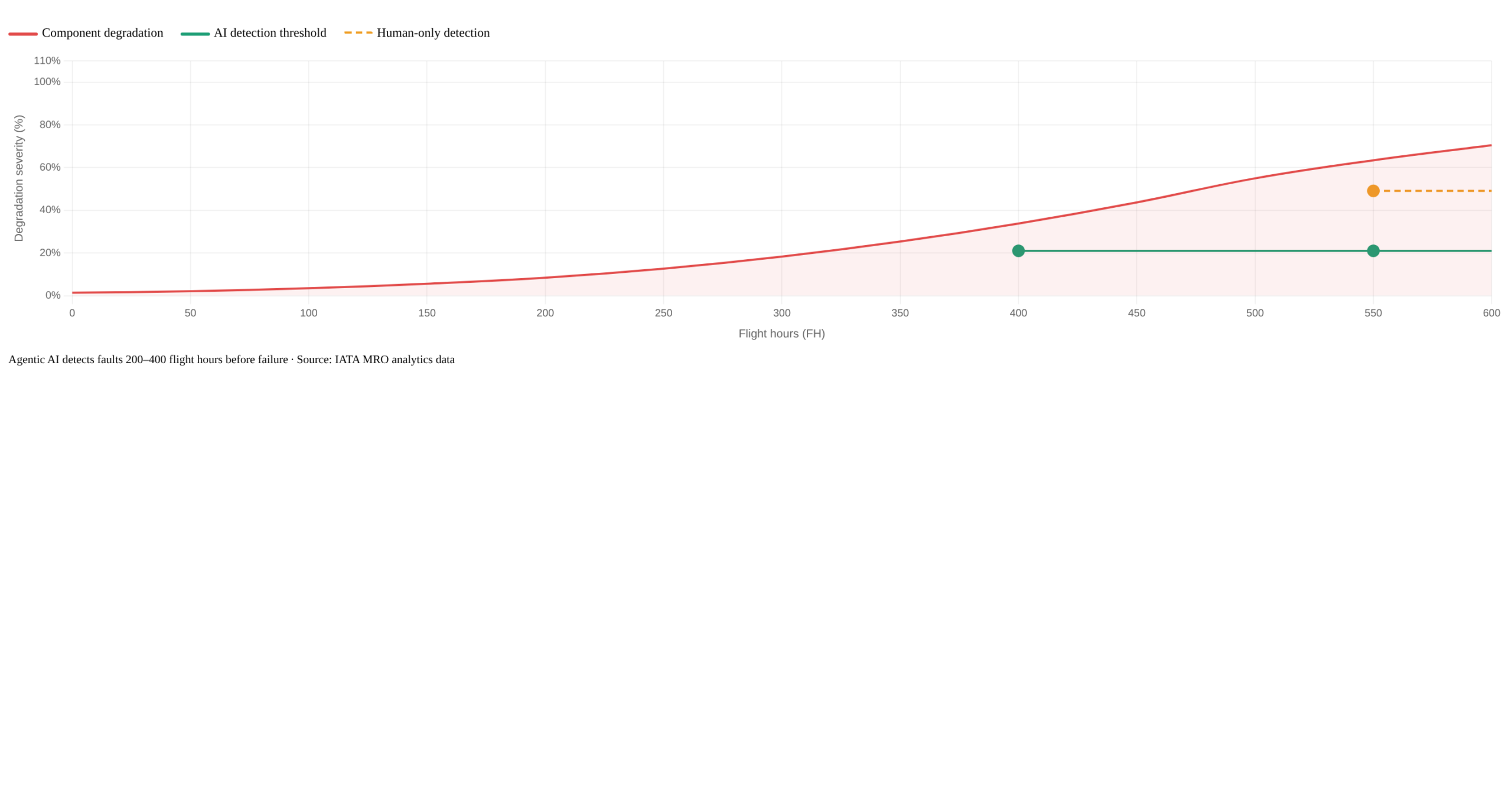
Predictive maintenance is one of the highest ROI applications of agentic AI. By continuously monitoring aircraft health, AI can predict component failures 200–400 flight hours in advance, reducing unexpected downtime.
In UAE MRO hubs like Dubai South and Abu Dhabi, predictive AI has cut Aircraft on Ground (AOG) events by 35–45%, saving airlines tens of thousands per hour (IATA).
Benefits:
Companies can integrate predictive analytics solutions to monitor aircraft health in real time.
Dubai International handles 87M+ passengers annually (Dubai Airports), making integrated systems critical. Agentic AI optimizes:
Result: wait times reduced by 25–30% (SITA). By connecting gates, baggage, security, and passenger services into a unified decision layer, airports achieve seamless operations while reducing manual workload.
Agentic AI ensures Arabic and English support, real-time assistance, and automatic disruption handling, enhancing passenger journeys across multiple touchpoints.
Passengers receive timely updates, smooth rebooking options, and personalized guidance, while frontline staff focus on complex care—enhancing satisfaction and operational reliability.
Agentic AI is helping UAE aviation operate more efficiently and sustainably. By optimizing flight paths in real time, AI can reduce fuel consumption and CO2 emissions by up to 10%, supporting initiatives like Etihad’s “Greenliner” program.
At aviation hubs such as Dubai South, AI-powered Digital Twins enable predictive maintenance, robotic inspections, and automated inventory management. These capabilities accelerate the region’s MRO 2.0 transformation and reduce operational costs.
As the UAE, Saudi Arabia, and Qatar explore unified aviation oversight, agentic AI ensures cross-border regulatory compliance while maintaining GCAA and PDPL data standards.
By adopting these technologies, airlines and airports in the UAE can achieve operational excellence, sustainability goals, and regulatory readiness, positioning the country as a global leader in smart, green aviation.
For UAE-based aerospace initiatives, Agentic AI accelerates aircraft design and engineering, compressing R&D cycles from weeks to days. By simulating aerodynamics, structural integrity, and prototyping, UAE aerospace stakeholders can iterate faster and reduce costs.
Industry data from Altair and Neural Concept indicate AI-driven simulation can reduce R&D cycles by 50–70%, allowing carriers and OEMs to push innovations to market much sooner. This capability gives UAE-based aerospace entities a competitive advantage
Agentic AI is human-centric, creating new roles and augmenting existing teams. Engineers move from repetitive analysis to AI-assisted modeling, operations staff shift from reactive to proactive management, and maintenance teams adopt predictive workflows.
Across Dubai and Abu Dhabi hubs, staff focus on strategy, innovation, and passenger experience while AI handles routine decision-making. Supported by AI workforce transformation services, this shift enhances productivity and employee satisfaction.
Agentic AI is delivering measurable results across UAE aviation. Airlines and airports are seeing fewer delays, improved operational efficiency, and enhanced passenger satisfaction.
Key outcomes include reduced operational disruptions, optimized aircraft utilization, and improved safety through predictive insights.
| Metric | Value | Source |
| Annual passengers – Dubai International | 87M+ | Dubai Airports |
| Reduction in AOG events with predictive AI | 35–45% | IATA |
| Cost per hour of AOG downtime | $10,000–$50,000 | IATA |
| Faster R&D cycles with AI simulation | 50–70% | Altair / Neural Concept |
| UAE aviation AI market (2026–2027) | AED 3.2B | Frost & Sullivan |
| CAGR for UAE aviation AI | 30–35% | Frost & Sullivan |
| Peak disruption delays | 1,200+ minutes per 1,000 flights | GCAA |
| Passenger wait time reduction at smart airports | 25–30% | SITA |
By adopting agentic AI, airlines and airports can achieve operational excellence while enhancing passenger experience, positioning UAE as a global leader in smart, AI-driven aviation.
While agentic AI solutions offer significant benefits, adoption comes with challenges. Legacy systems can limit data availability, and integrating AI into complex aviation infrastructure requires careful planning. Regulatory compliance with UAE aviation standards is also critical, as systems must meet strict safety and reliability requirements.
With the right implementation strategy, businesses can streamline integration, ensure compliance, and build scalable aviation systems.
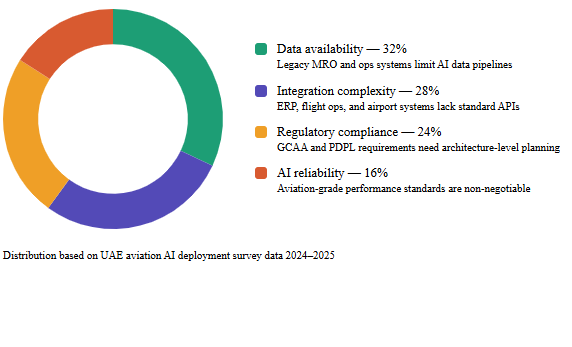
AI systems in UAE aviation must follow strict regulatory frameworks and data protection laws. Guidelines from the General Civil Aviation Authority (GCAA) ensure operations remain safe, transparent, and audit-ready.
Key requirements include hosting data within UAE jurisdictions (PDPL compliance), aligning with GCAA safety standards, maintaining audit logs, and implementing robust cybersecurity. Human oversight is critical for safety-critical decisions, with kill switches or manual overrides for high-risk scenarios.
| Requirement | Purpose | Example / Implementation |
| Data Residency | PDPL compliance | Host all flight & passenger data in UAE |
| Alignment with GCAA | Aviation safety | Follow Air Navigation Safety Strategy |
| Audit-Ready | Regulatory transparency | Maintain logs & reports for AI actions |
| Cybersecurity | Operational safety | Real-time threat monitoring & prevention |
| Human Oversight | Safety-critical decisions | Kill switch/manual override |
Layered compliance—from GCAA to UAE federal data protection laws—ensures airlines, airports, and related facilities operate securely while maintaining operational efficiency.
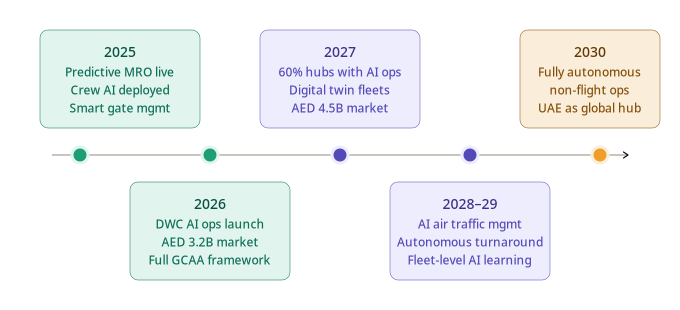
By 2030, 60% of major global hubs will feature autonomous airport capabilities (Frost & Sullivan UAE aviation AI). AI-driven air traffic management will dynamically optimize flight paths, congestion, and delays in real time.
Dubai, Abu Dhabi, and Sharjah are positioning themselves as global leaders in next-generation aviation, with agentic AI ensuring efficiency, safety, and passenger satisfaction.
Future capabilities include:
Look for partners with:
Code Brew Labs is already automating operations, MRO, and passenger support for UAE carriers — ensuring reliable, compliant, and efficient automation.
A global aerospace leader, Airbus, partnered with Code Brew Labs to modernize aviation operations using agentic AI.
Read the full case study here
Operating across high-traffic hubs such as Dubai and Abu Dhabi, the organization was facing increasing operational complexity. Frequent delays, reactive maintenance, and fragmented communication systems were creating inefficiencies that impacted both operational costs and passenger experience.
As operations scaled, existing systems struggled to keep up with real-time demands. Flight delays during peak traffic periods became harder to manage, while crew scheduling and gate allocation remained heavily manual and time-intensive. Maintenance teams were often reacting to issues after they occurred, leading to costly Aircraft on Ground (AOG) events.
Code Brew Labs implemented a custom agentic AI ecosystem tailored for aviation-scale environments. The system was designed to take real-time action — autonomously rescheduling flights, optimizing crew assignments, and adjusting gate allocations based on live conditions. Predictive maintenance models identified potential failures well in advance.
Ready to Achieve Similar Results?
Airlines and aviation operators looking to implement AI transformation can now move beyond traditional automation and adopt real-time decision systems.
View Our Aviation AI Portfolio to see more successful implementations across airlines and airports.
Agentic AI is no longer a future concept—it is actively transforming UAE aviation today. From airline operations to smart airports, AI-driven systems are enabling faster decisions, better efficiency, and improved passenger experiences.
Organizations that adopt agentic AI early will lead the next phase of aviation innovation.
Agentic AI in aviation UAE refers to autonomous AI systems that can make decisions and execute actions in real time. These systems help airlines in Dubai and Abu Dhabi reschedule flights, optimize crew assignments, predict maintenance issues, and manage passenger communication without human intervention.
AI is widely used across UAE airports like Dubai and Abu Dhabi for passenger flow management, automated check-ins, baggage handling, and smart security systems. It helps reduce wait times, improve operational efficiency, and deliver seamless travel experiences.
Predictive maintenance in UAE aviation allows airlines to identify potential aircraft issues before failure occurs. This reduces Aircraft on Ground (AOG) events, lowers maintenance costs, prevents delays, and improves safety across high-traffic hubs.
Agentic AI enhances passenger experience in UAE airlines by providing real-time updates, automatic rebooking during disruptions, multilingual support (Arabic and English), and personalized travel assistance, ensuring smoother journeys.
The UAE, particularly hubs like Dubai and Abu Dhabi, is building AI-first aviation infrastructure rather than retrofitting legacy systems. Developments such as Dubai South and national strategies like the Dubai Economic Agenda (D33) are accelerating large-scale adoption of AI across airlines, airports, and MRO operations.
Rule-based automation follows fixed “if-then” workflows, while agentic AI is adaptive and goal-driven. In UAE aviation operations, agentic AI can coordinate across systems—adjusting flight schedules, managing crew and inventory, and responding to disruptions dynamically in real time.
Agentic AI systems in aviation operate within strict safety limits. While they handle routine decisions autonomously, they are designed to escalate high-risk or safety-critical situations to human operators, ensuring compliance with aviation regulations and safety standards in the UAE.


 Contact Us
Team Up With Us Today For An Unforgettable Service Experience












 Book Free Consultation