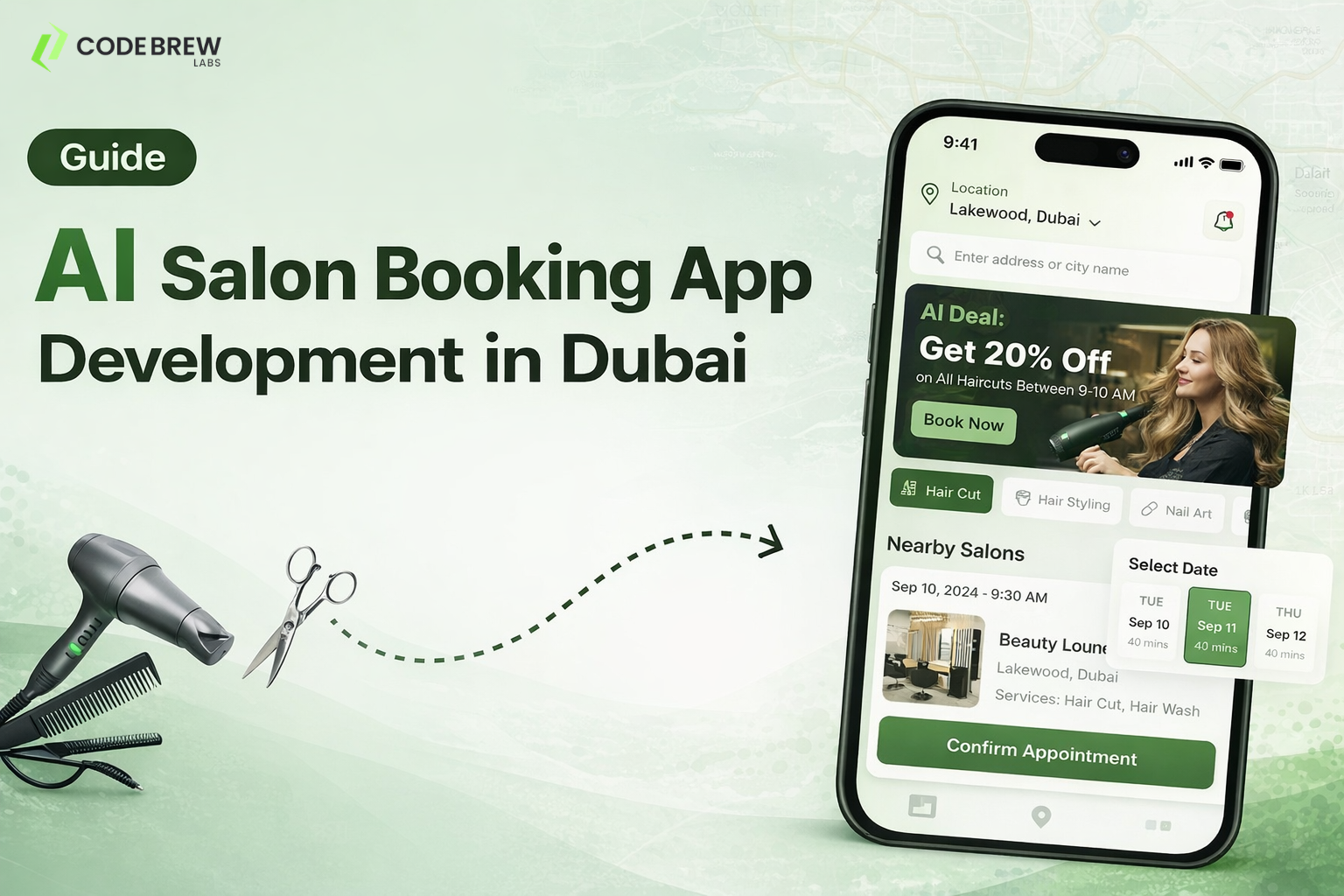
The UAE’s wellness economy is now valued at a staggering 34.1 billion dollars, according to the Global Wellness Institute. With Dubai standing at the center of this growth, salon businesses are facing rising competition and higher customer expectations. Traditional booking systems are no longer enough to manage demand efficiently or prevent revenue loss from missed appointments.
Table of Content
In this guide, you will learn how AI-powered salon booking apps work, what features truly matter, how much development costs in Dubai, and how to choose the right salon app development company for your business. If you are planning to build a smarter and more scalable salon platform, this guide will help you make an informed decision.
When we hear the name Dubai, luxury is the first thing that comes to our mind. But it isn’t just a city of luxury; it is a global hub for the beauty industry. For salon owners and tech developers, the numbers show a massive opportunity for AI-driven automation.
The beauty and personal care market in the UAE is experiencing a significant post-pandemic surge.
The UAE boasts one of the most digitally connected populations on earth, providing the perfect infrastructure for mobile booking apps.
Dubai’s diverse and tech-savvy population expects “concierge-level” service through their smartphones.
While the market is lucrative, it is also increasingly crowded, requiring salons to find a technological edge.
An AI salon booking app is a smart system that learns from data, predicts patterns, and makes automated decisions to improve salon operations and customer experience.
Since most salons already use online booking tools, the real difference lies in the AI layer built on top of the booking system.
Instead of simply allowing customers to pick time slots, AI enables the app to:
In short, a traditional booking app reacts to user input. An AI-powered booking app analyzes past behavior and proactively improves future outcomes.
Artificial intelligence works by collecting data from bookings, customer actions, staff schedules, and service history, then using that data to improve decisions automatically. Instead of relying on manual planning, the system studies patterns over time and adjusts operations to improve efficiency and revenue.
AI improves a salon booking system in the following ways:
In simple terms, AI studies real booking data and turns it into smarter actions. It improves scheduling, reduces losses, increases revenue opportunities, and enhances the overall customer experience without requiring constant manual control.
An AI salon booking app includes all the basic functions of a regular booking system, but the difference lies in how those features become intelligent and data-driven. Below are the key features grouped by user side and business side, with a clear focus on how AI adds value.
These features together turn a simple booking tool into a business management system. The AI layer ensures that every feature works toward improving efficiency, increasing revenue, and delivering a better experience for both customers and salon owners.
Building an AI salon booking app requires more than just designing a booking interface. Since artificial intelligence depends on structured data and continuous learning, the development process must be planned carefully from the beginning. Below is a practical step by step approach that businesses in Dubai can follow.
Step 1. Market research and requirement analysis
The first step is to clearly define the target audience and business goals. This includes understanding whether the app is being built for a single salon, a chain of salons, or as a SaaS product for multiple businesses. Research should focus on local customer behavior, competitor apps in Dubai, pricing expectations, and service trends. Clear requirements at this stage prevent costly changes later.
Step 2. Defining the business model
Before development begins, it is important to decide how the app will generate revenue. Options may include subscription plans, commission per booking, premium AI analytics, or white label licensing. The AI features should align with the chosen business model to ensure long-term sustainability.
Step 3. UX and UI design
The design phase focuses on creating a simple and smooth user experience for both customers and salon staff. Since AI features operate in the background, the interface should remain clean and easy to use. The goal is to make smart suggestions feel natural rather than complex. For Dubai-based audiences, the design should also consider multilingual support and mobile first behavior.
Step 4. Backend and database architecture setup
A strong backend is essential because AI systems depend on well-organized data. Developers set up secure servers, cloud infrastructure, and structured databases to store booking history, customer profiles, payments, and staff schedules. This stage ensures that the app can scale as user volume increases.
Step 5. AI model selection and development
At this stage, developers choose the right machine learning models for tasks such as demand prediction, recommendation systems, and no show detection. The models are trained using historical booking data or simulated data in the early stages. As real users start using the app, the models continue to improve.
Step 6. Integration with third-party services
The app must connect with payment gateways, SMS systems, email services, and customer management tools. These integrations allow the AI system to automate reminders, marketing campaigns, and financial tracking without manual effort.
Step 7. Testing and performance optimization
Before launch, the app goes through technical testing to ensure stability and security. AI features are also tested to check prediction accuracy and recommendation quality. Feedback from beta users can help refine the system.
Step 8. Launch and post-launch monitoring
After deployment, monitoring becomes critical. AI systems improve with real data, so developers track user behavior, booking patterns, and system performance. Regular updates ensure the app remains accurate, secure, and aligned with changing business needs.
An AI salon booking app requires multiple technical layers working together. The table below outlines the core components and their purpose within the system.
|
Layer |
Technologies Commonly Used | Purpose in the AI Salon Booking App |
|
Frontend Mobile App |
Flutter, React Native | Builds Android and iOS apps with a smooth user experience and real-time booking updates |
|
Web Admin Panel |
React, Vue | Allows salon owners to manage bookings, staff schedules, analytics, and reports |
|
Backend Server |
Node.js, Python | Handles business logic, booking management, user authentication, and system integrations |
|
AI and Machine Learning |
TensorFlow, PyTorch |
Powers demand prediction, service recommendations, and no-show detection models |
| Database | PostgreSQL, MongoDB |
Stores booking history, customer profiles, payment data, and service information |
| Cloud Infrastructure | AWS, Microsoft Azure, Google Cloud |
Provides scalable hosting, data processing, and secure storage |
| Payment Integration | Stripe, local UAE payment gateways |
Enables secure online payments and advance deposits |
| Security Layer | SSL encryption, role-based access control |
Protects user data and ensures secure system access |
The cost of building an AI salon booking app depends on feature depth, AI complexity, integrations, and scalability requirements. Below is a structured breakdown.
|
Level |
Estimated Cost | Key Inclusions | Ideal For |
|
Basic AI Setup |
40,000 to 70,000 USD | Booking system, staff management, payments, basic analytics, simple AI reminders, and recommendations | Independent salons |
| Advanced AI Integration | 70,000 to 150,000 USD | Demand forecasting, no-show prediction, customer segmentation, automated marketing, detailed analytics dashboard |
Growing salon brands |
| Enterprise AI Platform | 150,000 to 300,000 USD and above | Multi branch support, dynamic pricing, advanced AI insights, loyalty automation, CRM integration, scalable infrastructure |
Large chains or SaaS providers |
|
Expense Category |
Estimated Monthly Cost | Why It Is Required |
|
Cloud Infrastructure |
1,000 to 5,000 USD | Hosting, data storage, and scaling as the user base grows |
|
Technical Maintenance |
2,000 to 8,000 USD |
Updates, bug fixes, and performance optimization |
| AI Monitoring and Training | 1,500 to 6,000 USD |
Model improvement and accuracy enhancement |
| Security and Compliance | Depends on scale |
Data protection and regulatory requirements |
While AI brings strong advantages, it also comes with challenges that businesses must plan for. Understanding these early helps avoid delays, budget overruns, and performance issues after launch.
Below are the main challenges salon businesses in Dubai should consider.
These challenges do not reduce the value of AI, but they highlight the importance of proper planning and expert development. When addressed correctly, the risks can be managed, allowing salons to benefit from automation and smarter decision-making without disruption.
Once a salon business decides to build an AI-powered booking app, the next major decision is whether to build it internally or partner with an external development company. Both approaches have advantages, but the right choice depends on budget, expertise, and long-term plans.
Building an in-house team gives full control over the project. You can directly manage developers, designers, and AI engineers, and align the product closely with your internal business goals.
However, hiring a skilled team is expensive. AI engineers, mobile developers, and cloud architects require competitive salaries in Dubai. In addition to salaries, there are recruitment costs, office infrastructure, employee benefits, and ongoing training expenses.
In-house teams also take time to build. Hiring experienced AI specialists can take months, and during that time, development is delayed. For salon businesses whose main focus is service operations rather than technology, managing a tech team can become a distraction.
This option is usually suitable for large enterprises planning to build multiple digital products long-term.
Outsourcing allows businesses to work with an experienced team that already has the required technical expertise. This reduces hiring risks and shortens development timelines.
A professional development company brings structured processes, tested frameworks, and real project experience. Instead of building everything from scratch, they use proven methodologies to reduce technical errors and improve scalability.
Outsourcing also converts fixed employee costs into project-based investment. This makes budgeting more predictable.
The key challenge with outsourcing is choosing the right partner. Not all companies have real experience with AI systems, and some may overpromise capabilities without strong technical depth.
For most salon brands and growing chains, outsourcing is often the practical choice. It allows them to focus on business operations while experienced developers handle technical execution.
Large salon groups or businesses planning to expand into a full technology platform may consider building a hybrid model, where the core strategy remains internal while technical execution is handled by specialists.
The right decision depends on scale, budget, and long-term digital strategy.
If you decide to outsource, choosing the right AI development company becomes one of the most important decisions in the entire project. The right partner can help you build a scalable and efficient platform. The wrong choice can lead to delays, budget overruns, and technical limitations.
Here are the key factors to evaluate before finalizing a company.
When evaluating potential partners, experience and credibility matter.
Code Brew Labs brings over 13 years of experience in technology development and more than 4 years of focused experience in artificial intelligence solutions. The company has transformed more than 2,600 business ventures across industries and engineered over 25 enterprise-level AI solutions. With more than 50 Fortune 100 technology partnerships, Code Brew Labs has built scalable digital platforms that handle complex business requirements.
This level of experience ensures that AI is not treated as a trend but implemented as a structured and results-driven system. For salon brands in Dubai looking to build a reliable AI-powered booking platform, working with a partner that combines technical depth with proven execution can significantly reduce risk and improve long term outcomes.
Dubai’s salon industry is moving toward smarter and more automated systems. Customers expect fast booking, personalized service, and smooth communication. An AI-powered salon booking app helps salons reduce no-shows, optimize staff schedules, increase repeat bookings, and make better business decisions using real data.
Building the right platform requires proper planning, the right technology stack, and an experienced development partner. AI should be implemented as a long-term business solution, not just a feature.
With 13 years of technology experience and 4 years focused on AI, Code Brew Labs has transformed over 2,600 business ventures, engineered 25-plus enterprise AI solutions, and partnered with more than 50 Fortune 100 technology leaders.
If you are ready to build a scalable and intelligent salon booking platform in Dubai, choosing the right strategy and the right partner will define your success.


 Contact Us
Team Up With Us Today For An Unforgettable Service Experience












 Book Free Consultation