Artificial Intelligence is no longer just a buzzword tossed around in tech conferences; it has become a transformative force, reshaping the way businesses operate in every industry. From retail and healthcare to finance and logistics, AI is now at the heart of digital innovation. But what makes it so powerful? It’s not about robots replacing humans; it’s about machines enhancing human capabilities to solve complex problems faster, smarter, and more efficiently than ever before.
Table of Content
In the digital age, businesses are expected to do more with less, more personalization with less effort, more automation with fewer resources, and more insight from ever-growing mountains of data. AI is the ultimate enabler in this equation. It turns raw information into actionable intelligence, automates repetitive tasks, anticipates customer needs, and streamlines everything from marketing campaigns to supply chain logistics. In short, AI empowers businesses to be more proactive, data-driven, and customer-centric.
Imagine having systems that don’t just follow commands but actually learn from user behavior, adapt to market shifts, and make decisions in real-time. That’s what AI brings to the table. Whether it’s helping a sales team close more deals with predictive lead scoring or allowing customer service to operate 24/7 with intelligent chatbots, AI transforms inefficiencies into opportunities.
But integrating AI into your business isn’t about throwing money at a flashy new tool. It requires strategic planning, the right expertise, and technology that fits your goals. This is where a specialized partner, like our app development company, comes into play. With dedicated services in AI Development, AI Integration, and AI Consulting, we help companies not only adopt AI but make it a core part of their operations. Our approach ensures AI works hand-in-hand with your existing systems and evolves alongside your business needs.
As we explore the top 10 business problems that AI can solve, keep in mind that these aren’t distant future scenarios; they’re real, measurable solutions available today. Businesses that embrace AI now are the ones that will lead tomorrow.
So, how exactly does an app development company play a pivotal role in this transformation?
For starters, these companies are already experts in turning ideas into scalable software solutions. When you blend that expertise with deep AI capabilities, the result is a powerful synergy that goes beyond standard automation. It’s about embedding intelligence into your apps, platforms, and workflows from the backend systems to the user interface.
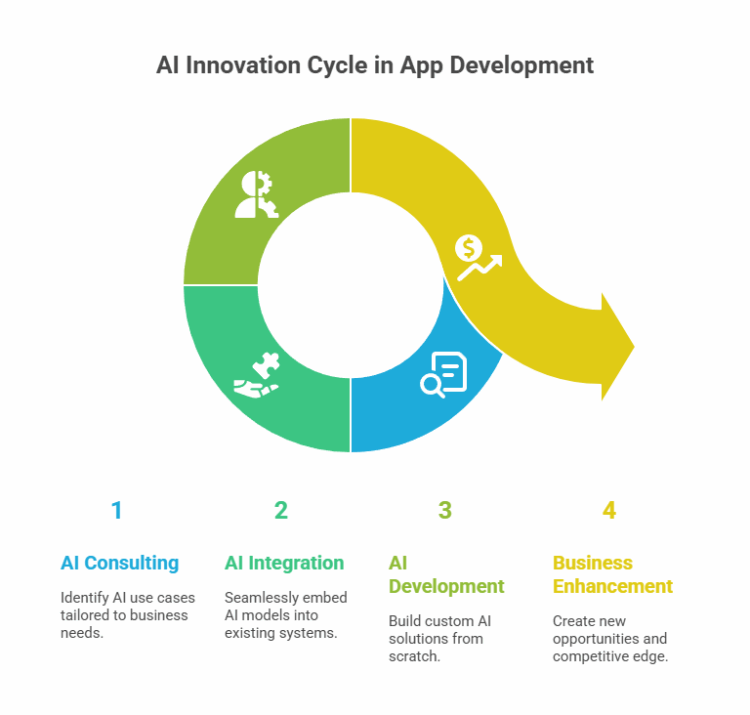
An experienced development partner will first consult to understand your specific challenges. Whether you’re dealing with customer churn, operational inefficiencies, or data bottlenecks, they’ll identify AI use cases tailored to your goals. This is where AI Consulting comes in, mapping the right tech to your business needs.
Next comes AI Integration, seamlessly embedding AI models into your existing infrastructure, apps, or newly built platforms. Whether it’s a smart recommendation engine, voice-powered assistant, or predictive dashboard, the integration needs to be flawless, scalable, and secure.
Finally, with AI Development, custom solutions are built from the ground up. These might include AI agents that automate support or sales tasks, machine learning models that analyze big data, or generative tools that create content or designs at scale.
When all three consulting, integration, and development work together, you’re not just solving business problems. You’re creating new opportunities, enhancing customer experiences, and gaining a competitive edge in your industry.
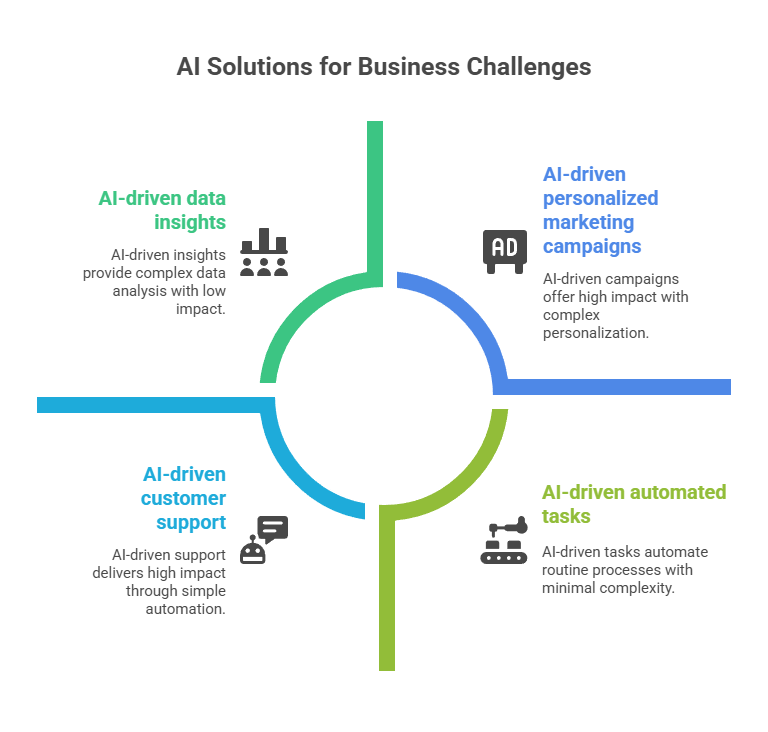
Customer support is one of the most resource-intensive departments in any business. Whether it’s handling product inquiries, processing returns, or resolving technical issues, customer service teams are often overwhelmed. Long wait times, inconsistent responses, and limited availability are just a few symptoms of a broken support system.
This is where AI chatbots come in, not as a replacement for humans, but as intelligent assistants that can handle the bulk of repetitive queries quickly and accurately. These bots are powered by Natural Language Processing (NLP), allowing them to understand user intent, respond conversationally, and even escalate to a live agent when necessary.
Unlike traditional live chat, AI chatbots don’t sleep. They work 24/7 across channels, your website, mobile app, social media platforms, and even WhatsApp. That means customers can get answers at midnight on a Sunday without waiting for office hours. And because they’re multilingual, they break down barriers that often limit support to only one or two languages.
What sets modern AI chatbots apart is their ability to learn and adapt. They don’t just respond with static answers—they continuously improve based on user interactions, which makes them smarter over time. They can pull data from CRMs, inventory systems, and order databases to provide highly personalized support.
Let’s break it down.
For example, a fast-growing fintech startup partnered with our team for custom AI Chatbot development. Within weeks, they saw a 65% drop in support tickets, freeing up their human agents to focus on complex, high-value conversations. The chatbot handled thousands of queries in real-time, covering topics from account setup to fraud detection alerts with zero wait time.
AI chatbots aren’t a luxury anymore; they’re a necessity. Especially for businesses aiming to scale without adding headcount. Whether you’re in eCommerce, healthcare, SaaS, or logistics, AI-powered support isn’t just solving customer service problems but setting a new standard for what exceptional service looks like.
In the age of digital everything, data is pouring in from every direction web analytics, CRMs, IoT devices, customer reviews, support tickets, social media, and more. Most companies are drowning in data but starving for insights. The real challenge? Making sense of this mountain of information quickly enough to influence decisions.
This is where AI’s analytical superpowers come into play.
AI tools can sift through vast volumes of structured and unstructured data, identify patterns, and surface insights that are simply beyond human capability. Instead of waiting for monthly reports, decision-makers can get real-time dashboards powered by machine learning and predictive analytics.
Let’s say you’re running an e-commerce business. Traditional data analysis might show you what happened last month. But AI can forecast what’s likely to happen next month whether it’s demand for a product, risk of customer churn, or changes in buyer behavior. That shift from reactive to proactive decision-making can significantly impact growth.
AI also helps eliminate bias in data interpretation. It doesn’t operate on gut feeling or limited perspectives. Instead, it evaluates data objectively, often revealing hidden opportunities or risks that may go unnoticed by human analysts.
An app development company that offers AI Integration and AI Consulting plays a vital role in turning raw data into business value. We help businesses implement tools like intelligent dashboards, predictive analytics engines, and real-time data alerts. And we ensure these tools integrate seamlessly with your existing ecosystem—whether that’s a CRM, ERP, or custom-built application.
So, if you’re sitting on a treasure trove of data but don’t know how to extract value from it, AI can help you unlock it—and we can help you put it to work.
Manual workflows are one of the biggest silent killers of productivity in modern businesses. From data entry and invoice processing to lead nurturing and report generation, these repetitive tasks suck up valuable human time and introduce unnecessary errors.
Enter AI agents—intelligent software entities that can handle specific tasks or workflows on behalf of human employees.
Unlike traditional automation scripts, AI agents are context-aware. They can read, understand, and act based on natural language, voice commands, or behavioral cues. They don’t just follow static rules—they learn and adapt. This makes them ideal for tasks that require a level of dynamic thinking or pattern recognition.
For instance, instead of hiring a virtual assistant to schedule meetings, you can use an AI agent that understands your preferences, availability, and priorities. In logistics, AI agents can manage inventory updates, optimize delivery routes, or even negotiate with vendors via email.
One of our clients—a SaaS platform with a lean operations team—implemented a custom-built AI Agent that managed onboarding processes for new users. The result? A 70% reduction in onboarding time and near-zero manual intervention.
With the right AI Development partner, these intelligent agents can be embedded into your apps, Slack channels, email systems, or CRM platforms. They’re not just automation—they’re augmentation.
So if you’re still relying on humans for tasks that could be done faster, cheaper, and more accurately by AI, it’s time to rethink how your business operates.
Sales teams often spend a lot of time chasing leads that never convert. Why? Because traditional lead qualification methods are outdated and generic. AI changes the game by applying predictive models that evaluate the likelihood of a lead converting based on historical behavior, engagement data, and buying signals.
Imagine knowing which leads are 80% more likely to convert before your team even makes the first call. AI allows you to segment leads not just by demographics but by real-time intent and behavior.
Sales AI can score leads, recommend follow-up actions, and even suggest the best time to reach out. It helps personalize the sales journey at scale by dynamically tailoring email sequences, demo scripts, or special offers based on user profiles.
Amazon and Netflix have already proven the power of AI-driven recommendations. But this technology isn’t exclusive to tech giants anymore.
When we worked with a B2B service provider, we helped them integrate AI into their CRM using our AI Consulting and AI Development services. The system automatically flagged high-intent leads, suggested next-best actions for sales reps, and triggered follow-up emails. The outcome? A 40% increase in qualified pipeline leads within 90 days.
Sales is no longer just about persistence—it’s about precision. And AI gives you the data-backed precision you need to close more deals, faster.
Marketing is often a guessing game. You launch a campaign, hope it sticks, and analyze the results afterward. But what if you could design marketing strategies that were data-informed, content-rich, and tailored for every audience segment before hitting “launch”?
That’s the power of Generative AI.
With tools like GPT-based content creators and AI-driven ad generators, you can create personalized landing pages, emails, ads, and social media posts at scale. And it’s not just about volume it’s about precision. AI uses user behavior data to craft messages that resonate more deeply with individual personas.
We recently partnered with a fashion tech startup to implement Generative AI across their email and social marketing campaigns. By auto-generating targeted messages and continuously optimizing based on performance, they saw a 58% uplift in email open rates and a 33% increase in click-throughs.
If your marketing still feels like you’re throwing darts in the dark, AI can hand you a laser pointer. And with proper AI Integration and consulting, you can embed generative capabilities into your marketing stack—from your CMS to your CRM and beyond.
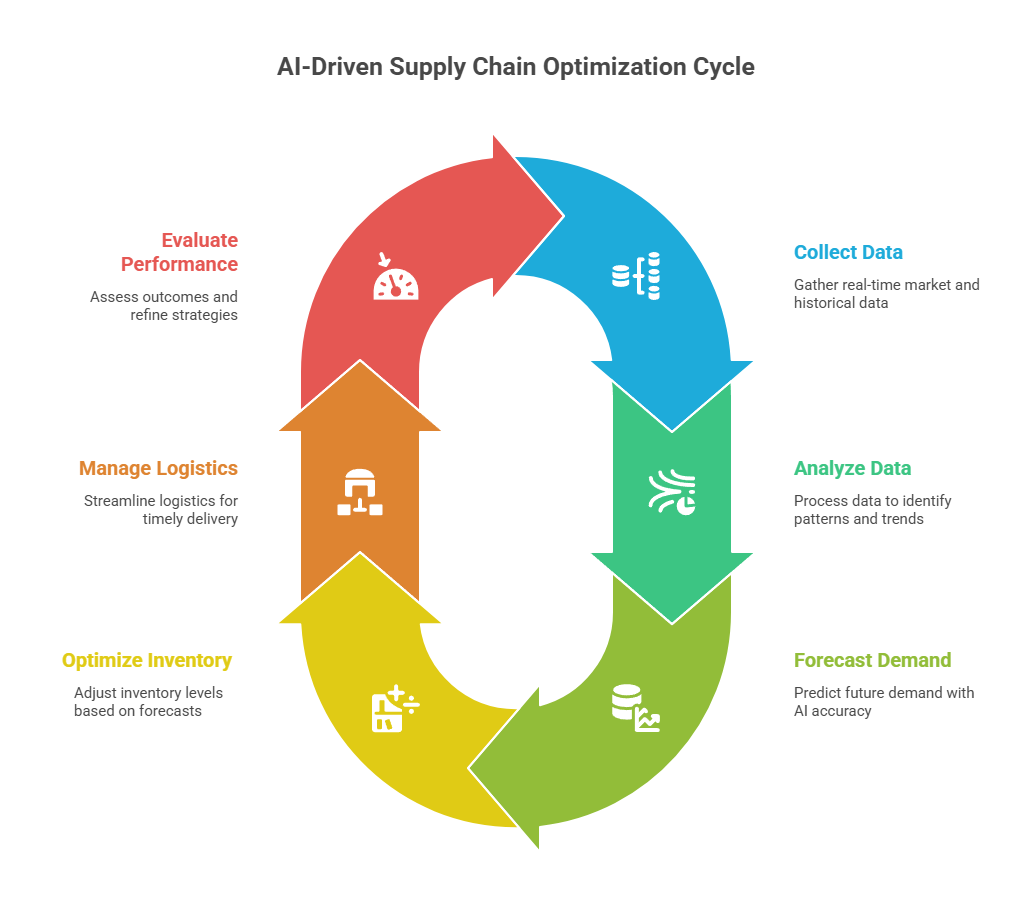
One of the most critical functions for any product-based business is forecasting demand. Get it wrong, and you risk two major problems: overstocking (which ties up capital and warehouse space) or understocking (which leads to lost sales and frustrated customers). Traditional forecasting methods rely on historical data, spreadsheets, and static models—none of which can respond to today’s fast-changing market dynamics.
Enter AI-powered demand forecasting.
AI forecasting models don’t just look at past data they combine it with real-time market signals, weather data, economic indicators, and customer trends to predict future demand with incredible accuracy. These models learn over time, constantly adapting as new data flows in.
Let’s take an example: a retail chain preparing for the back-to-school season. Instead of using last year’s sales figures alone, an AI system could analyze:
By combining all these variables, AI can offer dynamic forecasts that help businesses make smarter inventory and staffing decisions.
AI’s role in demand forecasting naturally extends to inventory management and logistics, where precision is key. With AI:
For one of our retail clients, we implemented a predictive inventory system using our AI Development services. The solution tracked thousands of SKUs across multiple locations and automated restocking based on demand signals. Within six months, the company reduced stockouts by 42% and decreased holding costs by 25%.
And when paired with our AI Consulting, businesses can identify not just the tools but also the strategic areas where AI will deliver the most ROI in the supply chain.
AI in demand forecasting isn’t just about numbers—it’s about agility, precision, and competitive advantage. In today’s environment, that’s not just helpful—it’s mission-critical.
As businesses become more digital, the risks multiply—cyber threats, data breaches, financial fraud, phishing attacks, identity theft, and more. Traditional security models are reactive, flagging threats after damage has already occurred. AI flips the script by enabling real-time, proactive threat detection.
Machine learning algorithms can analyze vast amounts of traffic, logs, and user behavior data in milliseconds, identifying suspicious patterns that would be nearly impossible for a human analyst to catch.
For instance:
Unlike static rules, AI models continuously learn and evolve. So even if attackers change tactics, the system adapts to recognize new methods, without manual intervention.
Different industries face different security challenges, and AI is up to the task.
A fintech client of ours struggled with frequent fraudulent sign-ups and account abuse. By embedding an AI-based fraud detection system through our AI Consulting service, they were able to block 92% of suspicious accounts automatically, without impacting the experience of legitimate users.
Cybersecurity is no longer optional. AI makes it proactive, intelligent, and deeply embedded in your digital ecosystem. Whether you’re running a payment gateway, healthcare portal, or cloud-based CRM, AI gives you the eyes and ears to stay ahead of attackers, without overwhelming your security team.
Hiring the right talent has become one of the biggest hurdles for growing companies. From sorting through hundreds of resumes to scheduling interviews and onboarding new hires, recruitment is often time-consuming and inconsistent. Human recruiters are valuable, but also limited in bandwidth and prone to bias.
AI steps in to remove those bottlenecks and speed up the entire process.
And unlike traditional tools, AI systems learn from past hiring decisions. They refine their criteria based on which hires performed well, stayed longer, or aligned with company culture.
Beyond screening and logistics, AI now plays a bigger role in predictive hiring, identifying candidates who are likely to succeed in specific roles based on past hiring data, personality assessments, and behavioral patterns.
AI tools can even help assess cultural fit, using psychometric analysis and communication style evaluations. That doesn’t just improve hiring outcomes—it enhances retention and team dynamics.
One of our tech startup clients used our AI Agent platform integrated with an HRMS to handle recruitment end-to-end. Within two months, their time-to-hire dropped by 40%, and candidate quality significantly improved.
With our expertise in AI Development, we build smart hiring engines that adapt to your company’s unique hiring patterns and goals. Combined with AI Consulting, we ensure that these solutions align with your business growth strategies and compliance requirements.
In a world where talent is the most valuable asset, AI gives you the competitive edge to find, hire, and retain the best, without burning out your HR team or missing great candidates due to bias or oversight.
Today’s users interact with brands across a mix of platforms—mobile apps, websites, voice assistants, social media, email, and even smart home devices. Yet, businesses often struggle to deliver a consistent, seamless experience across these channels. Fragmented communication, repeated information requests, and inconsistent branding all hurt user trust and satisfaction.
AI changes that enable unified omnichannel experiences.
AI chatbots can be deployed across all touchpoints from Facebook Messenger to in-app chat and WhatsApp, delivering consistent, real-time support. What’s more, these bots are now being extended into voice interfaces, allowing users to interact hands-free with businesses through smart speakers or voice-enabled apps.
With centralized AI systems managing interactions, users no longer have to repeat themselves when switching from web to mobile or chat to phone. Every interaction is logged, analyzed, and personalized based on user history.
Our clients leverage AI Chatbot solutions to maintain uniform messaging and support quality across platforms. And with AI Integration, we connect these bots to CRMs, ERPs, and support tools, ensuring every channel has access to the same real-time data.
Consistency is important, but personalization is what creates loyalty.
Behavioral AI takes omnichannel support a step further by learning from user actions, preferences, and historical behavior. It then uses that data to deliver tailored recommendations, promotions, messages, and even interface layouts.
For example:
Our team helped an e-learning platform implement personalization using AI Integration services, resulting in a 46% increase in user engagement and a 28% rise in course completions.
With behavioral AI and cross-channel bots, businesses can stop reacting and start anticipating—delivering a user experience that feels smart, responsive, and unified.
Innovation is no longer a luxury; it’s a necessity. But many businesses hit a wall when it comes to designing new features or digital products. They either lack technical direction or get bogged down by time-consuming prototyping and creative bottlenecks.
Generative AI is revolutionizing product development by acting as a creative partner.
It can:
For instance, designers can prompt generative AI tools to create variations of landing pages based on brand tone and audience data. Developers can generate backend code snippets to rapidly prototype APIs or logic flows.
Our Generative AI solutions are integrated into design and dev pipelines, enabling faster concept-to-launch cycles. This gives clients a critical speed advantage in launching MVPs and testing product-market fit.
Beyond ideation, AI is also embedded into the very DNA of modern apps.
With our AI Development expertise, we build applications that think and adapt—apps that can:
Whether it’s a health tracking app that offers dynamic fitness advice or a B2B dashboard that predicts future KPIs, AI isn’t just a feature—it’s the engine driving smarter digital experiences.
If innovation feels stalled, AI gives you the fuel to go further, faster.

Bringing AI into your app ecosystem isn’t a one-click job. It’s a strategic process that starts with AI Consulting.
Here’s the typical workflow:
This full-stack approach ensures AI doesn’t just exist in theory—it works in practice, inside your app.
What separates a good AI implementation from a great one? The team behind it.
Our dedicated AI Development team includes:
With close collaboration between consultants, developers, and your internal team, we build AI that doesn’t just solve problems—it creates lasting competitive advantages.
Let’s look at real businesses we’ve worked with and how AI made a measurable impact:
These successes stem from applying the right AI tools in the right place, guided by strong AI Consulting.
Across industries, AI-driven apps are delivering:
Whether you’re scaling a startup or modernizing an enterprise system, these are outcomes you can expect when AI is implemented thoughtfully.
Not every tech provider can do AI well, especially when it’s tied to custom app development.
The right partner should combine deep expertise in:
A team that understands both app development and AI consulting delivers solutions that are not only intelligent but also fast, secure, and user-friendly.
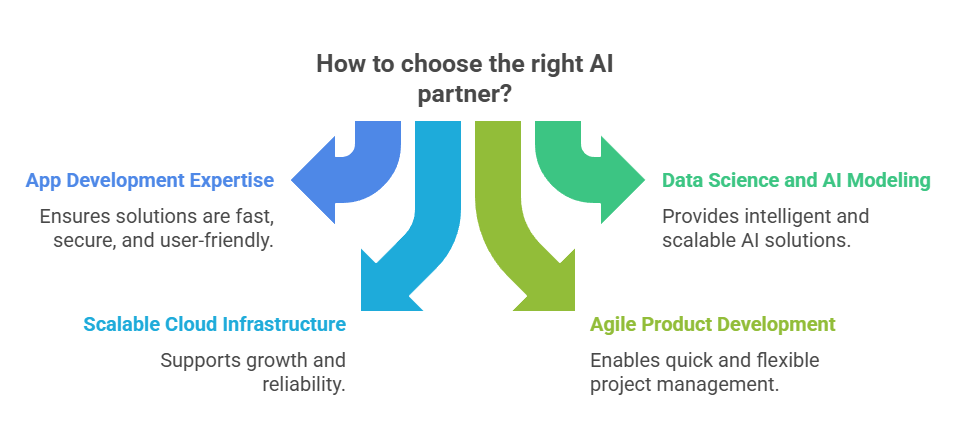
When evaluating potential partners, ask:
Our team’s strength lies in combining strategic AI Consulting with executional excellence in custom software development.
AI isn’t plug-and-play; it’s plan-and-build. And who you choose to plan and build it matters.
The business landscape is shifting, and AI is at the heart of that shift. In a world where business landscapes are evolving faster than ever, AI is no longer a futuristic luxury; it’s a present-day necessity. From transforming customer support and unlocking deep data insights to optimizing supply chains and supercharging marketing, AI offers practical, scalable solutions to the most pressing business challenges. What sets successful companies apart isn’t just their willingness to adopt AI, but their strategy in implementing it through the right tools, the right processes, and most importantly, the right partners. As an app development company with deep expertise in AI Development, AI Integration, and AI Consulting, we don’t just build applications; we craft intelligent, future-ready ecosystems. Whether you’re looking to launch an AI chatbot, integrate a smart agent, or tap into the creative power of Generative AI, now is the time to act. The businesses that leverage AI today will be the leaders of tomorrow.


 Contact Us
Team Up With Us Today For An Unforgettable Service Experience












 Book Free Consultation