| Quick Summary: Table of Content AI chatbots in real estate are helping agents respond to leads in under 40 seconds, qualify prospects automatically, and book appointments without any manual effort. From 24/7 lead capture to personalized property recommendations, the technology is closing the gap between a visitor landing on your website and a deal making it to the finish line. And the numbers back it up. Agents using AI chatbots have reported up to 40% higher lead capture rates, 30% increase in conversions, and in some cases, returns as high as 42x on their investment. The ones who aren’t using it are handing those results to someone else. |
If you respond within 5 minutes to a lead, you’re 21x more likely to qualify it. But in real estate the median time to respond to a lead is 15.3 hours. That’s 15 hours for them to explore other properties and talk to other agents.
The slow response time is hurting your paychecks and leaving commissions on the table for someone else to take.
On the other hand, an AI chatbot in real estate typically responds in under 10 seconds. Means before your prospect even closes the tab, an AI chatbot will engage him. It will ask him about his budget, and book a meeting, without any agent involved.
So, if slow response times are costing you leads, this short guide is just the thing you’re looking for. But before we get down to the business, let’s first understand what an AI chatbot in real estate really is.
If you have an online presence you must’ve heard about chatbots. They’re the little widgets that you put on your website or your social media handles and they’ll respond to user queries.
But there was an issue with those typical chatbots: they only respond to preset queries. Means you have to map out every possible question and provide answers, and only after this the chatbot will work. If anything comes from outside the script, they will fold immediately.
AI Chatbots, as the name suggests, use artificial intelligence to understand and respond to queries the way a human would, without being limited to a preset script.
They’re trained on large amounts of data, which means they can handle unexpected questions, carry a conversation naturally, and still steer prospects toward the outcome you want: a booked call, a scheduled viewing, or a captured lead.
In real estate specifically, an AI chatbot can greet a visitor on your website, ask him what he’s looking for, qualify him based on budget and timeline, and hand him off to you.
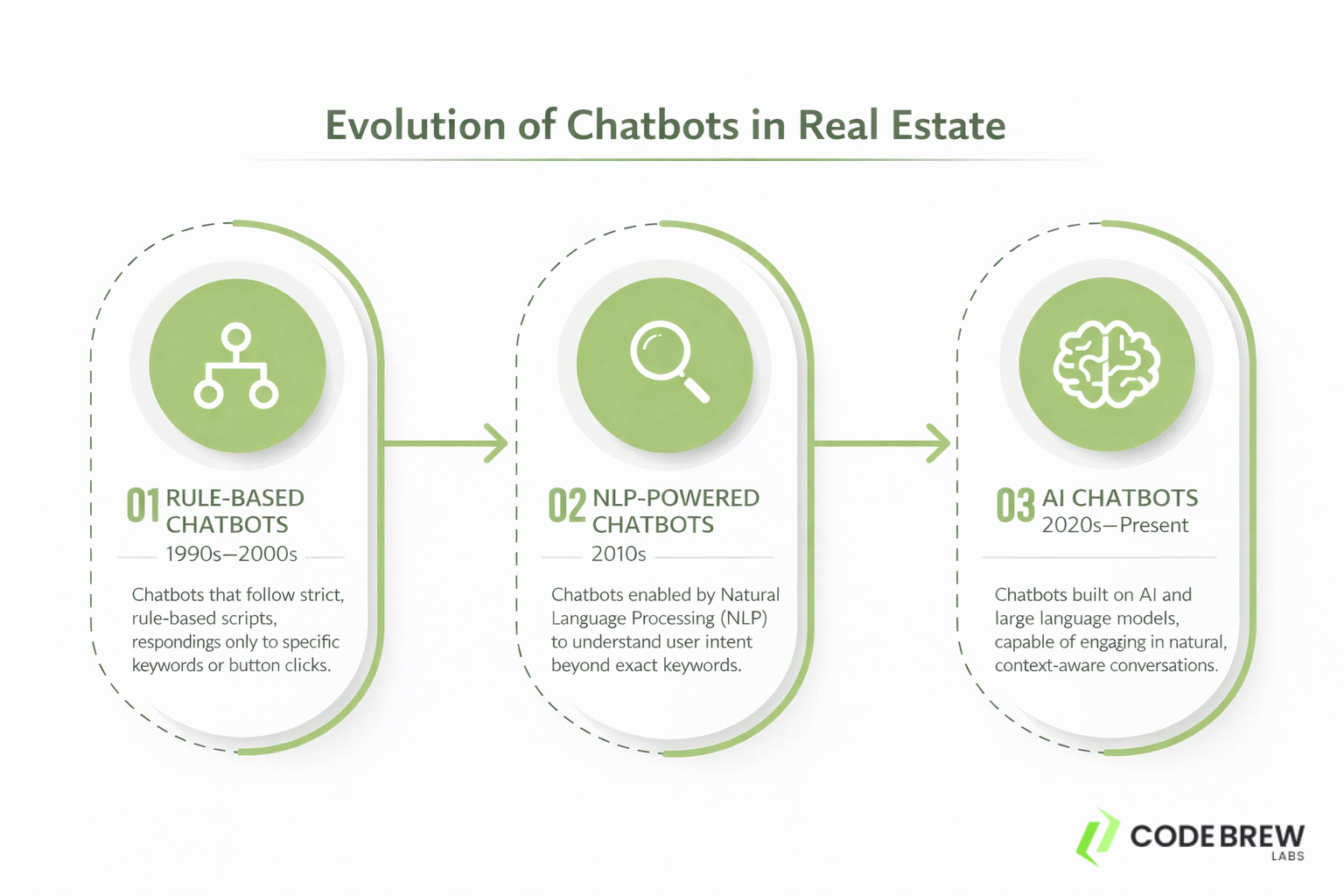
Chatbots didn’t start smart, they got there. Over the past few decades, they’ve gone from rigid, rule-based scripts to conversational AI that can handle a prospect the way a seasoned agent would.
Here’s how that journey looked:
Similar Read: AI in Real Estate: 16 Powerful Applications Driving Industry Disruption
Real estate firms that use AI-driven engagement reported up to 40% higher lead capture rates, and up to 30% increase in lead conversions. But, these are just surface level benefits. An AI chatbot can do much more than just lead generation.
Let’s put some limelight on the key use cases of AI chatbot in real estate.
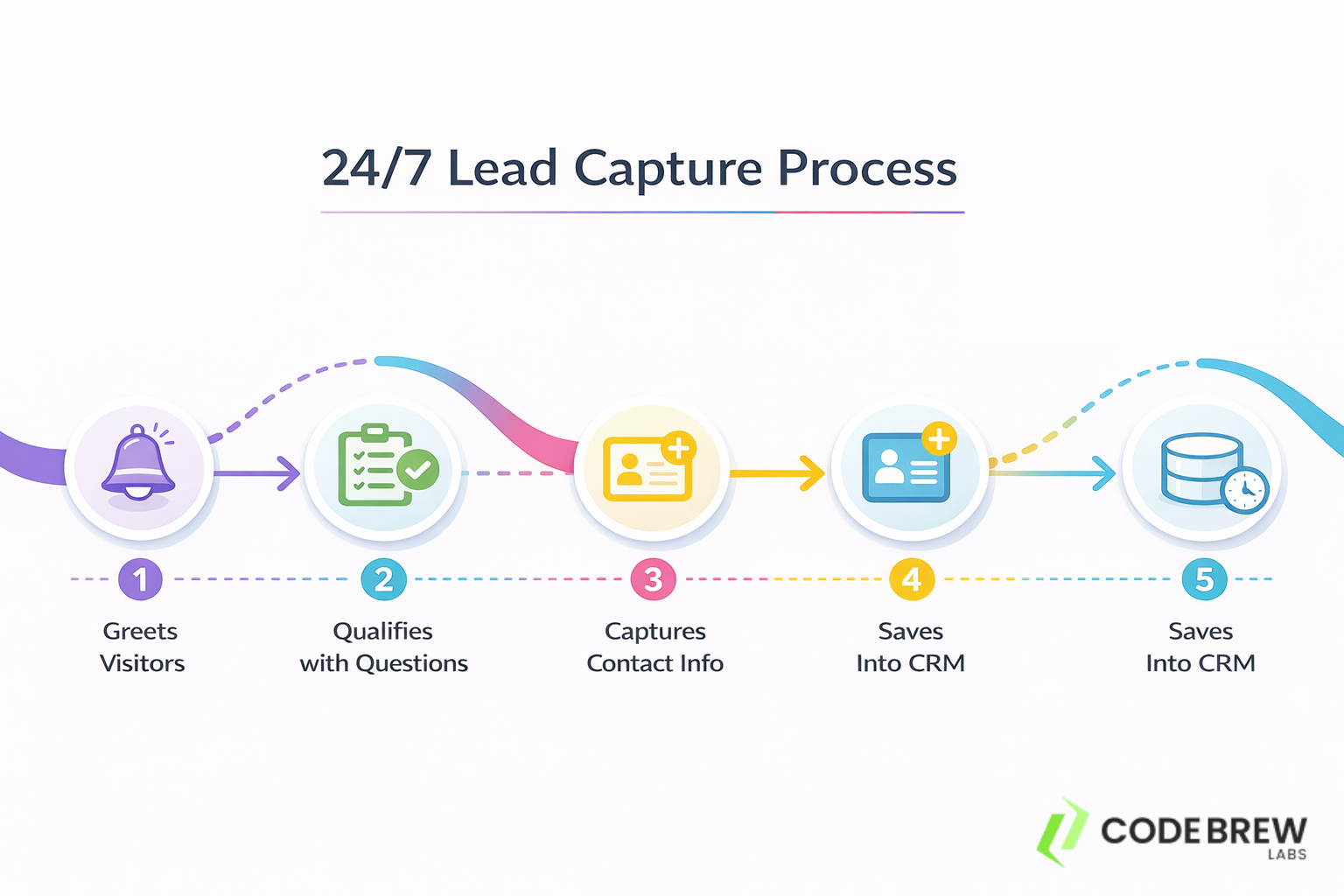
You wouldn’t be available at 3:54 am on a Friday night to answer a query, neither would your team. An AI Chatbot however, would be there at any given time. And that matters more than you’d think. Research shows that nearly 50% of buyers start their property search outside of business hours. That’s a massive chunk of potential leads hitting your website when no one’s around to respond.
Here’s what the AI chatbot does while you’re off the clock:
Ever chased a lead that wasn’t worth chasing in the first place? With AI Chatbot this problem is gone for good. Here’s how:
“Does Tuesday work for you?” “At what time are you available?”
Being a real estate agent, you must’ve had those endless email exchanges figuring out the right time for visitation appointments. Here’s how an AI Chatbot handles it:
Let’s shift our focus to renting. Being a property manager, the most tedious thing to do is responding to repetitive queries: when is rent due, how do I submit a maintenance request, what’s the pet policy.
Here’s how AI chatbots handles these low value tasks that eat up time:
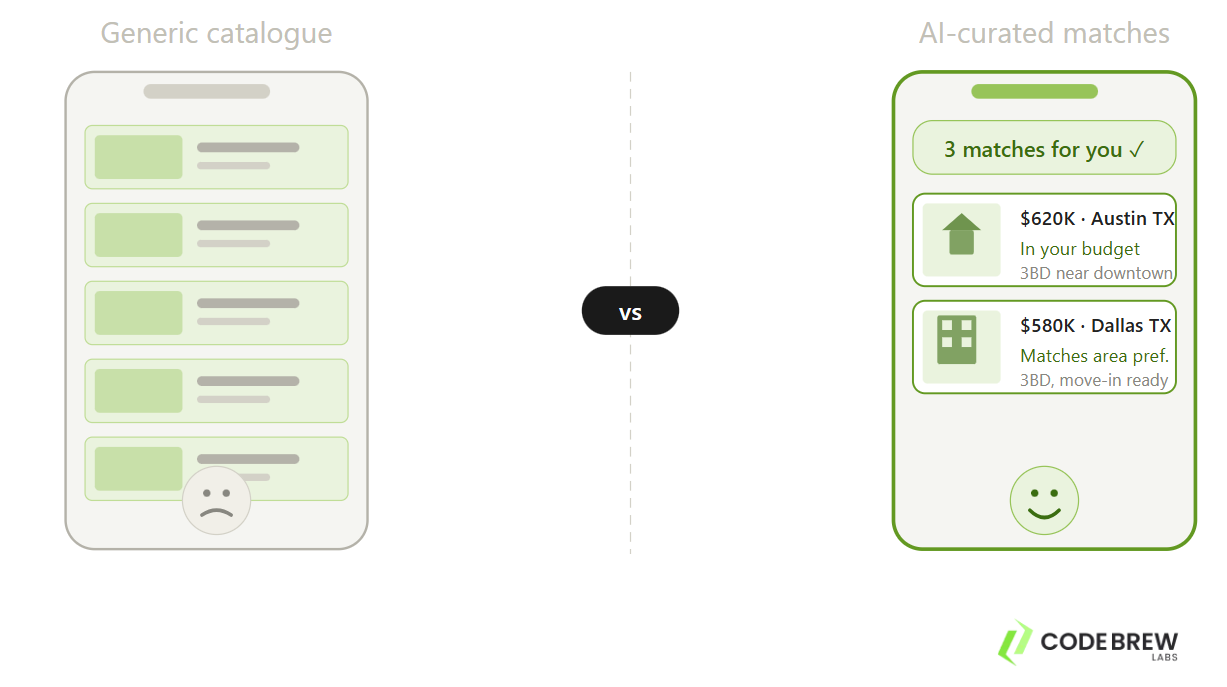
Sending a same, generic catalogue to all of your prospects is ineffective (and lazy). If the listing doesn’t match what they’re looking for, they’ll tune out.
Here’s how AI Chatbot in real estate handles this problem:
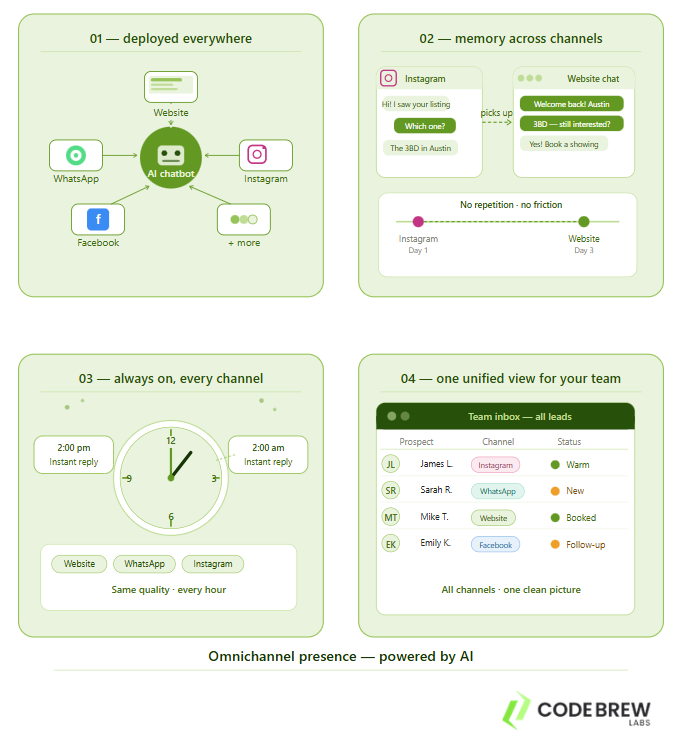
Different prospects find you in different places. Some land on your website, some DM you on Instagram, some message you on WhatsApp. Without a unified system, leads slip through the cracks.
Let’s see how AI chatbot handles this:
You don’t need to understand the technology to use it, the same way you don’t need to know how a car engine works to drive one. But a basic sense of what’s happening under the hood helps you trust the tool and set it up right.
Here’s the simple version:
We’ve discussed how an AI chatbot in real estate can capture leads, qualify prospects, schedule appointments, and keep your pipeline moving around the clock. But theory only goes so far.
Below are 5 success case studies from our clients at Code Brew, real agents and brokerages who put an AI chatbot to work and saw measurable results.
Result: 34 qualified leads in 45 days, 3 closed transactions, and response time cut from 6 hours to under 40 seconds.
Context: Marcus runs a mid-sized consultancy handling residential resale and new launches across the Phoenix metro. His website pulled steady traffic from Google ads but his 4-person team couldn’t keep up with inquiries coming in after hours. Most leads went cold before anyone picked up the phone the next morning.
Result: 520 new opportunities in 12 months, 385% increase in website leads, and 500+ hours of manual follow-up saved across 8 offices.
Context: Horizon Realty Group is a mid-sized brokerage operating across the Greater Houston area with 200+ agents spread across 8 offices. Their website was generating consistent traffic but leads were falling through the cracks, different offices, no unified response system, and a static contact form that converted poorly.
They needed something that could engage every visitor and route them to the right office without manual intervention.
Result: 2 luxury listing leads at $1.2M and $2.4M, generating $96,000+ in combined GCI within 60 days.
Context: Khalid is a luxury property consultant in Dubai Marina specializing in high-net-worth buyers looking for waterfront apartments and penthouses. His website attracted serious buyers from across the Gulf region but most visited outside business hours and left without making contact. A static inquiry form wasn’t cutting it for a clientele that expected instant, personalized responses.
Result: 22.5% lead-to-close rate, 20 closed transactions, and 16x ROI over 12 months.
Context: Pinnacle Properties is a boutique brokerage on Chicago’s North Side focused on the $400K–$800K condo and townhouse segment. They had a strong referral base but their website was an afterthought, pulling in traffic from Zillow and Realtor.com redirects with no system to capture or qualify it.
Leads were coming in through a basic contact form, sitting unattended for hours, and going cold before any agent followed up.
Finding the results interesting? There’s more. Check out the complete galore of Code Brew’s success stories.
Result: Signed listing agreement within the first two weeks and 14x ROI in the first 30 days from a website that had never generated a single online lead.
Context: Omar is a 15-year veteran agent in Abu Dhabi specializing in off-plan and ready-to-move residential properties across Yas Island and Saadiyat Island.
He had built a strong reputation through referrals and developer relationships but his website was purely informational, no lead capture, no engagement layer, nothing to hold a visitor who showed up outside of office hours. He deployed an AI chatbot expecting modest results.
The results above aren’t outliers. They’re what happens when the right system is in place at the right moment.
At Code Brew, we build AI chatbots for real estate businesses that are ready to stop losing leads to slow response times and start converting the traffic they’re already getting. Whether you’re a solo agent, a growing team, or a multi-office brokerage, we’ll build a chatbot that fits your market, speaks your language, and works while you don’t.
Both AI chatbots and traditional chatbots sit on your website and respond to visitors. But that’s where the similarities end.
The difference between the two isn’t just technical, it shows up directly in how many leads you capture, how well you qualify them, and how much time your team spends doing work the bot should be handling.
| Parameter | Traditional Chatbot | AI Chatbot |
| Response Capability | Only responds to preset keywords and scripted flows | Understands intent and handles open-ended, unpredictable questions |
| Setup & Maintenance | Requires manual mapping of every question and answer | Learns from conversations, minimal ongoing maintenance |
| Availability | 24/7 but breaks down outside its script | 24/7 with consistent, intelligent responses at any hour |
| Lead Qualification | Can collect basic info through fixed forms | Qualifies leads conversationally, gauging budget, timeline, and intent naturally |
| CRM Integration | Limited, often requires custom development | Integrates directly with most major CRMs out of the box |
| Cost | Lower upfront, but high maintenance and missed leads add up | Higher upfront, significantly better ROI over time |
| Personalization | One-size-fits-all responses | Adapts tone and responses based on the conversation |
AI chatbots in real estate are already delivering results that would’ve seemed far-fetched five years ago. But the technology is still in its early innings. Here’s what the next wave looks like for agents and brokerages who stay ahead of the curve.
The real estate market doesn’t wait. A prospect who doesn’t hear back in the first few minutes will move on to the next agent, the next listing, the next brokerage. That’s not a maybe, that’s what the data shows.
An AI chatbot doesn’t replace you. It makes sure no one leaves before you get the chance to show up. It captures the lead at 2am, qualifies him before your morning coffee, books the appointment while you’re showing another property, and keeps the conversation alive until you’re ready to close it.
The agents and brokerages in this guide weren’t doing anything extraordinary. They just stopped leaving the door open and walking away. They put something in place that could hold it open for them.
If your website is getting traffic and your pipeline isn’t reflecting it, you already know what the problem is. An AI chatbot is how you fix it.
How much does it cost to build an AI chatbot for real estate?
The cost varies depending on the complexity of the chatbot, the number of channels it needs to cover, and the integrations required. A basic AI chatbot with lead capture and qualification will cost significantly less than a fully integrated solution covering WhatsApp, CRM sync, and appointment scheduling across multiple offices. The best way to get an accurate number is to speak with a developer who can scope it based on your specific setup.
How long does it take to get the chatbot up and running?
A straightforward deployment on a single channel can be live within a few days. More complex builds involving multiple platforms, CRM integrations, and custom conversation flows typically take a few weeks. Either way, it’s a one-time setup with minimal disruption to your existing operations.
Will the chatbot sound robotic to my prospects?
Modern AI chatbots are trained to hold natural, conversational exchanges rather than stiff, scripted responses. Most prospects don’t realize they’re talking to a bot until well into the conversation, if at all.
What happens when the chatbot can’t answer a question?
A well-built AI chatbot is designed to gracefully hand off conversations it can’t resolve to a human agent, along with the full context of what was discussed. No prospect gets left hanging with a dead end.
Do I need a big website or a large team to make this worthwhile?
No. Some of the strongest results in real estate have come from solo agents and small teams who simply couldn’t afford to miss a lead outside business hours. The chatbot scales to your size, not the other way around.


 Contact Us
Team Up With Us Today For An Unforgettable Service Experience












 Book Free Consultation