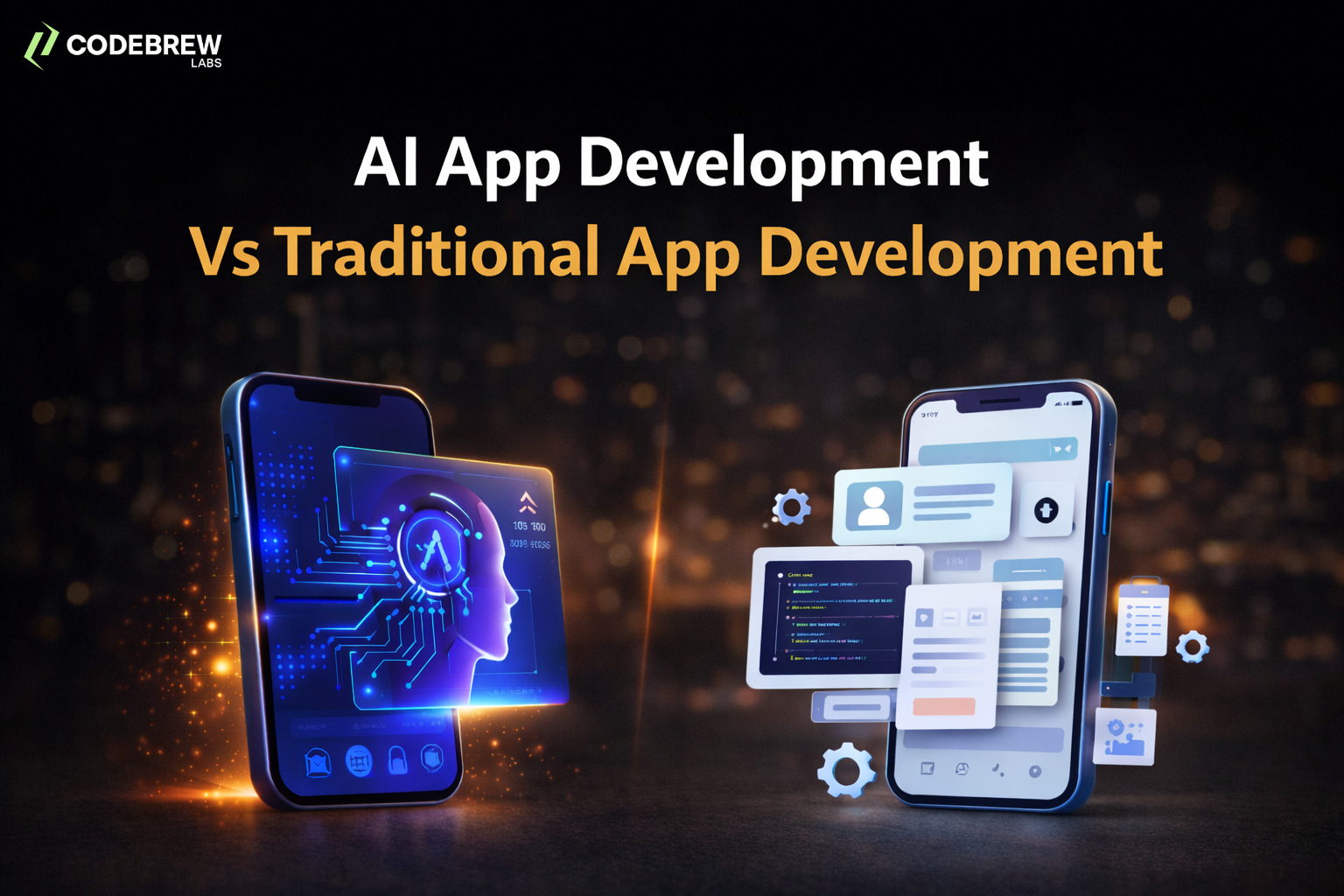
Building an app in 2026 is a lot like choosing between a bicycle and a self-driving car. Both will get you there, but only one is built for the road ahead.
Table of Content
That is exactly the decision businesses face when evaluating AI app development vs traditional app development. This is no longer just about writing code. It is about choosing whether your product will simply function or actually think, learn, and evolve with your users. And this shift is happening fast. Gartner predicts that by the end of 2026, 40 percent of enterprise applications will include task-specific AI agents, compared to less than 5 percent today, showing just how quickly AI is becoming the new standard for modern software
Every business wants faster growth, better customer experiences, and smarter operations. The way you build your digital products today will directly shape how well you compete tomorrow. In this guide, we break down the difference between AI app development and traditional app development in clear, simple terms so you can make the right choice with confidence.
AI app development is the process of building applications that are capable of learning, improving, and making decisions on their own over time. Instead of simply following a fixed set of instructions, these applications observe data, recognize patterns, and adjust their behavior based on what they learn from users and the environment.
In other words, traditional apps execute commands, while AI apps develop understanding.
This difference changes everything. When an application can adapt, it becomes more useful, more accurate, and more valuable with every interaction. That is exactly why AI app development has become one of the most important investments for modern businesses in 2026.
To understand how AI app development works, it helps to break the system down into its main building blocks.
Here are the core components that make an AI application function.
Together, these components create applications that grow smarter and more valuable the longer they are used.
The easiest way to understand the impact of AI app development is to look at how it already shapes everyday digital experiences.
Here are a few common examples that most people recognize.
These are no longer just apps performing basic tasks. They are intelligent systems that actively improve engagement, efficiency, and business results.
That is the real promise of AI app development. It is not simply about building applications. It is about creating systems that think, adapt, and help businesses grow in an increasingly competitive world.
Now that we have clearly explained what is AI app development, it becomes much easier to understand the other side of the conversation, which is what is traditional app development and how it works in practice.
Traditional app development is the process of building applications that operate based on fixed rules and predefined logic. Every feature, response, and behavior is manually written by developers in advance. The application only does what it is programmed to do, and nothing more.
While this approach has powered software for decades, it lacks the adaptability that modern businesses now demand. Unlike AI-powered apps vs traditional apps, where the difference lies in learning and improvement, traditional apps remain static unless developers manually update them.
To better understand how traditional applications are built, it helps to look at the tools and technologies commonly used.
Most traditional applications are created using:
This stack is reliable and well understood, which is why many businesses still rely on it for certain types of projects.
Traditional app development remains a practical solution in situations where the application does not require learning, prediction, or intelligent behavior.
Some common examples include:
In these cases, the development model remains straightforward and cost-effective. However, when business needs start changing rapidly or customer expectations become more complex, the limitations of this approach become easier to see. That is where the difference between AI app development and traditional app development begins to have a direct impact on long-term success.
Now that both approaches are clear, it becomes easier to see how they truly differ when placed side by side. This comparison highlights how the choice between these two development models affects not only technology decisions but also long-term business outcomes.
|
Feature |
AI App Development | Traditional App Development |
|
Architecture |
Built around data pipelines, AI models, and learning systems that continuously evolve | Built around fixed logic, workflows, and predefined rules |
|
Scalability |
Scales intelligently by adapting to new data and changing user behavior | Scales mainly through infrastructure upgrades and manual optimization |
|
Development Complexity |
Higher initial complexity due to model training and data preparation | Lower initial complexity with predictable coding and testing |
|
Initial Development Cost |
Higher upfront investment due to AI engineering and data work | Lower upfront cost with conventional development |
|
Long Term Cost |
Decreases over time as automation and optimization improve efficiency | Increases over time due to ongoing manual development and maintenance |
|
Time to Market |
Slightly longer early development, but faster improvement after launch | Faster initial launch, slower improvement cycle |
| Maintenance Effort | Reduces steadily as systems learn and self-optimize |
Remains high because every change requires developer intervention |
| User Experience | Highly personalized and adaptive for each user |
Uniform and mostly static for all users |
| Decision-Making Capability | Makes real-time decisions based on live data and learned patterns |
Follows pre-programmed decision rules |
| Automation Level | High automation across workflows, predictions, and responses |
Limited automation focused on simple tasks |
| Data Utilization | Continuously transforms data into actionable intelligence |
Stores data primarily for reporting and record-keeping |
| Security Approach | Proactive threat detection using intelligent monitoring |
Reactive protection through static security rules |
| Innovation Potential | Expands automatically as models improve and new data arrives |
Grows only when new features are manually developed |
When evaluating the difference between AI app development and traditional app development, this broader view makes one thing clear. AI is not just a new development method. It is a fundamentally different way of building digital products that evolve with the business.
The benefits of AI app development extend far beyond new technology. They directly impact revenue, efficiency, customer loyalty, and long-term competitiveness.
Here are the most important advantages in practical terms.
These advantages explain why more organizations are choosing custom AI app development and working with experienced AI app development services to build products that evolve with their business.
While traditional app development has served businesses well for many years, it also comes with clear limitations that become more noticeable as companies grow and customer expectations increase.
Here are the main challenges businesses face with the traditional approach.
These limitations are not always obvious at the start of a project. However, as businesses expand and markets evolve, they often become the biggest barriers to growth.
When businesses evaluate new technology, cost is always part of the conversation. However, the real question is not just how much it costs to build an application, but how much value it generates over time.
The table below illustrates the typical cost patterns companies see when comparing both approaches.
|
Cost Factor |
AI App Development | Traditional App Development |
|
Initial Development Cost |
$80,000 to $250,000+, depending on data and model complexity | $30,000 to $120,000, depending on features and platform |
|
Infrastructure Cost |
Moderate to high early investment for data processing and cloud resources | Low to moderate at launch, increases steadily with scale |
|
Maintenance Cost (Annual) |
Decreases over time as systems self-optimize |
Increases every year with growing manual work |
| Upgrade and Improvement Cost | Lower long-term due to continuous learning |
High long-term due to constant developer involvement |
| Operational Efficiency Impact | High cost reduction through automation |
Limited efficiency improvement |
| Long Term ROI | Very high return after 12 to 24 months |
Moderate return with slower growth |
While AI app development starts with a larger upfront investment, the financial benefits compound over time. Businesses typically begin seeing strong return on investment within the first one to two years as automation, optimization, and intelligent decision-making reduce operating costs and increase revenue.
Traditional app development may appear less expensive at the start, but long-term expenses continue to rise as the business grows and systems require constant manual updates and expansion.
When viewed as a multi-year investment, AI consistently delivers greater financial value for companies focused on sustainable growth.
By now, it should be clear that the real question is not whether AI will shape the future of app development, but who you trust to build it for you.
Choosing the right development partner plays a massive role in the success of your product. AI projects require more than just writing code. They demand deep understanding of data, business goals, user behavior, and long-term scalability.
When evaluating a development partner, here is what truly matters.
This is exactly where Code Brew stands apart. As a company specializing in AI app development and AI development services, we help businesses transform ideas into intelligent products that scale, adapt, and compete in modern markets.
From early strategy and custom AI app development to deployment and long-term optimization, our team works as an extension of your business, not just another vendor.
The difference between AI app development and traditional app development is no longer just technical. It is a strategic decision that shapes how your business grows, competes, and evolves in the years ahead.
Traditional development can still serve specific needs, but AI-powered applications are quickly becoming the foundation of modern digital success. They deliver smarter automation, deeper customer understanding, stronger decision making, and long-term competitive advantage.
If you are planning your next product, platform, or digital transformation, now is the time to invest in intelligence, not just software.
Our team at Code Brew is ready to help you build applications that learn, adapt, and drive real business growth.
The timeline depends on the complexity of the AI features, the quality of available data, and the scope of the product. Most AI-powered apps take between three and nine months for initial development, with ongoing improvement after launch as the system continues to learn.
Not necessarily. While more data improves accuracy, many AI models can start with smaller datasets and improve over time. In many cases, businesses begin with the data they already have and gradually expand their AI capabilities as usage grows.
Yes. Many companies enhance their current products with AI features such as recommendations, predictive analytics, automation, and intelligent search without rebuilding the entire application from scratch.
Absolutely. AI is no longer limited to large enterprises. With modern cloud infrastructure and flexible development models, startups and small businesses can now access AI capabilities that were once only available to major corporations.
Success is typically measured through business outcomes such as increased revenue, improved customer retention, higher conversion rates, reduced operating costs, and improved decision-making accuracy over time.
While nearly every industry can benefit, some of the strongest impact is seen in healthcare, finance, e-commerce, logistics, education, real estate, and SaaS platforms, where data-driven decisions and automation deliver immediate value.


 Contact Us
Team Up With Us Today For An Unforgettable Service Experience












 Book Free Consultation