Introduction: A New Era of Search and Brand Visibility
The way people find information online is changing faster than ever. For years, Google has been the go-to place for searching — type a few keywords, hit enter, and browse through pages of results. But now, a new kind of search experience is emerging, one that feels more natural and personal: AI-powered search.
OpenAI’s latest innovation, ChatGPT Atlas, is leading this change. Instead of searching through endless links, users can simply ask questions and get direct, conversational answers. It’s like talking to the internet rather than searching it.
This shift is more than just a new tool — it’s a major transformation in how we interact with the web. While Google’s search engine still relies on ranking pages and keywords, ChatGPT Atlas focuses on understanding context, intent, and human language through advanced AI solutions. It gives users exactly what they need, instantly and intelligently.
For brands, this marks a new challenge. The goal is no longer just to “rank on Google” but to stay visible in an AI-driven world where assistants like Atlas deliver answers directly. Businesses must start preparing now to ensure their content, products, and services remain part of this new conversation.
Understanding ChatGPT Atlas: The Next Generation AI Explorer
When OpenAI ChatGPT Atlas was introduced, it represented more than just an upgrade to the world’s most popular conversational AI — it signified the dawn of an AI-native search ecosystem. Unlike the traditional ChatGPT model, which primarily responds based on pre-trained data, Atlas integrates real-time web browsing, plugins, and contextual awareness to deliver dynamic, personalized, and actionable insights.
At its core, ChatGPT Atlas is designed to function as a fully-fledged AI search engine, bridging the gap between human curiosity and digital intelligence. Users can ask questions in natural language — “What’s the best strategy for launching a new tech product in 2025?” or “Compare Apple’s AI roadmap with Google’s” — and receive synthesized, up-to-date answers drawn from live sources, verified data, and previous context.
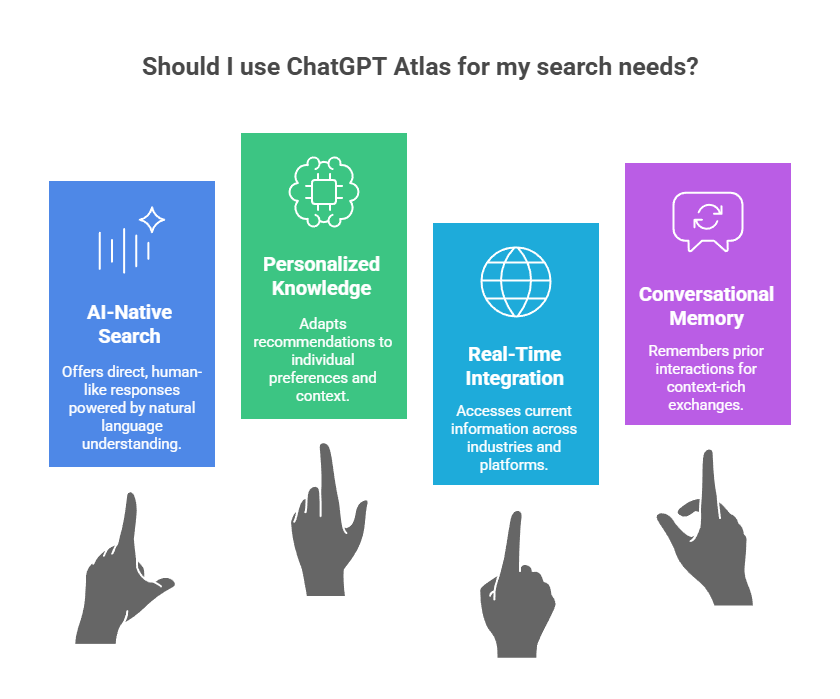
What makes Atlas revolutionary are its unique features:
- AI-native search experience: Instead of displaying a list of links, it delivers direct, human-like responses powered by natural language understanding.
- Personalized knowledge navigation: Atlas learns from each user’s context, adapting recommendations, tone, and detail to individual preferences.
- Real-time integration: Through connected browsing, APIs, and third-party plugins, Atlas accesses current information across industries and platforms.
- Conversational memory: It remembers prior interactions, enabling long-term, context-rich exchanges that evolve over time.
Compared to previous ChatGPT versions, the ChatGPT Atlas update focuses on deeper search intent comprehension. It doesn’t just answer what users ask — it understands why they’re asking. This ability to combine reasoning, real-time data, and personal context represents the evolution from static search queries to AI-powered discovery.
In essence, ChatGPT Atlas is more than an upgrade — it’s a reimagination of how humans find and interact with information online. As the boundaries between chat, research, and browsing blur, Atlas positions itself as the intelligent gateway to a world where the next click may no longer lead to a website, but to a direct, contextual conversation powered by AI.
Google’s Reign: The Traditional Search Empire

For more than two decades, Google has been the uncontested gateway to the internet. Its powerful algorithms, vast index of web pages, and advertising-driven ecosystem transformed how people access information and how businesses reach audiences. From the rise of Search Engine Optimization (SEO) to the dominance of Search Engine Marketing (SEM), Google shaped the digital world into a predictable formula — optimize content, earn backlinks, and climb the search rankings.
The brilliance of Google lay in its simplicity: type a query, and it instantly delivers millions of relevant links. This system created an entire economy of visibility, where ranking on the first page became synonymous with success. For years, marketers meticulously studied Google’s ranking signals — keyword density, metadata, mobile responsiveness, and domain authority — to stay ahead in the race for attention.
However, this once-perfect system is now facing disruption. The rise of AI-powered search has begun to challenge the very foundation of Google’s model. Although Google AI search (through innovations like Bard and now Gemini) has tried to evolve beyond traditional keyword matching, the search giant is still deeply tied to its advertising business — one that depends on clicks, not conversations.
At the same time, users’ behavior is changing. People no longer want to sift through ten blue links to find an answer — they want instant, personalized, and conversational responses. Zero-click searches, where users get answers directly on the results page without visiting any website, have already started reducing web traffic for publishers. This trend hints at a deeper transformation: a shift from search engines that point you to answers toward AI systems that give you answers directly.
In this new reality, the dominance of Google is being tested for the first time. The rise of tools like ChatGPT Atlas signals a turning point — from an information-driven web to an interaction-driven one.
The AI Search Revolution: Atlas vs Google at the Core
The emergence of ChatGPT Atlas has sparked a defining battle in the world of digital discovery — AI conversation-driven search versus traditional keyword-based search. Where Google organizes the internet, Atlas understands it. This difference marks the beginning of a new competitive era between OpenAI ChatGPT Atlas and Google AI search, one that could permanently redefine how information flows across the web.
Let’s break down the key differences between these two paradigms:
| Feature |
ChatGPT Atlas |
Google Search |
| Core Function |
Conversational, AI-driven exploration |
Keyword and link-based indexing |
| User Intent Handling |
Understands context, emotion, and previous interactions |
Matches query keywords to ranked pages |
| Content Output |
Provides summarized, personalized answers |
Displays lists of web links |
| Monetization Model |
Likely API, integration, and subscription-based |
Primarily ad-based (PPC and display) |
| Discoverability |
Based on knowledge accuracy and verified sources |
Based on SEO ranking and backlinks |
While Google AI search continues to experiment with its Search Generative Experience (SGE) — blending AI summaries with traditional links — ChatGPT Atlas is built from the ground up for a conversational world. It doesn’t just summarize; it contextualizes. Users can dive deeper into a topic by asking follow-up questions, refining tone, or requesting visuals, code, or reports — all without leaving the conversation.
This is the heart of the AI search engine revolution: moving from static search results to fluid, adaptive experiences. Atlas doesn’t wait for you to search — it predicts your needs based on ongoing dialogue and previous context.
For brands, this represents both a challenge and an opportunity. The challenge lies in losing control of traditional visibility metrics like keyword ranking or backlink authority. The opportunity lies in a new form of visibility — AI visibility — where being referenced, trusted, and cited by systems like Atlas becomes the key to staying relevant.
In this new competitive dynamic, OpenAI ChatGPT Atlas isn’t merely another AI product or AI chatbot; it’s a redefinition of what it means to “search.” It’s less about showing where the information is — and more about delivering exactly what matters to the user, instantly.
The ChatGPT Atlas update represents the beginning of an era where human curiosity meets real-time intelligence. Google built the map of the internet; Atlas is now building the compass that guides how we explore it.
How ChatGPT Atlas Will Change Digital Marketing Forever
The digital marketing landscape is standing on the edge of its most transformative moment yet. For nearly two decades, success in online marketing has revolved around one goal — ranking higher on Google search. From content creation and keyword optimization to backlinks and paid campaigns, every marketing effort has been tailored to appeal to Google’s algorithms. But with the arrival of ChatGPT Atlas, this traditional model is beginning to fade.
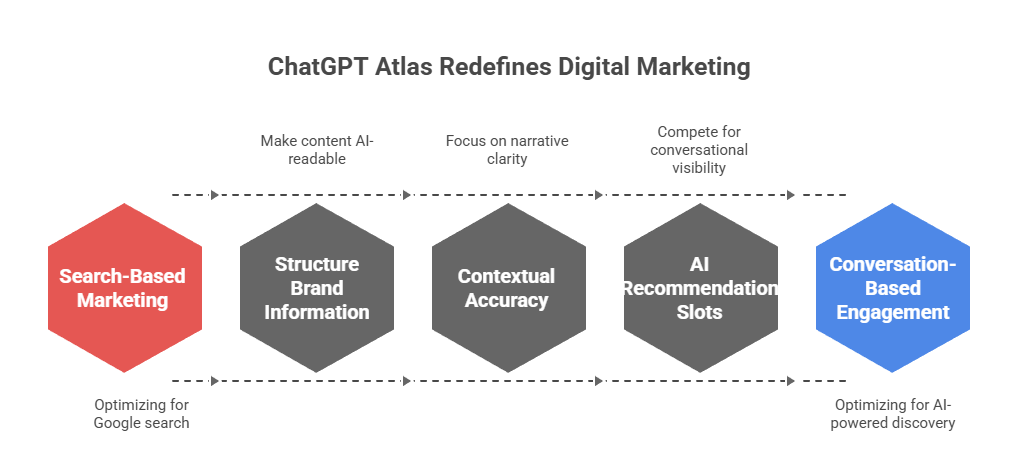
The ChatGPT Atlas launch signals a paradigm shift — from search-based marketing to conversation-based engagement. Instead of optimizing for visibility in search results, brands will need to optimize for AI-powered discovery. Atlas is not just another AI search engine; it’s an intelligent system that understands brand context, interprets intent, and delivers tailored answers directly to users without relying on web pages or SERP rankings.
This change means that marketing visibility will no longer depend solely on SEO performance or ad budgets. Instead, it will hinge on how effectively a brand’s information is structured, factual, and AI-readable. If a company’s content can be accurately interpreted and referenced by OpenAI ChatGPT Atlas, it has a greater chance of being featured in AI-generated responses — the new form of digital word-of-mouth.
Here’s how ChatGPT Atlas will redefine key marketing pillars:
- Brand Discovery: Traditional “search and click” behavior will evolve into “ask and receive.” Brands must ensure their content is present in AI’s knowledge ecosystem to remain discoverable.
- Content Strategy: The focus will move from keyword stuffing to contextual accuracy, narrative clarity, and verified data sources that AI models trust.
- Advertising: Instead of paying for ad space, brands may compete for AI recommendation slots or conversational visibility within AI platforms.
- Customer Experience: Atlas’s conversational capabilities mean customers can directly engage with AI to get product information, reviews, or comparisons — reducing the gap between intent and conversion.
In short, ChatGPT Atlas isn’t merely changing how people search — it’s redefining how brands are found. As Google AI search tries to adapt through AI summaries, marketers must prepare for a future where content is optimized not for algorithms, but for AI reasoning and relevance.
The brands that thrive will be those who understand that the future of marketing lies not in visibility — but in contextual trust within intelligent systems like Atlas.
The Role of SEO in the Post-Google World

For years, Search Engine Optimization (SEO) has been the cornerstone of online marketing — a blend of art, analytics, and algorithms that determines who gets noticed and who doesn’t. But as AI-powered search becomes mainstream, the traditional principles of SEO are being rewritten. The ChatGPT Atlas update highlights a fundamental truth: ranking on Google is no longer the only measure of digital success.
In the emerging ecosystem of AI search engines, optimization isn’t about keywords — it’s about comprehension. ChatGPT Atlas doesn’t crawl web pages the way Google does; it interprets structured data, verifies factual accuracy, and recalls contextual meaning. This means the focus is shifting from Search Engine Optimization (SEO) to AI Optimization (AIO) — ensuring content can be accurately understood, referenced, and trusted by AI systems.
So, what does SEO look like in the post-Google era?
- Structured and Verified Data:
AI systems like OpenAI ChatGPT Atlas rely on factual and structured information to generate reliable answers. Schema markup, knowledge graphs, and verified content will become critical to AI discoverability.
- Conversational and Contextual Content:
The keyword-centric approach is giving way to natural language optimization. Brands must create content that reads like real conversations, addressing user intent and context instead of chasing keyword density.
- Authenticity and Authority:
AI models prioritize credibility. Verified sources, author transparency, and consistency across platforms will directly influence whether Atlas or similar systems cite a brand in responses.
- Engagement Beyond Clicks:
As zero-click and AI-generated answers grow, website traffic might decline — but engagement will occur within AI platforms themselves. Success will depend on AI recall — how often and accurately a brand appears in AI answers.
While Google AI search continues to refine its own generative models, it’s clear that ChatGPT Atlas is pioneering a future where information retrieval is more about understanding meaning than ranking pages.
In this new paradigm, SEO professionals must evolve into AI visibility strategists — focusing on training data quality, conversational context, and machine-readable credibility powered by generative AI. The question is no longer “How do we rank on Google?” but “How do we ensure AI understands our brand well enough to recommend it?”
What Brands Must Do to Stay Visible in the ChatGPT Atlas Era
As ChatGPT Atlas reshapes the way people search, engage, and consume information, one thing has become crystal clear — the rules of digital visibility are changing. The old model of competing for keywords and backlinks is giving way to a new frontier of AI-powered discoverability, where brands must optimize not just for algorithms, but for understanding.
The arrival of OpenAI ChatGPT Atlas means that visibility will be defined not by how often a brand appears on search result pages, but by how accurately and confidently AI models can reference it in contextual conversations. In this new reality, brands must think beyond search engine rankings and begin preparing for AI search engine ecosystems that value precision, authority, and contextual relevance.
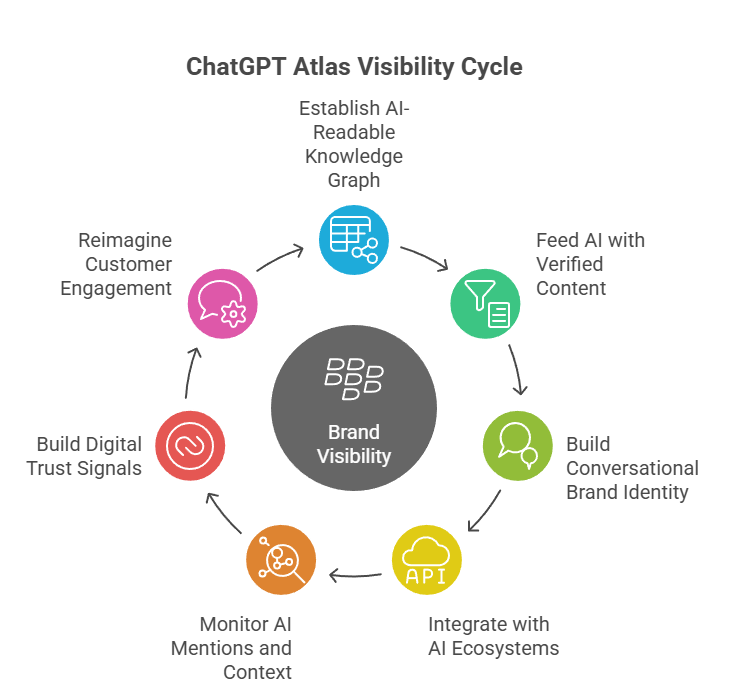
Here’s how brands can stay visible and relevant in the ChatGPT Atlas era:
1. Establish an AI-Readable Knowledge Graph
Ensure that your brand’s digital footprint — from product descriptions to leadership information — is structured, verified, and machine-readable. The goal is to make your brand’s data easily accessible for AI-powered search systems to interpret and include in responses.
2. Feed the AI With Verified Content
AI models like ChatGPT Atlas thrive on quality data. Create and maintain content that is factual, up-to-date, and consistent across all platforms. Verified knowledge sources and transparent brand information will make it easier for Atlas to confidently reference your business.
3. Build a Conversational Brand Identity
As interactions move from search queries to natural dialogue, brands must adapt their voice. Develop a conversational tone in content, FAQs, and support channels that aligns with how users interact with AI search engines.
4. Integrate With AI Ecosystems
Explore opportunities to integrate with AI platforms, such as creating plugins, APIs, or data access points that allow systems like ChatGPT Atlas to interact with your brand directly. This builds credibility and positions your business within AI-driven interfaces.
5. Monitor AI Mentions and Context
New analytics tools will emerge to track how AI systems mention and portray your brand. Monitor your “AI visibility” — not just search impressions — to understand how often your brand is being referenced in AI-powered search responses.
6. Build Digital Trust Signals
AI models rely heavily on verified trust indicators. Ensure your site and content display strong signals of authenticity — author bios, certifications, partnerships, and citations from credible sources.
7. Reimagine Customer Engagement
Instead of optimizing for clicks, optimize for conversations. The future belongs to brands that are not just searchable, but conversationally relevant within platforms like Atlas.
In short, surviving the ChatGPT Atlas update era will require brands to evolve from “ranking for visibility” to “earning AI trust.” Those who act early will not only maintain discoverability but become the go-to references for AI-driven recommendations in a post-Google world.
Case Scenarios: Early Adopters & Possible Outcomes
The transition from Google’s traditional dominance to the rise of ChatGPT Atlas and AI-powered search is still in its early stages — but the direction is clear. Some forward-thinking companies are already reimagining how they structure content, manage brand data, and optimize for AI interactions rather than keyword rankings.
To understand this shift, let’s explore two hypothetical cases that represent the new marketing reality:
Case 1: Brand A — The Traditional SEO Leader
Brand A has dominated Google AI search results for years through optimized blogs, backlinks, and PPC campaigns. Their strategy revolves around driving traffic through organic and paid search visibility.
But as AI search engines like Atlas start answering queries directly, Brand A’s web traffic begins to decline. Users no longer click on their links because Atlas delivers summarized, accurate insights in a conversational format — without the need for a search visit. Their traditional SEO investments suddenly yield diminishing returns.
Case 2: Brand B — The AI-Optimized Innovator
Brand B recognizes the changing landscape early. They restructure their web data for machine readability, implement schema markup, and ensure their brand facts are verifiable across platforms. They produce high-quality, fact-checked content and create an OpenAI ChatGPT Atlas plugin that allows users to interact directly with their services through AI.
As a result, their brand is frequently cited by ChatGPT Atlas in responses, gaining organic visibility through conversational recommendations rather than search rankings. Their audience reach grows not through clicks — but through AI credibility.
These cases highlight one undeniable truth: the brands that adapt to AI-powered search early will lead the next era of digital marketing.
Already, early adopters — from news publishers to eCommerce innovators — are experimenting with ChatGPT integrations and AI content structures. They’re learning that being “AI-recognized” is the new version of being “Google-ranked.”
In the near future, we can expect brands to measure success not by their website traffic, but by their AI discoverability score — how well they are understood, trusted, and referenced by AI systems like ChatGPT Atlas.
The outcome of this shift is profound: companies that embrace AI optimization will not just survive the post-search revolution — they’ll define it.
Ethical and Business Implications
As ChatGPT Atlas and other AI search engines reshape the way information is delivered, the conversation is expanding beyond technology into ethics, ownership, and responsibility. When an AI-powered search system becomes the mediator between users and content, several critical questions arise: Who owns the knowledge? Who controls the narrative? And how can brands ensure they are represented accurately and fairly?
The ChatGPT Atlas update is part of a broader technological evolution, but it also exposes new ethical dilemmas. For instance, when OpenAI ChatGPT Atlas references a brand in an answer, it may paraphrase or summarize information without linking to the original source. While this improves user experience by reducing friction, it can also blur the lines of attribution, impacting how creators and businesses receive recognition for their work.
1. Accuracy and Accountability
As AI-powered search replaces traditional indexing with synthesized responses, ensuring factual accuracy becomes paramount. A single error or bias in an AI-generated answer could misrepresent a brand or mislead users. This raises questions about who is accountable when misinformation spreads through AI-generated summaries.
2. Transparency and Trust
Brands must focus on maintaining transparency and reliability across their digital presence. If an AI engine like ChatGPT Atlas cannot verify a brand’s data from trusted, authoritative sources, it might omit or deprioritize it altogether. The future of brand trust will depend heavily on the clarity, authenticity, and factual consistency of public information.
3. Intellectual Property and Fair Use
As AI models absorb and process online content to generate insights, concerns about data ownership and intellectual property intensify. Businesses will need to navigate this carefully, balancing exposure within AI search engines with protecting proprietary data and brand integrity.
4. Privacy and Personalization
While personalization is a strength of AI-powered search, it also introduces privacy risks. Atlas tailors results based on user behavior and interaction, meaning data protection policies must evolve to ensure ethical personalization.
5. Regulatory Oversight
Governments are already beginning to address these concerns through frameworks like the EU AI Act and emerging U.S. AI regulations. Companies leveraging AI must stay ahead of compliance measures related to data usage, bias mitigation, and transparency in automated decision-making.
Ultimately, the ethical challenge lies in finding balance — enabling AI innovation while maintaining fairness, accuracy, and respect for intellectual ownership. Brands that proactively adopt transparent data practices and advocate for ethical AI usage will strengthen both trust and long-term resilience in this new landscape.
Preparing for the Future: The Road Ahead
The ChatGPT Atlas launch marks a defining moment in digital history — one that demands immediate attention from brands, marketers, and business leaders alike. The transition from Google AI search dominance to AI-powered discovery through systems like Atlas isn’t just a technological evolution; it’s a shift in how humans connect with information itself.
In this next phase of the internet, success won’t be about manipulating algorithms — it will be about earning understanding. OpenAI ChatGPT Atlas represents the future of intelligent interaction: systems that can reason, interpret, and engage with users in ways that feel almost human. For brands, this means moving beyond traditional SEO checklists and focusing instead on AI adaptability, credibility, and clarity.
Here are key steps businesses should take to future-proof their visibility:
- Audit Your Digital Presence for AI Readiness:
Ensure your brand’s online data — from website structure to metadata — is machine-readable and semantically organized. AI models rely on structured information to identify trustworthy sources.
- Invest in Authoritative Content Creation:
Focus on high-value, verifiable insights rather than keyword-heavy blogs. The stronger your content’s factual backbone, the more likely ChatGPT Atlas and similar systems will recognize your authority.
- Experiment with AI Integrations:
Explore creating tools, plugins, or APIs that allow your services to be accessed through AI search engines. By leveraging smart AI integration, this will not only enhance discoverability but also establish your brand as a pioneer in AI-based interaction.
- Embrace AIO — Artificial Intelligence Optimization:
Optimize your brand data for AI interpretation, not just for Google’s indexing. AIO will become the new SEO in the AI-powered search landscape.
- Prioritize Trust and Transparency:
The AI era rewards authenticity. Maintain open communication, verifiable facts, and credible references — these are the signals AI systems will use to determine brand reliability.
The ChatGPT Atlas update is more than a feature rollout — it’s the start of a global reorganization of how information, trust, and visibility work online. Brands that anticipate this evolution will not only retain relevance but lead in an environment where understanding, not ranking, defines success.
Conclusion
What it means to be discoverable in the digital world has been redefined with the release of ChatGPT Atlas. For many years, search ranks, backlinks, and keyword density determined visibility; this combination made SEO a science of optimization. However, the launch of ChatGPT Atlas signals the start of a new era in which visibility is determined by how well you are understood rather than how frequently you are searched.
“Finding” is giving way to “knowing” in the age of AI-powered search. OpenAI ChatGPT Atlas analyzes user intent, synthesizes insights, and provides straightforward, conversational responses rather than returning thousands of links. The conventional Google AI search experience, which is centered on terms and links, feels slower, less user-friendly, and more antiquated as a result of this change.
For brands, this change is monumental. Your content is no longer speaking to algorithms; it’s communicating with an intelligent system capable of understanding nuance, context, and meaning. The AI search engine of tomorrow doesn’t just list you — it represents you. How it does that depends entirely on the information you share, the authority you establish, and the trust you build.
As the ChatGPT Atlas update continues to roll out, every business, creator, and marketer must ask a critical question: If AI becomes the gateway to the internet, what story is it telling about my brand?
Adapting to the New Reality
To thrive in this AI-first environment, brands must adopt what can be called AI Visibility Optimization (AIO) — a strategy focused on making your brand’s data, content, and expertise intelligible to machine learning models. This means:
- Prioritizing authentic, factual, and conversational content that aligns with how people ask questions in natural language.
- Structuring websites and digital assets for clarity, transparency, and context.
- Building a consistent brand identity across every channel — because AI doesn’t just read data, it learns patterns.
The ChatGPT Atlas revolution isn’t just a competitive shift for Google AI search — it’s a philosophical one. It’s about changing how people interact with information, how truth is distributed, and how brands earn attention in an algorithmic world guided by intelligence, not indexation.
In the end, the brands that will lead in this new age of AI-powered search are not the ones shouting the loudest — but the ones speaking the clearest.
Those who adapt, educate, and engage through authentic, intelligent communication will find themselves not only visible but valued in the emerging AI-driven internet.


 Book Free Consultation





 Contact Us